
How Ball Flight Laws in Golf Work, Explained for Players
This post contains affiliate links. As an Amazon Associate, we earn from qualifying purchases.
This post contains affiliate links. As an Amazon Associate, we earn from qualifying purchases.
Ball flight laws in golf explain that the clubface angle determines the shot’s starting direction, while the relationship between the clubface and the swing path creates curvature. Modern data from launch monitors like Trackman shows face angle accounts for 75-95% of initial direction. A shot curves away from the path relative to the face, a face left of the path produces a draw for a right-handed golfer.
This core relationship is physics, not opinion. It replaced a century of golf myth because radar can now measure clubhead movement to within one degree. That precision killed the old idea that you swing right to make the ball start right.
What follows is the breakdown every player needs: the three numbers that define any shot, the measurable environmental factors that add or subtract 40 yards, and the exact failure mode that turns a small miss into a snap-hook. By the end, you’ll read your own ball flight like a launch monitor readout.
Key Takeaways
- Clubface direction at impact dictates 75-95% of where your ball starts, a fact proven by Trackman’s one-degree measurement accuracy.
- Curvature is created by the spin-tilt axis, which tilts based on the difference between face angle and club path, the ball curves away from the path.
- A peer-reviewed study from Princeton quantified environmental impacts: air temperature changes carry by 0.26 feet per degree Fahrenheit, and altitude can add 15 yards to a 150-yard shot.
- “Gear effect” from a toe or heel strike can override face/path data, adding unexpected draw or fade spin by twisting the clubhead at impact.
- To fix a slice, you must square the clubface to the target, swinging more left (out-to-in) while leaving the face open makes it worse.
The Core Relationship: Face, Path, and Curve
Forget everything you heard about “swinging out to in to fade it.” That’s the old law, and it was wrong. The modern understanding comes from one machine: the Trackman launch monitor. Its radar detects changes in clubhead path and face orientation of about one degree. That precision allowed researchers to see what actually happens at impact.
The face angle is the boss. It points the ball where to go first.
The clubface angle at impact is responsible for 75-95% of the shot’s initial direction. If your ball starts left of the target, your face was left. If it starts right, your face was right. The swing path has minimal effect on this starting line.
So a slice doesn’t start left because of an out-to-in path. It starts left because the face is left at impact. The path then decides what happens next.
Curvature comes from the spin-tilt axis. Imagine a line running through the middle of the ball. That’s its spin axis. If the axis is tilted, the ball curves. The tilt is determined by the difference, the “face-to-path” relationship. * If the face is pointed right of your swing path, the axis tilts to the right. The ball spins clockwise and curves right (a fade or slice for a righty). * If the face is pointed left of your swing path, the axis tilts left. The ball spins counter-clockwise and curves left (a draw or hook).
The ball always curves away from the direction of the swing path. This is the non-negotiable law.
The Nine Ball Flights Diagnosed
Every shot you hit fits into one of these nine boxes, defined by start direction (face) and curvature (face-to-path).
| Shot Name | Face Angle at Impact | Swing Path Relative to Face | Resulting Ball Flight |
|---|---|---|---|
| Pull Hook | Left of Target | Right of Face (In-to-Out) | Starts left, curves further left. |
| Pull | Left of Target | Same as Face (Zero Path) | Starts left, flies straight left. |
| Pull Slice | Left of Target | Left of Face (Out-to-In) | Starts left, curves back to the right. |
| Straight Hook | At Target | Right of Face (In-to-Out) | Starts straight, curves left. |
| Straight | At Target | Same as Face (Zero Path) | Starts straight, flies straight. |
| Straight Slice | At Target | Left of Face (Out-to-In) | Starts straight, curves right. |
| Push Hook | Right of Target | Right of Face (In-to-Out) | Starts right, curves back to the left. |
| Push | Right of Target | Same as Face (Zero Path) | Starts right, flies straight right. |
| Push Slice | Right of Target | Left of Face (Out-to-In) | Starts right, curves further right. |
To use this, watch your ball’s first five yards. That tells you the face. Watch its curve. That tells you the path relative to that face. A push-slice means a right-facing club with an even more rightward path.
How Launch Monitors Measure the Laws
You can’t feel one degree. That’s why the old laws persisted. Today’s launch monitors give you the numbers. Systems like the Foresight GC2 use high-speed cameras to capture launch conditions: ball speed, launch angle, and azimuth (the horizontal start direction).
These devices calculate the spin-tilt axis, showing you the exact tilt causing your curve. They measure what you can’t see. This data is why every serious fitter and coach uses one. Guessing is over.
Where this goes sideways: Ignoring strike location. If your face and path numbers say you should hit a draw but you hit a fade, check where you hit the ball on the face. A toe strike twists the clubhead open, adding fade spin. A heel strike twists it closed, adding draw spin. This “gear effect” can override the face-to-path relationship, especially with a driver. It’s the missing piece when the shot shape doesn’t match the swing you felt.
The Environmental Physics You Can’t Control
The ball flight laws assume a vacuum. The real world adds variables that change everything. Meteorological research shows temperature, humidity, and altitude can alter shot distances by 40 yards or more.
A study from Princeton University, “On the flight of a golf ball in the vertical plane,” modeled these effects with precise coefficients. It found that for a nominal 250-foot drive, air temperature affects impact range by 0.26 feet per degree Fahrenheit. Humidity affects range by 0.0033 feet per percent.
The bigger factors are altitude and wind. Thinner air at elevation means less drag. * Altitude: A 150-yard shot at sea level in 40-degree weather will fly about 165 yards at 5,000 feet in 80-degree weather. That’s a 15-yard difference from air density alone. Planning a mountain golf trip? You’ll need less club, always. * Wind: The Princeton study calculated that a 10 mph headwind reduces carry by roughly 24 yards on that same drive. A 10 mph tailwind adds about 12 yards. Crosswinds tilt the spin axis further, exaggerating hook or slice spin.
These aren’t guesses. They are the calculated results of changing the forces acting on a ball in flight. Your 7-iron isn’t suddenly broken in Denver; the aerodynamics of a golf ball have changed.
| Environmental Factor | Effect on Carry Distance | Mechanism |
|---|---|---|
| Increased Temperature | Adds distance | Warmer air is less dense, reducing drag force. |
| Increased Altitude | Significantly adds distance | Thinner atmosphere provides less resistance. |
| Low Humidity | Slightly adds distance | Dry air is slightly denser than humid air, a counterintuitive fact. |
| Headwind | Dramatically reduces distance | Increases relative airflow, maximizing drag. |
| Tailwind | Moderately adds distance | Decreases relative airflow, reducing drag. |
Understanding how altitude affects distance and temperature effects turns weather from an excuse into a calculable part of your club selection.
Applying the Laws to Fix Your Swing

Diagnosis comes first. You must know your miss. Let’s take the most common one: the slice.
The Slice (for a right-handed golfer): Ball starts left or straight and curves right. * Diagnosis: Face is open (pointing left) relative to the target at impact. The path is further left than the face (out-to-in). * Old (Wrong) Fix: “Swing more out to the right.” This would make the path even more leftward relative to the face, increasing the slice spin. * Correct Fix: Square the clubface. The primary fault is an open face. Work on grip, wrist hinge, or release to get the face pointing at the target at impact. The path will often improve automatically.
The Snap-Hook: Ball starts wildly left and curves violently further left. * Diagnosis: Face is extremely closed (pointing far left). The path is likely in-to-out, but the face is closed relative to it. * The Danger: If you believe the old laws, you’ll think “I’m swinging too far right.” You might try to swing left, but with that closed face, you’ll now produce a dead pull. The real fix is to calm the hands and reduce the closure rate through impact.
Common mistake: Trying to change path before fixing face. If you have a slice and you work on swinging in-to-out while your face remains open, you’ll produce a push-slice, a shot that starts right and curves further right. It’s a different monster, not a fix.
Practice with alignment sticks and impact tape. Use the stickers that leave a mark on your clubface. Feedback is everything. The goal is to move strike location toward the center and see a face mark that is square, not angled.
The Role of Equipment in Ball Flight
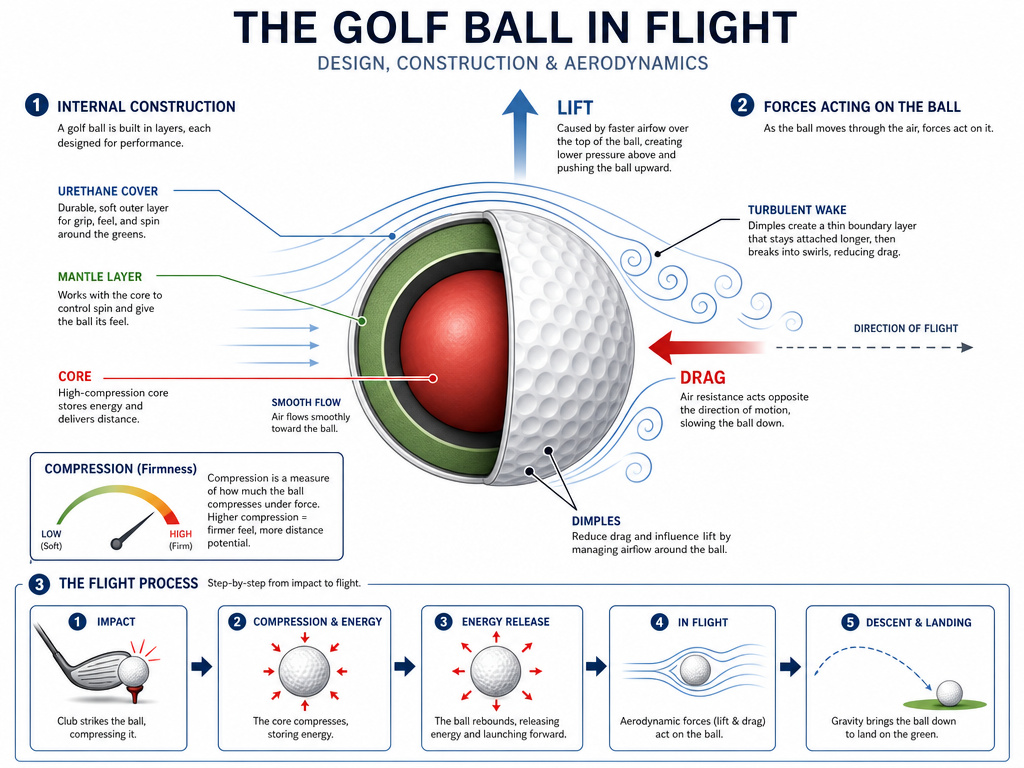
The laws govern the interaction, but your gear influences the result. The construction of a modern golf ball, its layers, cover, and compression rating, affects spin and energy transfer.
The R&A’s equipment effect on golf ball distance report states that 6-8% of the clubhead’s energy is lost at impact. After that, drag consumes 85% of the ball’s initial kinetic energy during a long drive. This is why golf ball dimples exist, to manage that drag and create lift.
Your driver’s lie angle and loft change the delivered face angle and launch conditions. A ball with a urethane vs Surlyn cover will spin differently on wedge shots. The point is to get fitted so your equipment isn’t fighting the swing you’re trying to build. Choosing a golf ball that matches your swing speed is a foundational step.
Frequently Asked Questions
What is the most important ball flight law?
The face angle determines the starting direction. If you don’t control where the face is pointing, you have no chance of controlling where the ball goes. Everything else is a correction to that starting line.
Do irons and drivers follow the same ball flight laws?
Yes, the physics are identical. However, drivers show more “gear effect” due to their curved faces, and irons have more loft which affects spin rates. The core relationship, face for start line, face-to-path for curve, remains the law for every club.
Why did the ball flight laws change?
They didn’t change. Physics has always worked this way. Our understanding changed because technology (Trackman, Foresight) finally allowed us to measure impact conditions accurately enough to see the truth. The old laws were a best guess based on observation without data.
Can you have a straight shot with an open clubface?
No. If the face is open relative to your target at impact, the ball will start right of the target. It might not curve if the path matches the face exactly, but it will not start straight. A straight shot requires the face pointing at the target.
How does swing speed affect the laws?
Swing speed increases the magnitude of everything. A face open by two degrees at 80 mph driver speed produces a smaller offline shot than the same two-degree face at 110 mph. The laws are proportional; faster speed amplifies both good and bad inputs.
What’s the fastest way to see these laws in action?
Go to a simulator with a quality launch monitor. Hit ten shots and ignore the curve. Just look at the “start direction” data. You’ll see it correlates directly with the measured face angle. Then look at the “side spin” or “spin axis” number and see how it correlates to the difference between face and path. It becomes undeniable.
Before You Go
The ball flight laws turn golf from a mystery into a solvable equation. Watch the start line, that’s your face. Watch the curve, that’s your path relative to that face. Use that diagnosis to target your practice, not random tips. Remember that a Titleist Pro V1 and a Callaway Chrome Soft will obey the same physics, but your job is to deliver the clubface consistently. On your next trip, factor in the altitude before you blame your swing. The game is hard enough without fighting gravity and air density too. Now you know what to look for. Go find it.
