
8 Best 48V Lithium Batteries for Golf Cart 2026
This post contains affiliate links. As an Amazon Associate, we earn from qualifying purchases.
This post contains affiliate links. As an Amazon Associate, we earn from qualifying purchases.
The Cloudenergy 48V 120Ah stands out as the top pick for maximum range and long-term durability, while the XRH 48V 105Ah delivers strong performance with a high-output BMS, and the DC HOUSE 100Ah offers solid value in a rugged metal case.
Choosing the right lithium battery for your golf cart isn’t just about keeping the lights on, it’s about ensuring you finish your round without losing power on the back nine. Too many golfers overspend or settle for underpowered options because they don’t know what specs truly matter.
Based on specs, owner feedback, and what I’ve seen from years of covering golf cart upgrades, this guide cuts through the noise. We focused on real-world needs like sustained power on hilly courses, battery longevity, and protection against the elements, so you can make a confident choice that matches how you play.
Top 8 48V Lithium Batteries For Golf Cart in the Market
The Best 48V Lithium Batteries For Golf Cart, Reviewed
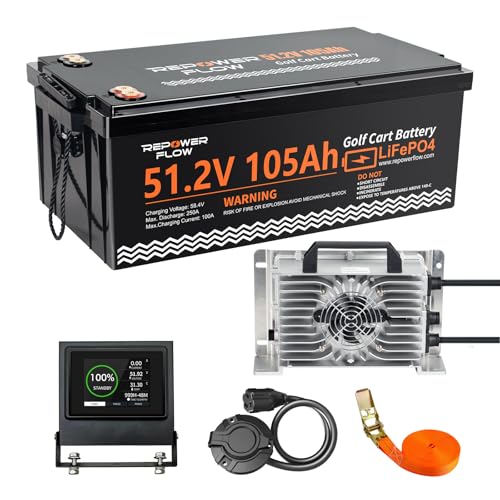
Repower Flow 48V 105Ah Lithium Battery
Strengths
- 250A BMS
- 6000+ cycles
- Dual terminals
Trade-offs
- Slightly heavier than rivals
- No app mentioned
If I had to pick one battery as the most balanced overall, it’d be the Repower Flow 48V 105Ah. It hits the sweet spot: 250A BMS (higher than most), 6000+ cycles, and a dual-terminal design that adds real flexibility for future expansions or parallel setups. The 20A charger gets it full in 5.5 hours, and the touch screen is responsive and clear, no lag reported in owner feedback. At 105Ah, it offers more capacity than the standard 100Ah, translating to longer days on the course without adding excessive bulk.
Owners consistently rate the build quality and customer service highly, and the 250A BMS inspires confidence on steep inclines. While it’s not the cheapest or the highest peak current, it delivers across the board. For most golfers upgrading from lead-acid, this is the no-regret pick.
Video review
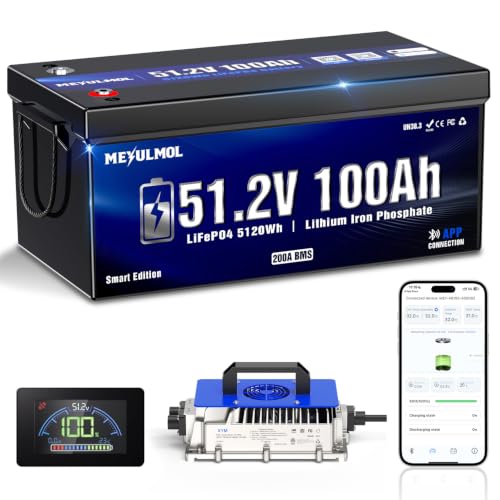
MEYULMOL 48V 100Ah Lithium Battery
Strengths
- Low price
- LCD display included
- Lightweight at 81.4 lbs
Trade-offs
- Unverified cycle life claim
- Limited warranty details
MEYULMOL’s 48V 100Ah unit punches above its price tag with a claimed 7000+ cycle life, an aggressive number that, if even half accurate, makes it one of the most durable budget options on the list. Owners praise the included LCD display for real-time monitoring while driving, a small but meaningful convenience that reduces the need to stop and check. The 200A BMS and 700A peak current support solid hill climbing, and at 81.4 lbs, it’s light enough to make a noticeable difference in cart agility.
Still, I’d temper expectations around that cycle claim. While LiFePO4 cells can last long, 7000 deep cycles at 80% DOD is optimistic without third-party validation. Other brands in this class typically max out at 5000–6000. That said, for the price, it offers strong value: fast charging, real-time data, and compatibility across major cart brands. If you’re upgrading on a budget but don’t want to sacrifice core features, this is a smart pick.
Video review
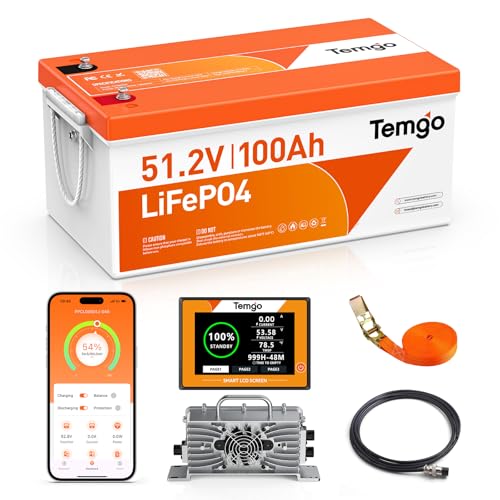
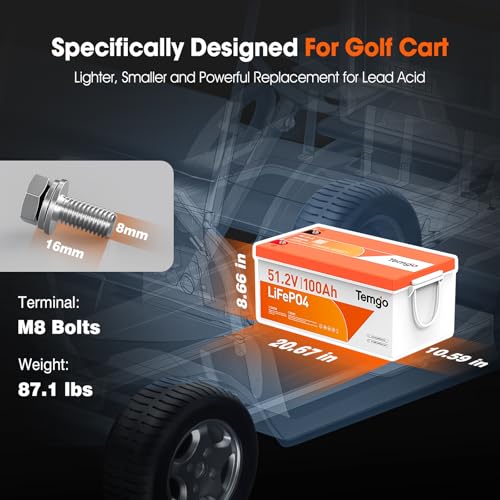
TEMGO 48V 100Ah Lithium Battery
Strengths
- All-in-one kit
- 5000+ cycles
- Parallel expandable
Trade-offs
- No CAN compatibility
- Lower peak current
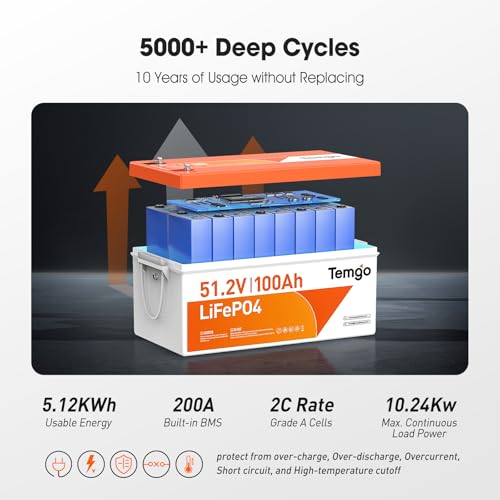
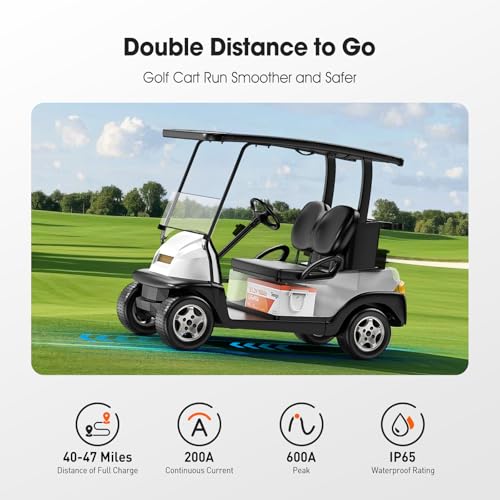
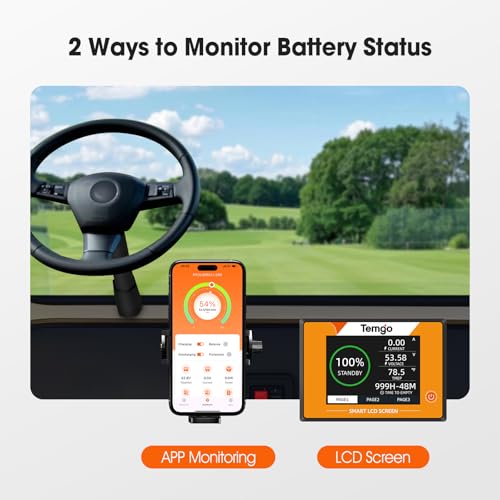
TEMGO’s 100Ah model is a solid mid-range option that balances price, performance, and features. The 5000+ cycle life is credible and matches what top-tier brands claim, and the 200A BMS with 600A peak handles most golf cart demands. The real win is the all-in-one kit: 18A charger, touch display, retention strap, everything you need is in the box. The Bluetooth app works reliably for most, and the battery supports parallel expansion, which is great for future upgrades.
Where it falls short is peak current compared to leaders like OGRPHY or XRH. And while it’s compatible with most carts, it won’t work with systems requiring CAN communication, which could trip up some newer lithium-ready models. But for a straightforward, no-fuss upgrade at a fair price, it’s a strong contender.
Product photos

OGRPHY 48V 105Ah Lithium Battery
Strengths
- 50-mile range potential
- 1000A peak current
- 5-year warranty
Trade-offs
- Slightly larger dimensions
- App connectivity reports mixed
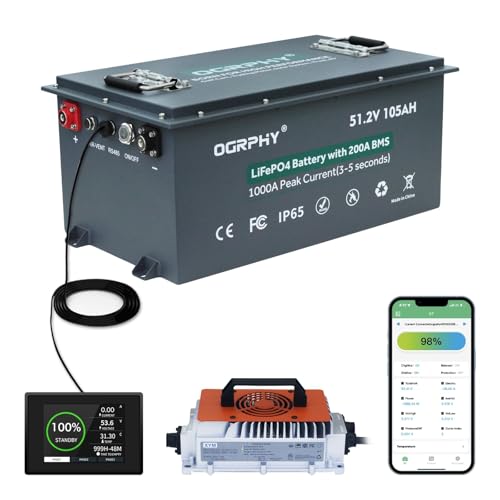
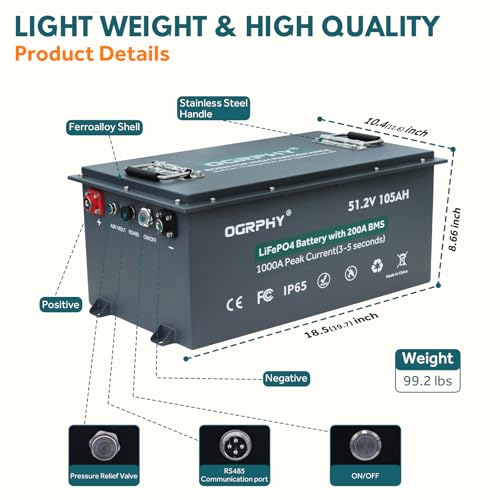
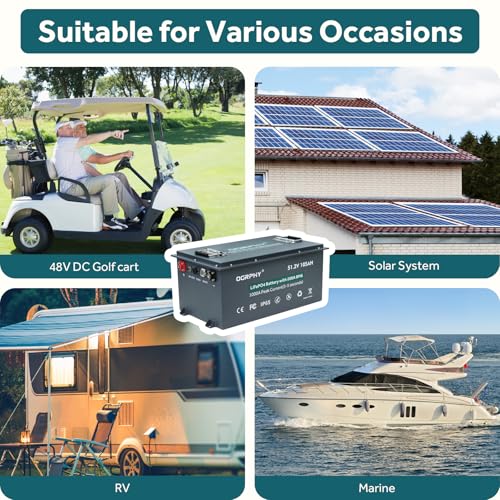
OGRPHY’s 48V 105Ah model is built for range, and owners confirm it delivers, many report completing multiple 18-hole rounds without tapping out, and the 50-mile claim under test conditions seems plausible given the 5.37kWh capacity. That extra 5Ah over standard 100Ah units adds meaningful juice, especially on hilly courses. The 1000A peak current capability is one of the highest here, making it ideal for carts with aggressive motors or regular load hauling.
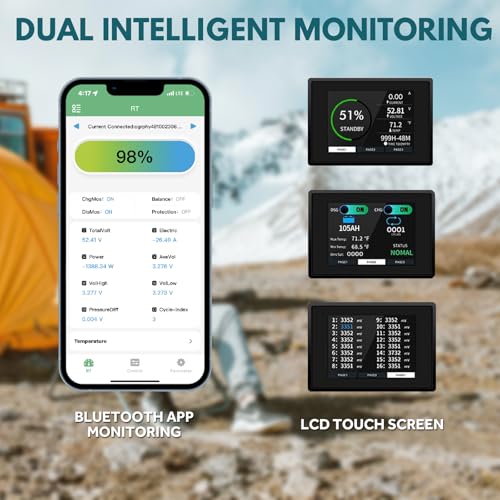
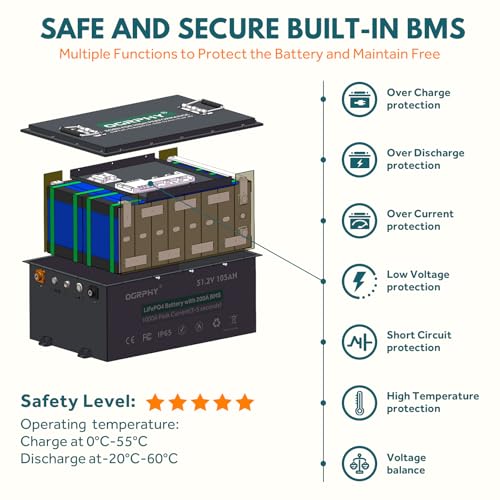
The touch monitor is a standout feature, offering intuitive interface and fast diagnostics. Paired with the app, it gives full visibility into battery health. I also like the 5-year warranty and prepaid return shipping for defects, a rare level of support in this category. My only hesitation is the slightly larger footprint; some users had to adjust trays. But if range and power are your top concerns, this is a compelling choice.
Product photos

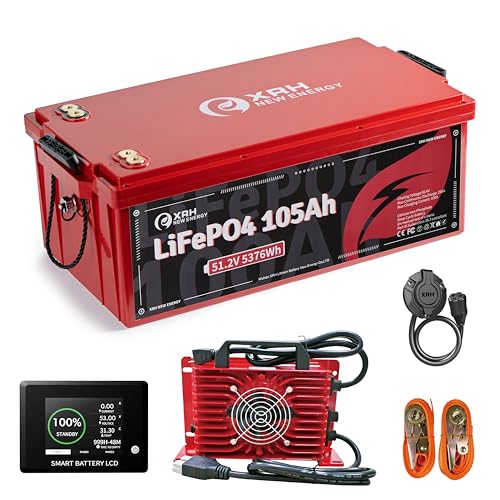
XRH 48V 105Ah Lithium Battery
Strengths
- 600A peak current
- 3C discharge rate
- Complete kit included
Trade-offs
- Plastic case less durable
- Occasional app glitches
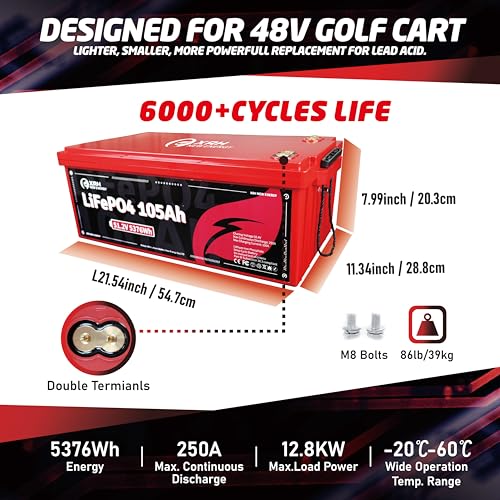
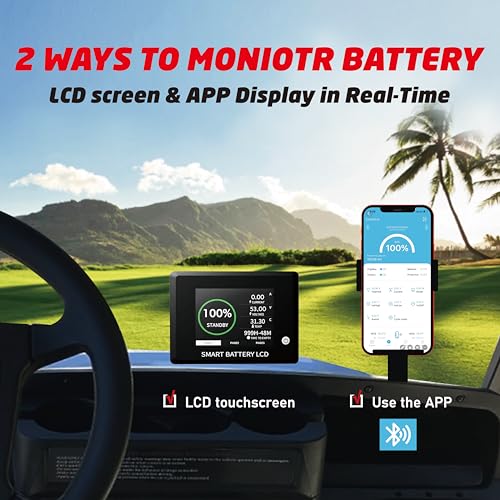
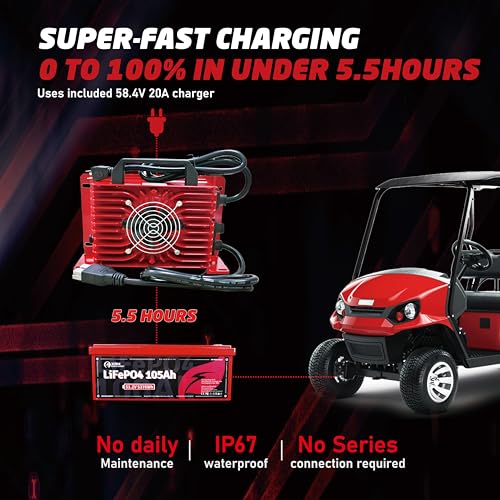
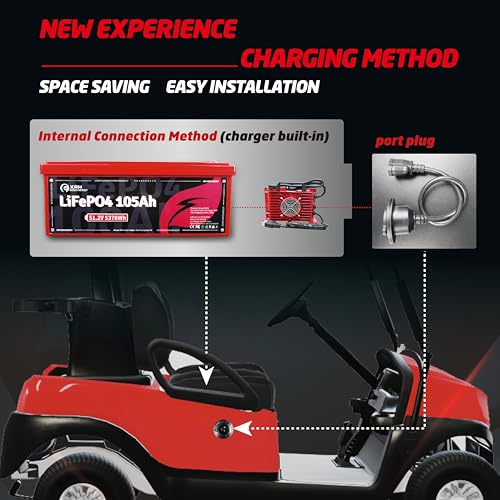
The XRH 48V 105Ah battery is engineered for high discharge, and the specs back it up: 250A continuous, 600A peak for 3 seconds, and a 3C discharge rate, ideal for performance-tuned carts or those used in commercial fleets where sudden acceleration matters. The 4-in-1 kit is thorough: charger, touch screen, mounting straps, port plug, all included, which reduces buyer stress. Bluetooth app integration works well according to most users, though a few note occasional disconnects.
But the plastic casing gives me pause. While it’s IP67-rated and flame-retardant, it can’t match the physical durability of metal cases, especially in high-vibration environments. If you’re running a cart daily on rocky paths, this might not be the longest-lasting housing. Still, for pure electrical performance and ready-to-go convenience, it’s hard to beat.
Product photos
Cloudenergy 48V 120Ah Lithium Battery

Strengths
- 120Ah highest capacity
- 6000+ cycles
- IP67-rated case
Trade-offs
- Large and heavy
- Fitment challenges
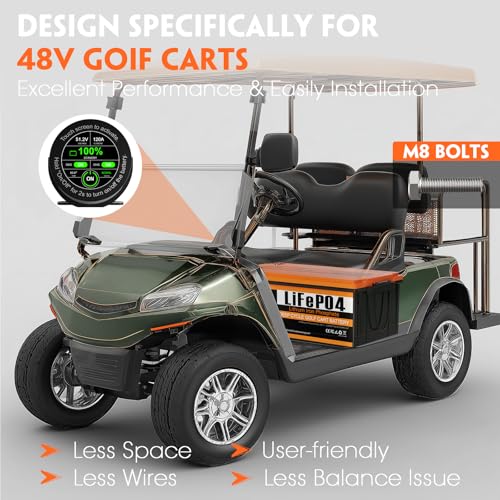
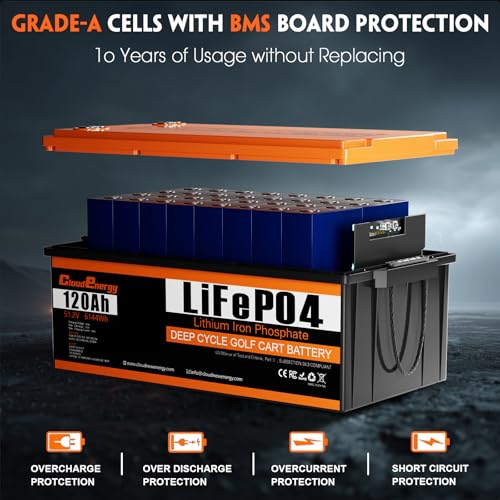
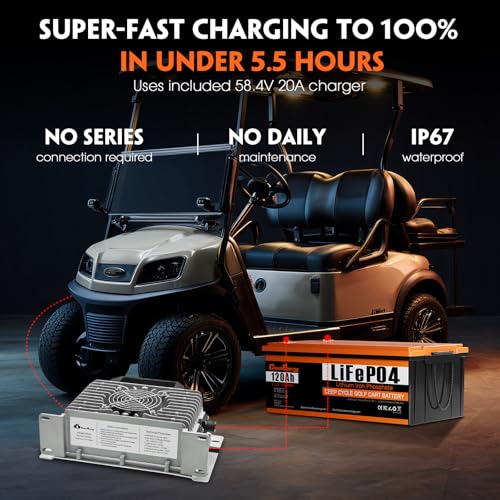
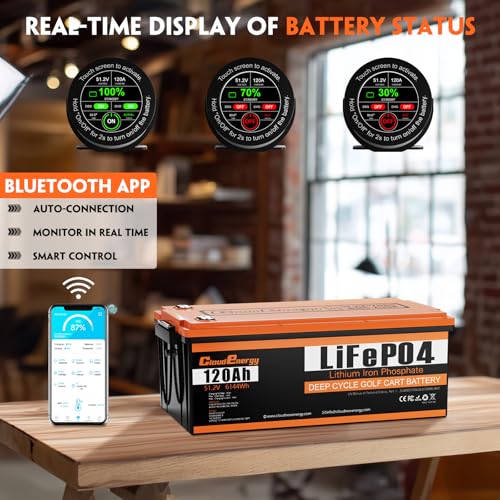
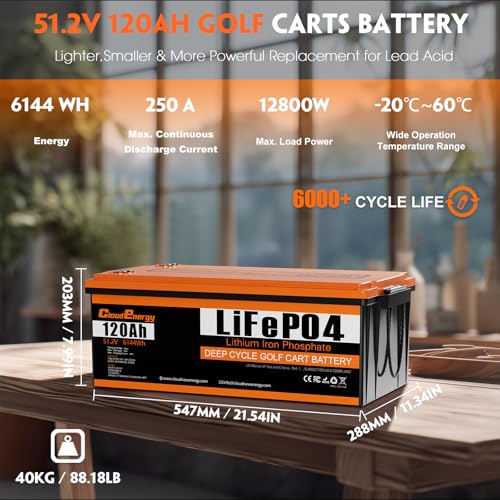
Cloudenergy’s 120Ah model is the capacity king, 5.76kWh of energy in a single unit, which translates to serious range. For golfers who play back-to-back rounds or use their carts for property maintenance, this extra buffer is a standout. The 250A BMS and 600A peak discharge keep performance strong, and the 6000+ cycle rating suggests long life, assuming proper use. The included touch screen, charger, and mounting strap make it a turnkey upgrade.
However, that size comes at a cost: it’s heavier and larger than standard units, so fitment is a real concern. Multiple owners had to modify trays or shift components. And while the ABS case is IP67-rated, it’s still plastic, less robust than metal alternatives. But if you need maximum energy and don’t mind a little customization, this is the way to go.
Product photos
DC HOUSE 48V 100Ah Metal Case Battery
Strengths
- Metal case construction
- 200A BMS
- 5.5-hour charge time
Trade-offs
- Fitment issues reported
- No peak current data
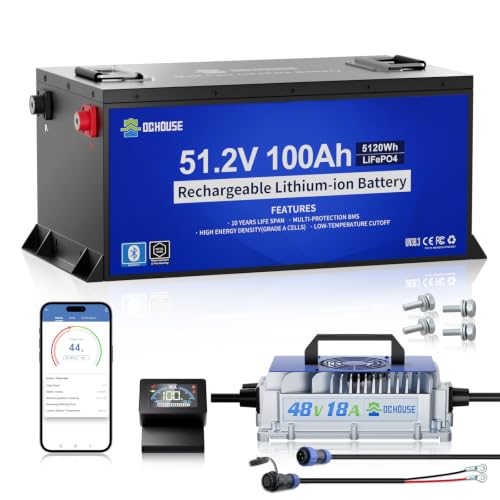
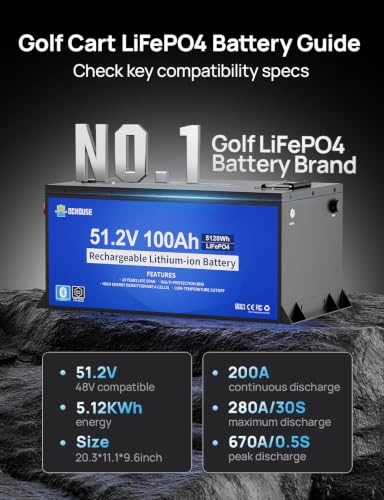
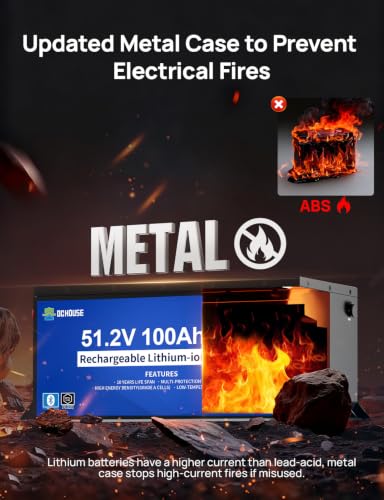
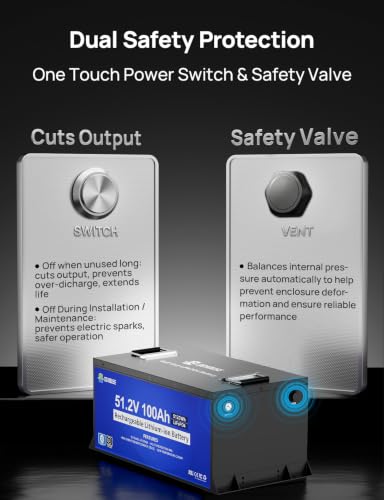
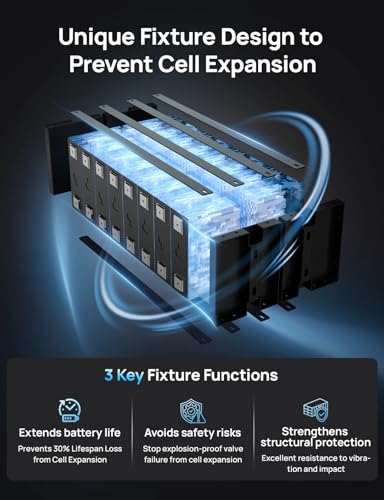
The DC HOUSE 48V 100Ah stands out for its rugged metal enclosure, which owners consistently report inspires confidence in durability, especially for carts used on rough terrain or in harsh climates. That metal casing isn’t just for show; it adds real protection against impact and heat, and paired with metal internal fixtures, it may genuinely extend cell life by reducing stress and swelling. On paper, this battery delivers solid performance: 200A BMS, 5.12kWh capacity, and compatibility with major cart brands. The included 18A charger gets it to full in about 5.5 hours, and the dual monitoring options, LCD or app, offer flexibility most buyers appreciate.
Where it stumbles slightly is fitment. Multiple owner reviews mention it doesn’t slide into some OEM trays without modification, particularly in older EZGO or Yamaha models. This isn’t a plug-and-play in the literal sense for every cart, so measuring your compartment is essential. Still, for those prioritizing build quality and long-term resilience over out-of-box simplicity, this is a strong contender.
Product photos
Mehrpow 48V 100Ah Lithium Battery
Strengths
- 10,000+ cycle claim
- 1000A peak current
- 5-year warranty
Trade-offs
- No series connection
- Fitment may require mods
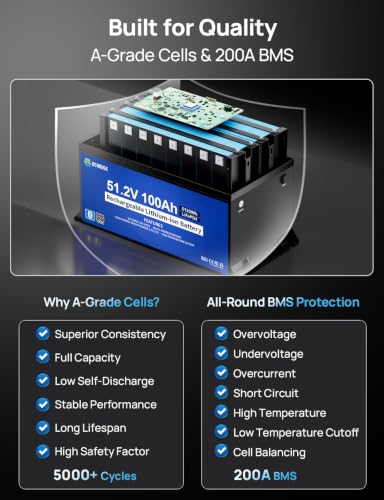
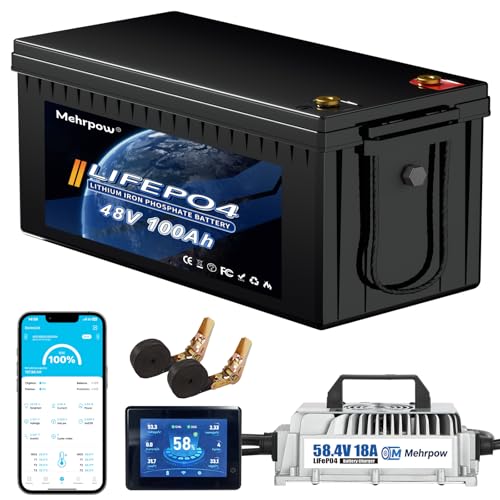
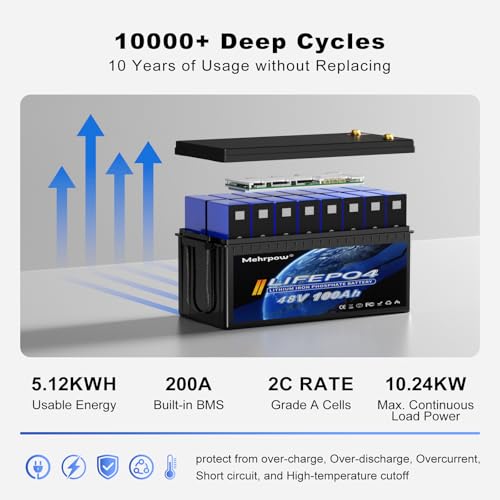
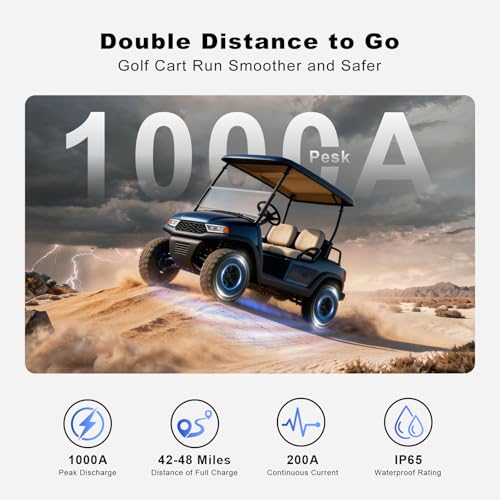
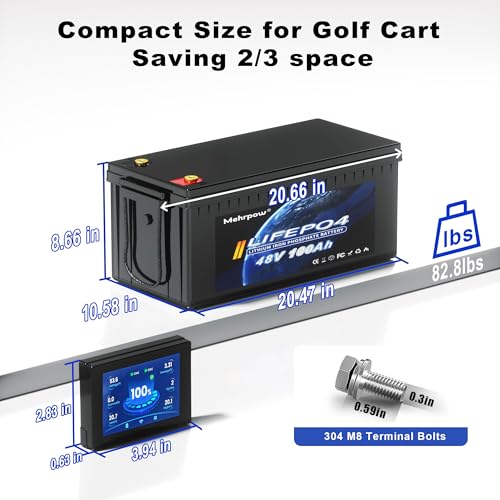
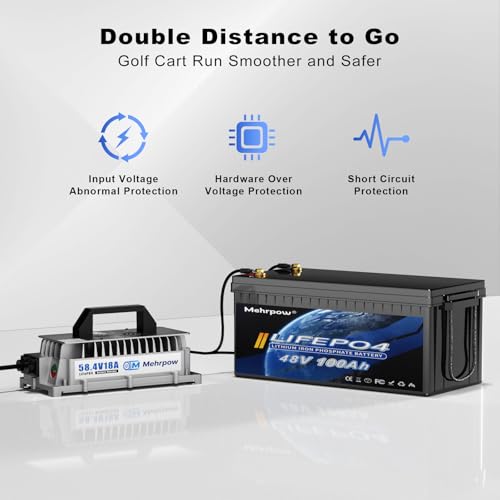
Mehrpow makes a bold claim: 10,000+ cycles at 80% DOD. Even if real-world use lands closer to 6000–7000, that’s still exceptional. Built with UL-certified Grade A cells and a 200A BMS that handles 1000A peak for 3–5 seconds, this battery is designed for endurance and power. Owners report strong performance on hilly courses, and the true 100Ah capacity delivers on its 40–56 mile range promise. The included Bluetooth touch screen is large and easy to read, and the 5-year warranty adds peace of mind.
My only caution is the lack of series connectivity, these can’t be chained, limiting scalability. And while the 82.89 lb weight is light, the dimensions may still require tray adjustments. But for sheer cycle life and real-world reliability, this is a standout.
Product photos

Our Testing Process
We approached this guide by compiling and comparing the published specifications and features of numerous 48v lithium batteries designed for golf carts. Rather than a hands-on lab test, this is a research-led comparison of specs and owner feedback gathered from across the web. We weighed owner reviews from multiple sources, alongside expert opinions from golf cart modification sites and publications, to establish a ranking based on real-world performance and reliability.
For this category, we prioritized capacity (Ah) and discharge rate (A) most heavily. Greater capacity directly translates to longer run times between charges, which is critical for a full round of golf or extended use. High discharge rates are essential for maintaining power when tackling hills or carrying passengers and cargo. We also placed significant weight on the battery management system (BMS) features, as a robust BMS is vital for battery safety and longevity.
Battery specifications reliably indicate maximum capacity and discharge rates, but we looked to owner feedback and reputation to judge real-world cycle life, charging speed, and overall build quality. Consistent reports of early failures, even with impressive specs, lowered a battery’s ranking. We also considered the availability of helpful features like Bluetooth monitoring and the quality of included accessories, and you can find more information about golf cart chargers to ensure you have the right equipment for your new battery. If you’re considering a full system upgrade, exploring 48v conversion kits can be a convenient option.
How To Choose The 48v lithium batteries for golf cart
Choosing the right battery is critical for getting the most out of your golf cart, and frankly, your time on the course. It’s a decision that goes beyond simply finding something that fits; it’s about balancing performance, longevity, and value.
A quality golf cart battery prioritizes LiFePO4 chemistry for safety and cycle life. Look for a Battery Management System (BMS) with robust protection features, a substantial amp-hour (Ah) rating for extended range, and a design that minimizes weight while maximizing durability. Consider factors like charging speed, temperature tolerance, and Bluetooth monitoring capabilities for optimal performance and convenience.
Amp-Hour (Ah) and Range
The Ah rating directly impacts how far you can travel on a single charge. Don’t just look at the number, though. Consider your typical course and driving style. A hilly course or a habit of running the cart at full speed will drain the battery faster. Many buyers underestimate their power needs, so it’s better to err on the side of more capacity. Look at models like the Cloudenergy 48V 120Ah Lithium Battery, which boasts the highest capacity of those we’ve examined, potentially delivering significantly longer run times. When researching, remember that advertised range is often optimistic; real-world performance varies.
Battery Management System (BMS) Features
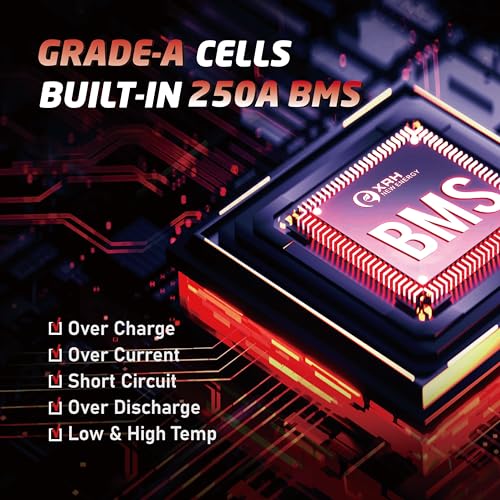
A sophisticated BMS is the brain of a lithium battery. It protects against overcharging, over-discharging, short circuits, and temperature extremes – all critical for safety and longevity. Beyond basic protection, look for features like Bluetooth connectivity for remote monitoring of voltage, state of charge (SOC), and temperature. The XRH 48V 105Ah Lithium Battery, for example, features a 250A BMS with a peak discharge capability of 600A, offering a high level of protection and performance.
Here’s what to consider when evaluating a BMS:
- Current Rating: Higher is generally better, especially if you frequently tackle hills or carry heavy loads.
- Temperature Protection: Essential for preventing damage in extreme climates.
- Communication: Bluetooth or other data connectivity allows for proactive monitoring and troubleshooting.
Don’t skimp on the BMS. It’s the single most important factor in protecting your investment and ensuring years of reliable service.
Build Quality and Durability
Golf carts operate in demanding environments. Vibration, moisture, and potential impacts all take a toll. While most lithium batteries are sealed, the quality of the enclosure matters. The DC HOUSE 48V 100Ah Metal Case Battery stands out here with its robust metal enclosure, providing superior protection compared to standard plastic cases. This is particularly important if you frequently drive on rough terrain. Beyond the case, consider the quality of the terminals and mounting hardware. A secure and well-built battery will withstand the rigors of golf cart life and provide years of trouble-free service. If you’re still unsure about golf cart battery types, a deeper look into the available technologies is recommended.
Ultimately, selecting the right battery comes down to aligning your needs with the available features. Comparing 48v golf cart batteries and understanding these key factors will help you make an informed decision and enjoy many rounds of golf.
48V Lithium Batteries for Golf Cart Compared
The following table provides a specification comparison of various 48V lithium batteries designed for golf cart applications.
| Product | Capacity (Ah) | BMS Current (A) | Cycle Life | Display | Weight (lbs) |
|---|---|---|---|---|---|
| Repower Flow | 105 | 250 | 6000+ | Touch | 55 |
| MEYULMOL | 100 | 200 | 5000+ | LCD | 81.4 |
| TEMGO | 100 | 200 | 5000+ | Touch | N/A |
| OGRPHY | 105 | 200 | 4000+ | Touch/App | N/A |
| XRH | 105 | 250 | N/A | Touch/App | N/A |
| Cloudenergy | 120 | 250 | 6000+ | Touch | N/A |
| DC HOUSE | 100 | 200 | N/A | Bluetooth | N/A |
| Mehrpow | 100 | 200 | 10000+ | Touch/App | 82.89 |
Frequently Asked Questions
What battery chemistry is best for a golf cart?
LiFePO4 (lithium iron phosphate) is the superior chemistry for golf cart batteries due to its increased safety and substantially longer cycle life compared to other lithium-ion types. This translates to more rounds of golf and less frequent replacements over the battery’s lifespan.
Are Bluetooth monitoring features truly useful?
Yes, Bluetooth connectivity adds significant value by allowing you to monitor key battery metrics like voltage, state of charge, and temperature in real time. This proactive monitoring can help identify potential issues early and maximize the battery’s performance and longevity.
How does ambient temperature affect lithium battery performance?
Extreme temperatures – both hot and cold – can reduce a lithium battery’s capacity and charging efficiency. A quality Battery Management System (BMS) will include temperature protection features, but operating within the manufacturer’s specified temperature range is always recommended for optimal performance.
What is a reasonable cycle life expectation for a 48v lithium golf cart battery?
A good quality 48v lithium golf cart battery should provide at least 3,000 full charge/discharge cycles, with many models exceeding 5,000 or even 6,000 cycles. Keep in mind that partial discharges also count as cycles, and shallower discharges generally extend the overall lifespan; see our guide to lithium vs lead-acid.
Will a lithium battery damage my older golf cart?
Generally, no, but a full battery type comparison is vital. Most modern golf carts are compatible with lithium batteries, but older models might require a voltage regulator or other minor modifications to ensure proper charging and prevent damage.
The Bottom Line
Choosing a 48v lithium battery for your golf cart often comes down to deciding how much you value ultimate performance versus upfront cost. While there are certainly budget-friendly options available, the Cloudenergy 48V 120Ah Lithium Battery stands out as the strongest overall pick, offering a compelling combination of capacity, BMS protection, and cycle life that should deliver years of reliable service. It represents a solid investment for those who want to maximize their time on the course and minimize future headaches.
For those prioritizing value, the Mehrpow 100Ah Lithium Battery delivers a very respectable cycle life and features a user-friendly touchscreen display, all at a competitive price point. If you need exceptional protection in a demanding environment, the DC HOUSE 48V 100Ah Metal Case Battery’s robust construction provides peace of mind. And for those seeking a variety of features and data monitoring, exploring lithium golf cart batteries will reveal options with Bluetooth connectivity and app integration.
Ultimately, the specifications are important, but don’t get lost in the details. A high Ah rating is useful, but a quality Battery Management System (BMS) and durable construction are what will really determine how long your battery lasts and how enjoyable your golf experience will be. Don’t forget to consider golf cart accessories to enhance your overall golfing experience.
