
The Natural Design Philosophy of Golf Architect Bill Coore
This post contains affiliate links. As an Amazon Associate, we earn from qualifying purchases.
This post contains affiliate links. As an Amazon Associate, we earn from qualifying purchases.
Bill Coore’s natural design style is a minimalist philosophy that prioritizes the existing land, moving minimal earth, sometimes as little as 4,000 cubic yards for an entire 18-hole course, to create strategic golf that appears discovered, not built. It’s defined by five factors: the land itself, the course concept, the owner’s needs, the clientele, and a desire to avoid redundancy from previous projects.
This number, 4,000 cubic yards, is the documented earth moved to shape the greens and bunkers at Sand Hills, the course that rewrote the modern design playbook.That scale of restraint separates a true natural design from a course that just looks rustic.
What follows is a breakdown of that philosophy, from its roots with Pete Dye to its execution by a tight crew of shapers. You’ll see how the approach works on perfect land, where it bends on less-than-perfect sites, and why this style produces the most enduring courses of the last 30 years.
Key Takeaways
- Coore’s style is governed by five specific factors from his ASGCA profile: land, concept, owner, clientele, and avoiding past project repetition.
- The benchmark for minimal earth movement is 4,000 cubic yards, used at Sand Hills to formalize natural features rather than create them.
- The routing is the “bone structure”; if it isn’t great, the course can’t be great, and it’s always drawn from walking the land with no preconceived notions.
- Trusted associates like Jimbo Wright and Trev Dormer execute the vision, a human element as critical as the design principles themselves.
- Even on a site with poor natural features, like McArthur Golf Club, the philosophy adapts by focusing on small contours and perfect sequence over grand earthworks.
The Five Pillars of Coore’s Natural Design
The framework isn’t a vague artistic statement. According to his official American Society of Golf Course Architects directory profile, five concrete factors influence Bill Coore’s design style: the land, the course’s concept, the owner’s needs and desires, the clientele, and his previous projects.
That last one is crucial. It’s a built-in check against self-plagiarism. The goal is to keep designs interesting and avoid redundancy. This is why a Coore & Crenshaw course in Nebraska feels distinct from one in Oregon, even though both share a philosophical DNA. The land and the client’s vision lead, not a signature template.
The land, the concept, the owner, the clientele, and the lessons of past projects, these five factors form the non-negotiable framework for every Coore & Crenshaw design, ensuring each course is a direct response to its unique site and purpose rather than a stylistic repetition.
This framework directly opposes a top-down, “visionary” approach. You don’t start with a concept sketch and then find land to force it onto. You start with a property, walk it for days, and let its knolls, hollows, and swales suggest the routing. The routing process is what Coore calls the “bone structure.” If it isn’t great, the course can’t be great.
From Pete Dye’s Chainsaw to a Partnership
Coore’s path wasn’t linear. After Wake Forest, he started in 1972 as a “non-entity” on Pete Dye’s construction crews, wielding a chainsaw. He credits Pete and Alice Dye with an enduring kindness and the foundational education of eavesdropping on client meetings. This apprenticeship under a figure who changed golf architecture twice, with Harbour Town and then TPC Sawgrass, instilled a deep respect for the craft’s history and impact.
He launched his own firm in 1982, but the pivotal moment came when Ben Crenshaw, the historian and two-time Masters champion, played Coore’s first solo design. Crenshaw’s passion for Golden Age architecture. Ross, MacKenzie, Maxwell, Tillinghast, aligned perfectly with Coore’s growing land-first sensibility. The partnership, Coore and Crenshaw, formed in 1985.
The fusion was potent. Coore provided the on-ground construction experience and routing genius. Crenshaw provided the scholarly depth, the player’s perspective on strategy, and a stated preference for a varied set of holes: a reachable and unreachable par five, short par fours on each side, and short par threes. Together, they codified a minimalist philosophy that felt both revolutionary and like a return to the game’s roots.
The Signature: Sand Hills and the 4,000-Cubic-Yard Benchmark
The theory became a world-altering reality with Sand Hills Golf Club in Nebraska (opening 1995/96). The site was a remote expanse of sandy blowouts, land so naturally gifted it seemed to already be a golf course. Coore & Crenshaw’s job was largely curation.
They moved approximately 4,000 cubic yards of earth. For perspective, many modern “minimalist” projects move ten to twenty times that volume. That dirt was used almost exclusively to formalize greens and excavate bunkers from the wind-shaped sand blowouts that already existed.
| Element at Sand Hills | Coore & Crenshaw’s Action | Result & Why It Matters |
|---|---|---|
| Earth Movement | ~4,000 cubic yards total. | A quantitative benchmark for true minimalism. It proves great golf lies in finding, not making. |
| Bunkers | Excavated from existing wind-blown “blowouts.” | Created instantly aged, natural hazards. The club now sprays sand to crust it against the wind, preserving the original aesthetic. |
| Routing | Drawn from walking the dunes for days. | Eighteen holes flow with the land’s natural rhythm, creating the “discovered” feel. |
| Strategy | Width, angles, and ground game emphasized. | Embodies the strategic design school, rewarding thought over sheer power. |
Sand Hills did two things. It proved a spectacular course could be built in a remote, sandy location with a tiny budget, directly inspiring Mike Keiser’s Bandon Dunes model. More importantly, it set a new, rigorous standard for what “minimalist” actually meant. It wasn’t an aesthetic; it was an ethic of restraint. This project cemented their place among the creators of the world’s best courses.
The Human Machinery: Associates and the On-Ground Execution
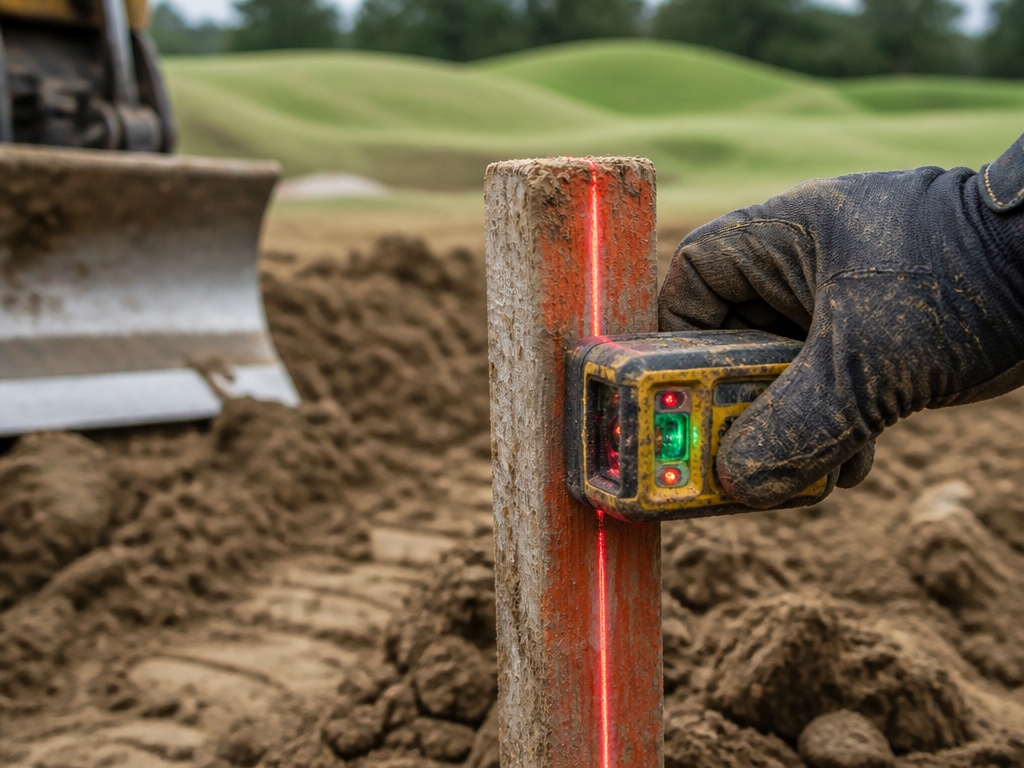
A philosophy is just words without the people to build it. Coore & Crenshaw’s style relies on a small, trusted crew of shapers who understand the vision intuitively. These aren’t anonymous contractors; they’re design associates like Jimbo Wright (with the firm since 1989) and Trev Dormer.
Wright learned from “two of the best dozer hands in the business” on the Plantation Course at Kapalua and has been a stalwart ever since. Dormer notes that the most important attribute he’s picked up from Bill and Ben is humility. “The talent speaks for itself, but it’s their humility and humanity that sets them apart,” he says.
This creates a unique on-site culture. The bosses know the names of the silt-fence crew. Client dinners are filled with laughter, rarely about the project itself. This respectful, low-ego environment allows talented shapers to take ownership. Associates like Riley Johns, Trev Dormer, and Keith Rhebb have gone on to design their own well-received courses, a testament to the mentorship within the firm.
Where this goes sideways: Thinking natural design means no earth movement. It means judicious movement. The wrong shaper, one who over-interprets or lacks subtlety, can turn a subtle contour into a cartoonish mound in an afternoon. The crew’s discipline is the last line of defense for the philosophy.
When the Land Doesn’t Give You Much: The McArthur Case Study
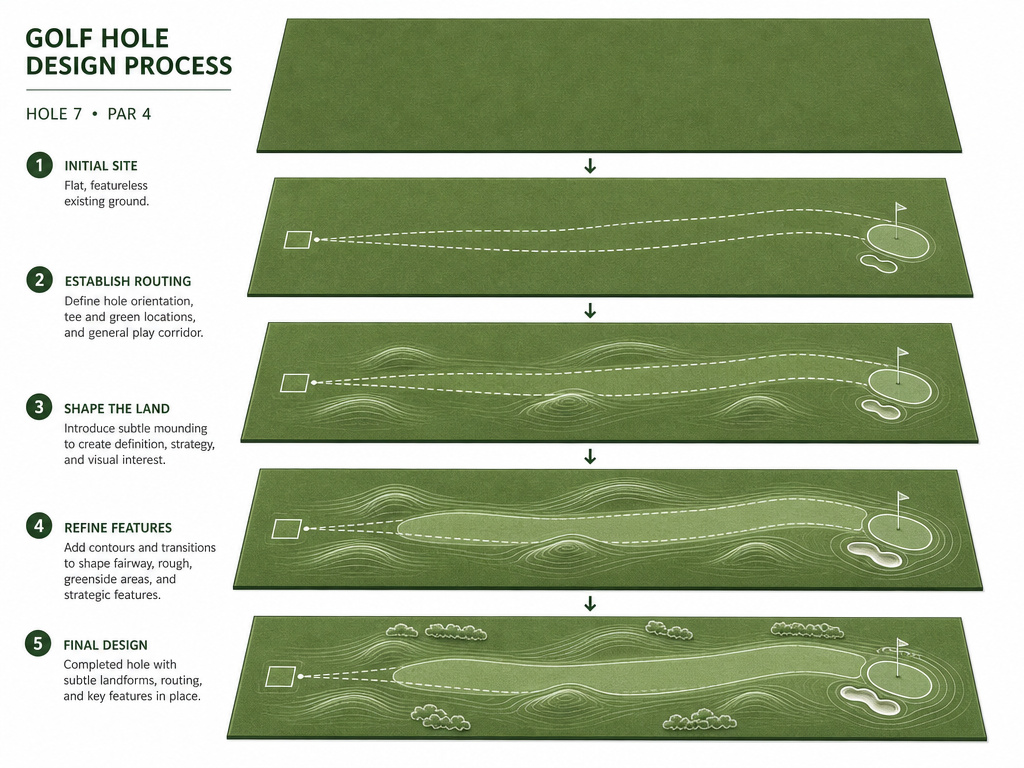
The ultimate test of a philosophy is how it handles a weak site. Not every property is Sand Hills. McArthur Golf Club in Florida was largely flat, featureless Florida land. The naturalist’s nightmare.
Coore has openly acknowledged McArthur is “all created.” Yet, he finds reward in that challenge occasionally. The key is scale. The contours built were “small, though, not giant cuts.” Developer Mike Keiser observed that even here, “Bill routes interesting holes in perfect sequence and it works beautifully.”
This reveals the hierarchy of the design principles. When the land is the star, it leads the routing and defines the features. When the land is mute, routing and sequence, the fundamental architecture of the round, carry the weight. The restraint shifts from moving little earth to moving earth with subtlety and purpose. It proves the style is a flexible intelligence, not a rigid dogma.
Coore & Crenshaw in the Minimalist Landscape
No architect exists in a vacuum. The modern minimalist movement includes other major figures like Tom Doak and Gil Hanse, both of whom also apprenticed under Pete Dye. The shared ethos is a reverence for the ground and a rejection of the overly-manicured, penal architecture of the late 20th century.
The difference often comes down to tone and texture. Doak’s work can carry a more bold, dramatic edge. Coore & Crenshaw’s work leans toward a quieter, more classical serenity. Their greens, while large, are often flatter with subtler contours, recalling the classics like Chicago Golf Club. Their fairways tend to be more generously wide, emphasizing strategic angle play over punitive penalty.
It’s not a competition, but a conversation. Together, they have reshaped the industry’s values, proving that the most forward-thinking design looks backward to the game’s strategic origins and outward to the land it occupies.
Frequently Asked Questions
What is Bill Coore’s most famous golf course?
Sand Hills Golf Club in Nebraska is the most influential. Its 1995 opening on a remote, sandy site with only about 4,000 cubic yards of earth movement defined the modern minimalist movement and inspired the destination resort boom.
How did Bill Coore and Ben Crenshaw meet?
Ben Crenshaw, a student of golf architecture, played Coore’s first solo design, Rockport Country Club in Texas, in the early 1980s. Impressed, he approached Coore to form a partnership. Their shared love for Golden Age courses led to the founding of Coore & Crenshaw in 1985.
What does “minimalist” mean in golf course design?
In true minimalist design, the architect acts as a curator of the existing landscape. The goal is to move as little earth as possible, allowing natural landforms to dictate the routing and hazards. The course should feel discovered, not constructed. It’s an ethic of restraint, not just a rustic aesthetic.
Is Coore & Crenshaw still designing courses?
Yes, they remain highly active and selective. Their philosophy mandates a low workload, typically one to three projects a year, to ensure intense personal focus on each site. Recent and upcoming projects include courses at Cabot St. Lucia and Pinehurst No. 11.
What is the biggest misconception about natural design?
That it’s easy or requires no skill. Finding the great golf in the land requires immense vision and discipline. As Coore says, the routing is a complex puzzle. Restraint is harder than creation; knowing what not to build is the mark of a master.
Before You Go
The lesson from Coore’s natural design style is about process. Start with what you have, not what you wish you had.Listen more than you dictate. And understand that the most powerful statement is often made through restraint, not addition.
For the golfer, playing a Coore & Crenshaw course is an invitation to think. The wide fairways aren’t a pardon; they’re a question. Which angle do you want? The bunkers are strategic landmarks. It’s golf that feels older, smarter, and more connected to the ground beneath your feet, because it is. That feeling, more than any ranking, is the ultimate signature of a style that will outlast any trend.
