
Golf Metrics: Carry Distance vs Total Distance Compared
This post contains affiliate links. As an Amazon Associate, we earn from qualifying purchases.
This post contains affiliate links. As an Amazon Associate, we earn from qualifying purchases.
Carry distance is the yardage your ball travels through the air from impact to first bounce. Total distance is carry plus any ground roll. Your driver’s total distance number is mostly marketing; your iron’s carry distance is the only number that matters on the course. Amateurs chase roll-out, but professionals optimize for a consistent, predictable carry that lands at a specific yardage, because you can’t control what happens after the ball hits the ground.
That distinction changes how you practice, what you buy, and which numbers you trust. A launch monitor spits out both figures, but one is a result and the other is a command. If you practice for total distance, you’re practicing for conditions that might not exist when you play, firm fairways, dry weather, perfect lies. If you practice for carry distance, you’re practicing for the only part of the shot you actually control.
What follows: the physics that separates air yardage from ground game, the three course conditions where total distance lies to you, and how to read your own launch data to find the yardage you can actually play to.
Key Takeaways
- Carry distance is the only controllable metric. You dictate launch and spin; the ground dictates roll. Practice to a specific carry number.
- Total distance is a variable outcome, not a target. It changes daily with turf moisture, firmness, and slope. Ignore it for club fitting and gapping.
- High spin kills driver roll but saves your irons. Low-spin drivers maximize total distance on paper; high-spin irons maximize stopping power on greens.
- Amateur swing flaws artificially boost total distance. A low, spinning slice may run out 30 yards, masking a weak carry. Fix the strike, not the roll.
- Always club for your carry yardage over hazards. If you need 175 yards to clear water, your 175-yard total-distance club might only carry 165.
What’s the Physical Difference Between Carry and Roll?
Carry is aerodynamics. Roll is geology.
A ball in flight obeys physics you can measure and influence: launch angle, spin rate, and ball speed. The combination of those three determines its arc and where it lands. Once it lands, the ball becomes a prisoner of terrain. Its forward momentum meets grass friction, ground hardness, slope, and moisture. You have zero say in that conversation.
Carry distance = ball speed × launch angle × spin rate (optimized). It’s the product of your strike quality and the equipment’s designed performance window. Total distance = carry distance + roll-out. Roll-out = (landing angle × ground hardness) – (grass friction × moisture).
The math isn’t neat, but the principle is. Your 7-iron might carry 150 yards and stop within a yard of its pitch mark. Your driver might carry 230 yards and roll out another 20 on a baked July fairway, but only 5 on a soggy April morning. The driver’s carry stayed constant; the total distance changed by 15 yards because of the ground.
Why Launch Monitors Love Total Distance (And Why You Shouldn’t)
Launch monitors report total distance because it’s a bigger, more impressive number. It’s also the number most sensitive to the machine’s “conditions” setting. Simulator software lets you dial in fairway firmness from “soft” to “concrete.” Crank it to concrete, and your total distance spikes. That’s fantasy.
On a real course, you get the fairway you get. The variable is the weather two days ago, not your swing. If you fit your driver for maximum total distance on a simulator set to “firm,” you’ve bought a club for a condition that might appear four times a year in your climate.You’ve also likely chosen a low-spin setup that falls out of the sky on windy days, because you traded stable flight for extra roll.
For irons, this focus is disastrous. An iron’s job is to land and stop. Roll-out with a scoring club is a bug, not a feature. When you’re trying to hit a green, total distance is irrelevant. You need to know the carry yardage to the front edge, the pin, and the back. The ball’s behavior after it lands is about spin rate and descent angle, not how far it trickles.
| Shot Type | Primary Goal | Key Metric | Why Total Distance Misleads |
|---|---|---|---|
| Driver | Optimal position | Carry + Roll | Roll varies daily by 10-30 yards. |
| Fairway Wood | Reach par 5 | Carry | Must carry hazards; roll unreliable. |
| Iron (4-7) | Advance, hold green | Carry | Run-out depends on green firmness. |
| Iron (8-W) | Accuracy, stop | Carry | Any roll is a miss; you want spin. |
When Your Total Distance Number Is a Lie
Three common course conditions render your driver’s total distance useless. If you’ve ever flown a green with a club you “usually hit 165,” you’ve met one of them.
Wet turf or dormant grass. The ball lands and plugs. Roll-out drops to near zero. Your 250-yard total-distance drive becomes a 230-yard carry. That’s a two-club difference into the green.
Uphill landing zones. Even on firm ground, an uphill slope kills momentum. The ball uses its energy to climb instead of roll. Your total distance shrinks to essentially your carry distance.
Rough or hazards. This is the obvious one. If your ball needs to carry a bunker at 180 yards, a 180-yard total-distance 6-iron that only carries 172 is in the sand. You clubbed for roll that doesn’t exist over the hazard.
The fix is simple, yet most amateurs resist it: ignore your total distance with every club except the driver, and even then, only use it for planning safe sides of fairways. Build your distance control system around carry. On the course, ask one question before every shot: “What yardage must this ball carry to be successful?” Then hit the club that delivers that carry, regardless of what it might do on the ground.
How to Find Your Real Carry Yardages (Forget the Range)
Range balls are flight-limited. Mats produce unrealistic spin. You cannot find your true carry distances at a typical driving range.
You need two things: real golf balls (the model you play) and a launch monitor session on grass, or data from the course itself. Here’s a field method that works without any tech.
- Pick a calm day. Wind adds a variable that will corrupt your data.
- Hit 5 shots with your 7-iron on a hole with a flat, open fairway.
- Walk to the nearest pitch mark. Not where the ball finished, where it first landed. Use your GPS watch or rangefinder to measure back to your hitting spot.
- Record that number. Throw out the highest and lowest, average the middle three.
- Repeat for each club in your bag, focusing on the landing spot, not the final resting place.
This gives you a baseline carry for each club in actual conditions. The dispersion will surprise you. Most golfers have a 15-yard variance in carry with their mid-irons. That’s the number you need to manage, not the occasional rocket that rolled out an extra 10.
Common mistake: Using range distance to gauge your clubs. Range balls often fly 10-15% shorter than premium balls, and mats can reduce spin by up to 2,000 RPMs. That means your range 7-iron that flies 150 might carry 165 with a real ball off grass.
What Your Launch Monitor Data Actually Means
If you have access to a monitor like TrackMan or Foresight, you can go deeper. Focus on these three data points for each club to understand and improve your carry.
- Ball Speed: The engine. Generated by smash factor (efficiency) and clubhead speed. More ball speed equals more potential carry.
- Launch Angle: The trajectory. Too low, the ball fights drag and falls short. Too high, it loses energy to the air. Every club has an optimal window.
- Spin Rate: The stability controller. For drivers, 2,000-2,800 RPMs is the modern sweet spot for carry and some roll. For a 7-iron, you want 6,500-7,500 RPMs to create stopping power.
A high spin rate with a driver might rob you of roll, but it provides control in the wind. A low-spinning 7-iron will run forever, making greens impossible to hold. The goal is to match the spin to the club’s purpose, rather than to minimize or maximize it.
| Club | Optimal Launch Angle | Optimal Spin Rate (RPMs) | Desired Outcome |
|---|---|---|---|
| Driver | 12° – 16° | 2,000 – 2,800 | Max carry, controlled roll |
| 7-Iron | 16° – 20° | 6,500 – 7,500 | Steep descent, stop on green |
| Pitching Wedge | 25° – 30° | 9,000 – 10,500 | High flight, minimal roll |
The Driver vs. Iron Debate: Two Different Philosophies
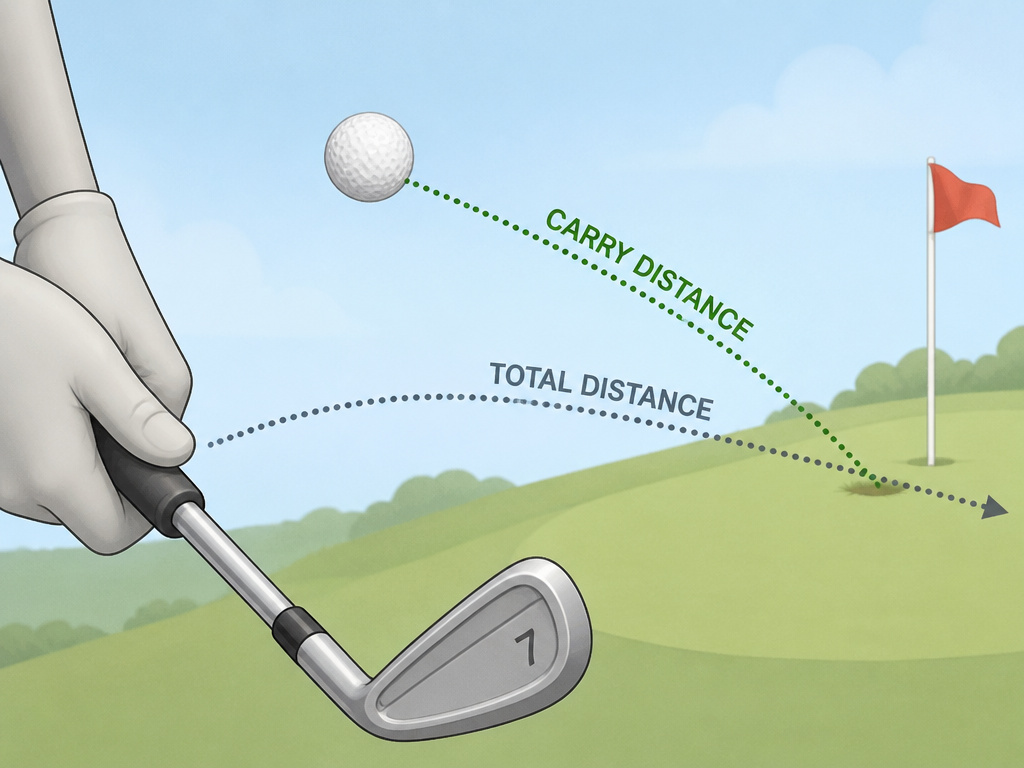
This is where carry distance vs total distance splits your bag in two. Your driver and your irons have opposite jobs.
The Driver’s Job: Find the longest, safest spot off the tee. Here, total distance has some value. On a wide-open par 5, you might welcome 30 yards of roll. But the carry must still be the priority, because it must clear any trouble. You fit and swing for a combination of high launch and low spin to maximize both. But you always plan for the carry.
The Iron’s Job: Deliver the ball to a specific, often guarded, landing zone. Full stop. Spin rate is your friend. You need enough backspin to counteract the ball’s forward momentum upon landing. A well-struck 7-iron should land, bounce once or twice, and stop near its pitch mark. Any significant roll means you misjudged the shot, the spin, or the firmness of the green. For irons, you fit and swing for consistent carry, full stop.
Where this goes sideways: Using a low-spin “distance” iron. These clubs are designed for stronger players who generate plenty of spin naturally. For the average golfer, a low-spin iron plows through the green on flyers and offers zero stopping power on approaches. You gain 5 yards of total distance and lose all accuracy.
The Roll-Out Illusion and Swing Flaws
A slicer’s best friend is a hard, right-sloping fairway. The low, spinning slice hits the ground early and scuttles forward. The total distance on the scorecard might look respectable, 220 yards, say. But the carry was only 190. That player thinks they hit it 220, so they pull a 4-iron from 200, a club they can’t possibly get airborne enough to carry that far.
They’re playing to a total distance that doesn’t represent their actual ability. The fix is to improve strike quality to increase ball speed and launch, turning that 190-yard carry into a 210-yard carry. The total distance might not change much, but the quality of the shot, and the options it provides, improves dramatically.
This is the core of the technique vs strength argument. Pure power without a quality strike creates erratic, ground-dependent distance. Efficient technique transfers energy into the ball, producing reliable carry.
How Weather and Altitude Change the Equation
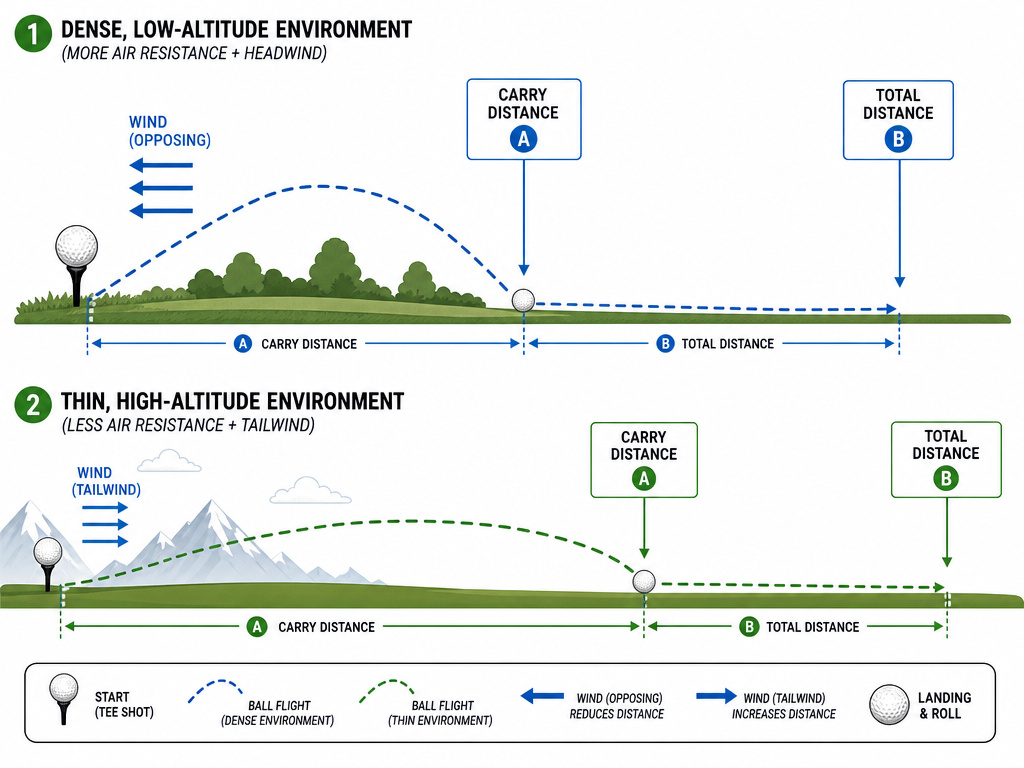
Your yardages aren’t static. Two external factors force you to recalculate everything: wind and altitude.
Wind affects carry directly. A 10 mph headwind can reduce carry by 10-15 yards. A tailwind can add 5-10. Crucially, wind has a negligible effect on roll-out. You must adjust your club selection based on the wind’s impact on carry, not total distance.
Altitude is a bigger multiplier. At high elevations, thinner air reduces drag and increases carry by about 2% per 1,000 feet above sea level. A ball that carries 200 yards at sea level might carry 212 yards in Denver at 5,000 feet. The roll-out also increases because the ball lands with more speed and at a shallower angle. This is the rare case where total distance can legitimately jump 20 yards or more. But the calculation still starts with carry.
The part nobody mentions: Humidity. Contrary to old myths, humid air is less dense than dry air. A ball flies slightly farther in high humidity. The effect is small (about 1-2 yards on a driver), but it’s real. It’s another tiny variable in the carry equation.
Frequently Asked Questions
Which is more important, carry distance or total distance?
Carry distance is infinitely more important. It’s the only part of the shot you control. Total distance is a helpful afterthought for drivers on open holes, but for every other club, planning for roll is a gamble. Your goal is to know your carry yardage for each club with absolute certainty.
Do pros care about total distance?
Professionals care about total distance with their driver for planning tee shots, but they are masters of carry distance with their irons and wedges. They know the exact carry yardage for every club at every swing intensity. Their caddies give them a “carry number” to a hazard or the front of the green, not a total distance.
Why does my driver have more roll than my friend’s?
The main reasons are lower spin rates, a higher launch angle, and firmer ground conditions when you play. Your swing might be delivering less backspin, which reduces lift and causes the ball to land at a shallower angle, promoting roll. Your friend might have a higher-spinning drive that lands steeper and stops faster.
How can I increase my carry distance?
Improve your smash factor (center-face contact) to increase ball speed. This is the number one factor. Ensure you’re using a golf ball that matches your swing speed, softer compression for slower swings, higher compression for faster swings. Finally, optimize your launch conditions through a professional club fitting to match your attack angle and dynamic loft.
Should I use different golf balls for carry vs. Total distance?
No. Use one ball model consistently. Modern distance golf balls from Titleist (Pro V1), TaylorMade (TP5), and Callaway (Chrome Soft) are engineered to provide a balance of carry and spin. Switching balls disrupts your feel and your predictable carry yardages. Find a ball that gives you the right combination of distance and forgiveness for your game and stick with it.
The Bottom Line
Chasing total distance is a fool’s errand. You’re optimizing for the part of the shot that is governed by the grounds crew and the weather. Chasing carry distance is the work of a practical golfer. It’s about controlling what you can control: strike quality, launch angle, and spin.
Start by learning your real carry numbers. Ignore the range. Ignore the simulator set to “tournament firm.” Use your eyes on the course or a launch monitor with real balls. Build your club gapping and your course strategy around those air yardages. When you know your 7-iron carries 155, you’ll stop flying greens and leaving approaches short. You’ll choose the right golf balls for distance and accuracy that fit your swing.
Distance is about knowing exactly how far the ball will fly, not about how far it eventually stops. That’s the difference between hoping and knowing.
