
Golf’s Shaft Lean at Impact Explained: Why Wrist Angle Wins
This post contains affiliate links. As an Amazon Associate, we earn from qualifying purchases.
This post contains affiliate links. As an Amazon Associate, we earn from qualifying purchases.
Shaft lean at impact is the handle of the club staying ahead of the clubhead through the strike. It works by delofting the clubface at contact, compressing the ball for more distance and a straighter flight. This position is created by a specific pattern of lead wrist flexion, not by forcing your hands forward or holding a static angle.
Most instruction gets the mechanism backwards. They tell you to push your hands ahead, which usually adds extension in your lead wrist, the exact move that opens the face and forces a scoop. The real difference between a pro and an amateur impact isn’t how far forward the hands are; it’s the 20–25 degree reduction in lead wrist extension from the top of the backswing down to the ball.
What follows: the two wrist motions that feel identical but produce opposite results, the three drills that bypass conscious manipulation, and the one tolerance spec from heavy industry that shows why a five-millimeter error in your setup destroys the whole system.
Key Takeaways
- Shaft lean is a product of lead wrist flexion, not wrist hinge or conscious hand pushing. Trying to “hold the angle” adds extension, opens the clubface, and guarantees a flip.
- A flat-to-flexed lead wrist through impact delofts the club, compresses the ball, and keeps the face square. A cupped or extended lead wrist adds loft and forces a last-second flip to close the face.
- You cannot create shaft lean from a poor address position. Too much forward press at setup locks you into an unrecoverable pattern. Start neutral.
- The Faldo Drill and P6 Face-Down Check are the fastest ways to ingrain the feel without swing thoughts. They train the body, not the hands.
- With the driver, seek minimal or zero shaft lean. The goal is an upward strike; forward lean with a driver creates a downward blow, increases spin, and kills distance.
The 2 Types of Wrist Motion That Create (Or Kill) Shaft Lean
Your wrists can move in several directions, but only two matter for shaft lean: radial/ulnar deviation (hinging) and extension/flexion. Confusing them is the root cause of poor impact.
Common mistake: Trying to create shaft lean by increasing wrist hinge. This is radial deviation, cocking the wrists up and down. It feels like you’re setting the club steep, but it forces the clubface open. You’ll need a violent flip to square it, and you’ll lose all lag and speed by impact.
Wrist hinge (radial deviation) is the up-and-down cocking of the wrists. It’s necessary for storing energy, but it does not control the clubface angle through impact. Over-hinging in the backswing makes it nearly impossible to return the lead wrist to a flat or flexed position in time.
Wrist extension/flexion is the bowing (flexion) or cupping (extension) of the lead wrist. This is the lever that actually controls dynamic loft and face angle. – Lead wrist flexion bows the knuckles downward, delofting the clubface and positioning the handle ahead of the head. This is the move. – Lead wrist extension cups the knuckles upward, adding loft and leaving the clubhead ahead of the hands. This is the scoop.
The data from systems like HackMotion is clear: pros reduce their lead wrist extension by 20–25 degrees from the top of the swing to impact. Amateurs often increase it. That difference isn’t about strength; it’s about matching the wrist hinge in the backswing with a flexion move in the downswing.
Why “Holding the Angle” Is the Worst Advice You’ll Hear
The phrase “hold the angle” typically refers to maintaining the wrist hinge from the top of the swing. It’s a visual cue that leads to a physical disaster. When a golfer consciously tries to keep that 90-degree angle between forearm and club, they almost always freeze the wrong part.
The body’s response is to stiffen the lead wrist and arm. This prevents the natural release of lag and, more critically, blocks the lead wrist from moving into flexion. The result is a cast from the top, a complete loss of power, and a wide-open clubface. The only way to hit the ball from there is a desperate flip of the hands, which adds even more extension.
Instead of holding an angle, think of letting the clubhead trail the hands as your body rotates. Your downswing sequence pulls the handle, and the club follows. The wrist angles respond; they aren’t held.
Where this goes sideways: Stiff-arming the downswing to “hold the lag.” By the time the club is waist-high (P6), the lead wrist is fully extended. The face is wide open, and the only possible strike is a thin block to the right. You’ll do it three times in a row before you quit in frustration.
The Setup Flaw That Makes Shaft Lean Impossible
You cannot arrive at a dynamic impact position from a static, compromised starting position. The most common setup error is too much forward press, pushing the hands so far ahead of the ball at address that the lead wrist is already fully flexed or the shaft is excessively leaned.
This feels athletic, like you’re “covering the ball.” In reality, you’ve put your body in a box. From this pressed position, the only way to take the club back is to immediately add extension (cup) in the lead wrist. You’ve programmed the exact wrong pattern before you even move.
Start neutral. For a mid-iron, the handle should be slightly ahead of the ball, with the shaft leaning forward maybe an inch or two. The lead wrist should be flat, not bowed or cupped. This gives your wrists their full range of motion to hinge correctly in the backswing and flex correctly in the downswing.
Your backswing sequence sets the stage. A poor takeaway that suckes the club inside or lifts it outside the plane forces extreme wrist adjustments later. A simple, width-building takeaway makes the path to a flexed impact position straightforward.
The 3 Drills That Rewire Your Impact (Without Swing Thoughts)
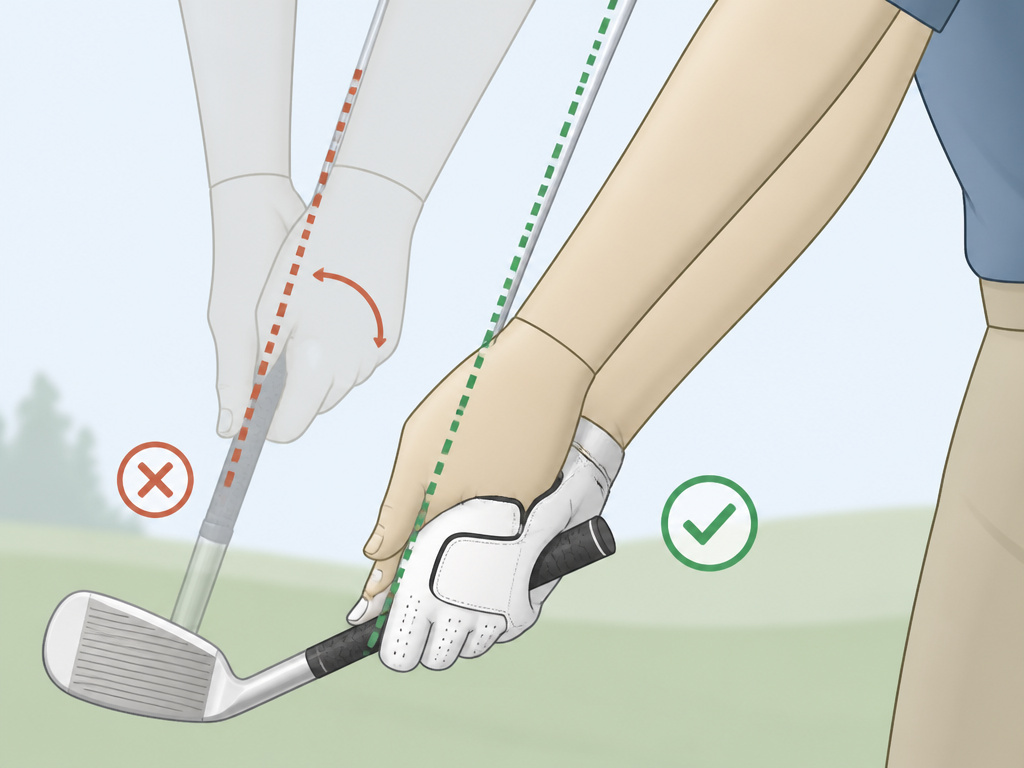
Thinking about your wrists during a full-speed swing is a guarantee of failure. These drills install the correct feel at a slow speed, so your subconscious can execute it under pressure.
1. The Faldo Drill
This isn’t just a warm-up. It’s a full motor pattern reset. 1. Take your normal stance with a 7-iron. 2. Set the club in the impact position: hands ahead, shaft leaning forward, lead wrist flat. 3. Without moving your lower body, swing back only with your arms until the shaft is parallel to the ground. 4. Swing through, returning to that exact impact position. 5. Repeat for ten slow swings, focusing on the sensation of the flat lead wrist.
Why it works: It completely bypasses the backswing, eliminating any chance you’ll get into a cupped position at the top. It teaches your body the singular feel of arriving at impact correctly.
2. The Flexion Freeze
Use this to kill the scoop. 1. At the range, hit half-wedge shots at 50% speed. 2. Your only goal: freeze your follow-through when your hands are belt-high. 3. In this frozen position, look at your lead wrist. Is it bowed (flexed) or cupped (extended)? 4. If it’s cupped, start over. Focus on feeling the back of your lead hand press down toward the ground through impact.
The consequence of getting it wrong is immediate, a weak, high shot that falls out of the sky. The feedback is brutal and perfect.
3. The P6 Face-Down Check
P6 is the moment the clubshaft is parallel to the ground on the downswing. It’s the last checkpoint before impact. 1. Record your swing face-on. 2. Pause the video at P6. 3. Look at the clubface. Is it looking down at the ground (toe-down), or is it looking skyward (toe-up)? 4. Toe-down indicates a flexed lead wrist and a square face. You’re on track. 5. Toe-up indicates an extended lead wrist and an open face. A flip is now mandatory.
This drill provides objective proof. You can’t argue with a screenshot. It directly connects your wrist condition to the clubface, showing how your swing plane and wrist action are intertwined.
Shaft Lean With Driver vs. Irons: The Critical Difference
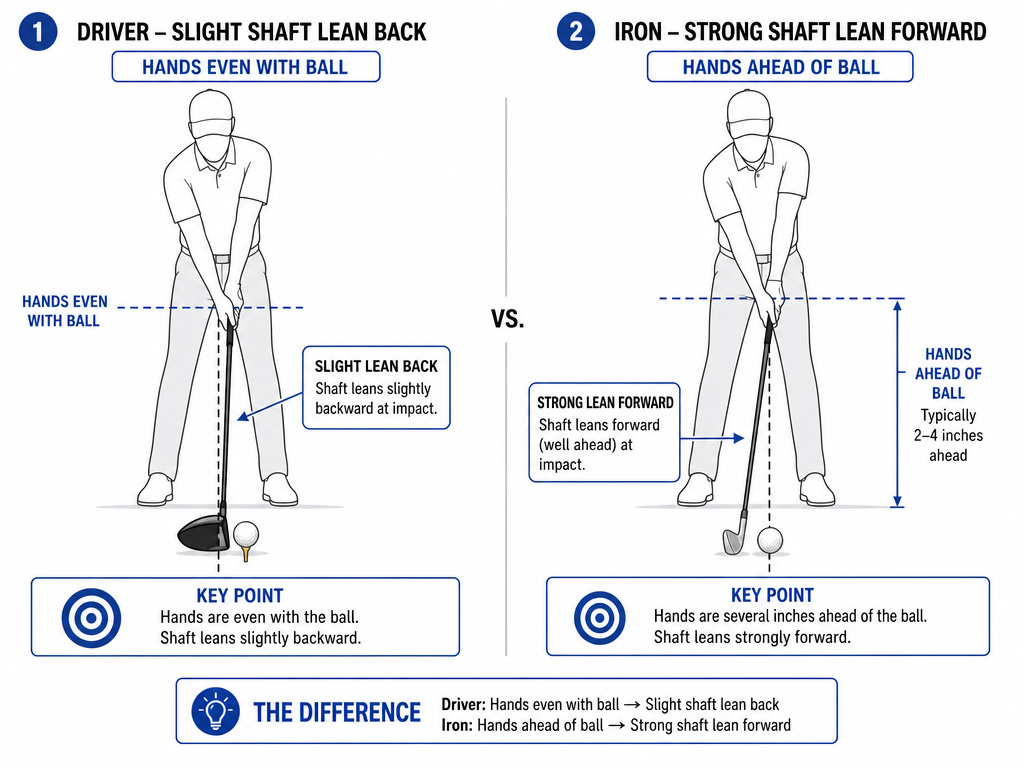
This is where golfers who learn about shaft lean often self-destruct. The physics of the driver are inverted.
| Club Type | Goal at Impact | Optimal Shaft Lean | Why |
|---|---|---|---|
| Irons (4-9, Wedges) | Downward strike, ball then turf | Handle 3-4 inches ahead of ball | Compresses ball, reduces dynamic loft, creates penetrating flight. |
| Driver | Upward strike, catching ball on the rise | Handle even with or slightly behind ball | Promotes positive angle of attack, reduces spin, maximizes carry distance. |
Applying iron swing mechanics to the driver is a category error. With the driver, you want to hit up on the ball. If your hands are ahead of the ball at impact with a driver, you are by definition hitting down. This increases backspin, launches the ball too low, and robs you of 20-30 yards.
For the driver, focus on a wide rotational swing and a level or slightly extended lead wrist through impact. Let the clubhead pass the hands. This is the opposite of the iron feel, which is why so many players struggle with one club when they get good with the other.
How Your Body Rotation Enables (Or Blocks) Wrist Action
Your wrists are not independent actors. They are passengers in a car driven by your torso rotation. If the body stops rotating, the wrists have to flip the club to catch up. This is the classic “over the top, cast, and scoop” sequence.
The proper downswing sequence starts with a lateral shift and rotation of the lower body. This pulls the torso, which pulls the arms, which pulls the handle of the club. When this sequence is correct, the lead wrist naturally moves into flexion as a reaction to the pulling force, you don’t have to “do” it.
If you initiate the downswing with your arms or shoulders, the body stops. The arms outrace the pivot, and the only way to deliver the clubhead is for the wrists to throw it. This throwing motion is always an extension move.
Easy to miss: The feeling of pulling the butt of the club with your left hip (for a right-handed golfer). When you feel that, the wrist flexion happens automatically. When you feel like you’re throwing the clubhead with your hands, you’ve already lost.
The Mechanical Truth: Why Tiny Errors Have Big Consequences
The precision required for consistent shaft lean isn’t unique to golf. In heavy machinery, a misalignment of a few millimeters or a single degree can cause destructive vibrations and total system failure.
The ABS propulsion shafting alignment guide details how raising an intermediate bearing by just 1 mm can unload one engine bearing by 254 kN and overload another by 188.6 kN. The system is that sensitive.
Similarly, an NHTSA driveline angle technical bulletin notes that moving a truck’s driveline carrier bearing by 5 mm can cause the entire driveline to fail its design requirements. Component manufacturers will deny warranty claims over this tiny error.
Your golf swing is the same. A 5-degree change in lead wrist extension at the top of your swing isn’t a minor flaw. It’s a system-killing misalignment that dictates a chain of compensations, resulting in a weak, offline shot. Understanding this should change your practice. You’re not looking for a “feel;” you’re engineering a reliable, repeatable mechanical condition.
Frequently Asked Questions
How much forward shaft lean should I have with a 7-iron?
Your hands should be about 3–4 inches ahead of the ball at impact. Visually, the handle should be over your lead thigh, not over your zipper. More than 4 inches starts to deloft the club excessively, leading to overly low shots that don’t hold greens.
Why do I keep scooping the ball instead of leaning the shaft?
You are almost certainly initiating your downswing with your upper body or arms, stopping your hip rotation. When your body stops, your arms keep going, forcing the wrists to throw the clubhead to reach the ball. This throw is a scoop. Focus on starting your downswing with your lower body and feeling like your hands are passive.
Should I have shaft lean with my wedges?
Yes, but less than with a mid-iron. For full-swing wedges, you still want a downward strike and compression. However, too much lean with a high-lofted wedge can drive the ball too low with too much spin. For finesse shots around the green, shaft lean is a primary tool for controlling trajectory and spin.
Does forward shaft lean increase distance?
Absolutely. It reduces the dynamic loft of the club at impact. A pitching wedge lofted at 46 degrees can be delivered at 42 degrees or less with effective shaft lean. This lower loft, combined with clean compression, creates a more penetrating ball flight that carries farther and rolls out more.
Can I check my shaft lean without a video camera?
Yes, use the divot test. After a solid iron shot, look at your divot. It should start just in front of where the ball was resting. If the divot starts behind the ball, you scooped. If it starts well ahead of the ball, you may have excessive lean or hit it thin. The divot pattern doesn’t lie.
Before You Go
Shaft lean isn’t a position you force. It’s an outcome of a correct sequence: a neutral setup, a connected backswing, a lower-body-led downswing, and a passive allowance of lead wrist flexion. Chasing the look of hands ahead of the ball is what causes the scoop. Chasing the feel of a flat left wrist through the ball is what delivers it.
Spend one range session doing nothing but the Faldo Drill with a 7-iron. Then hit ten balls at half speed, focusing only on the “frozen flexion” feel. The change in sound, from a clicky, thin tick to a deep, solid thump, will tell you more than any article ever could. That sound is the sound of compression, and it’s the direct result of getting your correct impact position finally, mechanically right.
