
Golf for Complete Beginners: The 7 Clubs You Actually Need
This post contains affiliate links. As an Amazon Associate, we earn from qualifying purchases.
This post contains affiliate links. As an Amazon Associate, we earn from qualifying purchases.
Golf for complete beginners starts with seven clubs: a mallet putter, a sand wedge, a pitching wedge, an 8-iron, a 6-iron, a hybrid, and a forgiving driver (10.5-12 degrees loft). You do not need 14 clubs, a $500 fitting, or a top-tier course. Your first investment should be in short-game practice and understanding basic rules, not in gear you will outgrow within a season.
That seven-club list is the whole equipment argument stripped back. The USGA allows 14 clubs in a bag, but that rule is a ceiling for tournament players, not a starting line for someone who hasn’t broken 100. Filling a bag with clubs you cannot hit is how frustration gets a permanent seat in your cart.
What follows is the map I wish I’d had: the specific clubs that work, the practice routine that builds confidence instead of confusion, and the honest timeline for when to spend real money. We will walk from the putting green to the first tee without wasting a dollar on the wrong gear.
Key Takeaways
- Start with seven clubs maximum: putter, sand wedge, pitching wedge, 8-iron, 6-iron, hybrid, driver. A 3-iron or lob wedge will ruin your early experience.
- Your first $200–$300 is best spent on a used, game-improvement iron set and a group lesson package, not a shiny new full set.
- Practice in reverse: spend 70% of your first month on the putting green and chipping area, not beating drivers on the range.
- A full club fitting only fits the swing you bring that day; if your swing changes in six months (and it will), the fitting is obsolete.
- Play a par-3 or executive course for your first five rounds. A full-length championship course will overwhelm you and make the game feel impossible.
The 7 Essential Clubs for Your First Round
Forget the 14-club limit. That is a tournament rule, not a beginner’s requirement. The goal is to cover all the shots on a course without holding a club that makes the game harder.
A forgiving driver has a large, 460cc clubhead and higher loft (10.5 to 12 degrees). The big head is more forgiving on off-center hits, and the extra loft helps get the ball airborne, fighting the typical beginner slice. You do not need a 9-degree tour model.
A 460cc driver head is the industry standard for maximum forgiveness. The larger size increases the moment of inertia (MOI), which reduces twisting on mishits and helps maintain ball speed and direction even when you don’t strike the center of the face.
The hybrid replaces long irons. A 4- or 5-hybrid is easier to hit than a 3- or 4-iron because its design glides through grass and its center of gravity is lower, launching the ball higher. This is your club for longer shots from the fairway or light rough.
Your iron selection is sparse on purpose. Start with a 6-iron and an 8-iron. The 6-iron gives you distance for longer approach shots, while the 8-iron is easier to control for shorter ones. The gap between them doesn’t matter when you’re learning to make solid contact. Add the 7-iron and 9-iron later.
The scoring clubs are essential. A pitching wedge (often included with iron sets) and a sand wedge are for shots within 100 yards. More than half your strokes happen here. The sand wedge’s wide sole is designed to splash out of bunkers and prevent digging in the grass around the green.
Finally, the putter. A mallet-style putter with clear alignment lines on the top is the default for beginners. It’s more stable and forgiving on off-center strikes than a blade putter. Feel is built from consistency, and a mallet delivers that.
| Club Type | Why It’s Essential | Beginner Spec to Look For |
|---|---|---|
| Driver | Longest club; used on most par-4 and par-5 holes. | 460cc head, 10.5°–12° loft, regular flex shaft. |
| Hybrid | Replaces hard-to-hit long irons; versatile from rough. | 19°–24° loft, game-improvement head design. |
| 6-Iron | Mid-length approach club; builds swing tempo. | Oversized head, wide sole, perimeter weighting. |
| 8-Iron | Shorter, more controllable iron for accuracy. | Same as 6-iron; part of a matched set. |
| Pitching Wedge | For shots from 50–100 yards; high, soft landing. | Typically 44°–48° loft, included with iron sets. |
| Sand Wedge | Escapes bunkers; performs high-loft chips around green. | 54°–56° loft, wide bounce sole (10°–14°). |
| Putter | Used on every hole; most strokes in a round. | Mallet style with alignment aids, face-balanced. |
Bottom line: You can play any public course with these seven clubs. The missing clubs are the hard ones. Leaving them out removes temptation.
Navigating Equipment Rules and Gear Myths
The rulebook exists to keep competition fair, not to intimidate you. Knowing a few key pieces protects you from buying nonsense.
The USGA and R&A jointly govern the golf equipment conformity standards. Their Equipment Rules cover everything from club length to spring-like effect. For a beginner, two rules matter: the 14-club limit (USGA Rule 4) and the condition of your clubs.
Common mistake: Thinking you need 14 clubs because it’s the limit. The limit is a maximum, not a minimum. Carrying fewer clubs is always legal and often smarter.
You are responsible for your clubs’ conformity. If you buy a major brand’s complete golf sets like the Callaway Strata or TaylorMade RBZ from a retailer like Golf Galaxy or PGA Tour Superstore, they conform. The danger zone is modifying clubs or buying obscure components online. If you alter a club’s playing characteristics during a round, like adjusting an adjustable hosel, you break the rules.
A conforming club that gets damaged during a round from normal play can still be used. But if you break a shaft in anger, that’s abuse, and the club is out of play. Normal wear, like face scratching from sand, does not make a club non-conforming.
The official club length rules state a club must be at least 18 inches and not longer than 48 inches (except putters). Almost every standard club falls within this. The myth is that you need custom length immediately. Unless you are exceptionally tall or short, standard length is fine for your first year.
Your First Practice Routine: Green to Tee
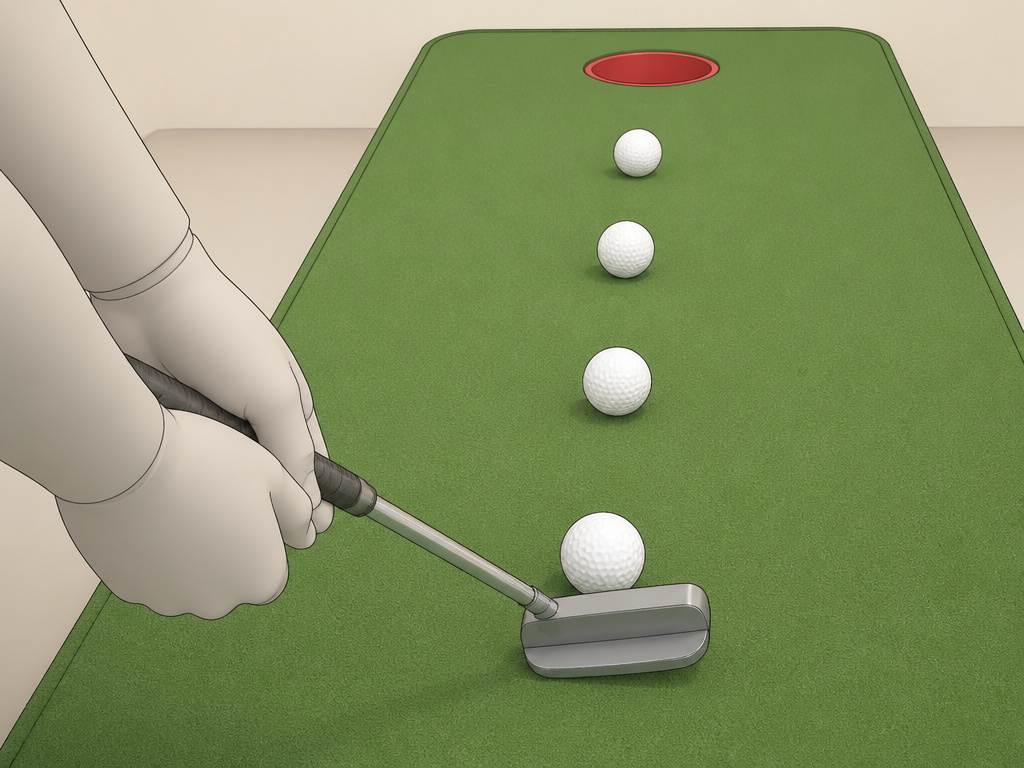 Most beginners go straight to the driving range and hit a bucket of drivers. That is the slowest, most frustrating path to improvement. Good golf is built from the hole backward.
Your first ten practice sessions should follow this ratio: 1. Putting (40%): Start from three feet. Make twenty in a row before moving back to six feet. Don’t worry about long putts yet. You’re building a repeatable stroke and learning how the ball rolls. 2. Chipping & Pitching (30%): Use your sand wedge and pitching wedge. Practice from just off the green. The goal is to land the ball on the green and let it roll to the hole. This is where you develop feel. 3. Full Swings (30%): Start with your 8-iron, not the driver. Focus on making solid contact and finishing in balance. Distance is irrelevant.
This practice routine for beginners prioritizes the shots you’ll use most. You might only hit one driver per hole, but you’ll use your putter at least twice.
A student with a terrible slice once asked me for help. We didn’t touch his swing path. For two weeks, we focused solely on his grip, where his hands sat on the club. On the third week, with that single change ingrained, he hit the straightest drive of his life. The sound was a clean snap, not the weak thwack he was used to. He was shocked. I wasn’t. He had fixed the engine before trying to steer the car.
Where this goes sideways: Practicing driver exclusively. You’ll develop a wild, armsy swing with no foundation. When you finally need to hit a delicate chip, you’ll have no feel, and your score will balloon.
Starter Sets vs. Building Your Own Bag
 You have two logical paths for your first set of clubs: buy a pre-packaged beginner set or assemble a used set piece by piece.
Pre-packaged sets like the Callaway Strata or Wilson Profile SGI offer undeniable convenience. They include a bag, headcovers, and a curated set of starter clubs designed for forgiveness. The trade-off is lifespan. A $250 set is built with lighter, less durable materials. The grips will wear smooth within a season, and the shafts may feel whippy as your swing speed increases. This is a fine choice if you’re unsure about your commitment.
Building a used set takes more legwork but builds a better foundation. Look for game-improvement iron sets from major brands that are 3–5 years old, models like TaylorMade M2 or Ping G400. Pair them with a recent driver for beginners and a mallet putter. You’ll spend a similar amount, but the quality and longevity will be higher. This is the “first $500” I recommend: $300 on used irons and a wedge, $100 on a driver, and $100 on a group lesson series.
| Option | Pros | Cons | Best For |
|---|---|---|---|
| Pre-Packaged Beginner Set (e.g., Callaway Strata) | Everything in one box; designed for forgiveness; includes bag. | Lower-quality materials; outgrown in 1–2 seasons; limited customization. | The absolute beginner testing the waters; gift for a new player. |
| Assembled Used Set | Higher-quality components; can select specific clubs; longer useful life. | Requires research and hunting; no matching bag; may need regripping. | The committed beginner who knows golf is a long-term hobby. |
| New, Individual Clubs | Latest technology; custom fitting options; long-term investment. | Very expensive; fitting is wasted if swing changes quickly. | Not recommended for complete beginners. |
The best entry-level golf clubs aren’t the newest. They’re the ones that let you make progress without fighting the equipment. Whether packaged or assembled, prioritize game-improvement design: oversized clubheads, perimeter weighting, and graphite shafts in longer clubs for easier swing speed.
The Club Fitting Debate for New Golfers
Walk into any major golf retailer, and they’ll offer you a fitting. For a complete beginner, this is often a waste of money. Here’s the truth nobody sells: a fitting only fits the swing you bring on that day.
If your swing is uncoordinated and inconsistent, which is normal and fine, the fitting will optimize for that flawed motion. Six months of lessons and practice will change your swing dramatically. The clubs that were “perfect” in month one will be wrong by month seven. You’ve spent $500–$1000 on a fitting and clubs that no longer suit you.
I won’t recommend a full dynamic fitting for a first-timer. The visual feedback is honest, but new players overcorrect on every data point and chase ghosts. I found that out training my first apprentice.
There is, however, a middle ground: a static fitting. This checks basic, static attributes that won’t change much: * Club Length: Based on your wrist-to-floor measurement. * Shaft Flex: Based on your estimated swing speed (regular flex is the default for most men, senior or ladies for slower swings). * Grip Size: Based on your hand measurements.
Most reputable complete guide to starting golf will point you to online charts for this. It’s good enough. Save the full fitting for when you can make consistent contact and have a repeatable swing, usually after you can regularly break 100.
Where to Play and How to Behave
Your first full round should not be on a championship course. The length, difficulty, and pace will overwhelm you. This is the single biggest mistake I see.
Start on a par-3 or executive course. These courses are shorter (all holes are par-3 or a mix of par-3 and par-4), faster to play, and less intimidating. You’ll use your essential clubs, putter, wedges, short irons, on every hole, which is exactly the practice you need. You can play 9 holes in under two hours.
On the course, etiquette is safety and pace. A few non-negotiable rules: 1. Safety: Never swing a club when someone is standing close to you. Always check that the group ahead is out of range before you hit. 2. Pace: Be ready to play when it’s your turn. Take no more than one practice swing. If you’re struggling on a hole, pick up your ball after a reasonable number of strokes (e.g., double par) and move on. 3. Care: Repair your ball marks on the green, rake bunkers after you play from them, and avoid driving carts on tee boxes or too close to greens.
Nobody expects a beginner to know every rule. But knowing these basics shows respect for the game and the other players, making everyone’s experience better. Our complete guide dives deeper into on-course protocol.
Frequently Asked Questions
What is the easiest golf club to hit for a beginner?
7-iron or 8-iron is the easiest club to hit. It’s a mid-length club with enough loft to get the ball airborne easily, and it’s designed for a balanced, rhythmic swing. This is why most lessons start with a 7-iron. Avoid long irons (3,4,5) and the driver at first.
How much does it cost to start playing golf?
The initial cost is lower than you think. A used set of starter golf clubs can be found for $200–$300. A bag is $50–$100. Public course fees for a par-3 course are often $15–$25 for 9 holes. Your first investment should be a group lesson series ($100–$200 for 4–6 sessions), not the most expensive equipment.
Can I wear tennis shoes to play golf?
You can, but you shouldn’t. Golf shoes have spiked or spikeless soles designed for traction during your swing, especially on wet grass. Tennis shoes will slip, causing you to lose balance and power. A pair of spikeless golf shoes with a waterproof warranty is a worthwhile first purchase, they look like trainers but perform on the course.
How many golf balls should a beginner carry?
Carry at least six to nine balls. Beginners lose balls, in water, thick rough, woods. It’s part of the learning process. Start with inexpensive, durable golf balls for beginners like the Callaway Warbird or Titleist TruFeel. Don’t use expensive tour-level balls; you’ll lose them just as quickly.
What is a good score for a complete beginner?
Good score for a first round is simply finishing. On a par-3 course, shooting 45–55 for 9 holes (par is usually 27) is excellent. On a full-length course, breaking 120 for 18 holes is a fantastic start. The number doesn’t matter. Focus on making solid contact, enjoying a few good shots, and learning the flow of the game.
Before You Go
Strip it back. Golf for complete beginners is not about a full bag, a perfect swing, or a low score. It’s about building a foundation with the right tools in the right order.
Start with seven clubs. Practice from the green back to the tee. Play a short course. Spend your first dollars on lessons, not the latest driver. This game gets complicated quickly enough on its own. Your job is to not help it.
One rule most guides skip: if you haven’t touched a club in two months, don’t go buy new gear to re-motivate yourself. Go to a par-3 course with a wedge and a putter. Rediscover the fun of a chip that lands close and a putt that drops. That feeling, not any piece of equipment, is what keeps you coming back. Everything above assumes you’re still having fun, if you’re not, the clubs won’t fix it.
