
Understanding the Handicap Stroke Index & USGA Allocation
This post contains affiliate links. As an Amazon Associate, we earn from qualifying purchases.
This post contains affiliate links. As an Amazon Associate, we earn from qualifying purchases.
A handicap stroke index is the number from 1 to 18 printed next to each hole on a scorecard, indicating the order in which handicap strokes are given or received. It is the official ranking of hole difficulty used to apply your strokes fairly across the course, turning your Course Handicap into a hole-by-hole playing advantage.
That definition is the rulebook answer. What it leaves out is the mechanical reason the system exists: a stroke on the hardest hole isn’t worth the same as a stroke on the easiest. The index spreads your allotted strokes across the 18 holes in a specific, debated order so that a match stays competitive all the way to the 18th green. Get the order wrong, and the higher-handicap player runs out of strokes before the match is decided.
What follows is the three-step method the USGA uses to set these numbers, why your club’s Handicap Committee might tweak them, and exactly how to read the index whether you’re playing a $5 Nassau or posting a score for your handicap.
Key Takeaways
- The stroke index is not just a difficulty ranking. It’s a competitive equalizer designed by the USGA to spread strokes evenly across both nines, preventing a player from receiving multiple strokes on consecutive holes early in the round.
- Your Playing Handicap determines which holes you get strokes on. If your Playing Handicap is 10, you receive one stroke on the holes indexed 1 through 10.
- Clubs use Course Rating data—not just member scores—to set the initial ranking. This objective method from the World Handicap System avoids bias and creates a consistent standard.
- For plus handicap players, the system reverses. You give strokes back to the course, starting on the hole with the highest stroke index.
- The official USGA Rules of Handicapping appendix splits each nine into three triads, placing the lowest numbers (1 and 2) in the middle of each nine whenever possible.
How Does the Stroke Index Work? (The Simple Answer)
You look at your scorecard. Next to the par for each hole is a number, 1 through 18. That’s the stroke index.
The stroke index allocates handicap strokes in ascending order. A player with a Playing Handicap of 14 receives one stroke on each hole ranked 1 through 14 on the card. A player with a Playing Handicap of 22 receives one stroke on every hole (1-18) plus a second stroke on holes ranked 1 through 4.
Your Course Handicap is the raw number of strokes you get on that course. Your Playing Handicap is that number adjusted by any competition allowance (often 85% or 95%). The Playing Handicap is the final count you use to look at the stroke index.
The hole with index 1 is where a stroke is most needed to halve the hole. The hole with index 18 is where it’s least needed. This is why the allocation matters. Giving the 1st and 2nd hardest holes back-to-back skews a match.
The USGA’s 3-Step Method for Setting the Index
Your club doesn’t just guess. The World Handicap System stroke index guide provides a standardized, three-step procedure that leans on hard data.
Step 1: Evaluate Course Rating Data. The club’s Handicap Committee contacts its local Allied Golf Association (AGA). The AGA uses the detailed “effective playing length” and “obstacle” data from the most recent Course Rating. This objective data is better than collecting member scorecards, which can be inconsistent and skewed by player ability.
Step 2: Rank Holes by Difficulty. The AGA uses that data to generate a raw ranking of each hole’s difficulty relative to par. This creates the foundation. Then, to spread strokes out, the front nine is initially assigned the odd-numbered stroke indexes (1, 3, 5, etc.) and the back nine gets the even numbers (2, 4, 6, etc.). This can be flipped if the back nine’s Course Rating is significantly higher.
Step 3: Apply the Triad Adjustments. This is where match-play equity is engineered. Each nine is split into three triads: holes 1-3, 4-6, 7-9 on the front; 10-12, 13-15, 16-18 on the back. The USGA’s rules in Appendix E then make specific placements.
| Triad (Front Nine) | Recommended Stroke Index Placement |
|---|---|
| Holes 1-3 | Avoid the lowest strokes (1-6). Place strokes 3 or 4 here. |
| Holes 4-6 (Middle) | Must contain the lowest stroke on the nine (1 or 2). |
| Holes 7-9 | Avoid the lowest strokes (1-6). Place strokes 3 or 4 here. |
The goal is to avoid low stroke indexes on consecutive holes and to keep the first and last holes of each nine from having a critical stroke. A player shouldn’t get a stroke on the 1st, 2nd, 17th, and 18th holes.
Stroke Index in Match Play vs. Stroke Play
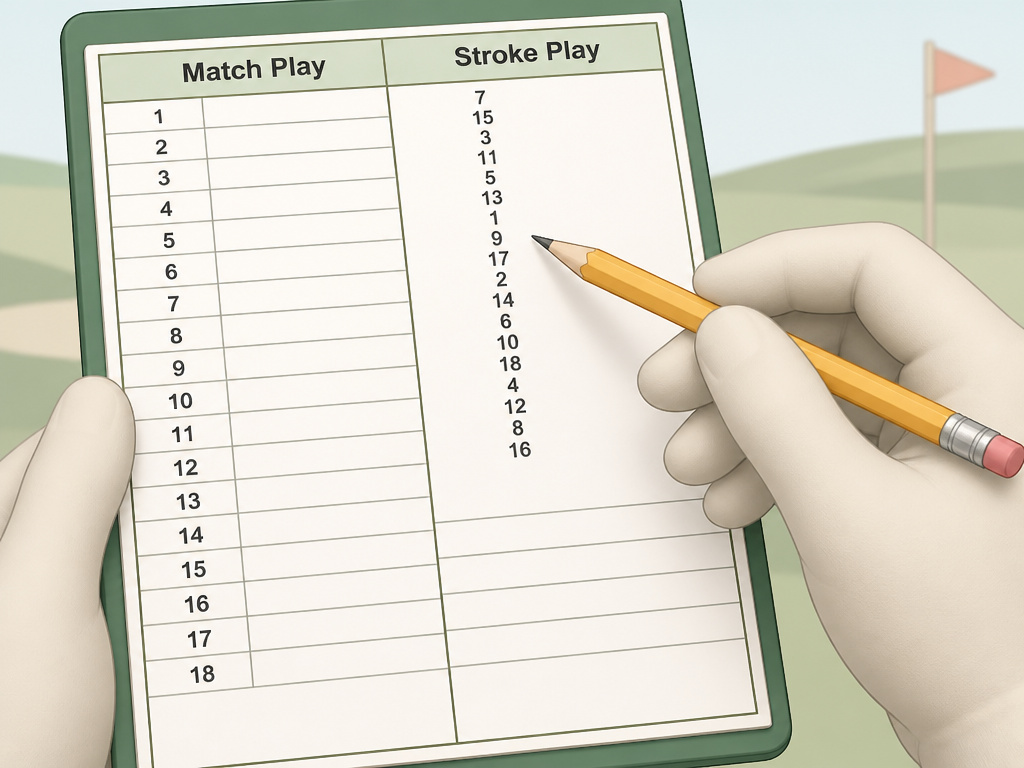
The stroke index serves two different masters, and some clubs maintain two different indexes because of it.
In match play, the even spread is everything. You’re competing hole-by-hole. The triad system exists to guarantee that a player receiving 10 strokes doesn’t get them on three holes in a row. The stroke is an equalizer meant to keep the match tight. The official handicap system states the stroke should be “available on a hole where it most likely will be needed by the higher-handicapped player to obtain a half.”
In stroke play formats like Stableford or Par/Bogey competitions, the even distribution is less critical. You’re tallying a total score, not winning individual holes. Here, many clubs simply assign index 1 to the most difficult hole and index 18 to the easiest. The Wikipedia entry on Stroke Index notes this is a common, simpler practice.
Where this goes sideways: Using a pure difficulty ranking (hardest=1) for a Saturday morning match play game. The player receiving strokes gets them clustered on the toughest stretch of the course, wins those holes easily, and the match is over by the turn.
How to Use It: A Player’s Guide
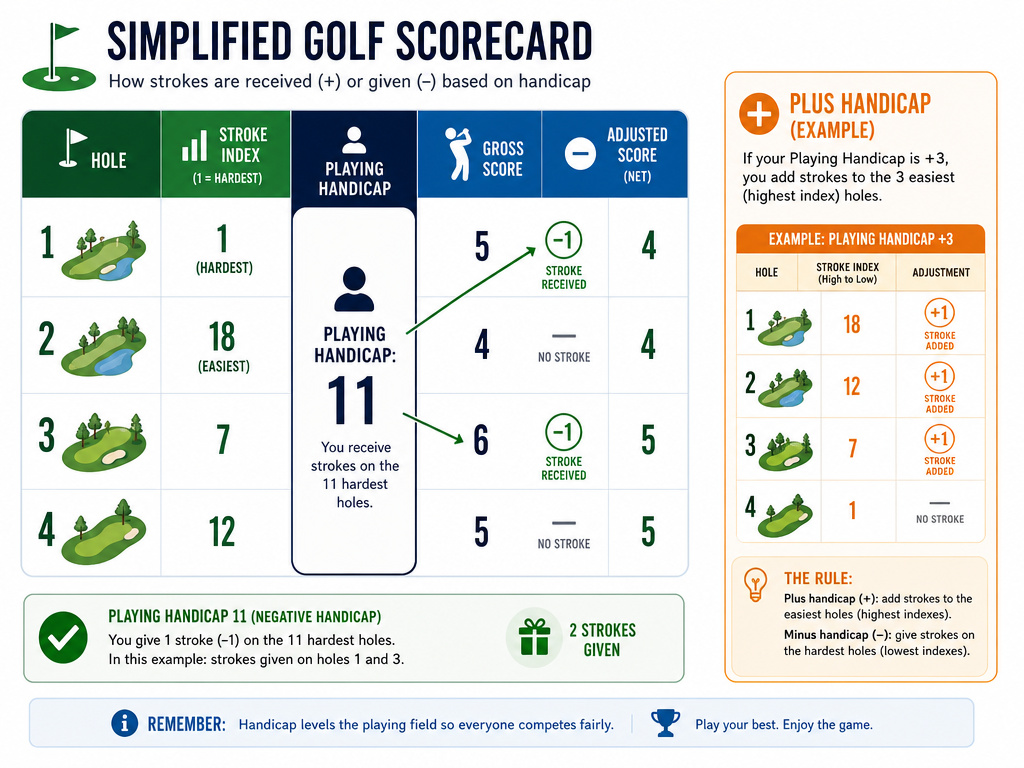
You’ve calculated your Course Handicap. Now you need to apply it.
- Determine Your Playing Handicap. Check the competition format. Is it 100% allowance (full Course Handicap), 95% for four-ball match play, or 85% for four-ball stroke play? Apply that percentage to your Course Handicap, rounding to the nearest whole number.
- Locate Your Strokes. Find your Playing Handicap number on the scorecard. You receive one stroke on every hole whose stroke index is less than or equal to that number. A Playing Handicap of 11 means strokes on holes indexed 1 through 11.
- Apply the Stroke. On those holes, you deduct one stroke from your gross score to get your net score for that hole. In match play, you simply win or halve the hole with the benefit of that extra stroke.
- For Plus Handicaps, Reverse It. If you have a plus Course Handicap (e.g., +3), you give strokes back. You add one stroke to your score on the holes with the highest stroke indexes, starting at 18 and moving down.
This process is also how the Net Double Bogey rule is applied for handicap posting. Your maximum score on a hole is net double bogey. If your Course Handicap is 14, you get a stroke on holes 1-14, so your max is triple bogey on those holes and double bogey on holes 15-18.
Common Questions About Stroke Index Allocation
Why Are the Lowest Numbers Not on the Hardest Holes?
They usually are, but not always. The USGA’s triad system prioritizes spread over pure difficulty ranking. The hardest hole might be the 1st or the 18th. Putting stroke index 1 there would waste the equalizing effect at the very start or end of a match. So, the hardest hole might get index 3 or 5 to keep it out of the first or last triad.
Can Men and Women Have Different Stroke Indexes?
Yes, and they often should. The USGA Handicap Manual states, “Stroke allocations for men and women will usually be different because the need to equalize holes may vary from hole to hole.” Different tee boxes change the effective difficulty and length of each hole, requiring a separate ranking for each set of tees.
What If the Back Nine Is Much Harder?
The initial rule is odd indexes on the front, even on the back. If the back nine’s Course Rating is significantly higher, the committee switches it: even indexes go on the front nine, odd indexes on the harder back nine. This ensures strokes are spread across the tougher nine.
Who Has the Final Say on the Numbers?
The club’s Handicap Committee. They receive the recommended allocation from the AGA based on Course Rating data. They can then make minor adjustments based on years of observing member play, but they must justify any change. The final index is printed on the scorecard and used in all competitions.
Frequently Asked Questions
Does stroke index affect my handicap calculation?
Indirectly, yes. When you post a score, you must record the stroke index for each hole because it determines where your Net Double Bogey limit applies. This ensures you post an accurate handicap-adjusted score.
What’s the difference between stroke index and hole handicap?
They are the same thing. “Stroke index” is the modern term used under the World Handicap System, while “hole handicap” is the older, more colloquial phrase. Both refer to the number 1-18 on the scorecard.
How does stroke index work in a scramble?
In a scramble, the stroke index determines the order in which the team’s combined handicap strokes are taken. Typically, a team will use their strokes on the lowest-indexed holes. Always check the local scramble rules, as formats vary widely.
Why does my stroke index change when I play a different course?
Because each course’s stroke index is set specifically for that layout’s unique sequence of holes. The handicap calculation gives you a portable Handicap Index, but you must convert it to a Course Handicap and then apply the local stroke index order.
Can I use the stroke index for gambling games?
Absolutely. Games like Nassau, Wolf, and Vegas use the stroke index to allocate strokes fairly. It’s the standard reference for any handicap-based wager, ensuring everyone knows exactly which holes are “stroke holes.”
The Bottom Line
The stroke index is the silent referee in every handicap match. It’s not a random ranking but a carefully engineered list built from Course Rating and Slope Rating data and designed to keep a match competitive. Understanding it lets you see why you get a stroke on the 7th hole but not the 8th, and it demystifies your scorecard. Before your next match, take ten seconds to find your Playing Handicap and circle your stroke holes. That’s the map to playing your handicap.
