
How to Hit From a Sidehill Lie Successfully | Golf Tips
This post contains affiliate links. As an Amazon Associate, we earn from qualifying purchases.
This post contains affiliate links. As an Amazon Associate, we earn from qualifying purchases.
To hit from a sidehill lie when the ball is below your feet, you must counter the slope’s three physical effects: a tendency to stand too upright, a swing path that gets too flat, and a clubface that points right. The fix is a three-part setup: flex your knees to lower your center of gravity, position the ball slightly forward to ensure clean contact, and aim left of your target to preempt the slice. Always take one more club.
The conflict in standard advice is real. One source says move the ball forward; another says use your normal position. One says weight on your heels; another says weight on your toes. The disagreement isn’t about fundamentals—it’s about which of the slope’s effects is dominating your specific lie. Your job is to diagnose which one.
What follows is a system, not just tips. We’ll break down the physics of the slope, show you how to read your lie, and give you the adjustments that actually work. You’ll learn the one setup mistake that guarantees a toe strike and the simple swing thought that keeps you from falling over.
Key Takeaways
- Flex your knees, don’t bend over. Lowering your center of gravity by sitting into your heels is the only way to maintain posture and reach the ball without topping it.
- Aim left, always. A ball-below-feet lie adds loft and opens the clubface, producing a predictable slice. Compensate by aligning your body and clubface 5-10 yards left of the target.
- Take more club. The slice spin and often-weak contact from the toe cost distance. Club up once, sometimes twice, to ensure you carry the hazard or reach the green.
- Match your swing plane to the hill. Your instinct will be to swing around your body. Fight it by swinging more vertically, like you’re chopping wood, to strike down on the ball.
- Ball position is negotiable, posture is not. Experts disagree on moving the ball forward. All agree that if you don’t flex your knees enough, no ball position will save the shot.
The Physics of a Sidehill Lie: Why It Fights You
A sidehill lie with the ball below your feet changes your relationship to the golf ball in three specific ways. You’re standing on the high side of the slope, looking down at the ball. This isn’t an optical illusion—it’s a geometry problem that rewrites your swing.
First, the slope wants to pull you upright. To avoid falling downhill, your body naturally leans back toward the high side. This raises your swing center and makes you more likely to hit the top half of the ball, or worse, completely whiff.
Second, it flattens your swing plane. When your feet are above the ball, the natural arc of your swing wants to follow the contour of the hill around your body, not down toward the ball. This flat, around-the-body swing path is the primary cause of a weak, glancing blow off the club’s toe.
Third, it opens the clubface. At address, the sole of your club is designed to sit flush on level ground. On this slope, the toe of the club dips down, lowering the heel. This effectively opens the face, pointing it right of your target before you even take the club back. That’s the source of the infamous slice.
A ball-below-feet lie adds effective loft, opens the clubface, and encourages a flat swing plane. The combined result is a high, weak shot that starts left of target and slices dramatically right, falling short.
Understanding these forces isn’t academic. It tells you exactly what to fix: posture counters the upright pull, swing plane correction counters the flat path, and aimed alignment counters the open face.
The Core Adjustment for a Ball-Below-Feet Lie
Your setup is everything. Rushing this step is how a manageable lie turns into a lost ball. You have three non-negotiable moves to make before you even think about your takeaway.
First, widen your stance and flex your knees. Don’t just bend from the hips. Push your rear end back and down, as if sitting into a chair positioned on the uphill side behind you. You should feel weight in your heels. This lowers your center of gravity and stabilizes you against the slope. If you only bend over, your spine angle becomes vertical too quickly in the downswing, guaranteeing a fat or thin strike.
Second, align everything left. Pick a target, then pick an intermediate target 5-10 yards left of it. Align your feet, hips, and shoulders parallel to that leftward line. Now, square your clubface to that same leftward line. This feels extreme, but it pre-sets the compensation for the slice. The ball will start on this line and curve back toward your actual target.
Third, take more club. The slice spin and frequent toe contact rob power. If you’d normally hit a 7-iron, take a 6-iron. The extra loft of the longer club helps get the ball airborne from the awkward lie, and the extra distance coverage is your safety net.
Ball Position and Weight: Cutting Through the Confusion
Here’s where the instruction manuals split. MyGolfSpy says move the ball slightly forward in your stance. Golf Digest advises using your normal position. Who’s right? They both are, depending on what you’re trying to fix.
The “move it forward” advice is for players who consistently hit behind the ball on this lie. A forward position encourages a steeper, more descending blow, ensuring ball-first contact. The “keep it normal” advice is for players who maintain their spine angle and knee flex. For them, moving it forward can lead to hitting it thin.
The same split happens with weight. Do you favor your heels or your toes?
Where this goes sideways: Putting all your weight on your toes. It pulls you forward, toward the ball, and makes you even more upright. You’ll hit a severe slice off the toe every time.
The safer, consensus move is to feel the weight in your heels at address, as you sit into the slope. During the swing, the key is to maintain that flex. Don’t let your legs straighten. If you must err, a little extra weight on the toes during the downswing can promote ball-first contact, but only if your knee flex is intact. For most, “weight in the heels at address, then swing” is the rule.
Swing Plane and Follow-Through: Staying on the Hill
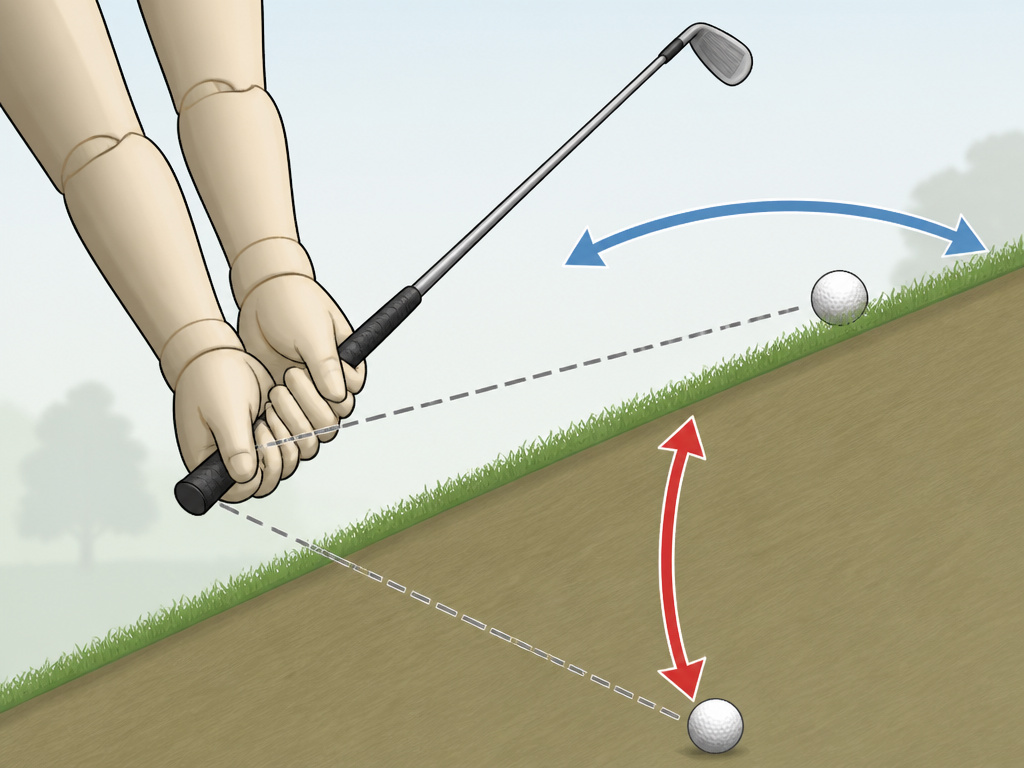
Your standard swing won’t work. The slope pulls your plane flat, so you must consciously swing more upright. Imagine the butt of the club pointing at the ball during your backswing, not behind it. Take a three-quarter backswing to maintain control.
The follow-through is your balance check. A full, complete finish means you managed your weight transfer. If you fall back or can’t hold your finish, you swung around your body, not down the slope.
| Lie Type | Primary Goal | Swing Feel | Common Miss |
|---|---|---|---|
| Ball Below Feet | Steep, descending strike | “Chop wood” or “swing the club straight up and down” | Weak slice off the toe |
| Ball Above Feet | Shallow, sweeping strike | “Swing around your body” or “flat baseball swing” | Low hook off the heel |
This table isn’t just a reminder—it’s a diagnostic. If your ball balloons right, your plane was too flat. If you top it, you didn’t stay in your posture.
How to Practice Sidehill Lies (When Your Range is Flat)
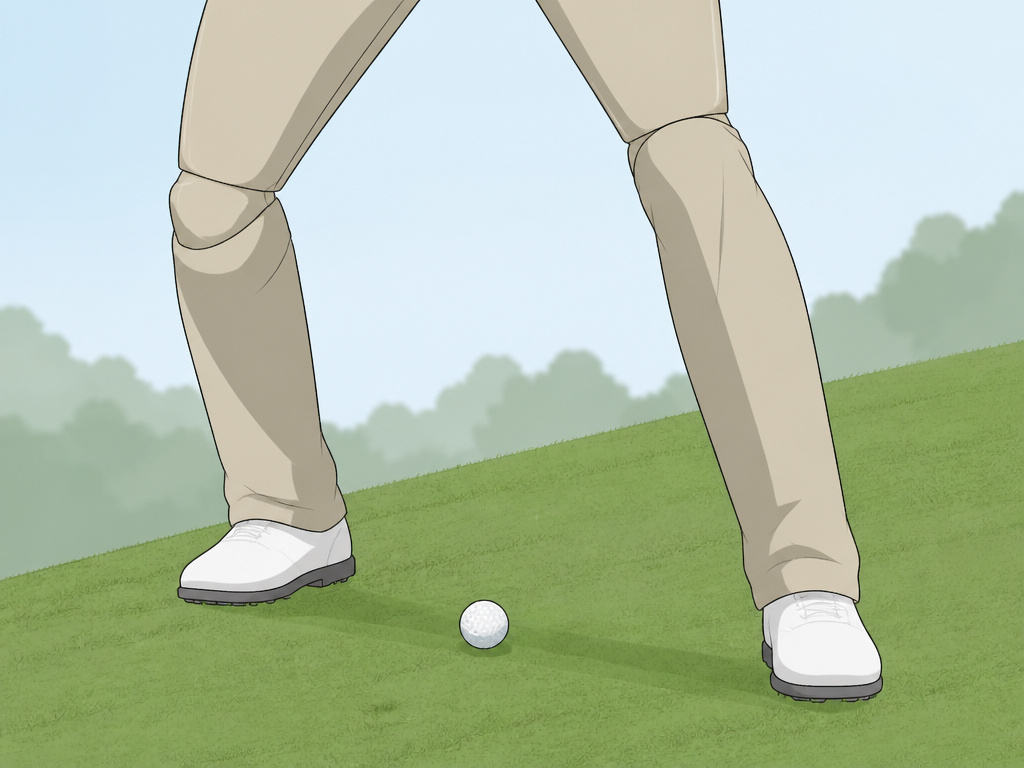
You can’t replicate this lie on a flat mat, but you can train the feelings. Find a gentle slope in the rough or near a bunker at your course during a quiet time. Hit ten balls focusing only on knee flex. Then hit ten focusing only on swinging upright.
No slope available? Practice hitting shots off your back foot. Place the ball an inch back in your stance and feel the steeper angle of attack. It’s not the same, but it trains the “ball-first” strike you need.
The best practice is mental. When you see this lie on the course, your routine is non-negotiable: 1) Widen stance and flex knees. 2) Align left. 3) Take more club. 4) Swing vertically. This consistent irons mindset turns a crisis shot into a calculated play.
Sidehill Lie vs. Other Uneven Lies
A sidehill lie is its own beast. Don’t confuse it with a straight downhill lie or uphill lie. On a downhill lie, you move the ball back and lean with the slope to avoid skying it. On an uphill lie, you move the ball forward and favor your front side to add loft.
The sidehill lie is unique because the slope works across you, not with or against you. It affects direction more than trajectory. That’s why the alignment adjustment is paramount, more so than with any other uneven lie. Understanding your club lie angle also helps here—a lie that’s too upright will exaggerate the toe-down, slice effect on this slope.
Frequently Asked Questions
What is the biggest mistake when hitting from a sidehill lie?
Standing up too tall. Players fear falling, so they subconsciously straighten their legs. This raises your entire swing arc, making clean contact nearly impossible. You’ll either top the ball or hit it fat. The fix is deliberate, exaggerated knee flex.
How much should I aim left?
For a moderate slope, aim your body and clubface at a target 5-10 yards left of your actual flag. The steeper the slope, the more you must compensate. On a severe slope, you might aim at the left edge of the green or even further left, trusting the slice to bring it back.
Can I ground my club in a sidehill lie?
Yes. The ball as it lies rule applies. You can sole your club behind the ball, even on a slope. However, if the ball moves after you’ve addressed it, it’s a one-stroke penalty. Be careful when placing your club down to avoid causing the ball to oscillate.
What if the lie is so bad I can’t swing?
You have options. If the slope is extreme or you’re near a tree, you can declare an unplayable lie. This costs one stroke, but allows you to drop within two club-lengths, go back on a line from the hole, or return to where you last played. Sometimes, taking a penalty is smarter than attempting a miracle shot.
Does this affect shot shape strategy?
Absolutely. A ball-below-feet lie naturally promotes a slice (a fade shot). Don’t fight it by trying to hit a draw. Instead, play for the fade and aim left. Conversely, a ball-above-feet lie promotes a draw. This is crucial for your shot shape strategy when planning your approach.
The Bottom Line
Hitting from a sidehill lie when the ball is below your feet is about managing geometry, not making a heroic swing. The formula is simple: flex your knees like you mean it, aim left without hesitation, and grab one more club. The slope will try to make you slice it. Your setup job is to let it slice right back to the target.
Stop overthinking ball position. Focus on posture and plane. A steep, controlled swing that finishes in balance will always beat a forced, off-balance lunge. Remember, the goal is to avoid big numbers. Getting the ball back in play, even if it’s short of the green, is a win. Master these adjustments, and you’ll turn one of golf’s most frustrating shots into a reliable part of your game.
