
How to Practice Golf Effectively With Proven, Science-Backed Methods
This post contains affiliate links. As an Amazon Associate, we earn from qualifying purchases.
This post contains affiliate links. As an Amazon Associate, we earn from qualifying purchases.
To practice golf effectively, you must move beyond simple repetition. The research is clear: effective practice is structured, varied, and focuses on the outcome, not your swing mechanics. Key methods include random practice (mixing clubs and shots), an external focus of attention (thinking about the ball’s flight), and distributed practice (shorter, more frequent sessions). A validated pre-shot routine like STOP S.L.O.W. GO locks in these gains under pressure.
Most advice tells you to “have a plan” or “work on your weaknesses.” That’s not wrong, but it’s not specific enough to change anything. The difference between a plateau and progress comes down to the type of practice you schedule and where you place your attention during each shot. This isn’t about grinding more hours; it’s about using the hours you have in a way that science says your brain and body actually learn.
What follows breaks down the six research-backed strategies that work, the one common mistake that ruins retention, and how to build a session that transfers skill from the range to the course.
Key Takeaways
- Mix your shots during practice. Hitting 10 drivers in a row (block practice) feels good but teaches you nothing about the on-course demand of switching clubs. Random practice builds lasting skill.
- Think about the target, not your elbows. An external focus of attention (“start the ball at the right edge of the bunker”) consistently outperforms an internal focus (“keep my lead elbow straight”).
- Shorter, more frequent practice beats a marathon session. Distributed practice, like four sessions of 60 putts over four days, leads to better retention than 240 putts in one day.
- Use the STOP S.L.O.W. GO pre-shot routine. This six-step model, validated by a Delphi study of college coaches, structures your decision-making and reduces anxiety.
- Limit your ball count. For mid-handicappers, research suggests hitting no more than 3 balls in a row before resetting. This prevents mindless repetition.
What Does the Research Say About Practice Methods?
A 2024 systematic review in Frontiers in Sports and Active Living analyzed 52 randomized controlled trials on golf motor learning. The goal was to cut through the noise and identify which methods actually improve performance in retention and transfer tests, the kind that matter on the course. The findings reframe common range habits.
The review grouped studies into strategies like practice scheduling, focus of attention, and implicit learning. Within each, specific methods proved superior. For practice scheduling, that meant random practice and distributed practice. For focus of attention, an external focus won every time. For learning new skills, errorless learning, starting easy and gradually increasing difficulty, outperformed learning from mistakes.
A 2024 systematic review of 52 randomized controlled trials on golf motor learning found superior methods included an external focus of attention, increasing contextual interference (random practice), and errorless learning. The biggest limitation noted was that most studies investigated simple putting tasks in novices only.
This last point is critical. Much of the gold-standard evidence comes from novice putting studies. The transfer to full-swing shots with a driver for a seasoned player isn’t guaranteed, but the principles are robust. They provide a framework you can test against your own game.
The Block Practice vs. Random Practice War
This is the most actionable finding from the research. Block practice is hitting the same shot with the same club repeatedly. It’s the default for most range sessions: a bucket of balls, a 7-iron, and swing thoughts. You often see rapid improvement during the session. This is “performance.” It feels great.
Random practice is mixing shots: driver, then 9-iron chip, then 6-iron, then a bunker shot. Performance during the session is usually worse. It’s frustrating. But this is “learning.” The cognitive effort of switching tasks encodes the skill more deeply.
The Frontiers systematic review on motor learning cites multiple studies where random practice groups performed worse during acquisition but significantly better in transfer tests. Your brain, forced to reload the motor program for each shot, builds a more adaptable and resilient skill. For a deeper dive on applying this, our guide on block practice and random practice in golf breaks down the how and why.
| Practice Type | What It Is | Feels Like | Long-Term Result |
|---|---|---|---|
| Block Practice | Hitting 50 7-irons in a row. | Smooth, confident, improving. | Poor skill retention. Fails under on-course pressure. |
| Random Practice | Hitting driver, wedge, 5-iron, putt in random order. | Frustrating, inconsistent. | Excellent skill retention. Transfers directly to the course. |
Where Should Your Focus Be?
Your focus of attention is a lever you control on every shot. An internal focus directs your attention to your body movements (“shift my weight,” “hinge my wrists”). An external focus directs attention to the effect of your movement on the club or ball (“sweep the grass toward the target,” “send the ball to the left edge of the green”).
The research is not subtle here. The systematic review and the older PMC golf performance improvement review both note that an external focus consistently leads to better accuracy, consistency, and learning. Internal focus creates “paralysis by analysis”, your conscious brain interferes with the automated motor pattern you’ve trained.
Common mistake: Focusing on a swing mechanic during the shot. By the time you’re over the ball, your focus must be external. Thinking about your backswing during your downswing guarantees a mishit.
This is why a good practice routine spends time on technique in slow motion or in front of a mirror (internal focus), but always transitions to external-focus drills before hitting full shots.
Building a Research-Backed Practice Session
Knowing the principles is one thing. Applying them to a 60-minute range session is another. This structure balances technical work, random practice, and pressure simulation.
1. Warm-Up With External Focus (10 minutes)
Don’t just stretch. Hit 15-20 very easy shots with a wedge. Your only thought: “make the ball land on that specific divot 30 yards away.” This sets an external focus tone for the session. Use alignment sticks to check setup, but put them away before you swing.
2. Technical Skill Work (15 minutes)
This is your block practice window. Pick one specific technical element. Work on it with slow-motion rehearsals, half-swings, or using training aids. Keep the focus internal here. The key is to stop before you get tired or sloppy. Hit no more than 10-15 full shots focused purely on this mechanic.
3. Random Practice & Skills Integration (25 minutes)
This is the core of the session. Play the course in your mind. * “Tee shot on hole 1”: Hit driver. * “Approach on hole 1”: Based on your driver result, hit the required iron (e.g., 8-iron from 150). * “Chip on hole 2”: Hit a 20-yard wedge shot. * “Par 3 over water”: Hit a 5-iron to a tight target. Change targets, clubs, and shot shapes every single ball. This is the contextual interference that builds real skill. For short game, incorporate chipping games that add consequence.
4. Pressure & Routine Practice (10 minutes)
End under simulated pressure. Use the STOP S.L.O.W. GO pre-shot routine for every shot. Set a goal: “I must hit 7 out of 10 shots to a defined target area.” This mimics the need for performance. As noted in the golf science journal practice optimization PDF, ensuring about a 70% success rate during challenge is optimal for learning.
The STOP S.L.O.W. GO Pre-Shot Routine
A pre-shot routine isn’t just superstition. It’s a cognitive script that manages anxiety, directs focus, and triggers automatic execution. The STOP S.L.O.W. GO model was developed and validated through a Delphi study with 36 NCAA Division I golf coaches. It provides a specific, research-backed structure.
- Stop: The mental trigger to end walking/talking and focus on the next shot.
- Strategy: Game planning. Decide the shot shape, club, and specific target.
- Look: Visualization. See the ball’s entire flight and roll in your mind.
- Outline: Motor programming. Rehearse the swing feel that will produce the visualized shot.
- Waggle: Approach the ball and achieve proper alignment. This is the physical setup.
- Go: Execute the swing you outlined without conscious thought.
The model achieved a 72.73% overall consensus among the expert coaches, with five of the six steps hitting 100% agreement on usefulness. This isn’t a theory; it’s a coach-approved protocol. Integrating this into your deliberate practice sessions makes your practice more transferable.
How to Practice Effectively at Home
You can’t hit full drivers in your living room. But you can practice the elements that research shows matter most: routine, focus, and motor programming. Home practice is for quality, not quantity.
Putting & Short Game: This is the easiest transfer. Use a putting mat to practice start line. For chipping, use practice balls into a practice net. The goal isn’t distance feedback; it’s strike quality and routine repetition. Go through your full STOP S.L.O.W. GO routine for every putt or chip.
Full Swing Mechanics (Without a Ball): This is mirror work and slow-motion rehearsal. Work on your backswing position, transition, or follow-through in super slow motion. The focus is internal here, pure technique. This is a form of errorless learning; you’re ingraining the correct movement without the ball’s distracting outcome.
Alignment and Setup: This is where home practice shines. Use alignment sticks daily to train your eyes to see proper alignment. Most amateurs have no idea where their feet, hips, and shoulders are actually aimed. Five minutes a day corrects this. For more structured ideas, see our article on ways to practice golf without a course.
Where this goes sideways: Trying to judge full-swing ball flight indoors. Without a launch monitor, you’re guessing. This ingrains compensations. Home practice is for process, not outcome.
Tracking Your Progress
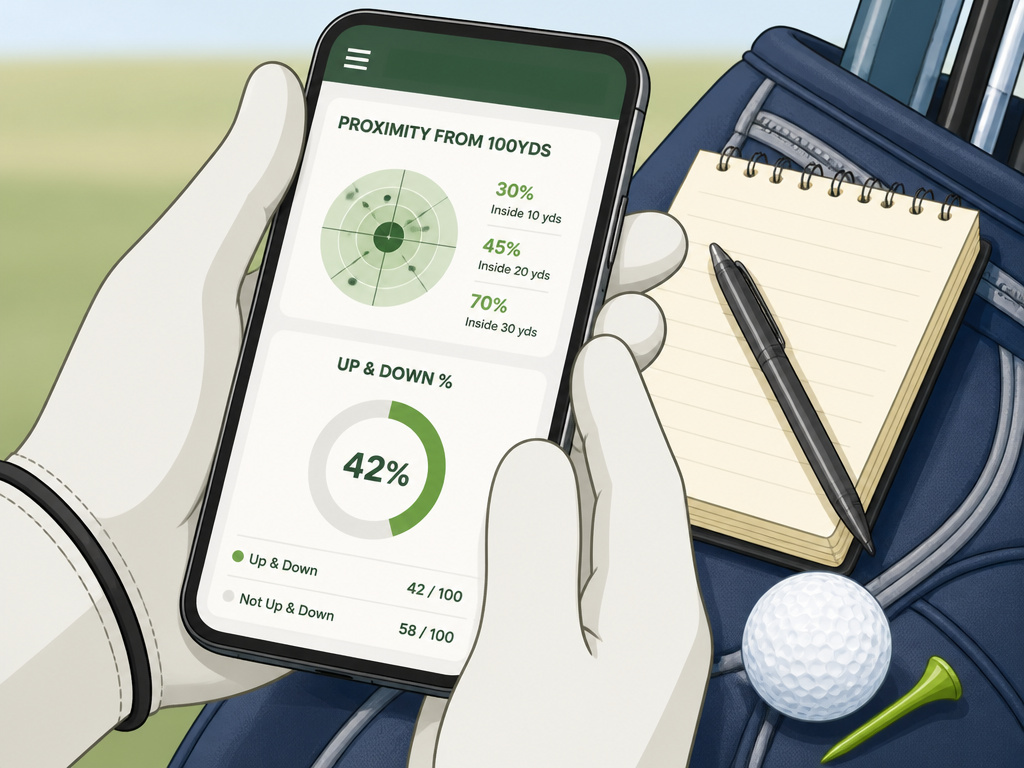
Effective practice requires feedback. If you don’t measure, you’re just exercising. Tracking stats tells you if your practice is working and what to work on next.
Don’t just track fairways and greens. Track quality. * Approaches: Proximity to the hole from 150 yards, 100 yards. * Short Game: Up-and-down percentage from inside 30 yards. * Putting: Three-putt avoidance, make percentage from 5 feet.
Use a notepad or a dedicated app. After each round, transfer these numbers. They will directly inform your next structured practice routine. If your proximity from 100 yards is 40 feet, your next session is 100-yard wedges with random targets. For a full system, learn how to track your golf stats effectively.
| Skill | Metric to Track | Practice Drill Link |
|---|---|---|
| Driving | Fairway % & Miss Direction (Left/Right) | Random Tee Shot Game |
| Approach | Average Proximity from 100-150yds | 9-Shot Drill (High/Low, Draw/Fade, Straight) |
| Chipping | % of chips inside 10 feet | Up & Down Circle Game |
| Putting | % made from 5 feet | 3-Foot Putting Ladder |
Frequently Asked Questions
How long should a golf practice session be?
Quality beats duration every time. A focused, 45-minute session using random practice and an external focus is far more valuable than two hours of mindless ball-beating. Research on distributed practice suggests that shorter, more frequent sessions (e.g., 45 minutes four times a week) lead to better long-term retention than one four-hour marathon.
What is the most important part of practice?
The transfer from range to course. Most players practice in conditions (perfect lie, same club, no consequence) that don’t exist on the course. The most important part is the last 20% of your session, where you simulate on-course conditions: changing clubs every shot, using your full pre-shot routine, and hitting to specific targets with a defined goal.
Can you practice too much?
Absolutely. Physical fatigue leads to poor mechanics, which you then ingrain. Mental fatigue leads to loss of focus, turning practice into repetition without learning. Professional volumes (2000+ shots a week) are unsustainable for amateurs and often lead to injury. The research-based limit for mid-handicappers is hitting no more than 3-5 balls in a row before taking a mental reset.
How do I make practice less boring?
Incorporate games and challenges. Boredom is a sign of ineffective, block practice. Use fun chipping games that force different shots and have scoring consequences. Create personal competitions on the range. When practice is a challenge, it engages your brain and stops being boring.
Is it better to practice one thing until it’s perfect or work on multiple things?
Work on multiple things within a structured plan. The “one thing” approach leads to block practice and neglects the integration of skills. Your weekly weekly practice plan should rotate through priorities (e.g., Monday: driving accuracy, Wednesday: wedge proximity, Friday: lag putting). This is distributed practice applied to your macro schedule.
The Bottom Line
Effective golf practice isn’t about effort. It’s about design. The research provides the blueprint: schedule your practice randomly, focus your attention externally, and distribute your time across days. Use the STOP S.L.O.W. GO routine to bridge the gap between the range and the first tee. Track your stats so you know what to practice next. Stop hitting ball after ball the same way. Start practicing with the methods that science says your brain will remember on Saturday morning when the match is on the line. That’s how you get better.
