
Net Double Bogey and Max Score Per Hole | The Rule Change
This post contains affiliate links. As an Amazon Associate, we earn from qualifying purchases.
This post contains affiliate links. As an Amazon Associate, we earn from qualifying purchases.
The maximum hole score you can post for your handicap is a net double bogey. This rule, part of the World Handicap System, limits your score on any hole to par + 2 + any handicap strokes you receive on that hole. For new players without an established Handicap Index, the limit is par + 5. The adjustment prevents one disastrous hole from skewing your handicap.
That calculation protects your scoring record from outliers. A single blow-up hole isn’t representative of your ability, and the system knows it. The rule gives you a clear ceiling for every hole based on your specific Course Handicap and the hole’s difficulty.
What follows: the exact math for net double bogey, the critical difference for new golfers, and the three edge cases that trip up even seasoned players. You’ll also see when you can legally pick up your ball and how apps like GHIN handle the adjustment automatically.
Key Takeaways
- Your maximum score on any hole is par + 2 + your handicap strokes on that hole. This is your net double bogey.
- Golfers establishing a Handicap Index for the first time use a simpler par + 5 maximum until they have 54 holes posted.
- When you post scores hole-by-hole in the GHIN app, the net double bogey adjustment happens automatically. You don’t need to do the math.
- If your Course Handicap is above 54 and you get 4+ strokes on a hole, your max falls back to par + 5.
- In a competition, always use your full, unrestricted Course Handicap for net double bogey, even if the event limits the strokes you can use.
What Net Double Bogey Replaced (And Why It Matters)
The net double bogey rule didn’t exist before 2020. It replaced the older Equitable Stroke Control (ESC) system when the World Handicap System went live on January 10th of that year. The change was more than a name swap.
ESC used a fixed table based on your Handicap Index. It was clunky. A 10-handicap had a maximum of 7 on any hole, regardless of whether it was the easiest or hardest hole on the course. Net double bogey is dynamic. It ties your personal limit directly to the strokes you receive on each specific hole, as shown on the Stroke Index of your scorecard.
The R&A Rules of Handicapping Rule 3 states the principle clearly: “A score for handicap purposes should not be overly influenced by one or two bad hole scores that are not reflective of a player’s demonstrated ability.”
This is the system acknowledging reality. Everyone has a meltdown hole. The rule ensures that one triple or quadruple bogey doesn’t tank your handicap for weeks. It’s designed for accuracy, not punishment.
How Net Double Bogey is Calculated: The Formula
The calculation is straightforward once you have your Course Handicap. You need two numbers: the par of the hole, and how many handicap strokes you get on that hole.
The formula is: Net Double Bogey = Par + 2 + (Handicap Strokes Received on the Hole).
Your Course Handicap tells you which holes you get strokes on. If you have a Course Handicap of 15, you receive one stroke on the 15 hardest holes (Stroke Index 1 through 15). You get zero strokes on the three easiest holes (Stroke Index 16-18).
Par of the hole + 2 strokes + Any handicap stroke(s) that the player receives on that hole. A net double bogey is equal to the lowest score on a hole for which the player would achieve zero Stableford points. – R&A Rules of Handicapping, Rule 3
Let’s walk through an example. A player with a Course Handicap of 15 is playing a par 4 with a Stroke Index of 10.
- Double Bogey: Par (4) + 2 = 6.
- Handicap Stroke: The player gets 1 stroke on this hole (Stroke Index 10 is within their 15 strokes).
- Net Double Bogey: 6 + 1 = 7.
Their maximum postable score for that hole is 7. If they card a 9, they must adjust it down to a 7 before posting their total. On a par 3 with a Stroke Index of 18 (where they get zero strokes), their max is simply par (3) + 2 = 5.
| Hole (Par / Stroke Index) | Course Handicap 15 Strokes Received? | Net Double Bogey Max | If You Card a 9… |
|---|---|---|---|
| Par 4 / SI 10 | Yes (1 stroke) | 4 + 2 + 1 = 7 | Post a 7 |
| Par 3 / SI 18 | No (0 strokes) | 3 + 2 + 0 = 5 | Post a 5 |
| Par 5 / SI 3 | Yes (1 stroke) | 5 + 2 + 1 = 8 | Post a 8 |
This personalized calculation is why net double bogey is fairer. It matches protection to the holes where you need it most.
The Par+5 Rule for New Golfers
There’s a crucial exception for golfers who don’t yet have a Handicap Index. You can’t calculate a net double bogey without a Course Handicap, and you can’t get a Course Handicap without an established index. The system solves this with a temporary, simpler rule.
For a player submitting their first scores to obtain an initial Handicap Index, the maximum score for each hole played is limited to par + 5 strokes. – R&A Rules of Handicapping, Rule 3.1a
This “par + 5” cap applies to your first 54 holes (three 18-hole rounds or equivalent) as you build your initial scoring record. It’s a blunt instrument, but it works. A 12 on a par 3 becomes an 8. A 10 on a par 4 becomes a 9. It prevents a true beginner’s blow-up holes from creating a wildly inaccurate first handicap.
Once you have an established index, you immediately switch to the net double bogey rule. The USGA’s FAQ on max score and the R&A’s handicap system Rule 3 are the governing documents for this transition.
When You Can (And Should) Pick Up Your Ball
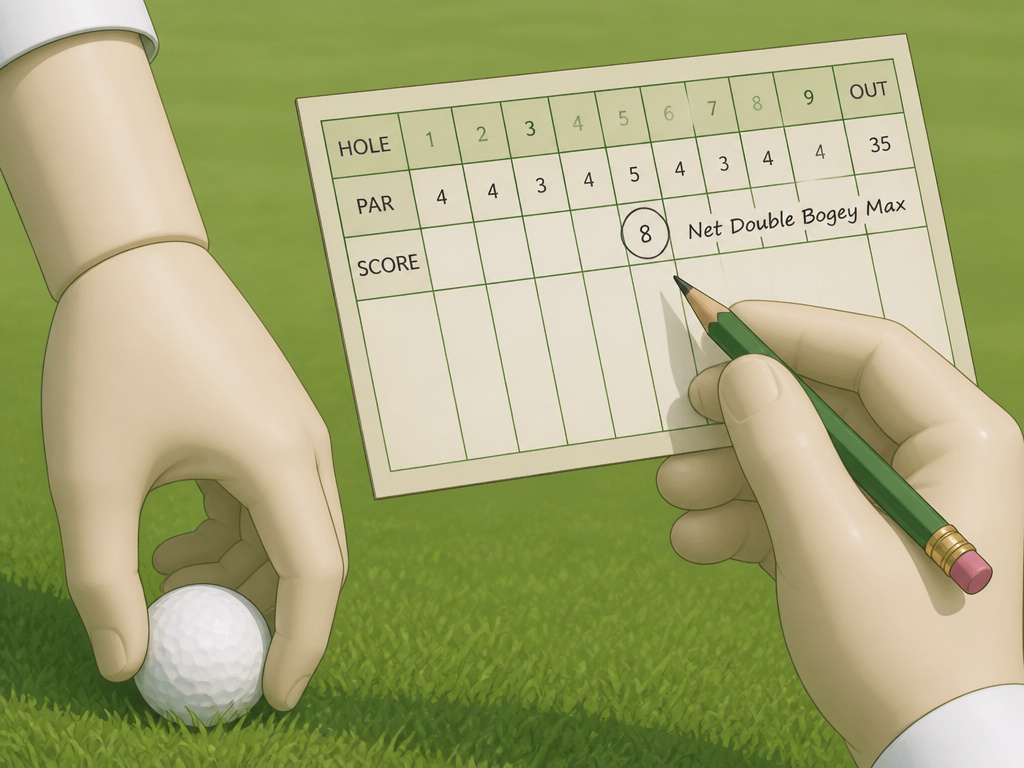
The net double bogey rule has a practical, pace-of-play benefit. In a casual round or a format that allows it, you can pick up once you’ve reached your net double bogey limit for the hole.
You’ve topped two shots into the water on a par 5, and you’re lying 7 in the fairway with a Course Handicap that gives you a stroke on this hole. Your net double bogey max is 8 (5 + 2 + 1). You can pick up. Write down your most likely score—what you honestly think you’d take to finish the hole—but it cannot exceed that 8. If your most likely score is a 9, you post an 8.
This is not allowed in every situation. The official handicap score adjustment rule is clear: if the format of play does not allow picking up (like an individual gross score competition), and you do not hole out, you are disqualified from that competition. But for handicap posting, your adjusted score still counts.
Where this goes sideways: Picking up on a hole you find difficult because you don’t want to post a high score. If a handicap committee determines you did this to manipulate your scoring record, they can reject the round or post a penalty score. The reason for not holing out must be valid—pace of play, format rules, or sheer frustration on a hole you’ve already maxed out.
The High-Handicap Edge Case and Competition Pitfalls
Two advanced scenarios confuse golfers who’ve just memorized the basic formula.
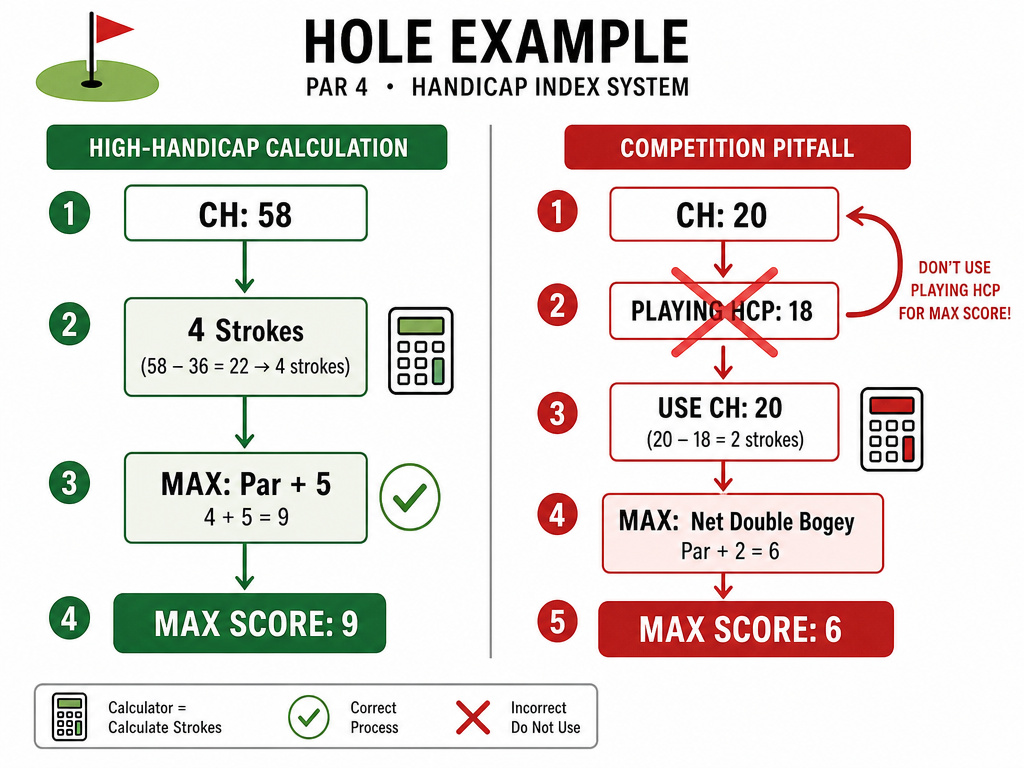
First, the very high-handicap edge case. The rules state that where a Course Handicap is calculated at more than 54 and a player receives 4 or more strokes on a hole, the maximum hole score is par + 5 for handicap purposes. This prevents a theoretical net nonuple bogey. If your Course Handicap is 58, you’d get 4 strokes on the hardest holes (58 – 54 = 4). On those specific holes, your max is par+5, not par+2+4.
Second, the competition pitfall. In a team event, the Terms of the Competition might restrict the number of strokes you can use. For example, your Course Handicap is 20, but the event uses 90% of handicaps, so your Playing Handicap is 18.
Common mistake: Using your restricted Playing Handicap (18) to calculate net double bogey for posting. Correct move: You must always use your full, unrestricted Course Handicap (20) for all net double bogey adjustments. The restricted handicap is only for determining competition results. Using the wrong number incorrectly lowers your maximum scores and artificially deflates your posted score differential.
This is a frequent audit flag for handicap committees. Always post with your real Course Handicap.
How GHIN and Score Posting Apps Handle It
You don’t need to be a math whiz. The technology does the work for you. When you post a score using the hole-by-hole entry option in the GHIN mobile app or on GHIN.com, the system applies the net double bogey adjustment automatically.
You enter your raw score for each hole—the 9s, the 10s, the occasional 12. The software knows your Handicap Index, calculates your Course Handicap for the tees you played, references the course’s Stroke Index, and instantly adjusts any hole exceeding your limit. Your final posted score is the adjusted gross score.
This automation is why understanding the rule is still critical. You need to verify the adjustment looks right. If you shot a 92 but the app posts an 89, check the hole-by-hole breakdown. It likely trimmed a few blow-up holes. Trust the system, but know what it’s doing. This automated tracking is a key part of tracking your golf statistics effectively.
Frequently Asked Questions
Does net double bogey affect my actual round score for a competition?
No. Your gross score for the competition is what you actually shot. The net double bogey adjustment is applied after the round, solely for the purpose of posting to your handicap record. You could win a net event with a gross 95 that gets adjusted to a 92 for posting.
What if I don’t finish a hole?
If you start a hole but don’t hole out for a valid reason (e.g., you’ve reached your net double bogey limit in a format that allows pick-up), you record your most likely score. That score cannot exceed your net double bogey maximum for that hole. Mark an “X” on your scorecard and note the adjusted score when posting.
How does this help me break 100?
The rule itself doesn’t lower your on-course score. But it does protect your handicap from inflation due to one or two nightmare holes. A more accurate handicap means you get the proper number of strokes in net events, making your strategies to break 100 more achievable. Mentally, knowing you have a “max” can also help with recovering after a bad hole—you can pick up, reset, and focus on the next tee shot.
I’m a “plus” handicap. How does net double bogey work for me?
The formula adjusts. For a plus handicap golfer (e.g., +3), you give back strokes. Your net double bogey is Par + 2 minus any handicap strokes you give on that hole. On a hole where you give one stroke, your max is par + 1. The system holds you to a higher standard.
Where can I read the official rule?
The World Handicap System net double bogey page from the USGA and Rule 3 of the R&A Rules of Handicapping are the primary sources. All golf associations base their guidance on these documents.
The Bottom Line
Net double bogey isn’t a cheat code. It’s a precision tool for fairness. It protects your handicap from outliers so it reflects your actual potential, not your occasional disaster. Remember the switch: par+5 for your first three rounds, then the personalized net double bogey limit for life.
Use the GHIN app’s hole-by-hole entry and let it do the math. Just know the two rules that matter most: always use your full Course Handicap for the adjustment, and understand that a high score on a single hole is now just a bad memory, not a handicap anchor.
