
Blade vs Mallet Putter Types Explained | The Changing Debate Data
This post contains affiliate links. As an Amazon Associate, we earn from qualifying purchases.
This post contains affiliate links. As an Amazon Associate, we earn from qualifying purchases.
The difference between a blade and mallet putter comes down to three measurable things: head shape, weight distribution, and moment of inertia (MOI). Blades are compact, heel-toe weighted designs (330-350g) with low MOI (3,000-5,000 g·cm²) suited for arcing strokes. Mallets are larger, perimeter-weighted heads with high MOI (often 8,000+) for stability, favoring straighter strokes. Modern testing of over 50,000 putts shows mallets offer better forgiveness and alignment, which is why over 75% of tour wins now come from mallets or zero-torque designs.
The head shape is just the wrapper. The real choice is between feedback and forgiveness, and the industry’s largest tests prove forgiveness now wins on both counts. A blade tells you exactly where you missed. A mallet makes the miss matter less.
What follows is a breakdown of the 2026 data, the tour’s irreversible shift, and a clear method to match a putter to your actual stroke, not the one you think you have.
Key Takeaways
- Modern mallet and zero-torque putters now score higher for feel and feedback in large-scale tests, debunking the blade’s last remaining trump card.
- For the average 15-handicap, a mallet means one more made putt inside six feet per round and fewer three-putts compared to a blade.
- The top five mallets leave shorter comeback putts than the top five blades at every distance, with the biggest gap (over two inches) on mid-range putts.
- On the PGA Tour, blade usage has collapsed from dominance to a niche choice, with only 3 of 24 Ryder Cup players using one in 2025.
- Your stroke’s natural arc dictates the needed putter balance (toe hang vs. Face-balanced), which is more critical than the head shape alone.
The Core Difference: Blade vs Mallet by the Numbers
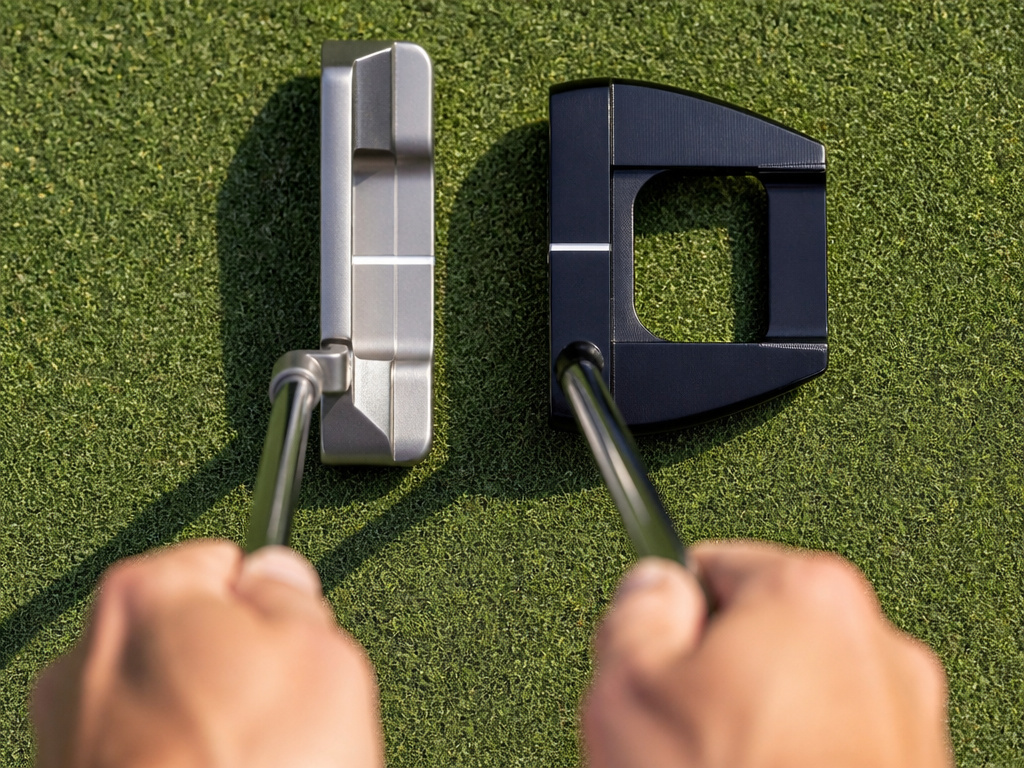
Forget aesthetics. The split is mechanical. A blade concentrates mass behind the face in a compact, usually metal, head. A mallet pushes weight to the perimeter and rear, often using different materials, to increase rotational stability.
Blade Putters: Head weight 330-350g. MOI 3,000-5,000 g·cm². Typically have moderate to significant toe hang (25-45°). Best for players with a pronounced arcing stroke. Mallet Putters: Head weight varies but is often heavier. MOI regularly exceeds 8,000 g·cm². Can be face-balanced or have toe hang. Built for stability on off-center strikes.
This table breaks down where each design directly impacts your game.
| Design Element | Blade Putter | Mallet Putter |
|---|---|---|
| Primary Goal | Pure feedback & player control | Forgiveness & consistent roll |
| Moment of Inertia (MOI) | Low (3k-5k g·cm²) | High (8k+ g·cm² common) |
| Best For Stroke Type | Strong arc | Straight-back, straight-through or slight arc |
| Alignment Aid | Minimal, clean topline | Often multiple lines, high-contrast designs |
| Common Feedback | “Crisp,” “firm,” “informative” | “Soft,” “stable,” “muted” |
The MOI number is the key. A putter with high MOI resists twisting on strikes away from the sweet spot. MyGolfSpy testing shows putters above 8,000 MOI retain over 90% of ball speed on mishits. Blades drop to 70-75%. That difference is a three-foot putt versus a four-foot comeback.
Where this goes sideways: Choosing a putter on looks alone. A beautiful blade in the hands of a player with a straight stroke fights physics every time. The head wants to open and close, but a straight stroke forces it square, leading to inconsistent face delivery. The result is a putt that starts offline even when it feels pure.
What the 50,000-Putt Data Says About Performance
The consensus for years was that blades felt better but mallets were more forgiving. The 2026 Most Wanted Putter test, which recorded over 50,000 putts across 79 models, turned that on its head.
The average PuttView handicap for all zero-torque putters was -6.29. Only one conventional putter in the entire test, the mallet Bettinardi BB 6.0 at -6.30, beat that average. Every single blade finished behind it. The best blade, the Mizuno M.Craft Osaka, posted a -5.5. That’s a significant performance gap at the professional level.
The data gets more revealing on comeback putts. Another test of 33,000 putts showed blades leave slightly shorter comebacks on average for short putts (16.1 inches vs. 16.5 for mallets). But when you compare only the top five performers in each category, the story flips.
The best five mallets leave shorter comebacks than the best five blades at every distance. The gap is most punishing on medium-length putts: over two inches separates them.
This means the very best mallets are objectively better at controlling distance. For the average golfer, the mallet advantage is even clearer. Shot Scope data from thousands of rounds shows a 15-handicap with a mallet makes 82% of putts inside six feet, compared to 75% with a blade. That’s one more made putt per round. They also three-putt less often (2.3 vs. 2.6 per round).
The Feel Factor: Is the Blade’s Last Advantage Gone?
Ask a blade loyalist why they won’t switch, and they’ll say “feel.” They believe the crisp, direct feedback of a compact metal head is irreplaceable. A 2026 test of 110 putters measured feedback scores, and the results were unambiguous.
Zero-torque putters scored highest (6.68 average). Mallets came next (6.50). Blades finished last (6.37). The top-rated putter for feel was the TaylorMade Spider Tour mallet. Only one blade, the Mizuno Osaka, cracked the top ten.
Why? Modern manufacturing. Companies now spend immense resources tuning sound and vibration in multi-material mallets. They don’t feel hollow or clicky anymore. The best ones feel solid, soft, and incredibly stable. At the same time, golfers have grown accustomed to larger heads. What felt strange a decade ago now feels normal.
Common mistake: Equating a harsh “click” with good feedback. A sharp, unpleasant sensation isn’t useful information, it’s just unpleasant. True feedback tells you where you struck the ball without punishing your hands.
This doesn’t mean blades feel bad. The Mizuno Osaka feels superb. It just means the mallet’s historic weakness has been engineered away. When you combine superior forgiveness with equal feel, the performance argument tilts heavily one way.
The Tour’s Unmistakable Shift Away From Blades
The professional tours are the ultimate proving ground. Players whose livelihoods depend on making putts will use whatever works best, sentiment be damned. The trend there is a tidal wave.
At the 2025 Ryder Cup, only 3 of the 24 competitors used a blade-style putter. Of the last 12 men’s majors, only two were won with a blade. The 2025 major season concluded without a single blade victory. Retail mirrors this: shop owners report selling one blade for every ten mallets.
The catalyst was data meeting high-profile success. Jason Day’s historic 2016 putting season with a TaylorMade Spider mallet broke the stigma. Rory McIlroy, Rickie Fowler, and Scottie Scheffler all switched from blades to mallets (or zero-torque designs like L.A.B. Golf) and saw their Strokes Gained: Putting rankings soar.
Scheffler’s case is the most telling. He won over $21 million in 2023 while being one of the tour’s worst putters statistically. After switching to a Spider mallet in 2024, he won the PGA Championship and The Open and climbed from 162nd to 21st in Strokes Gained: Putting.
“It’s almost like I need to practice with the blade at home, because you have to get your stroke spot-on to hit good putts with that style of putter. But then, when I come out here… The Spider felt so easy. Felt like I couldn’t not start it online.” – Rory McIlroy on his switch.
The message from the best in the world is clear. Forgiveness and technology trump tradition when every stroke counts. This shift is documented in detail in the Golfweek equipment analysis article on the decline of blade putters.
How to Choose: A Practical Fitting Guide
 You are not Scottie Scheffler. Your choice shouldn’t be based on tour trends alone, but on your stroke. The goal is to match the putter’s inherent balance to your natural path.
Step 1: Diagnose Your Stroke Arc.
Place two clubs or alignment sticks on the ground parallel to your target line. Make practice strokes. Does the putter head move straight back and straight through? That’s a straight stroke. Does it curve inside on the backstroke and back to square through impact? That’s an arc. Most golfers have some arc.
Step 2: Match Balance to Arc.
This is where putter toe hang is critical. Balance your current putter’s shaft on one finger. * If the toe points straight down (face-balanced), it’s for straight strokes. * If the toe points down at an angle (toe hang), it’s for arcing strokes. More arc needs more toe hang.
Step 3: Test with Purpose.
When you test putters, ignore the first five putts. You’ll adjust to anything. Hit twenty six-footers with a blade and a mallet that both match your balance. Track makes. The one that sinks more is objectively better for you. This is the single most effective putter fitting trick outside a lab.
Step 4: Check the Specs.
Once you find a shape you like, dial in the details. Ensure the putter loft and lie are correct for your setup (standard is about 3° loft and 70° lie). Consider if a heavier counterbalanced putter would help your tempo. Look at the putter alignment aids, do they help you aim, or are they distracting?
The short version: Find your arc, match the balance, then let performance decide the shape. A blade that matches your arc will beat a mallet that fights it, and vice-versa.
Blade vs Mallet: Direct Recommendations
 If you’ve read this far, you want a final answer. Here it is, based on the data and real-world results.
For most golfers, a mallet is the correct choice. The forgiveness on mishits, the easier alignment, and the modern feel profile lower scores. The Odyssey Ai-ONE #7 is a benchmark for a reason, its AI-designed face insert produces incredibly consistent speed. For a more compact mallet, the TaylorMade Spider Tour Series offers tour-proven stability.
If you have a pronounced, repeating arc and value traditional feedback, a modern blade can still excel. The Mizuno M.Craft Osaka is the current performance king, winning the 2026 blade test. The PING PLD Anser 2 remains the classic, refined to perfection.
Worth knowing before you start: Do not buy a blade because you think it will make you a better putter. It won’t. It will expose flaws. Buy a blade because your stroke is already consistent, and you want the feedback to keep it that way. Buy a mallet because you want help turning near-misses into makes.
Remember, this is one component in your full set. Understanding golf club types and how a putter fits within your golf club loft progression is part of building a cohesive bag, just as knowing the difference between blade irons and cavity backs is for your full swings.
Frequently Asked Questions
Do any tour pros still use blade putters?
Yes, but they are a shrinking minority. Players like Justin Thomas, Patrick Cantlay, and Will Zalatoris still game blades. However, the percentage of tour wins and top-ranked players using mallets or zero-torque designs has grown dramatically over the last decade, now representing over 75% of the field.
Can a high-handicap golfer use a blade putter effectively?
They can, but it’s an unnecessary challenge. A high-handicap typically has a less consistent stroke and strike pattern. A high-MOI mallet will help maintain ball speed and start line on mishits, directly reducing three-putts. The data shows higher handicaps make more short putts with mallets.
What is a “zero-torque” putter, and how is it different?
Zero-torque, or lie-angle-balanced, putters (like those from L.A.B. Golf) are a subset of mallets engineered to have zero twisting tendency during the stroke. They are designed to stay square to the arc path without any input from the golfer’s hands. In 2026 testing, the zero-torque category outperformed both mallets and blades on average.
Are mallet putters harder to control distance with?
This is a common myth. Modern mallet faces, especially with insert technology like Odyssey’s Ai-ONE or TaylorMade’s Pure Roll, are engineered for consistent speed across the face. The larger head and higher MOI actually promote more consistent energy transfer, leading to better distance control on off-center hits compared to blades.
How important is putter fitting compared to choosing the head shape?
It is more important. Getting the correct putter length, loft, lie, and grip size for your posture and stroke is foundational. A perfectly fitted blade will outperform a poorly fitted mallet. A fitting will also objectively show you whether a blade or mallet design produces tighter dispersion for your specific stroke.
Before You Go
The blade versus mallet debate is no longer about tradition versus technology. It’s about matching a tool to a task with clear evidence. Blades are precise instruments for repeatable arcing strokes. Mallets are stable platforms designed to mitigate error.
The numbers from the largest independent tests are conclusive: mallets and their zero-torque offspring offer more forgiveness, equal or better feel, and lead to more made putts for the average golfer. The tour has voted with its wallets and trophies.
Your move is simple. Diagnose your stroke’s natural shape. Test putters that match that balance. Let the make percentage from six feet be your guide. The right putter won’t just look good behind the ball, it will start more putts on line and leave you tap-ins instead of testers.
