
Good Swing Speed by Handicap: Realistic Data & Benchmarks
This post contains affiliate links. As an Amazon Associate, we earn from qualifying purchases.
This post contains affiliate links. As an Amazon Associate, we earn from qualifying purchases.
A swing speed of 95 to 105 miles per hour is typical for a 10 handicap. For male amateurs, the average is 93 mph. A scratch player averages 106 mph, a 10-handicap around 97 mph, and a 20-handicap about 91 mph. Speed matters, but efficiency matters more, a 95 mph swing with solid contact outdrives a 100 mph swing that’s off-center.**
These numbers come from aggregated launch monitor data, not guesswork. They give you a realistic baseline. Your goal is to understand where you are, then decide if your path to lower scores runs through more speed, better contact, or smarter equipment, rather than to match the PGA Tour’s 115 mph average overnight.
What follows breaks down the real benchmarks by handicap and age, explains the one efficiency metric that trumps raw speed, and shows how to use your numbers to make practical decisions, whether that’s a fitting, a speed training protocol, or accepting that your current speed is fine.
Key Takeaways
- The average male amateur driver swing speed is 93 mph. Scratch golfers average 106 mph, and PGA Tour pros average over 115 mph.
- Each 1 mph increase in swing speed adds about 2.5 to 3 yards of potential driver distance, but only with centered contact.
- Your smash factor (ball speed ÷ swing speed) is more important than raw speed. A value below 1.45 means you’re leaving yards on the table, regardless of your swing speed.
- Speed naturally declines with age, roughly 1-1.5 mph per decade after 30, but maintaining flexibility can slow this drop significantly.
- For most mid-handicappers, improving strike quality and launch conditions will gain more yards than a grueling quest for an extra 5 mph.
The Handicap-to-Speed Reality
Forget the range talk. Good swing speed is a band that correlates tightly with your ability to score, not a single number.
Trackman data gathered from thousands of golfers shows a clear pattern. Lower handicaps swing faster. It’s that simple, and the numbers are specific. A scratch golfer or better averages about 106 mph. A player with a handicap between 5 and 10 sits around 100 mph. The average male amateur, handicap around 14, swings at 93.4 mph. Once you get to a 20-handicap, the average dips to about 91 mph.
The data shows a clear pattern – lower handicapped players consistently produce higher driver swing speeds on average. This isn’t opinion; it’s the result of measuring millions of shots.
Why the link? Distance is a scoring advantage. A longer drive means a shorter club into the green, which statistically leads to more greens in regulation and lower scores. But this isn’t a license for every 15-handicap to obsess over reaching 110 mph. The connection exists because better players typically have more efficient, athletic motions that naturally produce speed. They aren’t just trying harder.
| Handicap Range | Average Driver Swing Speed | Typical Driver Carry |
|---|---|---|
| Scratch or Better | 105 – 110 mph | 250 – 265 yards |
| 5 – 10 | 97 – 103 mph | 230 – 245 yards |
| 11 – 15 | 93 – 96 mph | 215 – 230 yards |
| 16 – 20 | 89 – 92 mph | 205 – 220 yards |
| 20+ | 85 – 90 mph | 195 – 210 yards |
These are realistic launch monitor benchmarks. If your speed is at the top of your handicap band but your scores aren’t dropping, the problem is usually strike quality, almost never a lack of speed. A flaw in your swing path or angle of attack is costing you efficiency, which brings us to the real secret.
The Efficiency Metric That Beats Raw Speed
Swing speed is the engine, but smash factor is the transmission. It’s the measurement of energy transfer from club to ball, calculated by dividing ball speed by swing speed.
A perfect, centered strike with a driver produces a smash factor near 1.50. For amateurs, anything at or above 1.45 is excellent. The average male amateur, however, often operates around 1.42 or lower. This gap is where distance evaporates.
Here’s the math that changes how you see speed. A 95 mph swing with a 1.46 smash factor creates a ball speed of about 139 mph. A 100 mph swing with a poor 1.40 smash factor yields a ball speed of only 140 mph. You gained one mile per hour of ball speed after adding five miles per hour of swing speed. The first golfer likely out-drives the second, with less effort.
Common mistake: Chasing swing speed while ignoring strike quality. You’ll hear the clubhead whir faster, but the ball won’t go much farther, and your dispersion will widen.
This is why LPGA Tour players, who average about 94 mph of swing speed, carry the ball 250-265 yards, a distance many 95 mph male amateurs can’t touch. Their smash factors are consistently above 1.46, and their launch conditions are optimized. They prove that speed without efficiency is wasted. Before you invest in a SuperSpeed training program, spend a session with a launch monitor checking your smash factor. If it’s below 1.43, your quickest distance gains live in improving your strike, not your gym routine.
Where Your Speed Actually Comes From (And Where It Goes)
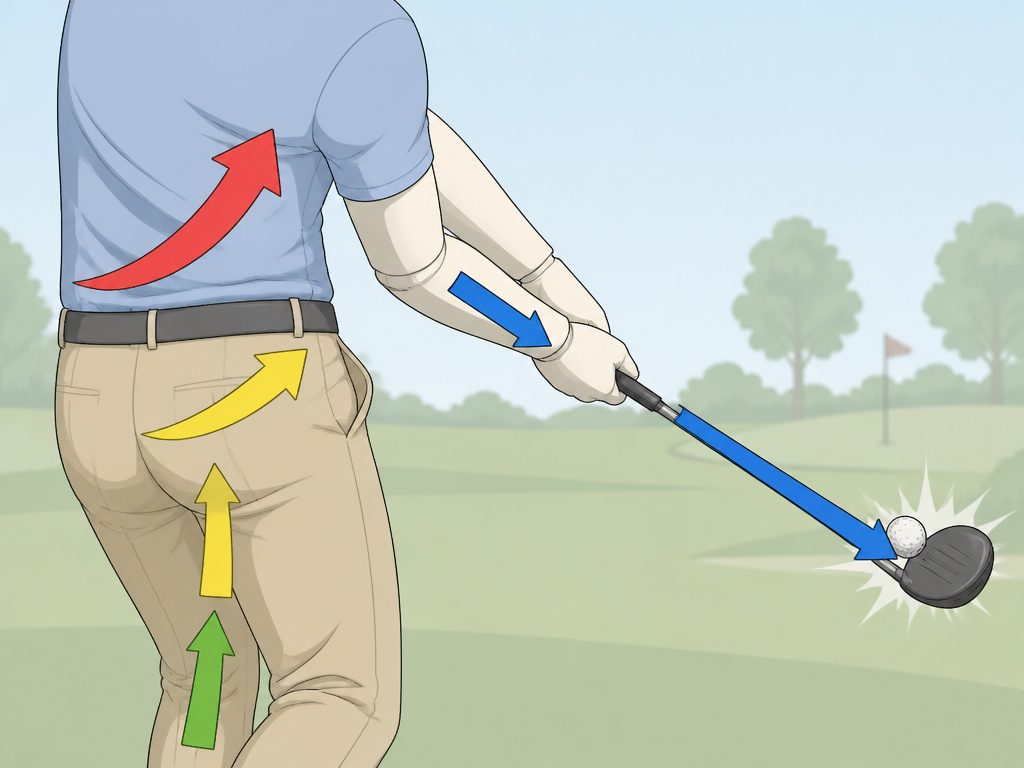
Swing speed is a product of mechanics, sequencing, and flexibility, not just about strength. The fastest part of your swing should be the clubhead just before impact, not your arms halfway back.
Good sequencing creates a whip-like effect. It starts from the ground up: feet, knees, hips, torso, shoulders, arms, hands, then finally the club. When this chain fires in order, speed is a byproduct. When it’s out of sync, like starting the downswing with your arms, you leak power and rely on muscle. That feels fast to you, but the radar tells a different story.
Age affects this chain. Flexibility and rotational range of motion tend to decrease over time. Data shows swing speed peaks in the late 20s and declines by roughly 1 to 1.5 mph per decade after age 30. The drop becomes more pronounced after 60.
| Age Range | Estimated Median Driver Swing Speed (Male) |
|---|---|
| 17 – 29 | 105 – 110 mph |
| 30 – 49 | 95 – 102 mph |
| 50 – 59 | 90 – 96 mph |
| 60+ | 85 – 92 mph |
The encouraging news is that this decline is mostly about rotation, not raw strength. Golfers who actively work on maintaining hip and shoulder mobility often hold 90% of their peak speed into their 60s. The feel is a full, connected turn away from the ball and a clear unwinding through it. If your backswing feels short or restricted, you’ve found your speed leak.
I learned this working with players of vastly different heights and builds. A tall, lanky junior with a huge turn could generate 105 mph with what looked like minimal effort. A strong but stiff middle-aged player, grinding with all his might, would struggle to break 95 mph. The difference wasn’t strength. It was the ability to create and store rotational energy. That’s a fixable problem, often with a few simple mobility drills, not a weightlifting mandate.
Matching Your Speed to Your Equipment

Your equipment should match your speed, not your ego. Using a shaft that’s too stiff or a driver head with too little loft is a guaranteed way to kill distance and accuracy.
General fitting guidelines exist for a reason. For male amateurs swinging under 85 mph, a higher-lofted driver (10.5 to 12 degrees) and a lighter, more flexible shaft help get the ball airborne with optimal spin. In the 95-105 mph range, the focus shifts to fine-tuning launch and spin with shaft weight and head design. For speeds over 110 mph, lower-spin heads and stiffer shafts become necessary to control the ball.
The same logic applies to your golf ball. Higher swing speeds (105+) can compress high-performance, multi-layer tour balls to get their spin and control benefits. For most amateurs in the 85-100 mph range, a low-compression ball designed for moderate swing speeds will often produce more carry and a softer feel. You can spend hours on a swing speed monitor dialing in your numbers, but if you’re playing a ball meant for a tour pro, you’re fighting your own gear. The right shaft weight for your tempo can make a slow swing efficient and a fast swing controllable.
Where this goes sideways: Buying a driver because a pro uses it. Their 9-degree head and extra-stiff shaft are calibrated for 120 mph of speed and a positive angle of attack. Your 95 mph swing with a neutral attack needs a different setup entirely.
A basic fitting is the fastest way to make sure the speed you have is being fully used, not a luxury. It also tells you if you should be working on techniques for more speed or if your current speed, with better equipment, is already enough.
How to Measure and Improve Your Swing Speed
You need a number. Guessing based on driving distance is wildly inaccurate because of the smash factor variable.
The most accessible tool is a personal launch monitor. Devices like the Garmin R10 use radar to give you direct clubhead speed, ball speed, and smash factor readings. They provide the objective data you need to track progress. Without it, you’re adjusting your swing in the dark.
Once you have your baseline, you can build a plan. 1. If your smash factor is low (<1.43): Focus on strike quality. Use foot spray on your clubface to see where you’re hitting it. This is a contact issue, not a speed issue. Better contact alone can add 15 yards. 2. If your smash factor is good (1.45+): Then consider speed training. Overspeed training with lightweight clubs or systems like The Stack is the proven method. The protocol, swinging a lighter tool, then a heavier one, then your gamer, recalibrates your nervous system to move faster. 3. Regardless of speed: Improve your mobility. A larger, smoother turn creates more potential energy. Simple rotational stretches and exercises that target your core and hips pay direct dividends in mph.
Improvement is a cycle: measure, train, and measure again. Don’t just swing harder and hope. Use a swing speed radar to get your starting point, incorporate golf fitness work, and retest every few weeks. Small, consistent gains of 1-2 mph per month are sustainable. Trying to add 10 mph in a week is a recipe for injury and a wrecked swing.
Frequently Asked Questions
A swing speed of 95 to 105 miles per hour is typical for a 10 handicap. Good driver swing speed for a 10-handicap male golfer is between 97 and 103 mph. This places you solidly above the average amateur and indicates you have the power to score, provided your strike consistency and short game are up to par. If you’re at the top of this range but not breaking 80, look at your approach shots and putting.
How does swing speed change with age?
Swing speed typically peaks in your late 20s. After age 30, it declines by about 1 to 1.5 mph per decade due to decreased flexibility and rotational range of motion. The drop becomes more significant after 60. However, golfers who maintain flexibility through targeted exercise can outperform these averages by a wide margin.
Is 95 mph swing speed good?
Yes, 95 mph is a good swing speed. It’s above the average male amateur (93 mph) and, with a solid smash factor of 1.45 or better, can produce a reliable 230+ yards of carry. This is enough speed to play any golf course effectively. The focus from here should be on optimizing your launch conditions and ensuring your equipment matches your speed.
What swing speed do you need to hit 250 yards?
To carry the ball 250 yards, you generally need a minimum ball speed of about 150 mph. With an efficient smash factor of 1.45, that requires a swing speed of approximately 103 mph. With a more common amateur smash factor of 1.42, you’d need closer to 106 mph of swing speed. It highlights why efficiency is just as critical as raw power.
Can I increase my swing speed without losing accuracy?
Yes, but the method matters. Increasing speed through better sequencing and mobility often improves accuracy because you’re creating power more efficiently, not more violently. However, blindly swinging harder with poor mechanics will wreck your accuracy. Use speed training aids with a focus on maintaining your strike pattern. Improving your swing tempo is often the first step to adding speed cleanly.
Before You Go
One rule most guides skip: if you’re a 15-handicap swinging at 93 mph, your speed is not your problem. The fastest path to lower scores is more centered contact, a smarter strategy, and a better short game, not another 5 mph.
Chasing speed has a time and a place. If you’re already efficient and your handicap is single digits, then overspeed training and a precise fitting are your logical next steps. But for the large majority of golfers, the pursuit of a “good” swing speed ends the moment you achieve a repeatable, efficient motion that matches your current athleticism. Measure your numbers, understand your efficiency gap, and then decide whether to build more engine or just tune the one you have.
