
What Is Greens in Regulation | The Stat That Drops Scores
This post contains affiliate links. As an Amazon Associate, we earn from qualifying purchases.
This post contains affiliate links. As an Amazon Associate, we earn from qualifying purchases.
Greens in regulation (GIR) is achieved when any part of your ball is on the putting surface in two strokes fewer than par. For a par 4, that means your second shot lands on the green; for a par 5, your third shot. It’s the single most predictive stat for scoring, turning three-putt bogeys into two-putt pars.
That definition is clean, but it hides the real work. Hitting the green isn’t the goal. Hitting it from a position that gives you a putt is. Your tee shot sets the table. Your approach shot either cashes in or leaves you scrambling. Most amateurs aim at the pin. That’s the mistake. The center of the green is almost always the smarter target.
What follows is a breakdown of why GIR matters more than you think, how to track it honestly, and where it fits alongside modern stats like Strokes Gained. You’ll also see the official rules that define the putting green itself, because knowing where you can mark your ball changes how you play the shot before it.
Key Takeaways
- GIR is a condition, not a quality metric. A ball six inches on the fringe doesn’t count, even if it’s closer than a ball sixty feet away on the green. The official rules draw a hard line.
- Improving GIR is about strategy first, swing second. Aiming at the center of every green, regardless of pin position, will boost your percentage faster than any swing tweak.
- The stat directly predicts your score. PGA Tour data shows a near-linear relationship: higher GIR percentage means lower average score, with scrambling ability being a secondary factor.
- Modern analytics haven’t replaced it; they’ve contextualized it. Strokes Gained: Approach tells you how well you hit your irons, but GIR tells you how often you give yourself a putt. You need both.
- New rules limit how you can study the green. Since 2023, approved yardage books must fit specific size and scale limits, changing how pros and serious amateurs prepare.
The Official Definition: When Is a Ball “On the Green”?
The USGA and R&A are specific. A ball is on the putting green when any part of it touches the prepared surface. It can also be considered on the green if it lies on or in something like a loose impediment that is inside the green’s edge.
This matters for relief. If your ball is on a wrong green, like the one for a different hole, you must take free relief. No shot from a putting surface that isn’t yours.
A ball is on the putting green when any part of it touches the putting surface. This definition governs free relief, marking, and cleaning. The player may also repair damage on the green and remove sand or loose soil without penalty.
The rules grant special privileges on the green. You can mark, lift, and clean your ball. You can repair ball marks and old hole plugs. There’s no penalty if you accidentally cause your ball or ball-marker to move. But you cannot deliberately test the surface by rubbing it or rolling a ball before your putt.
Knowing these USGA putting green rules turns a legal technicality into a tactical advantage. You can clear away a speck of mud that might deflect your putt. You can fix a ball mark on your line. That’s part of the game.
How Is Greens in Regulation Calculated?
The math is simple. Count how many holes you hit in regulation, then divide by the number of holes played.
On a par 72 course, if you hit 9 greens, your GIR percentage is 50% (9/18). The hard part is recording it honestly during the round.
Don’t trust memory. Use a notes app or the old-school method: circle the hole number on your scorecard for every GIR. An ‘X’ over the hole number means you missed the green because of a penalty or a disastrous tee shot. That distinction is crucial for later analysis.
| Par | Strokes for GIR | Example Scenario |
|---|---|---|
| 3 | 1 | Tee shot lands on green. |
| 4 | 2 | Approach shot (2nd) lands on green. |
| 5 | 3 | Third shot (after two layups) lands on green. |
The table shows the requirement, but the edge case is the par 5. If you go for it in two and your ball is just over the green, that doesn’t count. You were on the green in regulation, but the ball is off the green, which is a brutal distinction. That’s why your tracking stats need to separate “good misses” from bad ones.
Why Greens in Regulation is Your North Star
Forget driving distance for a minute. The fastest route to lower scores is hitting more greens. The correlation isn’t subtle.
From the fringe, even the best players are scrambling. From the green, they’re putting. The difference in expected score is massive. A 15-handicap player might three-putt from sixty feet, but they’ll almost always two-putt. That’s a guaranteed par on a GIR hole, versus a likely bogey or worse from off the green.
This is where traditional golf stats like fairways hit and putts per round can mislead. You can hit every fairway but miss every green with poor irons. You can have few putts because your chipping is stellar, masking terrible approach play. GIR cuts through the noise. It asks one question: did you give yourself a putt for birdie or par?
The data doesn’t lie. Amateurs who boost their GIR from 30% to 40% often drop 5-7 strokes off their handicap within a season. It forces better course management and sharper iron play.
The GIR vs. Proximity Debate
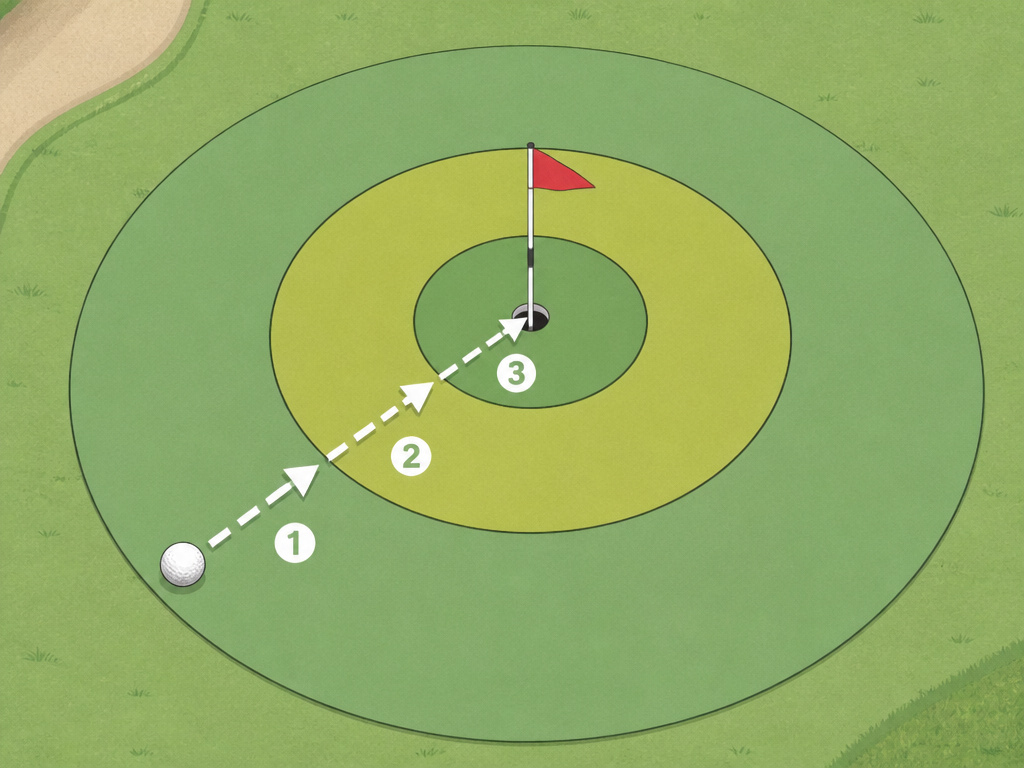 Some instructors argue proximity to the hole matters more than simply being on the green. They have a point. A ball six feet from the pin but just off the fringe is arguably a better result than a ball on the green but sixty feet away.
But that argument misses the forest for a single tree.
Common mistake: Chasing pin positions to improve proximity. The increased risk of missing the green entirely wipes out any benefit from being slightly closer when you do hit.
Proximity is a quality metric. GIR is a frequency metric. You need to be on the green first before worrying about how close. For amateurs, the priority list is clear: 1. Get the ball on the putting surface (GIR). 2. Get it on the correct tier or section of the green. 3. Get it close to the hole.
Trying to start with step three is how you post big numbers. This is the core of modern Strokes Gained analysis. Strokes Gained: Approach measures the quality of each shot against a benchmark. A shot to sixty feet on the green might still lose strokes to the field if the average proximity is twenty feet. But it loses far fewer strokes than a shot that misses the green.
How to Actually Hit More Greens
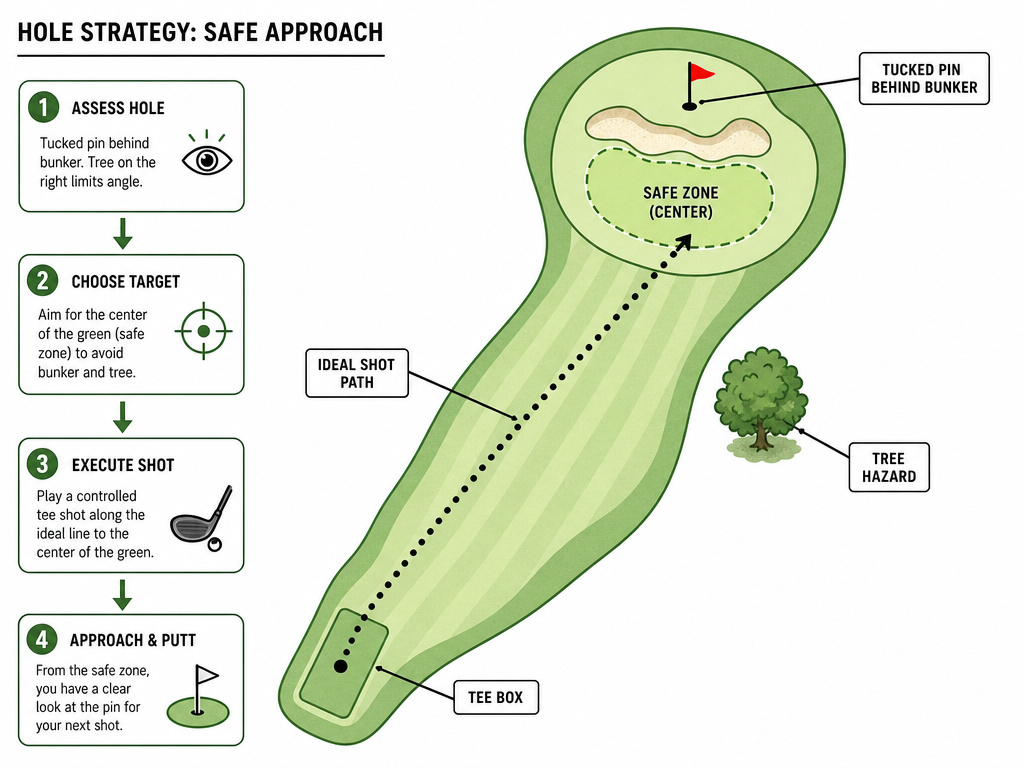 Improving your GIR percentage is a three-part project: strategy, tee shots, and approach play.
Strategy is everything. Before every approach shot, ask: “Where is the safest part of this green?” It’s almost never next to the pin tucked behind a bunker. It’s the center, or the fat side away from trouble. Aim there. Every time. Your goal is the putting surface, not the flag.
Tee shots set the angle. You’re not just trying to hit the fairway. You’re trying to hit the side of the fairway that gives you an open look at that safe target on the green. This is where course management software or a good yardage book pays off. Blocked by a tree? That’s a tee shot problem, not an iron problem.
Approach play requires honesty. Most amateurs mis-club. They take the club that will reach the pin on a perfect strike. You should take the club that will reach the back of the green with your average strike. Playing for the back yardage accounts for slight mis-hits and leaves you in the middle. It’s boring. It works.
A solid green reading routine also helps once you’re on the surface, turning those thirty-footers into two-putts instead of three-putts.
Greens in Regulation and Modern Golf Analytics
GIR remains a foundational statistic. Advanced metrics like Strokes Gained build on it.
Think of GIR as the “what” – did you hit the green? Strokes Gained: Approach is the “how well” – compared to other players, how good was that shot? A high GIR with poor Strokes Gained means you’re hitting greens, but from poor positions or with longer clubs than the average player. You need both numbers to diagnose your game.
The Strokes Gained calculation is complex, but its relationship to GIR is straightforward. Every shot that hits the green gains strokes relative to one that misses. The closer it is, the more strokes it gains. So while chasing GIR, you’re inherently improving your Strokes Gained: Approach.
This is especially true for Strokes Gained Putting. You can’t gain strokes putting if you’re not on the green. A great putting day often follows a high GIR day, because you have more opportunities.
Rules, Technology, and the Modern Green
The tools you can use to read greens have changed. In 2023, the USGA and R&A implemented Clarification 4.3a/1, which limits green-reading materials.
Approved yardage books must now be no larger than 4.25 x 7 inches. The scale of the green diagrams cannot exceed 3/8 of an inch for every 5 yards. Hand-drawn notes are allowed, but they must be in a book or on paper that meets the size limit.
The part nobody mentions: This rule is for elite competition. But it trickles down. It means the detailed, poster-sized green maps you see pros using on TV are now banned at that level. For amateurs, it’s a reminder that reading the green with your feet and eyes is still the core skill.
Understanding the green grass types. Bermuda, bentgrass, Poa annua, affects your read more than any book. Bermuda grain pulls your putt. Bentgrass is smoother and faster. This local knowledge, combined with the official R&A Rule 13 documentation, is what separates a player who hits greens from a player who scores on them.
Frequently Asked Questions
Does a ball on the fringe count as a green in regulation?
No. The official definition requires the ball to be on the putting surface. The fringe is not the putting green, even if it’s cut short. A ball on the fringe is a missed green.
What is a good greens in regulation percentage?
It scales with skill. A PGA Tour pro averages 65-70%. A scratch golfer might hit 60-65%. A 10-handicap often sits around 35-45%. A good goal for an improving player is to increase their current percentage by 5 points over a season.
How does GIR relate to scrambling?
They are opposite sides of the same coin. GIR measures how often you avoid needing a chip or pitch. Scrambling measures how often you save par after missing a green. A good player needs both a decent GIR percentage and a scrambling percentage around 40-50%.
Should I track GIR if I’m a high handicapper?
Yes, but with adjusted expectations. Don’t get discouraged by a low number. Use it to identify which part of your game is causing the miss. Was the tee shot in the trees? Did the approach come up short? The stat is a diagnostic tool, not just a bragging right.
Do putts from off the green count as a putt?
No. A stroke from off the green, even with a putter, is counted as an approach or a chip in the ‘putts per round’ statistic. This is why “putts per GIR” is a better metric than total putts, it only counts strokes made on the green.
The Bottom Line
Greens in regulation is the stat that doesn’t flatter you. It records a binary outcome: on or off. That honesty is its value. Chasing it forces smarter decisions off the tee, more disciplined iron play, and a realistic appraisal of your game.
Don’t get lost in the debate between GIR and proximity, or between traditional and advanced stats. Start by hitting more greens. Aim at the center. Take enough club. Track your percentage honestly. The scores will drop because the math is simple: more putts for birdie mean fewer chips for bogey.
The rest, the grain on greens, the impact of aeration, the nuances of green maintenance, matters once you’re on the dance floor. First, you have to get there.
