
Biomechanics of the Women Golf Swing: Critical Considerations
This post contains affiliate links. As an Amazon Associate, we earn from qualifying purchases.
This post contains affiliate links. As an Amazon Associate, we earn from qualifying purchases.
A woman’s golf swing isn’t a scaled-down version of a man’s; it’s a distinct biomechanical system optimized for different levers and strengths. The primary considerations are posture (less forward trunk tilt), flexibility (greater reliance on segmental speed), and equipment (shaft weight and flex), all of which influence the kinetic chain from pelvis rotation to clubhead delivery. Ignoring these differences leads to generic advice that hurts consistency and power.
That distinction is practical, marking the difference between a swing that feels powerful and repeatable and one that feels like a constant fight against your own body. The research on elite female golfers shows a pattern: they achieve similar hand and clubhead consistency as men by using a different sequence of movements, particularly in the trunk and lower body.
What follows breaks down the peer-reviewed biomechanics, separates the elite data from what matters for the weekend player, and gives you three swing keys you can take to the range today. We’ll look at why chasing a “perfect” top-of-backswing position is often counterproductive, how your flexibility is an asset, and which training aids actually help rather than overwhelm.
Key Takeaways
- Female golfers, on average, use less forward trunk tilt and different pelvis-thorax sequencing than male golfers, which is a functional adaptation, not a flaw.
- Clubhead speed is strongly linked to left-hand grip strength and rotational flexibility in women, making targeted strength and mobility work more effective than just swinging harder.
- The 5-iron presents a unique technical challenge, often showing insufficient lead knee flexion in the downswing—a specific fault to watch for during practice.
- Modern swing analysis tools can create data paralysis; the most useful feedback for amateurs is often simple video from a face-on view.
- Good golf for women, as on the LPGA Tour, is built on precision and repeatability from 150 yards in, not maximizing driver distance at all costs.
The Core Biomechanical Differences (and Why They Matter)
Ever wonder why a standard golf lesson sometimes feels like it’s written for someone else’s body? The kinematics are different from the ground up. A pivotal study published in the International Journal of Sports Medicine comparing LPGA and PGA Tour players found that at the peak of the backswing, female pros averaged 25 degrees of trunk forward tilt compared to 31 degrees for male pros. At impact, their pelvis rotation was -52 degrees versus -42 degrees for men.
The technical snippet: Female skilled golfers exhibit higher variability in thorax and pelvis axial rotation during the downswing but achieve similarly low variability in hand and clubhead trajectory at impact. This suggests the arms and hands play a heightened regulatory role, refining a less consistent trunk motion into a consistent delivery.
Those numbers aren’t about who is “better.” They describe two different engines. The male model often uses greater trunk tilt and a later pelvis rotation to create a powerful “coil and uncoil” effect. The female model, with a more upright trunk, creates speed through exceptional segmental sequencing—getting the arms, wrists, and club to accelerate in a precise chain. One system isn’t superior to the other; they are different solutions to the same physics problem.
Where this goes sideways is when a coach tries to force the male kinematic model onto a female student. Telling a woman with less trunk tilt to “get more over the ball” can destroy her balance and eliminate her natural power source. The goal is to optimize the angles you naturally produce rather than matching a man’s angles.
The Flexibility and Strength Connection
The research gets more actionable. A study of low-handicap female golfers found a significant correlation between left-hand grip strength and clubhead speed (r = 0.54). It also found positive correlations between rotational flexibility tests and clubhead speed. You can use immediately.
Your flexibility is a direct power asset. The takeaway isn’t just “get more flexible.” It’s that your swing speed is tied to your ability to create a large, tension-free turn and to hold the club firmly at the top of that turn. A weak grip or a stiff midsection directly caps your potential. This is why generic gym routines fail golfers. The work needs to be specific.
| Physical Factor | Impact on Swing | Simple Diagnostic Test |
|---|---|---|
| Rotational Flexibility | Determines backswing depth & X-factor (separation between pelvis & shoulder turn). | Sitting trunk rotation: Can you rotate 45+ degrees each way without hip movement? |
| Grip Strength | Controls clubface stability at the top and through impact. | Hand dynamometer: Compare left vs. Right; a weak lead hand hurts control. |
| Lead Knee Stability | Governs weight transfer and pelvis clearance in the downswing. | Single-leg balance: Can you hold for 30 seconds without wobble? |
I learned this the hard way with a student who was all arms and no turn. We spent a month on rotation drills with zero speed gain. Then we measured her grip strength—her lead hand was 30% weaker than her trail hand. After four weeks of simple grip work, her clubhead speed jumped 4 mph without a single swing thought change. The physical limitation was the ceiling.
How Elite Women Adapt Their Swing by Club
The swing isn’t a monolithic motion. It changes with the club in your hand, and the data from female professionals shows exactly how. A 2026 study in Frontiers in Sports and Active Living used 3D motion capture on female pros and found clear club-specific adaptations.
For the driver, head forward tilt and rotation were significantly smaller during the backswing compared to irons. The torso showed greater rotation at impact. This makes sense: the driver swing is a circle around a more centered pivot, maximizing rotational speed for distance. With the 7-iron, vertical angle and RPM were highest, and lead knee flexion in the downswing was strongly correlated with smash factor (r = 0.799).
The 5-iron is the interesting outlier. It consistently showed the smallest lead knee internal rotation during the backswing and insufficient lead knee flexion at the half-downswing point. This suggests the mid-iron is a technical bridge that many players, even pros, navigate awkwardly, often straightening the lead knee too early and losing power.
Common mistake: Practicing all clubs the same way. The driver rewards rotational freedom, the 5-iron demands disciplined knee action, and the 7-iron is about maintaining spine angle through impact. Your practice should reflect those different jobs.
Here’s the practical translation for an amateur: * Driver: Feel your head stay centered and your shoulders turn under a stable chin. Think “turn and burn.” * 5-Iron: Focus on feeling your lead knee soften and flex toward the target in the downswing, not straighten. A golf swing trainer for beginners like the Orange Whip can ingrain this rhythm. * 7-Iron/Wedges: Concentrate on keeping your torso forward tilt constant through impact. The feeling is of your chest covering the ball as you strike it.
Practical Swing Keys for Amateur Women (Not Pros)
The elite data is a roadmap, not a destination. Your swing won’t match a pro’s, and it shouldn’t. The goal is to build a reliable, repeating motion that works for your body. Strip it back to three things you can control.
First, master your setup posture. Most amateur women I see set up with too much knee flex and not enough hip hinge. They look athletic but are stuck in a crouch. The correct sequence: stand tall, push your hips back as if closing a car door with your rear, then allow a slight knee flex. This puts your weight in your heels and your spine in a powerful, neutral position. You should feel tension in your hamstrings, not your quads.
Second, sequence your turn, don’t force it. The downswing starts from the ground up, but for many women, the feeling is of the hips allowing the shoulders to turn, not violently pulling them. A step drill bit with a titanium nitride coating is a good drill.” Hit shots starting with your feet together, then step into the lead foot as you begin the downswing. This physically forces the lower body to lead without you having to think about “hip rotation.”
Third, train for connection, not positions. The modern obsession with a perfect “P2” or “P4” position is a trap. I stopped using advanced golf swing analyzers that showed twenty data points because it paralyzed students. They’d freeze at the top trying to match an angle. Better feedback comes from a simple slow-motion camera. Film face-on. Does your lead arm stay connected to your chest in the backswing? Does your trail elbow stay in front of your body in the downswing? That connection is what creates consistency.
| Swing Key | Elite Biomechanic | Amateur Feel / Drill |
|---|---|---|
| Posture | Reduced forward trunk tilt at address. | “Hip hinge, then slight knee bend.” Feel hamstrings engage. |
| Downswing Initiation | Pelvis leads thorax rotation; precise timing differential. | “Step into your lead foot” drill. Think “hips clear, then swing.” |
| Impact Stability | Consistent hand path despite higher trunk variability. | “Connection drill”: Hold a headcover under lead armpit; don’t drop it. |
Let’s be clear about this. You don’t need to replicate the -52 degrees of pelvis rotation from the pro golfer swing kinematics study. You need to feel your lower body start the downswing before your upper body does. That single thought improves contact more than any position check.
Equipment and Training Aids That Actually Help
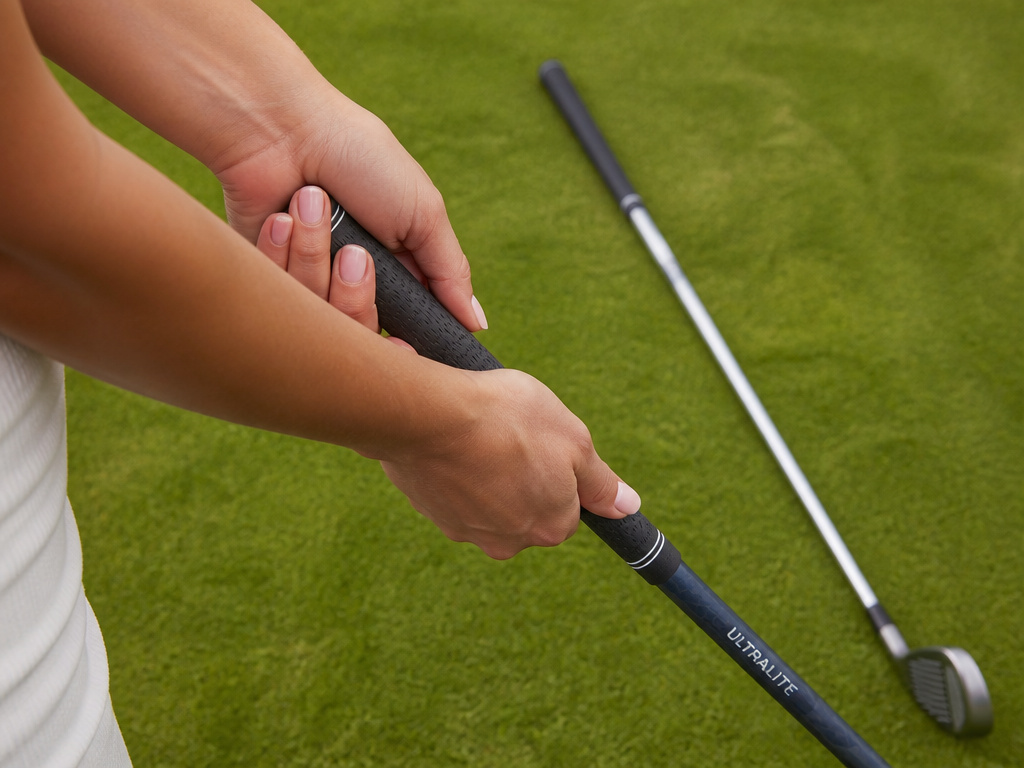
The wrong equipment magnifies swing flaws. The right equipment supports your natural mechanics. For women, the most common mistake is playing with shafts that are too heavy and too stiff, which forces an overuse of the hands to square the face.
A lighter, more flexible shaft isn’t just for “slow swing speeds.” It’s for efficient energy transfer. If you have to manipulate the club to load it, you’ve lost consistency before you even start the downswing. Get fit, but go in knowing that feel is paramount. The club should feel like an extension of your arms, not a weight you’re dragging.
As for training aids, the market is flooded with gadgets. Be ruthless. A hearing aid with a directional microphone simplifies one thing. The Callaway Swing Easy is excellent for tempo. A simple alignment stick is the best tool for checking posture and path. I’m skeptical of most wearable sensors that buzz on your back—they add another layer of complexity to an action that should feel free.
The one tech category worth considering is a basic swing speed radar. Not to obsess over the number, but to use in a specific protocol: hit five balls at your normal speed, note the average. Then try five balls focusing only on making a smooth, full turn, ignoring speed. The second set is often faster. This teaches that speed is a byproduct of good mechanics, not effort.
Where this goes sideways: Buying a new driver to fix a slice. The gear effect might hide the flaw for a week, but the underlying path issue remains. Fix the swing first, then let the equipment optimize it.
A phone holder for golf is a higher-return investment than most fancy trainers. Being able to easily film your swing from down-the-line and face-on gives you objective feedback no feel can match. Set it up, hit a few shots, review. The disconnect between what you feel and what you see is where real improvement lives.
Frequently Asked Questions
Do women need to swing differently than men?
They don’t need to swing differently on purpose; their bodies create a different swing based on average differences in strength, flexibility, and mechanical advantage. The key is to optimize the swing you naturally produce, not to force it into a mold built for a different physiology. Coaching should focus on your kinetic chain, not a generic model.
What is the most important physical trait for a woman’s golf swing?
Rotational flexibility and core stability are the foundation. A study on skilled golfers highlighted that variables determining clubhead speed differ between sexes, with women relying more on segmental peak speeds. This means the ability to make a full, separated turn (pelvis versus shoulders) and then stabilize that rotation through impact is critical. Grip strength is a close second for club control.
Should women use men’s golf clubs?
Generally, no. Men’s standard clubs are longer, heavier, and have stiffer shafts. This can force a female golfer to alter her posture, grip, and swing plane to compensate, leading to inconsistency and lost power. Women’s or senior flex clubs are designed with lighter total weight and more flex to help generate clubhead speed with a smoother tempo.
How can I increase my clubhead speed without swinging harder?
Focus on sequence, not strength. The research from a low handicap female golfer study shows speed comes from the timing of the pelvis and thorax. Drills that emphasize starting the downswing with a lateral hip shift or a bump of the lead knee (like the step drill) will create more “whip” than trying to muscle the club with your arms. Using a lightweight speed monitor for feedback can keep you focused on smooth acceleration.
Are swing trainers useful for women?
Yes, but be selective. The best swing trainers for beginners focus on one thing: tempo, connection, or path. Avoid complex gadgets that promise to fix ten things at once. A simple weighted club or a tempo trainer like the “Orange Whip” can build rhythm and the feeling of the clubhead releasing without manipulation. Good golf comes from simpler, repeatable movements.
The Bottom Line
The best women golfers in the world, the ones on the LPGA Tour, are masters of a different biomechanical blueprint built on precision, flexibility, and exquisite timing. Your swing will not be a copy of theirs, and that is fine.The goal is to understand the principles that make theirs work: a posture that lets you turn, a sequence that builds speed from the ground up, and equipment that doesn’t fight you.
Forget the noise about perfect positions. Your next practice session should have one goal: film your swing with a golf swing camera. Check your hip hinge at setup. Check if your lead knee is flexing or straightening on the downswing with your 5-iron. That’s it. One observable, fixable thing. The research from the thorax and pelvis kinematics study gives us the map, but you have to walk the path. Start with posture, sequence the turn, and let the club do the work. The rest is just practice.
