
What Do Caddies Do? The Complete Guide to a Caddie’s Role
This post contains affiliate links. As an Amazon Associate, we earn from qualifying purchases.
This post contains affiliate links. As an Amazon Associate, we earn from qualifying purchases.
A golf caddie is a player’s on-course assistant, legally defined by the USGA Rules of Golf as the person who carries, handles, or transports the player’s clubs and gives advice. Their core duties are physical support, strategic guidance, and course maintenance, and an effective partnership is shown to improve a golfer’s score by one stroke per round.
That one-stroke figure comes from a peer-reviewed study controlling for skill and conditions. It turns a job often seen as bag-carrying into a measurable performance advantage. The difference between a good caddie and a great one isn’t weight lifted; it’s decisions shaped and penalties avoided.
What follows: the four-part breakdown of a caddie’s legal role, the psychological partnership that drives the score improvement, the specific rules only they can touch, and the real-world economics from your local club to the PGA Tour.
Key Takeaways
- An effective caddie-golfer partnership is proven to improve performance by an average of one stroke per round.
- Under USGA rules, a caddie is the only person a player can ask for advice during a competitive round without penalty.
- A caddie’s actions are considered the player’s actions; if a caddie breaks a rule, the player gets the penalty.
- Professional caddies operate on a “10-7-5” commission structure: 10% of a win, 7% for a top-10, 5% for making the cut.
- Beyond carrying clubs, a caddie’s most critical jobs are managing the player’s focus and providing distraction from past mistakes.
The Caddie’s Official Role Under the Rules of Golf
Forget the movies. The rulebook defines the job. The USGA’s definition is the only one that matters in competition: a caddie is the one who assists the player under the Rules, primarily by handling the clubs.
Under Rule 10.2, a caddie is the only person a player is allowed to ask for advice on club selection, strategy, or reading a putt during a round. Asking a playing partner, spectator, or your coach results in a two-stroke penalty in stroke play.
This makes the caddie an extension of the player in the eyes of the rules. If your caddie accidentally kicks your ball, you incur the penalty. If they lift your ball on the green without being asked, it’s allowed. Their knowledge of a rule is treated as your knowledge.
The role splits into four concrete, rule-bound functions.
Carrying and Managing Equipment. This is the baseline. A caddie is responsible for the player’s 14 clubs, bag, and any other gear like rainwear or extra gloves. They clean clubs after each shot, hand the player the selected club, and ensure nothing is lost.
Providing Authorized Advice and Information. This is the strategic core. A caddie supplies yardages, discusses wind and lie, suggests clubs, and helps read greens. They are a legal sounding board for every decision from tee to green.
Performing Specific On-Course Actions. The rules grant caddies unique permissions. They can mark and lift the player’s ball on the putting green without being told. They can repair pitch marks and old hole plugs on the green. They attend the flagstick when asked.
Maintaining the Course. This is etiquette codified into duty. A caddie rakes bunkers after their player’s shot, replaces divots in the fairway, and generally helps keep the course in good condition for players behind them. It’s not just polite; it’s expected.
How a Caddie Actually Improves Your Score (It’s Not Just Yardages)
Carrying the bag is the easiest part. The hard part is carrying the player’s focus for four hours. The academic research is clear: the value is psychological.
The study in the International Journal of Golf Science found the one-stroke improvement. The mechanism isn’t magic. It’s what researchers call “psychological optimization.” A caddie manages focus, provides positive distraction, and helps maintain “flow state”, that zone where everything clicks.
Where this goes sideways: A caddie who talks too much about the last bad hole. The research shows a key skill is “providing a distraction preventing the golfer from dwelling on past mistakes.” Rehashing a triple bogey on the walk to the next tee is amateur hour.
Think of a round as a series of mental resets. A good caddie executes the reset. After a poor shot, they immediately shift the conversation to the next one: “Okay, we’ve got 150 to the front, it’s sitting up, what’s our number?” They absorb frustration and reflect calm.
This requires reading the player like a golf rangefinder reads a pin. Some players need chatter. Some need silence. Some need a firm, “That’s the club,” to stop second-guessing. The peer-reviewed golf caddie study calls this “interpersonal effectiveness.” On tour, it’s the difference between keeping a job for a decade or getting fired after a month.
Caddie vs. Forecaddie vs. Push Cart: Who Does What?
Not every helper with a bag is a caddie. The distinctions change the cost, the experience, and the rules.
| Role | Carries Bag? | Works For | Primary Duty |
|---|---|---|---|
| Caddie | Yes | One player | Full service: club carrying, advice, course maintenance, psychological support. |
| Forecaddie | No | Entire group (e.g., foursome) | Spots shots, maintains pace, may provide general yardages. No advice or bag handling. |
| Push Cart / Trolley | No (You push it) | Yourself | Hauls your bag. Provides zero advice or service. |
A forecaddie is a cost-splitter. At high-end resorts, a foursome might hire one forecaddie instead of four caddies. The forecaddie walks ahead, finds balls, helps with pace, and might give yardages. They do not discuss strategy or touch a club. It’s a logistics role.
A push cart, whether a basic three-wheel cart or a stable four-wheel push cart, is equipment. It’s an alternative to carrying your own 14-club golf bag. An automatic golf cart or a remote control cart adds convenience but still offers no cognitive help. You are still your own caddie.
The choice depends on what you’re buying. Are you buying transportation, or are you buying a decision-making partner?
The Rules Only a Caddie Can Touch (And Where It Gets Tricky)
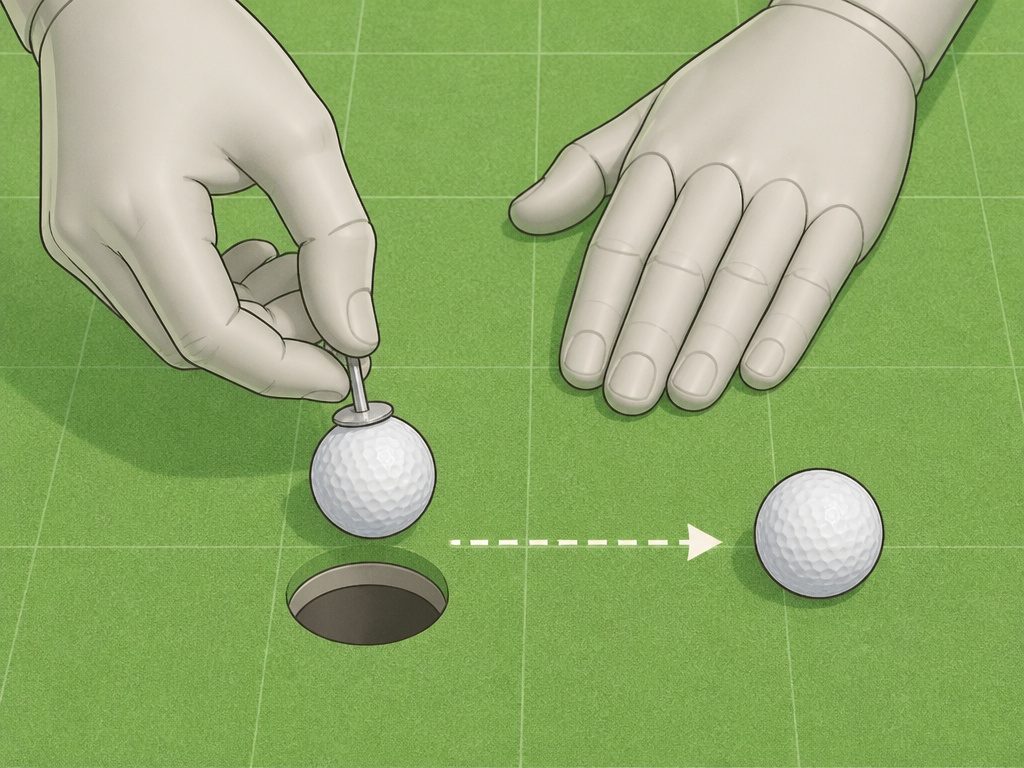 The rulebook gives caddies special privileges that even a player doesn’t have. It also lands the player with their caddie’s mistakes.
Ball Movement on the Green. This is a classic edge case. If a caddie accidentally moves a ball on the putting green, no penalty, it just gets replaced. But if the caddie has already marked and lifted that ball, then replaces it, and then it moves (even by wind), it must be replaced again. The status of the ball changes everything.
The Flagstick. The player must decide before the stroke: in, out, or attended. If they ask the caddie to attend it, the caddie must remove it before the ball gets to the hole. Leaving it in after attending is a penalty.
Advice is a One-Way Street. The player can ask the caddie anything. The caddie can offer anything. But the caddie cannot ask for advice from anyone else on the player’s behalf. That also incurs a penalty on the player.
The overarching principle is agency. When you hire a caddie, you hire their judgment. Their good calls lower your golf scoring. Their bad calls, like misunderstanding a local rule, raise your player’s handicap for that round. You are a team, for better or worse.
How a Caddie Gets Paid: From Resort Tips to Tour Millions
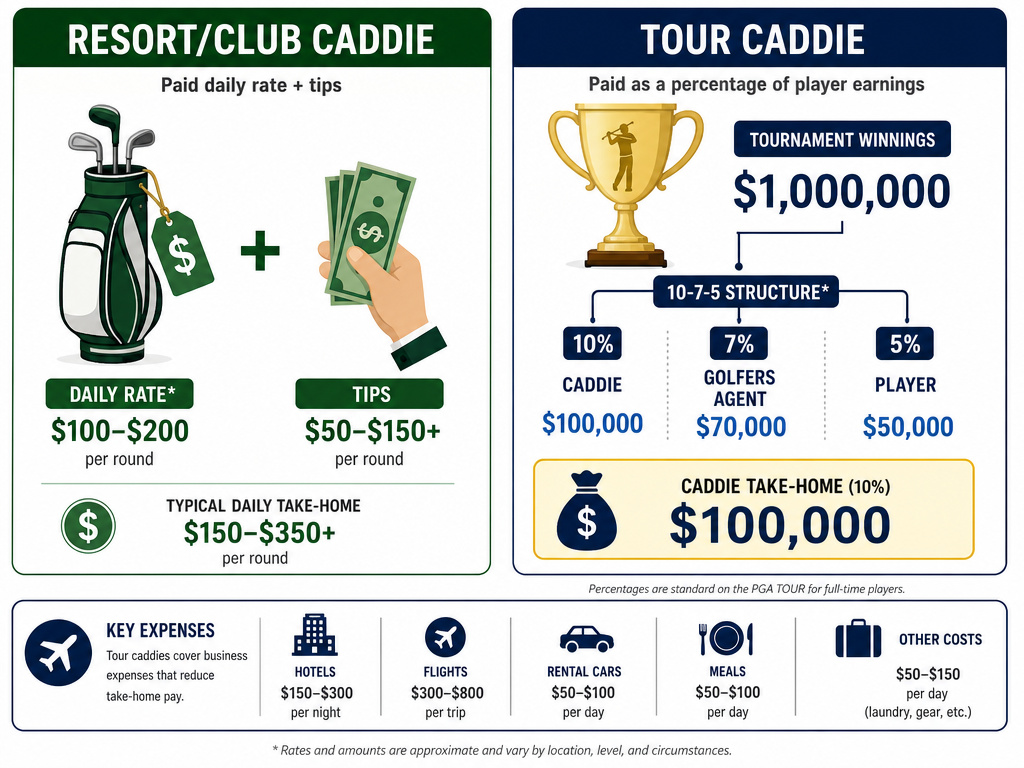 The financial model changes completely from the local muni to the PGA Tour.
At Resorts and Private Clubs. You pay a set fee per bag, per round. This fee, set by the club, goes to the caddie program. On top of that, a tip is standard and expected. A good tip for a single bag is often 50-100% of the base fee, more for exceptional service. You’re paying for a day’s labor.
On the Professional Tours. This is a performance-based partnership. The standard is a weekly base salary (anywhere from $1,500 to $3,000) plus a percentage of the player’s winnings. The famous “10-7-5” structure: 10% for a win, 7% for a top-10 finish, 5% for any other finish where the player makes the cut.
The math gets eye-watering fast. When Scottie Scheffler wins a $3.6 million prize, caddie Ted Scott’s 10% cut is $360,000 for that week alone. Reports estimated Scott earned around $2.6 million in 2024. Rory McIlroy’s caddie, Harry Diamond, earned a similar percentage from McIlroy’s 2026 Masters win.
The part nobody mentions: Tour caddies pay all their own expenses, flights, hotels, rental cars, food. That can run $50,000 a year or more. A caddie on a player who misses cuts consistently can lose money for the week after expenses. It’s a high-risk, high-reward gig that depends entirely on the player’s performance.
This is why finding a lasting partnership is so critical at the pro level. It’s not just chemistry; it’s economic survival. For the amateur hiring a caddie on vacation, you’re buying a better experience. For the pro, they’re hiring a key business partner.
Frequently Asked Questions
Are caddies required in golf?
No, caddies are never required by the rules of golf. They are a service offered at many courses. Most amateur golfers carry their own bag, use a push cart, or ride in a motorized cart.
What should you tip a golf caddie?
At a private club or resort, tip 50-100% of the base caddie fee per bag for good service. If the base fee is $80 per bag, a $120-$160 total payment ($40-$80 tip) is standard. Always ask the club for their recommended gratuity policy.
Can a caddie give you a putt?
No. A caddie cannot concede a putt (give you a putt) in stroke play. In match play, only the opponent can concede a stroke, hole, or match. A caddie suggesting you pick up a short putt could get you penalized if you act on it.
Do caddies have to wear a uniform?
Most private clubs and resorts require caddies to wear a uniform, like a collared shirt with the club logo and tailored pants or shorts. PGA Tour caddies typically wear a uniform provided by the player’s sponsors.
What’s the difference between a caddie and a looper?
“Looper” is old-fashioned slang for a caddie, implying they “loop” around the course. The terms are interchangeable, though “caddie” is the formal term used in the rules. Some in the industry use “looper” for caddies who work at a single course every day.
The Bottom Line
A caddie is part porter, part psychologist, and part rules consultant. The good ones make the game simpler by handling complexity. They turn a walk into a conversation and a round into a partnership.
The evidence for their value isn’t anecdotal. That one-stroke average from the research is a real target. Whether you’re on a bucket-list trip at St. Andrews or trying to lower your handicap at home, a skilled caddie offers more than a light bag. They offer a clearer head. And in golf, that’s often the only club you need.
