
How to Break 80 in Golf | The 3 Stats That Add Up to 79
This post contains affiliate links. As an Amazon Associate, we earn from qualifying purchases.
This post contains affiliate links. As an Amazon Associate, we earn from qualifying purchases.
To break 80 in golf, you must eliminate three specific, fractional stroke losses per round: 1.4 strokes off the tee, 0.4 strokes on 10–30 yard shots from the rough, and one three-putt. Data from Shot Scope and Arccos shows golfers stuck in the 80s average five greens in regulation and 2.5 three-putts per round; hitting nine greens and cutting three-putts to 1.5 is the numeric path to 79.
The difference between an 83 and a 78 is the sum of small, avoidable mistakes that happen three or four times a round. Each one feels like a minor frustration in the moment.By the 18th green, they’ve locked you out of the 70s.
What follows is a breakdown of the three statistical leaks that cost 4–5 shots, the club choices that plug them, and the pre-shot routine that makes the math work on the course.
Key Takeaways
- Golfers trying to break 80 lose 1.4 strokes per round off the tee compared to players already scoring in the 70s. Keeping the ball in play is non-negotiable.
- You average 2.5 three-putts per round if you shoot in the 80s. Cutting that to 1.5 saves a full stroke and is often a matter of lag-putt speed control.
- Missing the green from inside 70 yards happens 2.7 times per round for 80s shooters. Getting that number under 2.0 is a direct stroke saver.
- The target for breaking 80 is nine greens in regulation. That’s nearly double the average for a golfer stuck in the 80s.
- Your equipment matters at this level. A reliable 3-wood for tight holes and a precise 60-degree wedge for short-game saves are critical tools.
The 3 Stats That Add Up to 79
Forget trying to make more birdies. The barrier between the 80s and the 70s is built on mistakes you stop making. Shot Scope data provides a forensic look at where those strokes vanish.
Golfers trying to break 80 lose 1.4 strokes per round off the tee compared to players already scoring in the 70s. They also lose 0.4 strokes per round on 10–30 yard shots from the rough and additional strokes on 20–40 foot lag putts.
These are death by a thousand cuts—a drive into the trees leading to a punch-out, a clumsy chip from the rough that leaves a 15-footer for par, a lag putt raced eight feet past the cup. Fixing them requires a different mindset than the one you used to break 100 or even break 90.
The goal is damage limitation, not heroics. The table below shows where your focus needs to be.
| Statistic | Golfer Shooting in the 80s | Target to Break 80 | Strokes Gained/Lost |
|---|---|---|---|
| Greens in Regulation | 5 of 18 | 9 of 18 | +4 strokes |
| Three-Putts Per Round | 2.5 | 1.5 | +1 stroke |
| Failed Up & Downs (<70 yards) | 2.7 instances | <2.0 instances | +0.7–1.0 strokes |
| Fairways Hit | ~7 of 14 | ~7 of 14 | Key is quality of miss |
Notice that fairways hit doesn’t change much. The difference is what happens when you do miss. A player breaking 80 misses into a playable spot with a clear next shot. A player stuck in the 80s misses into a penalty area, deep rough, or behind a tree. That’s where the 1.4-stroke loss happens.
Stop Donating Strokes Off the Tee
You don’t need more distance. You need more predictability. The biggest separator isn’t your driver’s max carry; it’s your worst-case scenario.
A wild drive does two things. First, it costs the obvious penalty stroke or the wasted punch-out. Second, and more insidiously, it changes your entire approach to the hole. You’re now playing for bogey from the trees, which often leads to a rushed, aggressive recovery shot and a potential double. That sequence alone can account for two of the 1.4 lost strokes.
Common mistake: Pulling driver on every par-4 and par-5 without a plan. If the fairway narrows at 250 yards, and your miss is a slice, that’s not a driver hole for you today.
Your most important club off the tee might not be your driver. For tight holes where the penalty is severe, a reliable 3-wood or even a long iron is the smarter play. The goal is to find a club you can hit with a consistent, playable shape—even if it’s a fade or draw—and a predictable miss. This is the core strategy that moves you from hoping to break 80 to planning for it.
Your pre-shot routine here is everything. Before you tee it up, ask two questions: 1. Where is the worst place I can hit it? 2. What club gives me the best chance to avoid that spot?
If the answer to question one is “the water left” or “the out-of-bounds right,” and your driver tends to wander there, the club stays in the bag. This is how you reclaim the 1.4 strokes.
The Short-Game Holes in Your Pocket
From inside 70 yards, your job is to get the ball on the green in one shot. Every time. It sounds simple, but Shot Scope data reveals golfers in the 80s average 2.7 instances per round where they take multiple shots from this range just to find the putting surface.
That’s often a half-chunked wedge that goes 20 yards, followed by a skulled one over the green. Two strokes gone, and you haven’t even putted yet.
Where this goes sideways: Trying to be too cute with a flop shot from tight lies. The margin for error is tiny. A low, checking chip that uses the slope of the green is almost always the higher-percentage play.
This is where your wedge selection is critical. A versatile 60-degree wedge is essential for high, soft shots over bunkers. But for most routine chips and pitches from the rough, a 56-degree or even a gap wedge is the smarter choice. The higher loft gets the ball up quickly from deep grass, but it also reduces roll-out control.
Practice one stock shot from 30 yards in the rough. A slightly open stance, ball back, hands forward. Focus on a descending strike that pinches the ball out. The goal isn’t to get it close; the goal is to get it on the green, putting. Turning those 2.7 failures into 1.6 saves you a full stroke.
Putting: The Three-Putt Tax
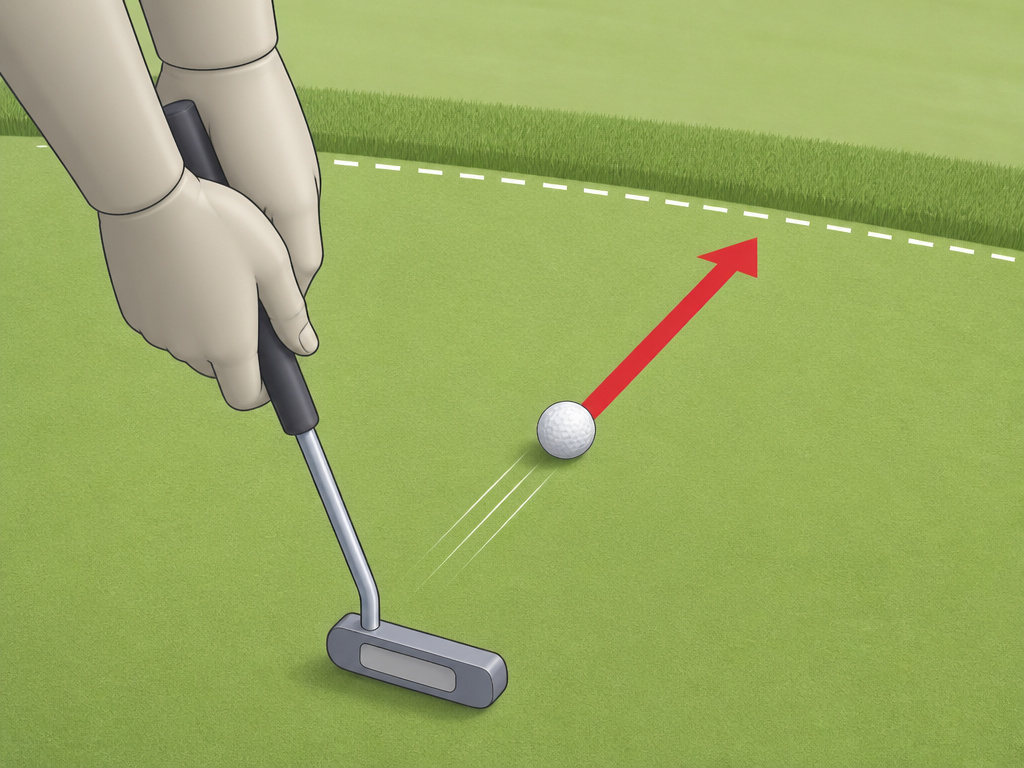
This is the easiest fix on the list. Golfers shooting in the 80s average 2.5 three-putts per round. The target to break 80 is 1.5. You just need to eliminate one.
The source isn’t poor aim from short range. From inside three feet, even a 25-handicap makes 88% of putts. The problem is speed control on long putts. A 40-foot lag putt hit too hard will race eight feet past, turning a probable two-putt into a likely three-putt.
Your only thought on any lag putt should be speed. Don’t even look at the line until you’ve felt the distance in your practice strokes. The read matters, but if your speed is perfect, even a bad read leaves a tap-in.
A practical drill: on the practice green, putt to the fringe, not to a hole. Try to get the ball to die just as it touches the fringe. Do this from various distances until you can consistently control the pace. This skill alone will cut your three-putt count. It turns stressful 5-footers for bogey into routine 2-footers for par.
Your Pre-Round Checklist
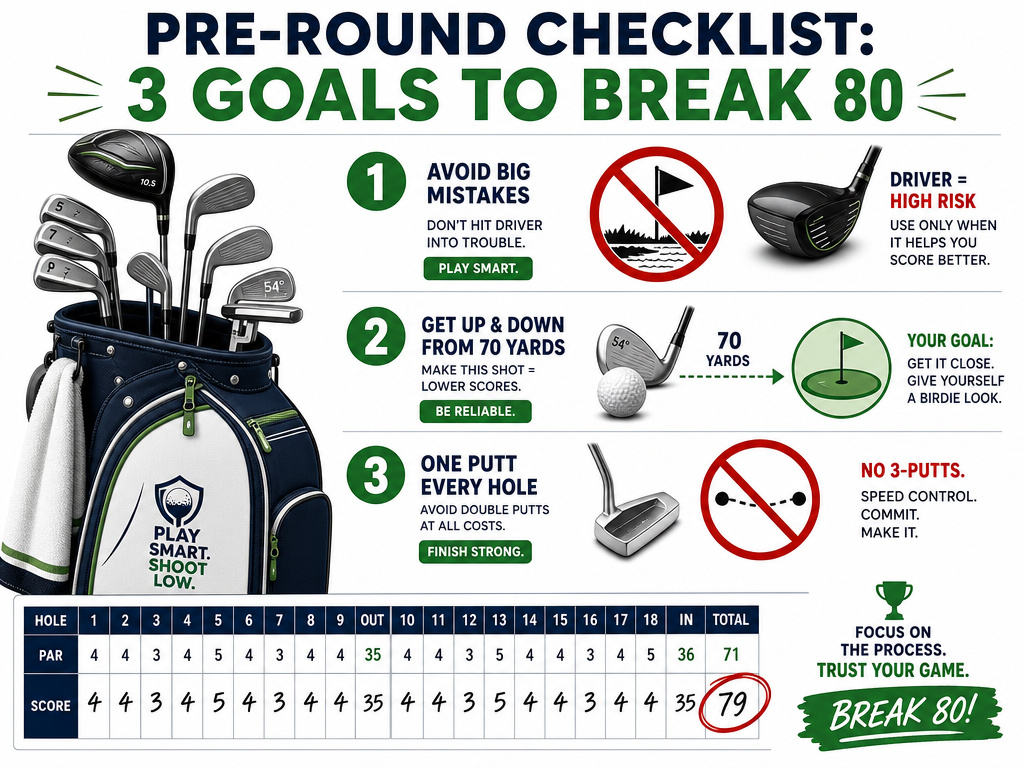
Breaking 80 is a project. You need the right tools and a clear plan. Your equipment and your mindset must support the goal of eliminating mistakes, not creating magic.
First, your bag. An organized 14-way bag lets you quickly grab the right club for the situation, reducing indecision. Your ball choice matters, too. For maximum forgiveness and distance on off-center strikes, a 2-piece golf ball is a solid choice. If you have the swing speed and want more greenside spin, a 3-piece golf ball offers better control.
Second, your plan. Before you play, write down your three goals for the round: 1. No penalty strokes off the tee. 2. Get every shot from inside 70 yards onto the green. 3. No three-putts.
That’s it. Don’t think about score. Just execute those three things. The 79 will take care of itself. This focused approach is what separates a strategic round from a hopeful one, and it’s the same disciplined thinking you’d apply to understanding complex playoff formats in a tournament.
Frequently Asked Questions
What handicap do you need to break 80?
To consistently break 80, most golfers need to play to a handicap between 5 and 9. Shooting 79 on a par-72 course is about 7 over par, which roughly corresponds to a 7-handicap on a course with standard difficulty. The Keiser University golf instruction guide confirms this is the typical skill threshold.
Is it harder to break 80 or 90?
Breaking 80 is significantly harder. Breaking 90 is about eliminating massive errors and keeping the ball in play. Breaking 80 is about refining precision and eliminating small, fractional-stroke mistakes that add up over 18 holes. The mindset shifts from avoidance to execution.
How many greens in regulation do I need to break 80?
The target is nine greens in regulation. Shot Scope data shows golfers consistently in the 70s hit about nine GIR, while those in the 80s average only five. You don’t have to hit every green, but you must drastically improve your ball-striking consistency.
Do I need to make birdies to break 80?
No. The path to breaking 80 is paved with avoiding bogeys and double bogeys, not making birdies. If you can eliminate one three-putt, one failed short-game shot, and one penalty off the tee per round, you will save the 3–4 strokes needed to get from the mid-80s into the 70s.
What’s the next level after breaking 80?
Once you can consistently break 80, the next major milestone is to break 70. This requires not just eliminating mistakes but actively gaining strokes through superior ball-striking, a world-class short game, and making multiple birdies per round.
The Bottom Line
Breaking 80 is about discipline you haven’t applied. The data gives you the blueprint: manage your tee shots, get your short-game misses on the green, and control your lag putting.Stop trying to shoot 79. Start trying to execute the three things that make 79 inevitable. The score is just the receipt.
