
Course Strategy for High Handicappers: Fix The 80% Mistake
This post contains affiliate links. As an Amazon Associate, we earn from qualifying purchases.
This post contains affiliate links. As an Amazon Associate, we earn from qualifying purchases.
Course strategy for high handicappers means making three core adjustments: aiming at the center of the green on every approach, adding one full club to your gut-feel selection, and playing a safe recovery shot from trouble 100% of the time. Data shows 80% of amateur mid-iron shots finish short, and avoiding that single mistake can cut three strokes in four rounds.
That 80% figure is the consensus finding from multiple instruction sources analyzing amateur shot patterns. Your brain picks a club based on the one perfect shot you remember.Your average swing delivers something else entirely. The gap between those two numbers is where double bogeys live.
What follows is a system built from tracking data and pro teaching consensus. It covers the club selection math that actually works, the single recovery decision that stops big numbers, and how to read conditions so your plan survives wind, cold, and firm greens. This is about using the game you have today to post a lower number by Saturday.
Key Takeaways
- Add one club on every approach. 80% of amateur mid-iron shots land short because players select based on their best-ever distance, not their average. A smooth 6-iron finds the green more often than a maxed-out 7.
- The center of the green is your target. Most greens are 25–35 yards deep. Aiming at the center means your worst miss is still on the putting surface, turning potential doubles into stress-free bogeys or two-putt pars.
- “Take your medicine” immediately. From trees or thick rough, the hero shot succeeds once in ten tries. Punching sideways to the fairway limits damage to a bogey, saving an average of three strokes per round.
- Improvement shows in 4–8 rounds. Players who systematically change recovery decisions and focus on three-putt elimination see measurable score drops within a month of play, per Arccos and Shot Scope datasets.
- Adjust for reality, not ego. Cold air costs 5–10 yards per club. A 10 mph headwind adds another club. Factor in conditions before you pull a club, not after you’ve come up short.
Why 80% of Your Mid-Irons Are Landing Short
You have a 150-yard shot to the middle of the green. You pull your 7-iron because you’ve hit it 150 yards before. The shot feels solid, but it lands on the front fringe, 10 yards short. This is predictable math.
Around 80% of mid-iron efforts by amateur golfers finish short of the target. This figure is consistently cited across multiple instruction sources, including Hackmotion and Chiputt Golf, analyzing real shot patterns.
The problem is the distance number in your head. It’s your career-best, flushed-perfectly, downhill-with-a-tailwind distance. Your average carry distance, the number you should use for every club selection decision, is often 10 to 15 yards less. You’re not accounting for dispersion, the natural spread of your shots. If your 7-iron’s average carry is 145 yards, a 150-yard shot requires your 6-iron.
| Club Selection Mindset | The Reality | Result on a 150-yd Shot |
|---|---|---|
| “My 7-iron goes 150.” | Best-case carry. | Ball lands 5-15 yards short. |
| “My 7-iron averages 145.” | Realistic carry. | Requires a 6-iron to reach. |
| Action: Add one club. | Action: Swing at 85-90%. | Outcome: Ball lands pin-high. |
The fix is mechanical, not magical. On your next range session, hit ten balls with your 7-iron. Throw out the longest and shortest two. The median distance of the remaining six is your true average. Write it on a piece of tape and stick it on the grip. Do this for every club from 6-iron through wedge. This list is your course management distances. Ignore it, and you join the 80%. Use it, and you start hitting greens.
The Center of the Green Is Not a Compromise. It’s the Plan.
Flag-hunting is for players who control their ball flight. For a high handicapper, aiming at a tucked pin is like aiming at a hazard. The pin is often placed next to trouble, a front bunker, a water-logged collection area, a steep slope. A slight miss becomes a short-sided disaster, a near-impossible up-and-down.
The geometry is simple. Most greens are 25 to 35 yards deep. The center is rarely more than 40 feet from any pin. A 40-foot putt is a routine two-putt. A chip from thick rough over a bunker is a potential double-bogey.
Your job is to place your entire shot dispersion pattern onto the safest part of the green. Think of your aim not as a point, but as a circle. You want the entire circle to fit on the putting surface. That almost always means the center.
Common mistake: Aiming at a right-side flag with water on the right. Your natural miss is in the water. Aim at the center, and your natural miss is still on the green.
This is the core of Scott Fawcett’s DECADE system, used by tour pros: you’re firing a shotgun, not a sniper rifle. Your target should be where the pellets can’t miss the barn. On approach shots, the barn is the center of the green. This single shift in target golf strategy is the fastest way to increase your greens-in-regulation and eliminate penalty strokes around the green.
The “Take Your Medicine” Shot That Saves 3 Strokes
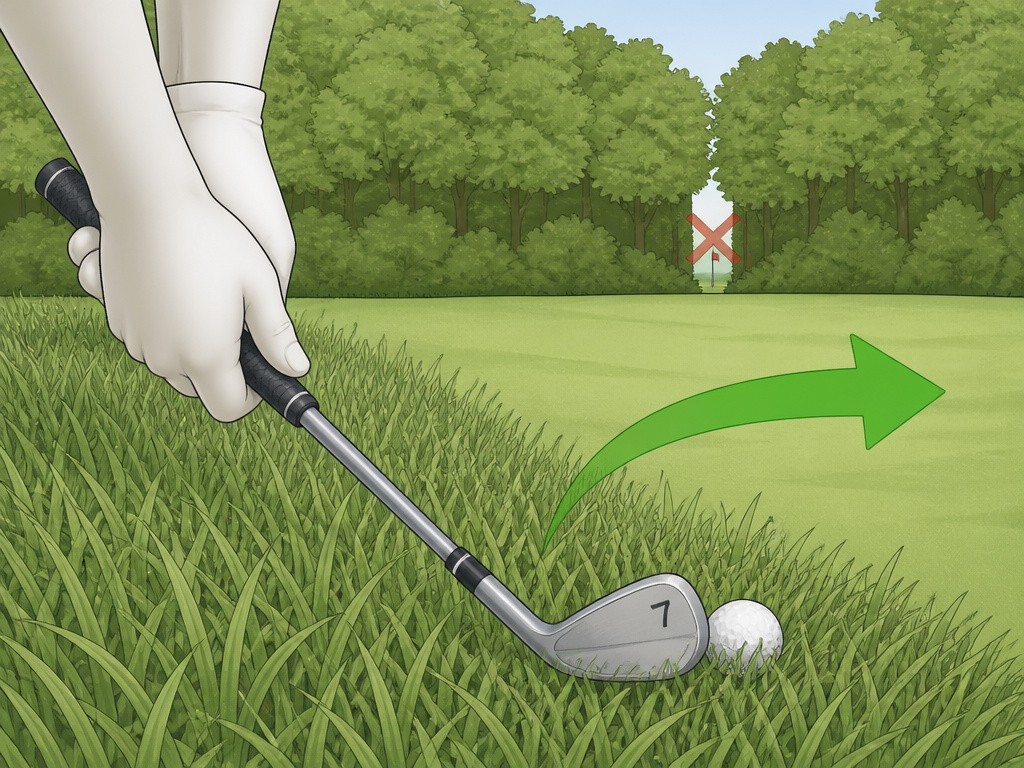
You pushed your drive into the trees. The green is visible through a tiny gap 180 yards away. The instinct is powerful: thread the needle, get back in the hole, be the hero. This instinct is why you make triple bogeys.
Data from shot-tracking companies like Arccos is brutal on hero shots. The recovery attempt that requires precision from a bad lie fails roughly 90% of the time for amateurs. When it fails, the ball often ends up in worse trouble, deeper woods, a penalty area, an unplayable lie. That single decision turns a possible bogey into a guaranteed double or triple.
The professional move is to take your medicine.
- Assess the lie. Is the ball sitting clean? Can you make a full swing?
- Find the widest, safest opening back to the fairway. It might be sideways or even slightly backward.
- Take a club you can control (often a 7 or 8-iron) and punch the ball back to the short grass.
You’re accepting you’ll need three shots to reach the green instead of two. The result is a 40-yard wedge from the fairway and a putt for bogey. A bogey is a great score from the trees. A triple is a round-killer. Mastering this one decision, this acceptance of a minor setback, is the highest-leverage managing emotions skill you can learn. It saves an average of three strokes per round immediately.
How to Adjust Your Strategy for Wind, Cold, and Firm Greens
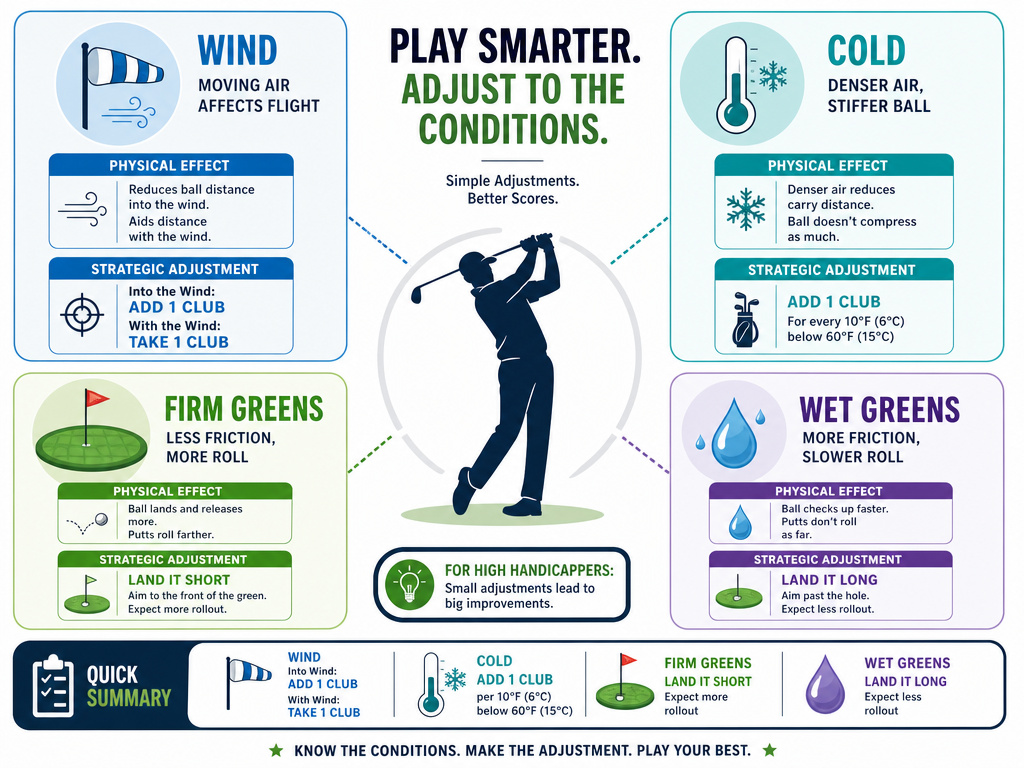
Your printed yardages assume 70-degree air, no wind, and a soft landing. Golf is rarely played in a lab. Ignoring conditions is another form of under-clubbing.
Wind Strategy: Into a headwind, the ball balloons and loses distance. The old adage is wrong, don’t swing harder. Take more club and swing smoother. A smooth 6-iron into the wind flies lower and penetrates better than a hard 7-iron. For a crosswind, aim into the wind so it blows the ball back toward your target. A good wind strategy turns a defensive situation into a controlled one.
Cold Temperatures: Cold air is denser. It creates more drag. Expect to lose 5 to 10 yards per club when the temperature drops below 50°F. That 150-yard shot in July is a 160-yard shot in October. Factor it in before you swing.
Firm vs. Soft Conditions: On firm, fast greens, the ball will release. Don’t fly it all the way to the hole. Land it 10-15 yards short and let it roll out. On wet, soft greens, the ball will stop quickly. You need to carry it all the way to your target. Understanding these firm vs soft conditions dictates everything from club selection to shot type.
| Condition | Physical Effect | Strategic Adjustment |
|---|---|---|
| Headwind (10 mph) | Increased drag, higher ball flight. | Add 1 club. Swing at 80-90% power for lower flight. |
| Cold (<50°F / 10°C) | Denser air reduces carry. | Add 1 club (5-10 yd loss per club). |
| Firm Greens | Low spin, high roll-out. | Land ball short of target. Use less loft. |
| Wet Greens | High spin, minimal roll. | Carry ball to target distance. |
The Tools That Make Smart Strategy Easier
Good decisions require good information. Guessing your distance is a strategy killer. Three tools remove the guesswork.
A GPS watch or handheld unit (like a Garmin Approach) gives you front, middle, and back distances to the green instantly. It eliminates the “is it 150 or 160?” debate that leads to the wrong club. Knowing the front distance is critical for avoiding short-sided trouble.
A rangefinder with slope (like a Bushnell Tour V5 Shift) is even better for players who walk. It gives exact yardage to any target, and the slope function calculates the adjusted distance for uphill and downhill shots. This is legal for casual play but must be disabled in tournament settings.
Finally, game-tracking sensors (Arccos or Shot Scope) are the ultimate feedback loop. They clip onto your clubs and record every shot via your phone. Their post-round reports show you exactly where you lose strokes: off the tee, on approach, around the green, or putting. The data doesn’t lie. It might show that your driving is fine, but your clubs for high handicappers aren’t forgiving enough on off-center strikes, or that your golf balls for high handicappers are costing you spin control on greens.
You don’t need all three. Start with a basic GPS. The goal is to replace “I think” with “I know” before every swing.
Frequently Asked Questions
What is the single biggest course management mistake high handicappers make?
Under-clubbing on approach shots. The 80% short statistic exists because players select a club based on their absolute best strike with it, not their average. The fix is to know your real average carry distance and add one club to your initial instinct.
Should I always lay up?
No. Smart strategy is about risk/reward. The question is: “If I try this and fail, what’s my worst likely score?” If the answer is a double bogey or worse, the shot is too risky. On an open par 5 with no trouble, going for it in two is fine. The mistake is trying a 200-yard carry over water when a layup to 100 yards gives you a simple wedge.
How long does it take to see lower scores from better strategy?
Tracking data from Arccos and Shot Scope indicates players who consistently implement changes, especially to recovery shots and three-putt avoidance, see measurable score drops within four to eight rounds. The improvement is faster than waiting for swing changes to take hold.
Do I need expensive equipment to manage my game better?
No. The core strategy, center of the green, add one club, take your medicine, costs nothing. A basic yardage book or free GPS app on your phone provides enough information. Advanced tools like shot trackers simply accelerate the learning process by showing you your personal patterns.
How does my course handicap affect strategy?
Your course handicap determines how many strokes you get on the hardest holes. Use those strokes. On a hole where you get a stroke, par is a net birdie. This means playing for a safe bogey is a fantastic result. Understanding the slope rating also tells you how much the course difficulty adjusts your handicap, helping you set realistic expectations.
Before You Go
Course strategy is the closest thing golf has to a cheat code. It works with the swing in your bag right now. Commit to one change in your next round: aim every approach shot at the center of the green, no exceptions. You’ll hit more greens. Your putts might be longer, but your chips will be easier. The score on the card will be lower.
Then add the second rule: take one more club than you think. Feel the relief of watching the ball land past the front bunker, on the putting surface. Finally, promise yourself you’ll chip out sideways from the trees. Just once. See how a boring bogey feels compared to a heroic triple.
The game is played between your ears long before the club touches the ball. Fill that space with the right numbers, the safe target, and the disciplined decision. The strokes will fall away on their own.
