
How to Recover From a Bad Hole to Finish Your Round Strong
This post contains affiliate links. As an Amazon Associate, we earn from qualifying purchases.
This post contains affiliate links. As an Amazon Associate, we earn from qualifying purchases.
To recover from a bad hole, execute a deliberate 3-step reset before you reach the next tee: physically walk away from the green, take three slow breaths, and verbally state one specific target for your next shot. This 90-second protocol separates the emotional reaction from the analytical fix, stopping the mistake from compounding into a full-round collapse.
The sequence isn’t about forgetting the triple bogey. It’s about containing it. A bad hole injects frustration, tightens muscles, and scrambles decision-making. If you carry that state onto the next tee, you’ve already lost the battle before you take the club back.
What follows is the breakdown of that reset, the psychology behind why most players fail at it, and the on-course adjustments that let you salvage a score. You’ll learn how to diagnose between a true mechanical flaw and a mental lapse, and how to structure your round so one hole can’t sink the next seventeen.
Key Takeaways
- Implement a strict 90-second reset ritual between the bad green and the next tee. This window is critical for emotional clearance.
- Diagnose the error immediately: was it a poor decision, a rushed swing, or a single technical flaw? Confusing these causes the wrong fix.
- Your pre-shot routine is your anchor. Returning to its exact steps, especially alignment and tempo, reboots focus faster than any swing thought.
- Manage the course aggressively after a mistake. Playing overly safe to “avoid another bogey” invites more mistakes by removing your committed swing.
- Write down one objective fact about the bad hole in your yardage book, then close it. This externalizes the problem and frees your mind for the present shot.
Why a Bad Hole Wrecks Your Next Five (It’s Not the Score)
The damage from a triple bogey isn’t the number on the card. It’s the physiological hangover. Your heart rate spikes, shoulders tense, and grip pressure doubles without you noticing. This isn’t just “feeling upset”, it’s a measurable stress response that directly degrades motor skill.
You can’t swing freely when your system is flooded with cortisol. The brain’s prefrontal cortex, responsible for calm decision-making and focus, gets hijacked by the amygdala’s threat alarm. This is why you’ll make a reckless driver choice or decelerate on a simple chip. You’re not thinking; you’re reacting.
Where this goes sideways: Trying to “fix your swing” right after a bad hole. Under stress, your kinesthetic sense is unreliable. A change made now is almost always the wrong change, embedding a new flaw that takes weeks to undo.
The goal isn’t to become emotionless. It’s to install a circuit breaker between the emotional event and the next athletic action. The players who recover best aren’t the calmest; they’re the ones with the most automatic reset routines.
The 3-Step Post-Hole Reset (Do This Before the Next Tee)
This ritual takes ninety seconds. Start it the moment your final putt drops. It works because it engages your body, your breath, and your language center in sequence, pulling you out of the emotional loop.
Step 1: The Physical Exit. Do not stand on the green re-putting in your mind. Do not immediately dive into a swing diagnosis with your partner. Pick up your ball, put your putter back in the bag, and walk to the next tee at a normal pace. The simple act of changing location signals to your brain that the event is over. It creates physical separation from the site of the failure.
Step 2: The Breath Reset. Once at the next tee box, before you even take your driver out, plant your feet and take three slow, deliberate breaths. Inhale for a count of four, hold for two, exhale for six. This isn’t spiritual, it stimulates the vagus nerve, which triggers the parasympathetic nervous system to lower your heart rate and reduce muscle tension. It’s a biochemical off-switch for the stress response.
Step 3: The Verbal Anchor. Out loud, state one specific, external target for your upcoming tee shot. Use clear, positive language: “Aim at the left edge of the fairway bunker.” or “Smooth swing to the 150-yard marker.” This forces your brain to stop its internal narrative and engage in concrete planning. It shifts you from past-tense emotion to future-tense execution.
Finish the reset by pulling your driver and beginning your standard pre-shot routine. The reset is the bridge back to your process. The routine is where you live.
Skip any one step, and the reset fails. Walk away fuming but don’t breathe, and you’re still tense. Breathe but then mutter “don’t slice it,” and you’ve just anchored a negative thought. The trio works as a single unit.
Stop the Story, Find the Fact
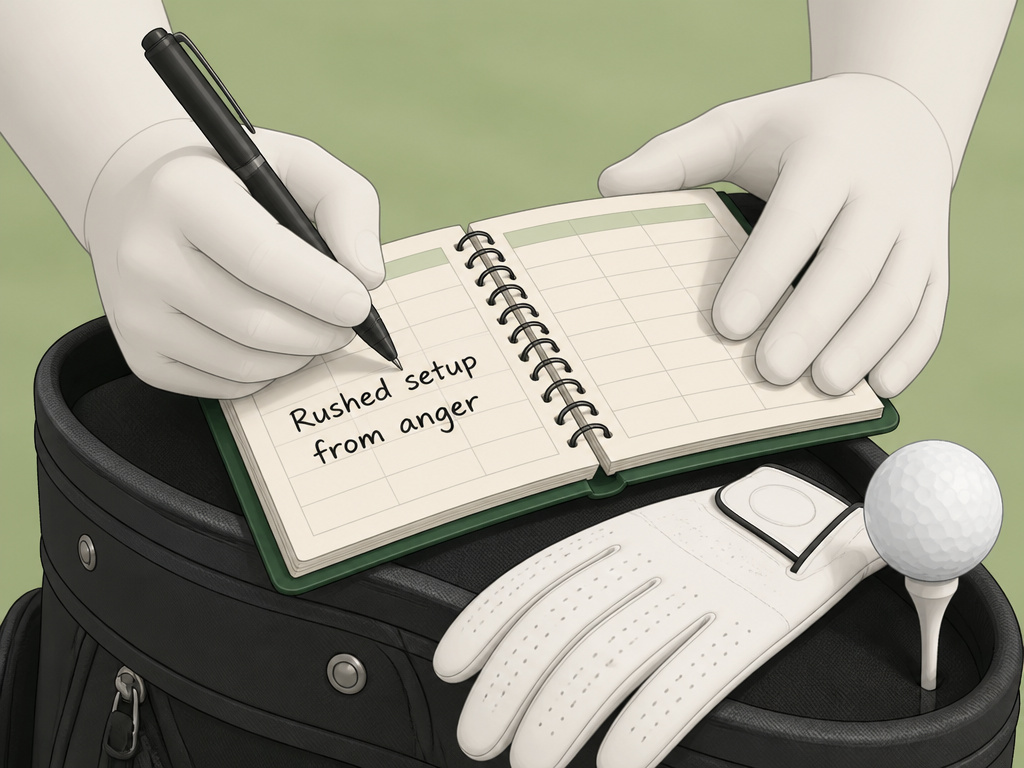
After the reset, you need a clear diagnosis. Most players tell themselves a story: “My swing is gone,” or “I can’t putt today.” These are global, fatalistic judgments that predict further failure. You must replace the story with a single, verifiable fact.
Ask this question: “What was the first thing that went wrong on that hole?” The answer is almost never the topped third shot that everyone saw. It’s the preceding error.
| The Visible Mistake | The Likely First Cause | The Real Fix |
|---|---|---|
| Topped fairway wood into water | Rushed setup because of lingering anger from previous green | Reset routine, then deliberate 15-second pre-shot count |
| Three-putt from 20 feet | Poor speed on first putt due to misread break | Verify read from two angles, focus on speed not line |
| Drive into heavy rough | Aimed too aggressively at a tight pin after a bogey | Course management adjustment: club down to find fairway |
| Chunked chip shot | Tension from trying to be too perfect | Rehearse the feel of the clubhead brushing the grass |
The fact is specific and actionable: “I didn’t commit to my alignment on the tee.” or “I rushed my takeaway because I was thinking about the water.” Write this one fact in your yardage book. The physical act of writing externalizes the problem, it’s now on the page, not in your head. Close the book. The analysis is done.
Common mistake: Full-swing analysis after a bad hole. If you’re thinking about hip rotation or wrist hinge while walking, you are guaranteeing a stiff, mechanical swing on the next shot. Save the deep mechanics for the range.
This is where a reliable pre-shot routine proves its worth. It automates the setup, so your conscious mind doesn’t have to wrestle with alignment or posture under pressure. You just run the program.
Course Management After a Mistake: Play More Aggressively
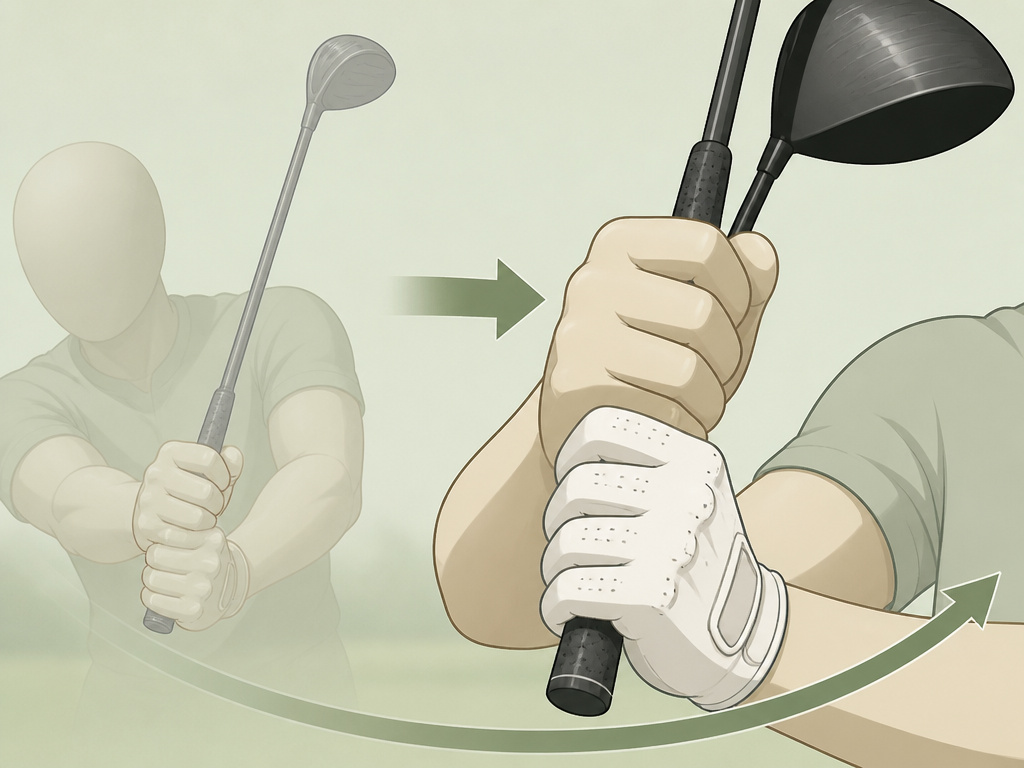
The instinct after a blow-up hole is to retreat. You’ll reach for a 3-wood instead of driver, aim for the fat of the green instead of the pin, lay up from distances you’d normally attack. This is a trap. Defensive golf requires more precision, not less. Trying to steer a 3-wood to a safe spot often produces a worse swing than a committed driver swing to a wider target.
Your goal isn’t to avoid bogey. It’s to hit a confident, committed shot. Often, that means taking more club and swinging easier.
- Tee Shot: If you’re rattled, take the driver but make your target the entire fairway, not a side. Focus purely on your swing rhythm. A smooth 80% swing with driver finds more fairways than a tense, guided 3-wood.
- Approach: Don’t automatically aim for the center. Assess the hole location. If it’s tucked behind a bunker with a tough pin, the correct play might be the center of the green. But if it’s accessible, commit to the shot. Indecision is what causes chunks and thins.
- Par 5s: This is your scoring reset button. After a bad hole, a par 5 presents three shots to rebuild rhythm. Focus on hitting three solid, consecutive shots in play. The birdie chance will come if you execute the sequence.
This philosophy ties directly to low point control. A committed, balanced swing maintains its low point. A tentative, defensive swing almost always hits the ground early or too late.
Rebuilding Rhythm: The Next-Shot Focus
You salvage a round one shot at a time. The moment you start thinking about your total score or what you “need to shoot on the back nine,” you’ve left the present. The only shot that exists is the one in front of you.
To lock in this focus, borrow a drill from short game practice: The Three-Shot Rule. After your reset, tell yourself you are only going to focus on executing the next three shots perfectly. Don’t think about score or outcome. Judge them purely on quality of contact and commitment.
- Shot 1: Focus solely on your balanced finish. Did you hold it until the ball landed?
- Shot 2: Focus solely on the feel of a full, smooth weight shift.
- Shot 3: Focus solely on a quiet mind over the ball. See the target, feel the tempo, go.
By the third shot, you’re often back in a flow state. You’ve replaced the memory of the bad hole with the fresh, positive feedback of three solid strikes. This is how you stop a double bogey from becoming a string of bogeys.
Your impact position is a reliable barometer. If you start making solid contact again, your mind and body are synced. If you’re still hitting it poorly, the issue is likely residual tension, not a swing flaw. Go back to the breath reset.
The Long-Term Mindset: How to Practice Recovery
Resilience is a skill you train. Don’t wait for a tournament blow-up to practice these tactics. Build them into your regular practice.
- On the Range: After a warm-up, intentionally hit three terrible shots in a row. Then, immediately run your 90-second reset and hit your next five shots to a specific target. Simulate the pressure.
- During Practice Rounds: Play a game where you start a hole by hitting your first shot OB or into a bunker. Play the hole out from there and try to save bogey. This desensitizes you to bad starts.
- Journaling: Keep a simple log. After a round, note any bad holes and what your “First Cause” fact was. Look for patterns. Do your bad holes often start with a poor drive? A missed short putt? The pattern reveals the real vulnerability in your game.
This work ensures that when a bad hole happens, and it will, your response isn’t panic. It’s protocol. You have a NHTSA technical service bulletin for your own mental game, a step-by-step procedure to return to service.
Frequently Asked Questions
How long should I let myself be angry after a bad hole?
Give yourself exactly the walk from the green to the next tee box. That’s about 90 seconds. Fume, curse, mutter, get it out. But the moment your foot touches the next tee, the reset ritual begins. Structured venting is more effective than trying to suppress frustration entirely.
What if my bad hole was caused by a real swing fault that I need to fix?
Unless the fault is catastrophic and dangerous, table it until after the round. Your in-round brain is terrible at making technical adjustments. If you must, pick one tiny feel key, like “complete the backswing” or “start down with the lower body.” Avoid complex thoughts about wrists, elbows, or clubface. Focus on a consistent swing rhythm above all else.
Is it okay to talk to my playing partner about the bad hole?
Not immediately. Talking about it during the reset period keeps the emotion active. After you’ve hit your next tee shot, once you’ve re-engaged with the present, then you can briefly acknowledge it. Keep it light. “Well, that got away from me!” is better than a five-minute post-mortem.
How do I stop one bad hole from making me doubt my entire game?
Compartmentalize. Golf is eighteen separate tests. A bad hole is evidence of a mistake on one test, not proof you’ve failed the subject. Your consistent irons from the previous holes are still a real part of your game. Trust the larger sample size of good shots, not the single outlier.
What’s the most important single thing to do after a bad hole?
Breathe. The three deliberate breaths are the fastest lever you have to change your physiological state. It’s more immediate than a positive thought or a swing tip. Control your physiology first, and your mind and technique will follow.
The Bottom Line
Recovering from a bad hole isn’t about mental toughness. It’s about having a better checklist than your frustration does. The 90-second reset, walk, breathe, declare a target, is that checklist. It forces a hard stop on the emotional spiral and creates a clean slate for the next shot.
Stop trying to solve mechanical puzzles in the middle of the round. Find the single fact, write it down, and return to the simplicity of your routine and your rhythm. The players who save their rounds aren’t the ones who never fail. They’re the ones who have rehearsed exactly what to do in the three minutes after they do.
