
Key Mobility Exercises for a Powerful, Fluid Golf Swing
This post contains affiliate links. As an Amazon Associate, we earn from qualifying purchases.
Effective mobility exercises for the golf swing target rotational power, not just flexibility. The goal is to increase the separation between your upper torso and pelvis (the X-Factor) during the backswing and then unleash that stored energy through a stable, sequenced downswing. Research shows dynamic stretching before a round increases club head speed by nearly 2 meters per second over static stretching, directly translating to longer drives.
That speed difference is the practical gap between reaching the front edge of a green and flying over it. Most golfers stretch, but they stretch the wrong way, focusing on holding static positions that can dampen muscle power right when they need it most.
What follows is a breakdown of the mobility work that actually moves the needle: the dynamic warm-up that primes your swing, the balance and rotational drills that build a stable platform, and the long-term proprioception training that rewires your movement patterns. By the end, you’ll know which three exercises to do before you tee off and which two to build into your weekly routine for lasting gains.
Key Takeaways
- Dynamic stretching before a round increases club head speed and shot accuracy more than static stretching. One study recorded a 1.9 m/s club head speed advantage.
- Better balance correlates directly with greater driving distance. Lower scores on the Balance Error System Test (BESS) link to longer carries.
- Golf-specific proprioception, like the Flexor Sports Training Program, trains your nervous system to use strength and flexibility within the swing sequence.
- An eight-week, golf-focused exercise program can significantly improve torso rotational strength, upper-torso rotational velocity, and total driving distance.
- Your pre-round routine should take less than 10 minutes and focus on movements that mimic the swing, not hold stretches.
What “Mobility” Actually Means for Your Swing
Forget touching your toes. Golf mobility is the available, usable range of motion your body can control under the dynamic, rotational forces of a swing. It’s the difference between being able to rotate your shoulders 90 degrees on a physio ball and actually maintaining that separation between your hips and shoulders at the top of your backswing while staying balanced.
The core concept here is the X-Factor – the rotational difference between your pelvis and your upper torso. A larger, properly controlled X-Factor stores more elastic energy. The key phrase is “properly controlled.” You need the strength to create the stretch and the stability to release it in sequence. Without the stability, that extra rotation leaks power or forces compensations that lead to inconsistent strikes and injuries. This is where understanding golf swing biomechanics shifts from theory to practical application.
A 2015 study in the Journal of Strength and Conditioning Research found that a Dynamic Rotation-Specific Warm-up did not significantly increase X-Factor over a sham warm-up in amateur golfers. The takeaway isn’t that rotation work is useless. It’s that simply going through the motions without focused intent and proper stability training may not create immediate change. The gains come from committed, long-term practice.
This is why a generic “stretch more” plan fails. The goal is optimal stiffness, meaning the right amount of tension in the right muscles at the right time to produce and transfer speed.
Dynamic vs. Static Stretching: What the Numbers Say
Your pre-round routine decides your first drive. The old model of holding static stretches for 30 seconds is now a proven performance killer for power sports. The data on golf is clear.
A study published in the International Journal of Sports and Exercise Medicine compared dynamic and static stretching warm-ups in competitive male golfers. The group using dynamic stretches significantly increased total carry distance and shot accuracy. The static stretching group did not. Another PMC golf performance study reinforced that better active flexibility correlates directly with more club head speed and distance.
The mechanism is physical. Static stretching can decrease muscle-tendon unit stiffness and temporarily reduce neural drive to the muscle. Dynamic stretching, which moves joints through their range of motion with control, increases blood flow, elevates muscle temperature, and primes the nervous system for explosive movement without the power leak.
| Stretching Type | Best For | Measured Performance Impact |
|---|---|---|
| Dynamic Stretching | Pre-round warm-up, activating movement patterns | Increases club head speed (~1.9 m/s), improves shot accuracy, maintains muscle stiffness for power. |
| Static Stretching | Post-round cool-down, improving long-term flexibility | Can reduce muscle power output if done before swinging; best for recovery and increasing overall range of motion. |
| Proprioceptive Drills | Long-term swing coordination, injury resilience | Rewires neural pathways for better swing sequence and functional stability on uneven lies. |
The numbers from a dynamic vs static stretching research summary are stark. Dynamic stretching produced greater club head speeds and ball speeds than static stretching or no stretching at all. The effects lasted for at least 30 minutes after the warm-up.
Bottom line: Save the long-hold stretches for after your round. The 10 minutes before you play are for movement.
The Non-Negotiable Link Between Balance and Distance
You can have the rotational range of a gymnast, but if you can’t balance on one foot, you’ll never transfer that power into the ball. Balance is the foundation of every athletic movement, and golf is a one-legged sport for critical moments of the swing.
Research is unequivocal. A study on collegiate golfers found a significant negative correlation between balance errors and driving distance. Lower scores on the Balance Error System Test (BESS) meant longer drives. The reason is kinetic chain efficiency. Every wobble during your swing is a leak of energy that should be going into the clubhead. Poor balance forces your body to make micro-corrections, breaking the smooth kinematic sequence from the ground up.
Where this goes sideways: Skipping balance work because it “feels easy.” A simple single-leg stand is different from maintaining a stable pelvis during a rotational lunge. The latter mimics the swing’s demand. If your trail knee buckles inward during your backswing, you’ve just lost your power base before you start down.
Balance training involves maintaining postural control while other parts of your body move. This is especially crucial for senior golf exercises, where natural declines in proprioception can erode distance faster than lost flexibility.Integrating balance into your mobility work is how you preserve power as you age.
Building a Golf-Specific Mobility Routine
A useful routine has two layers: a pre-round dynamic warm-up (5-10 minutes) and a foundational training program (2-3 times per week). The warm-up wakes up the movement patterns you’ll use. The training program builds the physical qualities that make those patterns more powerful over time.
The 8-Minute Pre-Round Dynamic Warm-Up
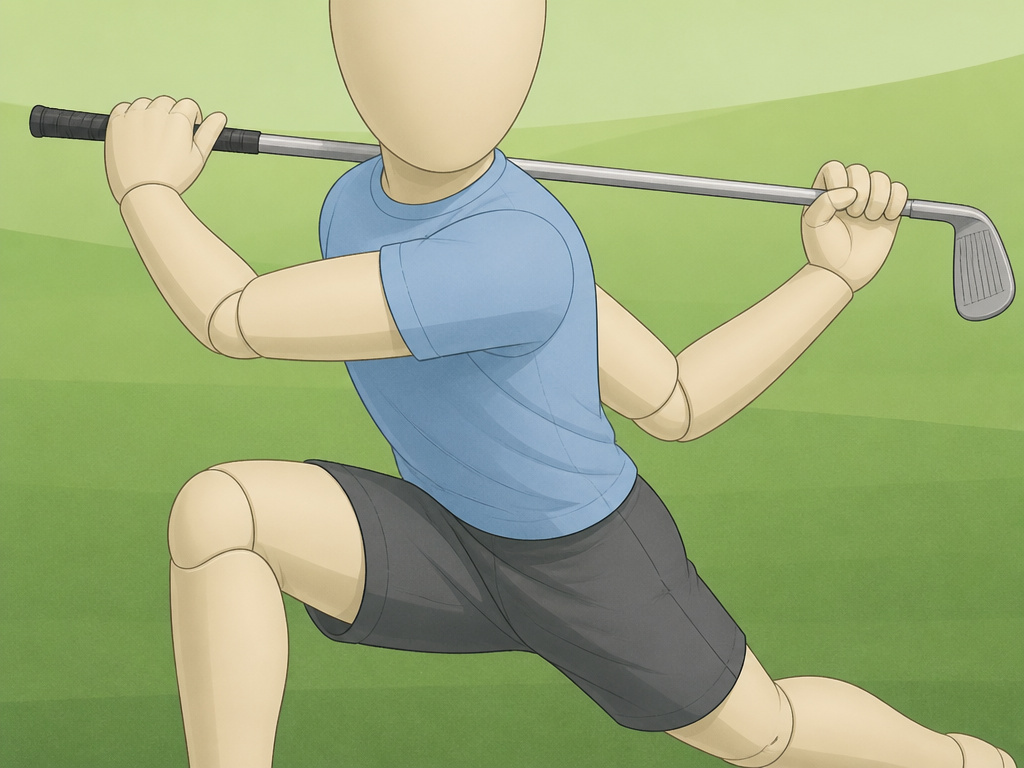
Do this sequence in order, moving smoothly from one exercise to the next. No holds, just controlled motion. 1. Leg Swings (Forward/Side): 10 each leg, each direction. Hold onto your cart or a club for support. This wakes up the hip flexors, glutes, and hamstrings. 2. Torso Rotations with Club Across Shoulders: 10 rotations each way. Keep your feet planted and hips quiet. Feel the stretch through your mid-back and obliques. 3. Lunge with a Twist: 5 each side. Step into a lunge, then rotate your torso toward your front leg. This combines hip mobility with rotational separation, directly feeding your rotational golf swing. 4. Cat-Cow Stretch: 8-10 cycles. On all fours, alternate between arching and rounding your back. This mobilizes the spine in a controlled manner. 5. Practice Swings with Gradual Intensity: Start at 50% effort, focusing on smooth golf swing rhythm. Build to 90% over 5-8 swings. This is where you integrate the newly primed mobility into your actual motion.
Foundational Mobility & Proprioception Training
This is your weekly work. It builds the attributes that make your warm-up effective. * Single-Leg Romanian Deadlifts (with or without light weight): 3 sets of 8 per leg. This is a hip hinge drill that builds glute and hamstring strength while challenging your balance. It directly supports a stable backswing pivot. * Seated Torso Rotations on a Physio Ball: 2 sets of 10 slow rotations each way. Sitting on an unstable surface forces your core to fire to control the rotation, marrying mobility to stability. This is a core element of golf-specific proprioception. * Band-Resisted Hip Rotations: Anchor a resistance band low, attach it to your knee, and slowly rotate your hip inward and outward against the tension. 2 sets of 12 per leg. This strengthens the often-ignited deep hip rotators critical for pelvis control. * Thoracic Extension over a Foam Roller: Lie with the roller perpendicular under your mid-back, hands behind head. Gently extend back over the roller. 10 slow reps. This combats the hunched posture from desks and cars, restoring your ability to extend in the backswing.
The eight-week exercise program study from the University of Pittsburgh showed that this kind of consistent, targeted work pays off. Recreational golfers improved torso rotational strength and, critically, upper-torso rotational velocity at the acceleration point of the swing. The result was more club speed, ball speed, and distance.
Common Mobility Mistakes and How to Fix Them
Mobility work is simple but not easy. The details derail most efforts.
Mistake 1: Confusing Flexibility for Mobility. You might be able to touch your toes sitting down but can’t maintain a spine angle during your drive. The fix: Always train movement under tension or on an unstable surface. The physio ball rotations are better than floor rotations.
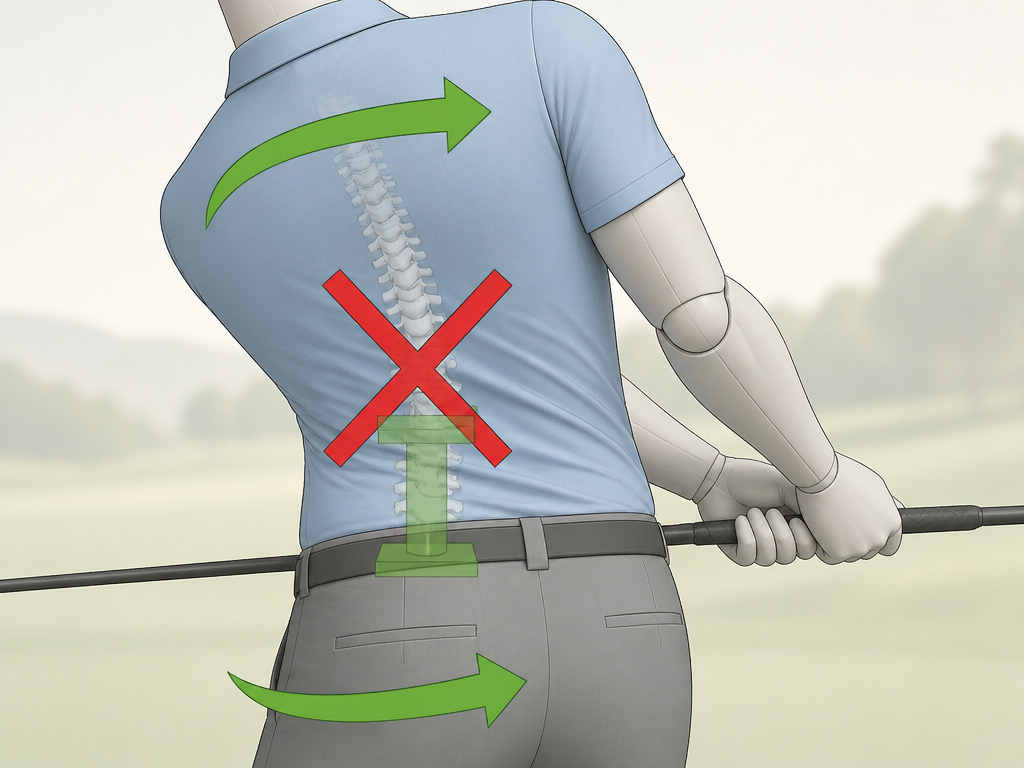
Mistake 2: Over-Rotating the Lower Back. Seeking more shoulder turn by forcing your lumbar spine to twist is a direct ticket to back pain. The fix: Focus on hip internal rotation on your trail side and thoracic spine mobility. Your lower back should be a stable pillar, not a twisting joint.
Mistake 3: Neglecting the Follow-Side. Most drills focus on the backswing position. But a restricted lead hip internal rotation will block your body through impact, causing early extension or a “spin out.” The fix: Include mobility work for your lead hip, like the band-resisted rotations mentioned above.
Mistake 4: Skipping the Cool-Down. This is where static stretching has a home. After a round or practice, your muscles are warm and pliable. Holding gentle stretches for your hamstrings, hips, chest, and back for 30 seconds each can aid recovery and gradually improve your baseline flexibility. This is a key component of any long-term plan for senior golfer flexibility routines.
Easy to miss: The connection between ankle mobility and your swing. If your ankles are stiff, your body will compensate by over-rotating your knees or hips. A simple calf stretch against a wall or a knee-over-toe lunge can have a surprising downstream effect on your entire balanced finish.
Frequently Asked Questions
How long does it take to see improvements in my swing from mobility work?
You may feel a difference in your warm-up quality immediately. Measurable changes in swing speed and consistency typically require a minimum of six to eight weeks of consistent training, two to three times per week. The seven-week exercise program from Bond University showed significant improvements in musculoskeletal tests, though swing variable changes can take longer to manifest.
Can I do these exercises if I have a bad back?
Yes, but you must proceed with caution and likely adapt. Avoid exercises that cause any sharp pain. Focus on non-rotational core stability first (like planks and dead bugs) before introducing rotation. The seated physio ball rotations are often a safer starting point than standing twists. Always consult a physical therapist or sports medicine doctor for back pain.
Are resistance bands or weights necessary?
Not for the pre-round warm-up. For the foundational training, light resistance bands are excellent for adding tension without heavy load. They’re perfect for rotational and hip work. Light dumbbells or kettlebells can be introduced for exercises like the single-leg deadlift once bodyweight mastery is achieved, but they are not a prerequisite.
What’s the single best mobility exercise for golfers?
If forced to pick one, it’s the Lunge with a Twist. It integrates hip mobility, ankle stability, core engagement, and rotational separation into one movement that directly mirrors the swing’s demand. It reveals weakness quickly – if you wobble, your balance needs work; if you can’t rotate, your thoracic spine is tight.
How does this differ from yoga for golfers?
Yoga is fantastic for general flexibility, breath control, and mindfulness. Golf-specific mobility training is more targeted. It prioritizes movements in the planes of the golf swing (horizontal rotation) and trains the body to produce power from stable positions, not just achieve extreme ranges of motion. They complement each other well, but for direct performance transfer, the golf-specific work gets results faster.
Before You Go
Mobility focuses on removing the physical barriers that keep your swing from being its most powerful, efficient version. The evidence trail is clear: dynamic beats static before you play, balance is a direct driver of distance, and targeted, consistent work rewires your movement patterns.
Start with the eight-minute warm-up before your next round. Feel the difference in your first practice swing. Then, pick two of the foundational exercises – maybe the single-leg deadlifts and the physio ball rotations – and commit to them twice a week for a month. This approach involves spending 15 minutes with purpose rather than adding another hour to your gym time.
That purpose is a more powerful, repeatable motion. It’s the feeling of your body coiling and releasing without a hitch. It’s watching your drive carry a bunker that used to be in play. The work is simple. The payoff is everything.
