
How the Rotational Golf Swing Works: Biomechanics for Distance
This post contains affiliate links. As an Amazon Associate, we earn from qualifying purchases.
This post contains affiliate links. As an Amazon Associate, we earn from qualifying purchases.
A rotational golf swing uses the body’s core, pelvis and torso, as a coiled spring, storing and releasing energy in a specific sequence to maximize clubhead speed. The key metrics are the X-Factor (shoulder-to-hip separation), S-Factor (shoulder tilt), and O-Factor (hip tilt), with professionals showing remarkably consistent rotational velocities. Power comes from the kinematic sequence: pelvis rotates first, then torso, then arms, then club, creating a whip-like effect.
That coiled-spring analogy is a measurable physical system. The difference between a 250-yard drive and a 280-yard drive often lives in a few degrees of separation and a fraction of a second in timing.This breakdown moves past swing thoughts and into the mechanics you can actually train.
What follows: the three measurable factors that define rotation, the non-negotiable sequence that transfers energy, the stark consistency gap between pros and amateurs, and how misapplied rotation leads directly to the most common golf injuries. By the end, you’ll watch a swing video and see the engine, not just the motion.
Key Takeaways
- The X-Factor (torso-pelvis separation) is the primary power source, but its velocity (X-Prime) at impact matters more than its maximum stretch.
- Professional golfers show extreme consistency in rotational metrics like peak free moment (6.8% variation) versus amateurs, which is a bigger differentiator than raw flexibility.
- The correct kinematic sequence is pelvis → torso → arms → club. Starting down with the shoulders “spins out” the sequence and drains power. Improper rotation is the leading cause of low back pain in golfers, from excessive shear forces on the spine.
- Training rotation effectively requires focusing on the downswing initiation, reversing the pelvis first while maintaining upper torso coil.
The Core Components of Rotation: X, S, and O-Factors
Forget trying to “turn more.” You need to measure what you’re actually doing. Research breaks down the rotational swing into three specific angles projected in the horizontal plane.
The X-Factor is the angle between the line of your shoulders (acromion processes) and the line of your hips (anterior superior iliac spines). It’s the classic “coil.” At the top of a professional’s backswing, this averages around 43 degrees, with a tight variation of just 7.4%. It’s not about achieving a huge number; it’s about creating a reliable, elastic stretch you can use.
The S-Factor (shoulder obliquity) and O-Factor (pelvic obliquity) describe side-to-side tilting. A positive S-Factor means the lead shoulder is lower than the trail shoulder at address, that’s standard. Excessive O-Factor tilt often signals a reverse pivot or sway. These factors matter for maintaining a centered pivot and delivering the club on plane.
Technical Snippet: In biomechanical studies, the X-Factor is calculated as the relative angular position of the pelvis and upper torso projected into the horizontal plane. Professional golfers demonstrate a coefficient of variation for peak X-Factor of 7.4%, indicating high movement pattern consistency, whereas amateur golfers show significantly greater variability.
Where does power really come from? It’s not the static X-Factor stretch at the top. It’s the rate at which you unwind that stretch, the X-Prime, or the relative rotational velocity between your torso and pelvis during the downswing. A study of recreational golfers found a direct, moderate relationship between increased ball velocity and increased torso-pelvic separation velocity in the last 40 milliseconds before impact. The spring must snap back fast.
The Kinematic Sequence: The Order of Operations
You can have perfect X-Factor stretch and still hit it short if your sequence is broken. The kinematic sequence is the non-negotiable order of energy transfer: pelvis rotates first, then torso, then lead arm, then the club.
Initiate the downswing by reversing the rotation of your pelvis toward the target. The upper torso should momentarily resist, increasing the X-Factor stretch even further for a few critical milliseconds. This is the “delay” that loads the whip. Then the torso fires, pulling the arms, which finally release the lag in the club. When this sequence is optimal, each segment peaks in speed after the one before it has already started to decelerate, efficiently transferring momentum.
Where this goes sideways: Starting the downswing with your shoulders or arms. This “spinning out” collapses the X-Factor immediately, eliminates the critical delay, and forces you to throw the club from the top with your hands. The result is a weak, inconsistent slice because the sequence is now arms → club → torso, with the pelvis trailing behind.
Research on elite male golfers confirms this. The downswing is initiated by the reversal of pelvic rotation, followed by the reversal of upper-torso rotation. This sequence was observed in every swing for every golfer in the study. Getting this order wrong is the fundamental barrier between amateur and professional power generation.
How the Pros Measure Up: Consistency Over Max Effort
Amateurs focus on maximum rotation. Professionals focus on repeatable rotation. The data makes this distinction brutally clear.
A study measuring rotational biomechanics in ten professionals and five amateurs found professionals are machines of consistency. Their peak free moment per kilogram of force showed a coefficient of variation of just 6.8%. Their peak X-Factor varied by only 7.4%. Amateurs showed far wider swings in these metrics from shot to shot. This consistency allows pros to calibrate their strike with precision; amateurs are guessing because their engine speed fluctuates.
| Rotational Metric | Pro Consistency (Coefficient of Variation) | What It Means for Your Game |
|---|---|---|
| Peak Free Moment/kg | 6.8% | The rotational force they apply into the ground is nearly identical every swing. |
| Peak X-Factor | 7.4% | Their shoulder-hip coil is reliably set at the top, creating a predictable power source. |
| Peak S-Factor | 8.4% | Their shoulder tilt at impact is controlled, promoting a consistent club path. |
Furthermore, these rotational metrics are powerfully linked to output. The same study found that peak free moment per kilogram, X-factor at impact, and peak upper-torso rotation were highly correlated to Clubhead Speed at Impact, with median correlation coefficients of 0.943.The efficiency of the rotation directly dictates clubhead speed.
The part nobody mentions: Trying to mimic a pro’s max X-Factor stretch without their hip and core mobility is a direct ticket to lower back pain. For amateurs, a repeatable, controlled 30-degree coil you can use aggressively is better than a forced 45-degree coil that you can’t sequence or stabilize.
The Direct Link to Power and Common Injuries
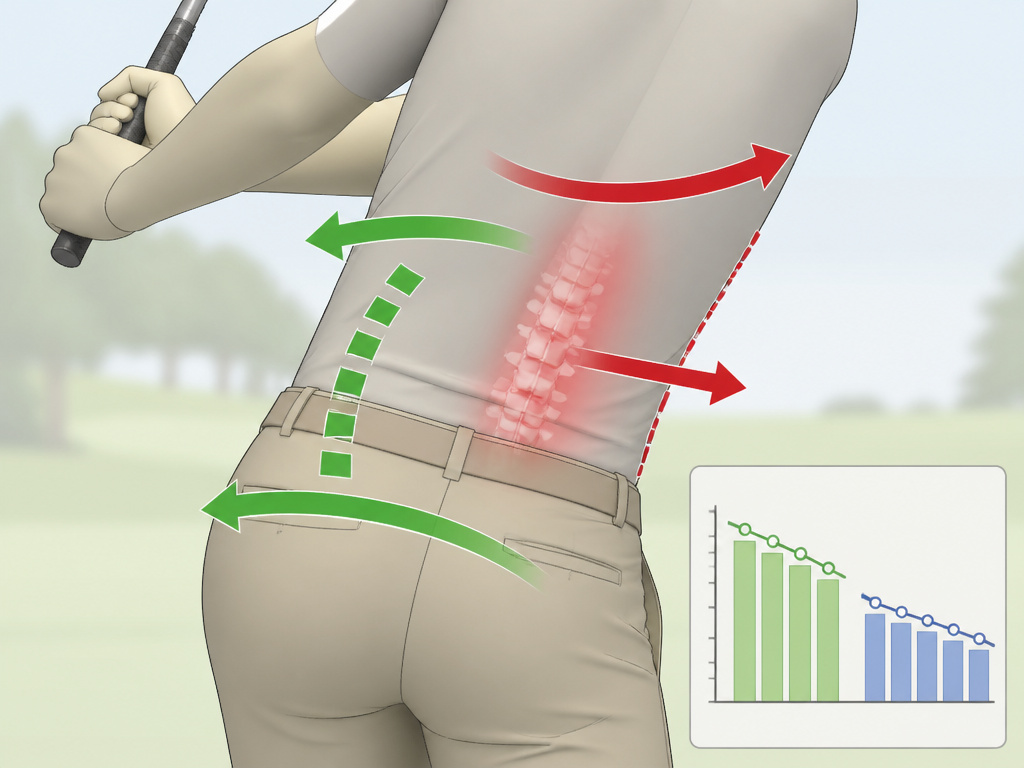 The rotational swing is a high-torque activity. Done correctly, it’s powerful. Done incorrectly, it’s destructive. The mechanics of power and injury are two sides of the same coin.
Power generation is a product of rotational velocity and efficient sequencing. The Swing Performance Index (SPI), a single-score metric combining pelvic and torso rotational velocities, cleanly separates pros from amateurs. Professionals averaged an SPI of 100, amateurs averaged 82. That gap represents the combined deficit in sequence, speed, and timing.
The body part that pays the price for poor rotation is almost always the lower back. It represents over a quarter of all golf injuries. The mechanism is often a “supramaximal” axial rotation of the trunk, trying to rotate the shoulders too far without the pelvic mobility or stability to support it. This places excessive shear and lateral-bending forces on the lumbar spine.
- Overuse injuries (common in professionals): Stem from the repetitive, high-force rotation of a proper sequence, often affecting the lead side.
- Trauma/improper mechanics injuries (common in amateurs): Stem from the violent, unsequenced rotation of a faulty pattern, like spinning out or reverse pivoting.
The fix is to rotate better. A proper kinematic sequence reduces peak stress on the spine by ensuring forces are distributed and timed correctly.This is why understanding swing biomechanics is as much about longevity as it is about distance.
Training Rotation: What to Actually Work On
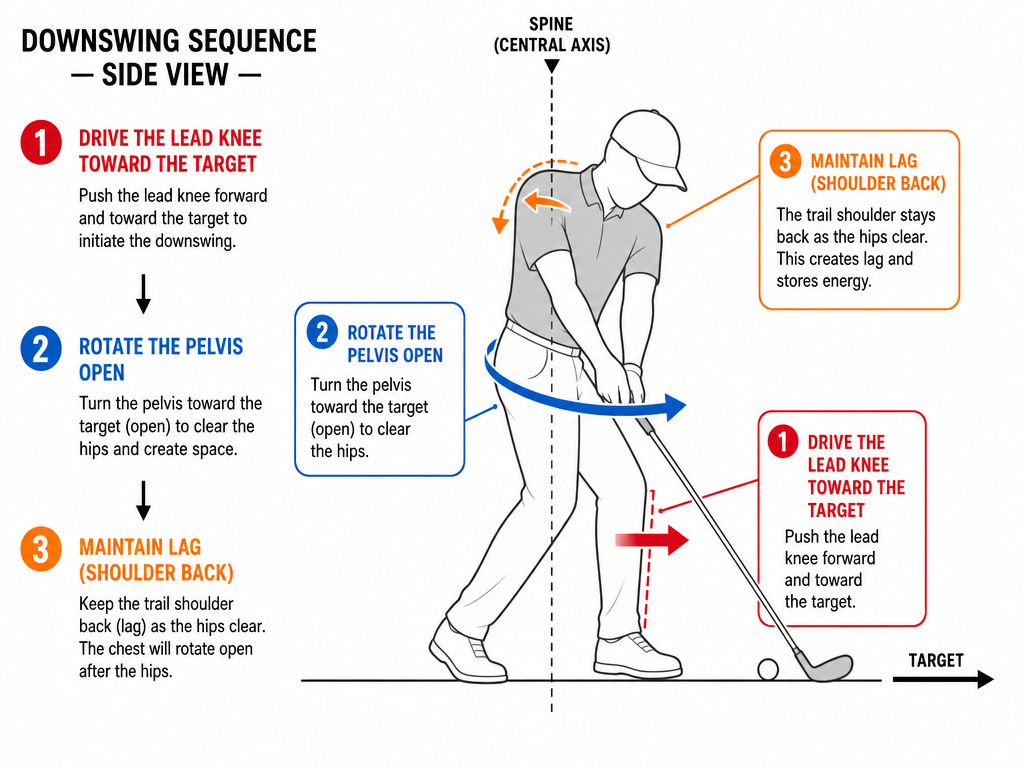 Knowing the theory is one thing. Changing your motion is another. Focus your practice on these two non-negotiable elements.
First, own the downswing initiation. This is the master key. Practice starting down by gently pushing your lead knee toward the target, letting the pelvis rotate open. Your shoulders and club should feel like they are being left behind. Use a mirror or video to check that your trail shoulder is not moving toward the ball before your hips have started to clear. Drills that emphasize lag are actually drills for proper sequencing.
Second, build rotational mobility separately from your swing. This is about training your pelvis and thoracic spine to rotate independently. * For the Hips/Pelvis: Work on internal rotation of your trail hip in your backswing stance.If it’s stiff, your pelvis will tilt (excess O-Factor) instead of rotate. * For the Torso: Practice rotating your upper body over a stable pelvis. This directly improves your ability to create and hold the X-Factor.
Avoid the trap of working on your backswing in isolation. A great backswing position is useless if you cannot transition from it correctly. Always connect backswing drills to a deliberate, sequenced downswing trigger.
Rotational Faults and Their Fixes
Even with good intent, common faults corrupt the sequence. Here’s how to diagnose and address them.
Fault: Spinning Out (Early Extension)
Cause: Initiating the downswing with the upper body. The hips slide toward the ball instead of rotating, the chest opens early, and the spine angle is lost. Fix: Feel like your first move down is to drag your trail elbow toward your trail hip. This encourages the pelvis to lead. Place a headcover just outside your trail foot and focus on rotating your trail hip back away from it to start down.
Fault: Reverse Pivot
Cause: Weight hangs back on the trail side during the downswing. This starves the swing of rotational force and often comes from a misunderstanding of weight shift. Fix: This is a rotation into the lead side. Practice swings feeling 70% of your weight on your lead foot at the top of the backswing.A proper weight transfer is a rotational fall, not a lateral lunge.
Fault: Excessive Sway
Cause: The entire body moves laterally off the ball during the backswing, then must lunge back to reach it. This destroys any chance of a stable, rotational coil. Fix: Feel a firm, braced inside post of your trail leg. Your head should not move laterally more than an inch or two behind the ball. Focus on turning around your spine, not away from the target. Learning to stay centered is foundational, as detailed in our guide on correcting sway in the swing.
| Fault | Primary Effect on Rotation | Feel-Based Fix |
|---|---|---|
| Spinning Out | Collapses X-Factor; sequence becomes shoulders-first. | “Start down by pulling the right hip backward.” |
| Reverse Pivot | Eliminates pelvic drive; power comes only from arms. | “Feel 70% weight on left foot at the top of the swing.” |
| Excessive Sway | Destroys coil stability; forces a compensatory lunge. | “Turn your back to the target, don’t drift away from it.” |
Frequently Asked Questions
Does a bigger shoulder turn mean more power?
Not necessarily. Power comes from the speed of unwinding the coil (X-Prime), not just the size of the coil (X-Factor). An over-rotated backswing can compromise balance, stability, and the ability to sequence the downswing correctly. A controlled, stable coil you can aggressively unwind beats a maxed-out, loose coil every time.
What is the “kinematic sequence” and why is it important?
The kinematic sequence is the order in which body segments reach peak speed during the downswing: pelvis first, then torso, then arms, then club. This sequence is crucial for efficient energy transfer, like cracking a whip. If the sequence is out of order (e.g., arms fire before hips), energy is lost, resulting in less clubhead speed and inconsistent contact. Research in journals like the Acta of Bioengineering and Biomechanics shows that even the method of measuring this sequence can affect its identification, highlighting its technical complexity.
How do I know if I’m rotating correctly?
The best feedback is video. Face-on, draw a line down your trail hip at address. At the top of your backswing, your trail hip should rotate behind that line, not just slide laterally along it. Down-the-line, check that your lead shoulder moves downward and under your chin in the downswing, not outward toward the ball. For a deep dive on the paths rotation can take, compare the one-plane vs two-plane swing styles.
Can improving my rotation help prevent back pain?
Yes, significantly. Most golf-related low back pain stems from improper rotational mechanics, such as “spinning out” with the shoulders, which places high shear forces on the spine. Learning a proper sequence where the pelvis initiates the movement reduces peak lumbar stress. The UConn golf swing model thesis and other biomechanical research directly link specific rotational patterns to spinal loading.
What’s the difference between a one-plane and two-plane swing rotation?
The difference is in the relationship between arm swing and body rotation. In a one-plane swing (associated with Moe Norman), the arms and shoulders rotate on a similar, single inclined plane around a stable spine. In a two-plane swing, the arms swing more vertically in the backswing while the shoulders rotate on a more horizontal plane, requiring more re-routing in the downswing. Both require excellent core rotation, but the one-plane method simplifies the swing plane geometry.
How does rotation affect swing rhythm?
Rotation is the engine of rhythm. A proper kinematic sequence creates a natural, accelerating tempo: a slower initiation from the ground up, building to a fast release. Poor rotation, like a jerky, arm-led start, shatters rhythm. Good rotation feels like a smooth, gathering wave of speed. Mastering the swing tempo that stems from this sequence is a hallmark of better players.
The Bottom Line
A rotational golf swing is physics, not magic. The goal is to move from feeling “tight” or “loose” to understanding X-Factor stretch, kinematic sequence, and rotational velocity. Professionals don’t swing harder in a vague sense; they rotate their core segments with remarkable consistency and in a specific order.
Chase consistency of movement, not maximum range of motion. Work on the downswing trigger, pelvis first, every time, more than your backswing pose. And listen to your body: lower back pain is often a bill for poor rotational mechanics, not just overuse. Integrate this knowledge with other key concepts like the single-plane technique to find the style that matches your physique. When you sync your body’s engine, the speed and strikes take care of themselves.
