
Your Guide to How to Hit Irons Consistently on the Course
This post contains affiliate links. As an Amazon Associate, we earn from qualifying purchases.
This post contains affiliate links. As an Amazon Associate, we earn from qualifying purchases.
To hit irons consistently, lock down three setup fundamentals: progressive ball position (center for short irons, forward for long), a stable stance width (shoulder-width for mid-irons), and 55% weight on your lead foot. From there, make a balanced, descending strike where the club hits the ball first and the divot starts ahead of it.
The gap between a pure 7-iron and a thinned blade is a predictable failure in one of those three setup numbers. Get those wrong, and your swing is just a series of frantic compensations that might work once on the range but never under pressure.
What follows is the breakdown of each number, the swing thought that actually works, and the two drills that force your body into the right positions. You’ll also get a clear map of the most common misses, fat, thin, left, right, and the one adjustment that fixes each.
Key Takeaways
- Move the ball forward in your stance as the club gets longer: center for a wedge, one ball-width forward for a 7-iron, two ball-widths forward for a 4-iron.
- Start with 55% of your weight on your lead foot and keep it there; shifting weight back during the swing is the #1 cause of fat shots.
- A proper divot starts at the ball, not behind it. If your divot is behind the ball, your low point is wrong. The “feet together” drill is a diagnostic tool that exposes balance flaws you can hide with a normal stance. If you consistently struggle with long irons, switch to a hybrid.Your scorecard doesn’t care what club you use.
The Setup: Your Pre-Swing Non-Negotiables
Your swing is a reaction to your setup. A flawed address position guarantees a flawed impact. You can’t consistently deliver the clubhead correctly if you start from the wrong place.
The variables are simple: where you stand, where the ball is, and how your weight is distributed. Get these three right, and the swing becomes a matter of rhythm, not rescue.
A proper iron setup positions the body to deliver a descending blow. The hands should be ahead of the ball, the spine tilted forward from the hips, and the weight favoring the lead side. This geometry places the low point of the swing arc just ahead of the ball, ensuring ball-first contact.
Ball Position: It Changes With Every Club
Playing every iron from the same spot is the most common amateur mistake. A one-size-fits-all ball position forces you to manipulate the club in the downswing to make contact.
Use this progressive system: * Short Irons (PW, 9i, 8i): Center of your stance. * Mid Irons (7i, 6i, 5i): One ball-width forward of center. * Long Irons & Hybrids (4i, 3i): Two ball-widths forward of center, roughly in line with the logo on your shirt.
This works because longer clubs have a flatter, wider swing arc. The bottom of that arc occurs farther forward in your stance. Positioning the ball forward lets you strike it as the club is descending, not as it’s already climbing.
Another method is the “inches to iron number” rule. For a right-handed golfer, measure from your left heel. A 7-iron sits 7 inches inside that heel. This method naturally pushes longer irons farther forward, reinforcing the same principle.
| Club Type | Ball Position | What Goes Wrong If It’s Off |
|---|---|---|
| Short Iron (PW-8i) | Center of stance | Too far forward: Thin or topped shots. Too far back: Low, digging hooks. |
| Mid Iron (7i-5i) | 1 ball-width forward of center | Too far back: Low, piercing shots that are hard to stop. Too far forward: Fat shots or a loss of compression. |
| Long Iron (4i+) | 2 ball-widths forward of center | Too far back: Extreme delofting, impossible to get airborne. Too far forward: You’ll hit the ground before the ball. |
Stance Width & Posture: Your Stability Platform
Stance width provides the foundation for rotation. Too wide, and you can’t turn. Too narrow, and you’ll sway.
- Mid Irons: Shoulder-width apart. This is your baseline.
- Short Irons: Slightly narrower than shoulder-width. The shorter shaft and more upright swing need less rotational base.
- Long Irons: Slightly wider than shoulder-width. The longer shaft and flatter plane require more stability.
From here, hinge forward from your hips until your hands hang naturally below your shoulders. Your back should be straight, not rounded. A useful checkpoint: you should feel a slight tension in your hamstrings.
Weight & Shaft Lean: The Impact Pre-Set
At address, preset the conditions you want at impact. That means forward weight and forward hands.
Start with roughly 55% of your weight on your lead foot. For a long iron, you might start closer to 50-50 to promote a shallower attack. Lean the shaft forward so your hands are ahead of the ball, about in line with your lead thigh. This forward press delofts the club slightly and encourages the downward strike you need.
Common mistake: Setting up with weight balanced or on the back foot. This forces a drastic weight shift forward during the downswing, which most amateurs time poorly. The result is a fat shot, where the club hits the ground first.
The Swing: One Move, Not a Checklist
Forget backswing positions and perfect planes. The iron swing is about one coordinated motion: turning your chest away from the target and then turning it through, with your arms and club following.
Your arms are connectors. Let your torso lead the backswing, feeling a stretch in your lead side.Your first move down should be your lead knee shifting toward the target, pulling your hips and then your chest through.
The feeling is of your chest covering the ball through impact. If your head stays relatively level and your chest rotates past the ball, you’ll compress it.
The One Swing Thought That Works
“Lead with the handle.” That’s it. On the downswing, focus on driving the butt end of the club toward the ball. This thought maintains forward shaft lean, delays the release of the clubhead, and ensures a descending blow. It turns a “hit” into a “strike.”
Why You Must Hit Down to Make It Go Up
This is the non-negotiable physics of an iron. The loft on the clubface launches the ball. Your job is to trap the ball between the clubface and the ground, creating backspin. That requires a descending angle of attack.
A good visual: imagine trying to take a divot that starts an inch in front of the ball. You’re not trying to pick it clean. You’re pinching it against the turf.
The Drills That Build Consistency
Theory is useless without feel. These two drills program the correct movements.
1. The Feet-Together Drill
This is the ultimate diagnostic tool. Hit shots with your feet touching or nearly touching.
- What it fixes: Swaying, loss of balance, over-the-top moves.
- How to do it: Take a 9-iron and make half-swings. Focus on making solid contact without losing your balance. If you fall forward or backward, your sequence is off.
- The carryover: The balance and core engagement you learn here translate directly to a powerful, stable full swing. It teaches you to rotate around a stable center.
2. The Low-Point Line Drill
This drill gives you instant, visual feedback on your most important skill: controlling where the club hits the ground.
- What it fixes: Fat and thin shots.
- How to do it: On the range, place a line of chalk or use a broken tee to create a line perpendicular to your target, about two feet long. Place the ball at the front end of this line. Your goal is to make your divot start at the ball and extend forward along the line.
- The result: You’ll see immediately if you’re hitting behind the ball (divot starts behind the line) or scooping (no divot). This drill trains the feeling of moving your low point forward.
Common Iron Misses & Fixes

Even with good mechanics, you’ll have bad days. Here’s how to diagnose and fix the four most common iron misses in two minutes or less.
| Miss | Likely Cause | Quick Fix |
|---|---|---|
| Fat (ground first) | Weight stays on back foot through impact. | Feel like your lead hip is pulling away from your head on the downswing. Keep 55% weight forward. |
| Thin or Topped | Standing up through impact, losing spine angle. | Focus on keeping your head level. Feel like your right shoulder works under your chin on the downswing. |
| Pull/Hook (left) | Clubface is closed at impact. Grip is too strong or forearms over-rotate. | Check your grip. The “V”s formed by thumb and forefinger should point to your trail shoulder. |
| Push/Slice (right) | Clubface is open at impact. Body stalls, arms take over. | Strengthen your grip slightly. Focus on rotating your chest all the way through to the finish. |
Where this goes sideways: Trying to fix a path issue with a face adjustment, or vice versa. A slice isn’t always an open face, it can be an out-to-in path with a square face. If your fix isn’t working within three shots, you’re probably correcting the wrong thing.
The Long Iron Solution: Just Switch
If you’ve tried everything and your 4-iron still produces more anxiety than altitude, the fix is a different club.
A modern 4-hybrid or 5-hybrid has a wider sole, lower center of gravity, and is designed to get the ball airborne easily. The distance is similar, the ball flight is higher and softer, and the consistency is dramatically better for most players. Embracing hybrids is a strategic move, not a concession. It’s one less thing to worry about when you’re staring down a 200-yard approach. Our guide on how to hit long irons dives deeper into the technique, but know that the hybrid is a valid, and often smarter, choice.
How to Practice for Lasting Improvement
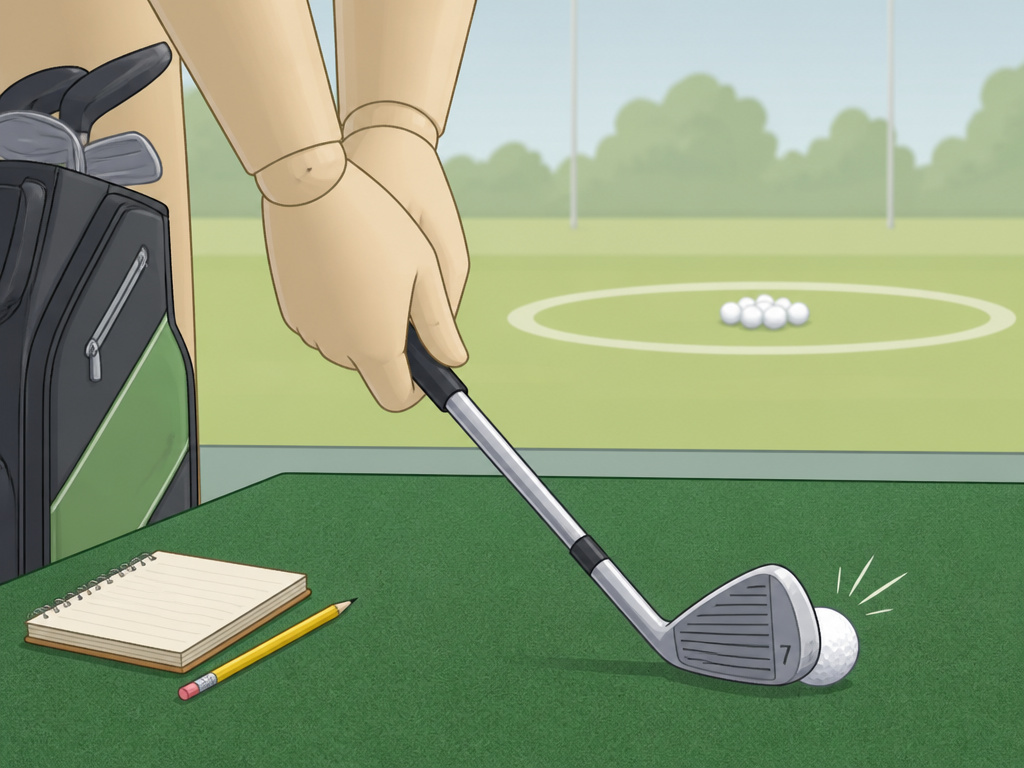
Mindless beating of balls reinforces your current flaws. Purposeful practice rewires them.
Don’t just hit at a green. Pick a specific target and a specific club. Your goal is not distance; it’s dispersion. Can you hit ten 7-irons within a 20-yard circle? That’s control.
Spend one range session with a notebook or your phone and document your real carry distances. Hit ten shots with each scoring iron (7i through PW) and note the average. Most amateurs overestimate by 10-15 yards. Knowing your true number eliminates one major guess on the course.
Finally, mix in the uncomfortable shots. Practice that sidehill lie and that uphill lie. Hit partial wedge shots to three different flags. This variability builds the adaptability you need for real golf.
Frequently Asked Questions
Why do I keep hitting behind the ball with my irons?
You are likely keeping your weight on your back foot or shifting it back during your downswing. This moves the low point of your swing arc behind the ball. The fix is to set up with 55-60% of your weight on your lead foot and make a conscious effort to keep it there. Think about your lead hip pulling away from your head as you start down.
Should I take a divot with every iron shot?
Yes, but it should be a shallow, dollar-bill-sized divot that starts at or just in front of the ball. No divot often means you’re scooping, which reduces spin and control. A deep, trench-like divot means your angle of attack is too steep. The ideal is a brushed patch of turf after the ball has been struck.
How can I stop scooping or trying to help the ball up?
Trust the loft on your club. Your job is to hit down; the club’s job is to launch the ball up. A great drill is to place a tee about two inches in front of your ball on the range. Focus on hitting the ball and then the tee. This promotes a downward strike and proper ball compression.
What’s more important, swing path or clubface?
For consistency with irons, clubface control is paramount. A square face with a slightly off-path swing will still produce a playable shot. An open or closed face, even with a perfect path, will send the ball wildly off-line. Work on delivering a square face at impact through grip and body rotation.
Are game improvement irons worth it for consistency?
Absolutely. Game improvement irons are designed with perimeter weighting and a lower center of gravity to make off-center hits more forgiving. They help maintain ball speed and direction on thin or toe strikes that would be penal severely with a blade. If your goal is more consistent outcomes, not shot-shaping, they are an excellent choice. The debate between cavity back irons vs blade irons often comes down to this trade-off between forgiveness and workability.
Before You Go
Consistent iron play is about a repeatable setup and a simple intention. Nail the three numbers, ball position, stance width, and forward weight.Then, make a balanced turn where your chest leads the way and your hands stay ahead of the ball.
Spend your next range session on the feet-together drill and the low-point line. They provide faster feedback than any swing tip. And if a long iron continues to betray you, pick up a hybrid without a second thought. The goal is lower scores, not stylistic points. Now go find a flag and start throwing darts.
