
How to Hit From an Uphill Lie: The Complete Swing & Aim Guide
This post contains affiliate links. As an Amazon Associate, we earn from qualifying purchases.
This post contains affiliate links. As an Amazon Associate, we earn from qualifying purchases.
To hit from an uphill lie, match your shoulders to the slope, position the ball forward, and take one more club. The slope adds effective loft, launching the ball higher and shorter. Your main adjustments are stance, aim, and club selection, but experts disagree on where your weight should go and which way to aim.
That disagreement isn’t academic. It’s the difference between a confident approach and a double-cross into the trees. One major instruction site says aim left; another top teacher says aim right. One tells you to feel weight on your downhill leg, another says shift it forward.
What follows cuts through the noise. It’s a physical breakdown of why the ball behaves the way it does, a step-by-step setup that works, and a clear take on where the conflicting advice actually applies. You’ll know exactly how to adjust your aim based on the shot you’re facing.
Key Takeaways
- The slope adds loft. An uphill lie effectively adds 2-4 degrees of loft to your club, making the ball fly higher and land shorter. Always take one more club.
- Match your shoulders to the hill. Tilt your lead shoulder down and your trail shoulder up until your shoulder line is parallel to the ground. This keeps your swing on-plane.
- Experts fight over aim. For a standard uphill approach shot, the slope can close the face, pulling the ball left. Many pros say aim right to compensate. For a severe greenside chip with the ball above your feet, the lie can point the face left at address, some say aim right for that, too.
- Weight distribution depends on the shot. For a full swing, feel more weight on your downhill leg to anchor against the slope. For a short chip, a wider stance with weight forward keeps you from falling back.
- Ball position is non-negotiable. Play the ball forward in your stance, toward your higher foot. Putting it back guarantees a fat shot or a whiff.
Why an Uphill Lie Changes Everything
An uphill lie alters three things simultaneously: your balance, your club’s loft, and the geometry of your strike. It’s not just a hill. It’s a machine that modifies your swing.
The primary mechanical shift is effective loft. When you set your shoulders parallel to the slope, the clubhead soles naturally behind the ball. This angles the clubface upward, adding loft. A 7-iron can play like a 9-iron. The ball launches higher, spins more, and falls out of the sky faster. Distance loss is guaranteed if you don’t club up.
Balance is the second thief. The incline pulls your weight toward your back foot. Your instinct is to fight it by leaning into the hill, which often leads to topping the ball. Or you give in to the pull and fall back, hitting fat behind it. A proper stance negotiates this tug-of-war.
Finally, the lie changes your swing path. To avoid digging into the hill behind the ball, your body must swing along the slope, not against it. That requires a specific shoulder and hip alignment. Get it wrong, and the club either jams into the turf or swings over the top of the ball.
A 2021 PGA.com instruction piece by Keith Stewart, PGA, notes that the fundamentals of hitting from uneven lies are about changing your setup to account for the slope, not changing your swing. The adjustment happens before you take the club back.
The 5-Step Uphill Lie Setup (And Why Step 3 is Contested)
This sequence happens before your waggle. Skip a step, and the shot unravels.
1. Shoulders First, Not Feet.
Forget your stance for a second. Plant your feet roughly shoulder-width apart, then tilt your upper body. Lower your lead shoulder and raise your trail shoulder until your shoulder line feels parallel to the ground under your feet. This is the single most important adjustment. It sets the plane for your entire swing.
2. Position the Ball Forward.
With your shoulders tilted, place the ball opposite your higher foot (the left foot for a right-handed golfer). This forward position ensures the clubhead reaches the ball at the bottom of its arc, not after it’s already climbing back up the hill. A center or back-ball position is a recipe for a thin or fat shot.
3. The Aiming Argument.
Here’s where instruction splits. The slope can cause the clubface to point left of your target line at address for a right-handed player. * The “Aim Right” Camp: Golf.com instructor James Hong advises this for severe greenside uphill lies, stating the closed face angle must be offset. * The “Aim Left” Camp: PGA.com’s Keith Stewart suggests aiming more left for an uphill shot to account for shot movement. The resolution? For a full swing from a moderate uphill lie, the ball tends to draw due to the swing path. Many experienced players aim slightly right. For a short chip with the ball well above your feet, the face points left at address, aim right to allow for it. You must diagnose your own shot.
4. Set Your Weight Distribution.
Another debate. Do you anchor against the slope with weight on your downhill leg, or shift forward to promote ball-first contact? * Full Shots: Feel 60-70% of your weight on your downhill leg. This stops you from falling back through impact. The Golf Distillery notes the hill will try to push your weight back; a solid base resists it. * Chips & Pitches: Use a wider stance and feel weight on your front foot. This promotes a descending strike and prevents chunking.
5. Widen Your Stance for Balance.
A slightly wider stance than normal lowers your center of gravity. It gives you a stable platform to rotate against. Don’t overdo it, just an inch or two wider than your normal width. This is especially critical on severe slopes.
| Adjustment | Standard Advice | The Why (Mechanism) | If You Skip It |
|---|---|---|---|
| Shoulder Tilt | Match shoulders to slope | Keeps swing path along the incline, not into it | Club digs into hill behind ball; fat shot |
| Ball Position | Forward, toward higher foot | Places ball at low point of swing arc on the slope | Strike is above or behind ball; thin or fat |
| Aim | Depends on shot type (see debate) | Counters closed clubface geometry from the lie | Ball starts left of target; often draws further left |
| Weight | Downhill leg (full), front foot (short) | Anchors against slope’s pull or ensures downward strike | Loss of balance; topped or chunked contact |
| Stance Width | Slightly wider than normal | Increases stability on uneven ground | Sway during swing; inconsistent strike |
Club Selection & Distance Control
This is where ego loses strokes. The added loft is real, and the distance penalty is predictable.
Take More Club.
The universal rule is to take one more club. That means if you have 150 yards to the pin and normally hit an 8-iron, hit a 7-iron. The slope may add 2-4 degrees of loft, turning your 7-iron into an 8-iron’s trajectory. On a severe slope, consider two clubs. It’s better to be at the back of the green than short in the bunker.
Expect a Higher, Softer Landing.
The ball will fly on a steeper trajectory and land with more spin. This isn’t a bad thing. It means you can attack pins, as the ball will stop quicker. Don’t try to force a lower flight; swing normally and let the loft do its work. Trying to “keep it down” usually leads to a lean back and a topped shot.
Common mistake: Using your normal club. The effective loft added by the slope can shorten your carry by 10-15 yards per club. That’s the difference between the front edge and the middle of the green.
How to Grip the Club.
You might need to grip down slightly. A wider stance brings you closer to the ball. Choking down an inch maintains your normal posture and control. Don’t stand farther away to compensate; that disrupts your balance and makes the club feel too long.
Uphill Lie vs. Other Uneven Lies
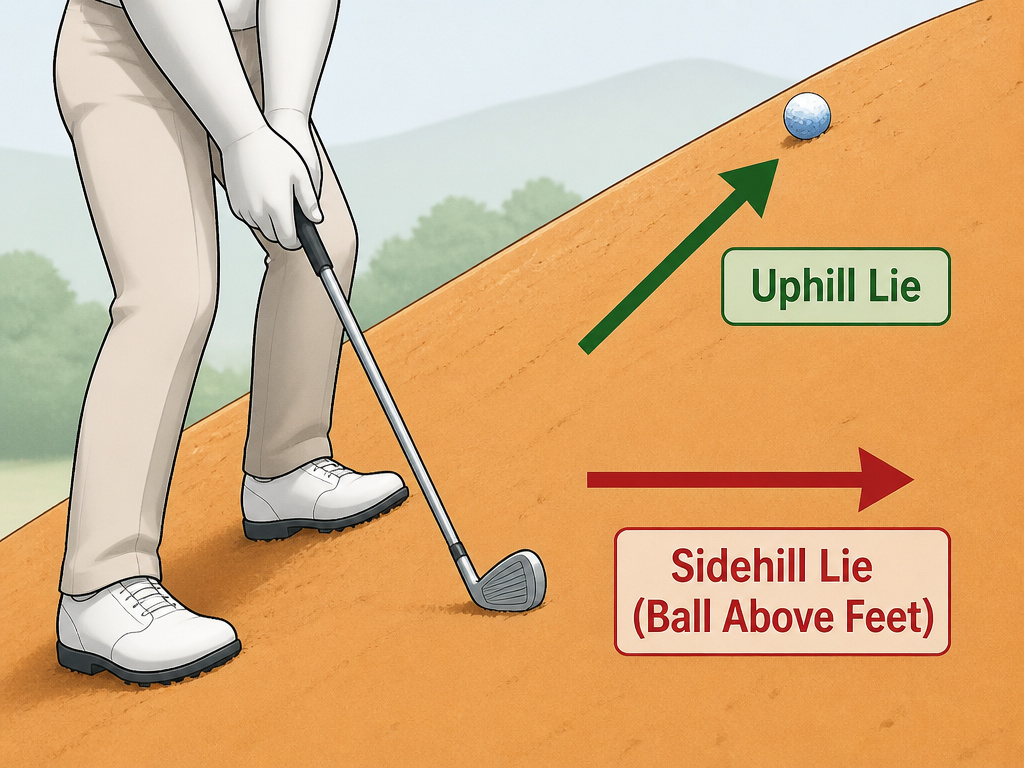
An uphill lie has a cousin: the sidehill lie with the ball above your feet. They’re often confused, but the adjustments are different.
Uphill Lie vs. Downhill Lie
These are opposites. An uphill lie adds loft; a downhill lie subtracts it. On a downhill slope, you must deloft the club, take less club, and lean with the slope. The weight shift moves to your front foot, and the ball flight is lower and longer. Mixing up these adjustments is a common error.
Uphill Lie vs. Sidehill Lie (Ball Above Feet)
This is the tricky one. A sidehill lie with the ball above your feet primarily affects direction, causing a left-to-right shot for a righty. The adjustment is to aim right and grip down. An uphill lie primarily affects loft and distance. You can have a combination lie, both uphill and above your feet, which requires blending the adjustments: take more club, aim right, and tilt your shoulders.
Knowing when to use each set of rules prevents big misses. If you’re ever unsure, the safe play is to take your medicine and declare an unplayable lie if the stance is too severe, rather than risking a disaster.
Drills to Practice Uphill Lies
You can’t always find a practice range with slopes. These drills train the feel.
The Shoulder-Tilt Mirror Drill.
At home, stand with your feet on a sloped surface (a driveway, a hill in your yard). Get into your address position without a club. Use a mirror or your phone’s camera to check your shoulder line. Tilt until it’s parallel to the ground. Hold for 30 seconds. This builds the muscle memory for the key setup position.
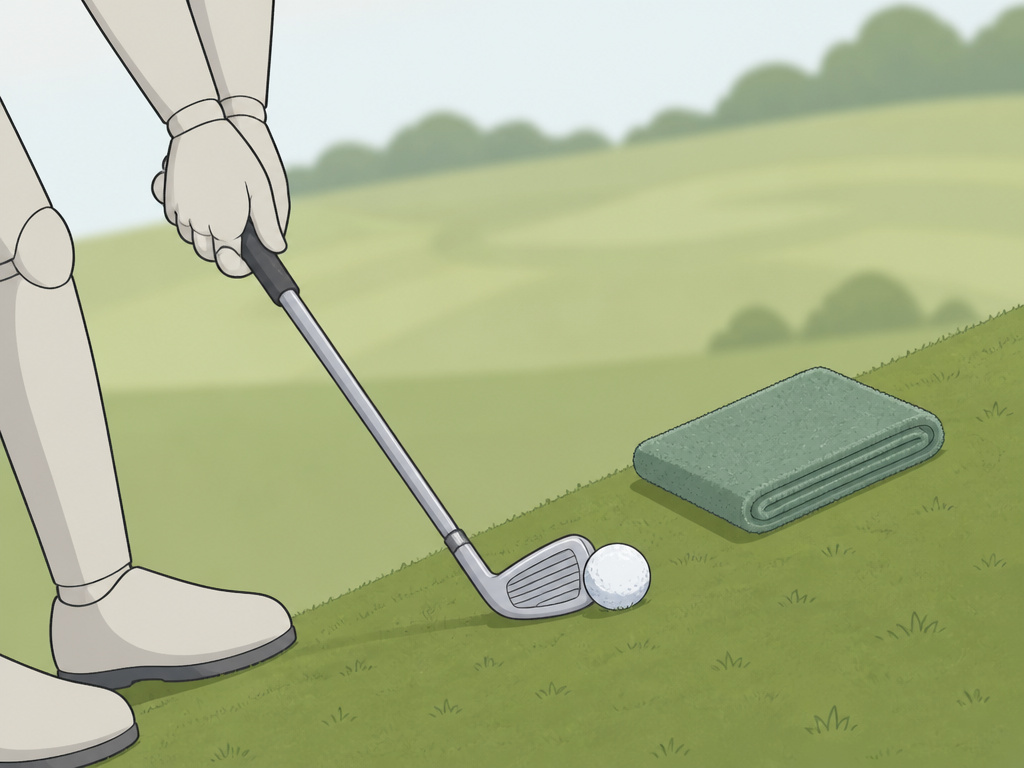
The Towel Behind the Ball Drill.
On the range, find any slight incline. Place a towel on the ground just behind the ball on the upslope side. Your goal is to hit the ball without touching the towel. This forces you to match your shoulders to the slope and strike the ball first. Hitting the towel means you’re swinging down too steeply into the hill.
The Two-Club Comparison.
Hit five balls with your normal club for a given distance from an uphill lie. Note where they land. Then hit five balls with one more club. The difference will be obvious and will convince you to always club up. This drill builds trust in the adjustment.
Practice these with your mid-irons first. Once comfortable, practice with your wedges for those tricky punch shot situations from uphill lies in the rough.
Frequently Asked Questions
Does an uphill lie make the ball go left or right?
For a right-handed golfer, a pure uphill lie (not combined with a sidehill) often promotes a draw or hook, pulling the ball left. This is because the swing path tends to be more in-to-out along the slope, and the clubface can close relative to that path. However, if the ball is also above your feet, the face may point left at address, requiring a right aim. You must assess the lie.
Where should your weight be on an uphill lie?
For a full swing, most of your weight should feel anchored on your downhill leg (right leg for a righty). This prevents you from falling back down the slope during your swing. For a short chip or pitch, a wider stance with weight favoring your front foot helps ensure ball-first contact. The “weight forward” advice often applies to short game shots.
What is the biggest mistake amateurs make?
Using the same club they would use from a flat lie. This is called under-clubbing, and it leaves every shot short. The second biggest mistake is not tilting their shoulders to match the slope, causing the club to dig into the hill behind the ball for a fat shot.
Can you hit a driver from an uphill lie?
You can, but it’s a low-percentage shot for most. The added loft will create a very high, spinning drive that loses significant distance. The optimal play is often to hit a 3-wood or even a long iron for position. If you must hit driver, tee it very low, position the ball forward, and expect a ballooning ball flight. For more on controlling long clubs, see our guide on how to hit long irons.
Before You Go
Hitting from an uphill lie is a test of adjustment, not power. The slope is going to change the shot; your job is to quantify that change and compensate. Shoulders tilt to the slope, ball goes forward, and you take more club. The debates on aim and weight are about fine-tuning for the specific shot in front of you.
The real skill is committing to the adjustment when it matters. It feels odd to aim right when the green is left, or to hit a 6-iron from 160 yards. But that’s the shot the lie demands. Trust your setup, make a committed swing along the slope, and accept the higher, softer flight. That’s how you turn a difficult lie into a controlled approach. For the foundation that makes all this possible, solid iron shots start with understanding your correct golf ball position.
