
Master One Armed Golf Swing Techniques & Fix Your Arm Speed Gap
This post contains affiliate links. As an Amazon Associate, we earn from qualifying purchases.
Effective one armed golf swing techniques require matching your physical reality—whether from limb difference, injury, or intentional practice—to three things: which arm you use, the specific swing mechanics that arm can execute, and the equipment rules that apply. For adaptive play, the USGA permits prosthetics and can waive anchoring bans. For swing diagnosis, data shows a 20% speed difference between your arms is the threshold where your slower arm becomes dead weight, actively robbing you of clubhead speed.
Most instruction treats the one-armed swing as a uniform drill. It isn’t. The mechanics, goals, and rules change completely depending on whether you’re an adaptive golfer building a lifetime swing or a two-armed player using isolation to fix a fault. Confusing the two is how golfers waste months of practice.
What follows is the split: first, the diagnostic framework and drills for players with two arms. Then, the adaptive pathway, equipment modifications, and governing rules for players with one. By the end, you’ll know whether to reach for a training aid, a rulebook, or a clubfitter.
Key Takeaways
- A 20% clubhead speed gap between your arms means your slower arm is dragging down your potential; the Stack Training Aid‘s data puts the fix threshold at 10 mph.
- For adaptive golfers, the USGA’s rules allow prosthetic devices and can permit anchoring the club, but a committee must rule there’s no “undue advantage.”
- Swinging one-handed isn’t about raw power; it’s about information. Your lead arm often controls the swing plane, while your trail arm manages the release.
- A study on amputee golfers found that swing parameters like the takeaway and horizontal force angle are dictated more by amputation level than by training.
- Building a one-armed game for the long term means prioritizing a repeatable kinematic sequence over mimicking two-handed positions.
The Core Principle: Diagnose, Don’t Assume
You don’t start by swinging. You start by measuring. The biggest mistake is assuming which arm is your “problem” arm. I’ve watched players blame their trail arm for a steep downswing for years, only to see a one-arm drill reveal the lead arm was the actual culprit, pulling the club across the line.
The goal is to strip away compensation. When both hands are on the club, they can hide each other’s mistakes. One arm might be steepening the shaft while the other tries to shallow it. Isolating each arm shows you the raw movement pattern.
A 2023 analysis from the Stack Training Aid, co-invented by biomechanist Sasho Mackenzie, found that about 20% of golfers tested swing their slower arm more than 10 mph slower than their faster arm. When the gap exceeds that, the slower arm can’t keep up and becomes dead weight, actively limiting your top speed.
That’s a sourced number, not a guess. It gives you a clear threshold. If your one-arm swings are within 5 mph of each other, your arms are working in sync. If the gap is wide, you have a specific, fixable problem: one arm needs to get stronger or learn a better movement pattern.
This diagnostic approach flips the script. You’re not just “practicing one-handed.” You’re conducting a controlled experiment on your own golf swing biomechanics.
Why Your Arms Play Different Roles
Your lead arm (left arm for a right-handed golfer) is primarily responsible for controlling the width of your swing arc and the plane. It’s the arm that connects the club to your torso. Your trail arm is more responsible for storing and releasing power, hinging the wrist, and delivering the clubface.
When you swing with only your lead arm, you’ll feel how much your body rotation must drive the motion. If you can’t turn, the arm will lift the club independently, creating a disconnect and a steep swing plane comparison. When you swing with only your trail arm, you’ll feel the importance of wrist hinge and the tendency to either “scoop” for lift or drive the club downward too aggressively.
Drill 1: The Single-Arm Full Swing Diagnostic
This isn’t a power drill. It’s an information-gathering exercise. You’ll need a mid-iron, like a 7-iron, and a safe space to make slow, controlled swings. Going full speed here is how you hurt your shoulder.
Step 1: Isolate the arm. Take your normal grip, then completely remove the other hand. Place it behind your back or on your hip. The free hand must not touch the club or influence your body turn.
Step 2: Make a slow, three-quarter backswing. Focus on letting your chest turn your arm. The instant you feel your arm lifting the club by itself, you’ve found a disconnect. The correct feel is that your torso drags the arm and club back.
Step 3: Transition and follow through smoothly. Don’t try to hit the ball hard. Focus on the path the club travels. Does it drop inside naturally, or does it come down steeply? Does your body continue to rotate through, or do you stall?
Where this goes sideways: Trying this drill with a driver first. The longer club and lower loft magnify faults and make solid contact nearly impossible, which frustrates you into abandoning the drill. Always start with a short iron.
Record these swings on video if you can. Compare your lead-arm swing to your trail-arm swing. Look for these key differences:
| Checkpoint | Lead Arm Only | Trail Arm Only |
|---|---|---|
| Backswing Top | Club may be more across the line if rotation is limited. | Wrist hinge is more pronounced; club can get deeper. |
| Downswing Path | Tends to be steeper if arm pulls independently. | Often shallows more naturally due to wrist angle. |
| Common Feel | “I have to turn my body to get power.” | “I have to use my wrist to square the face.” |
The arm that gives you a smoother, more connected transition is the movement pattern you want to replicate in your full swing. Use it to tutor the other arm.
Drill 2: The Single-Arm Release Drill
Once you’ve diagnosed the full swing, you need to fix the moment that matters most: impact. This drill trains the hands and wrists to deliver energy correctly, eliminating the flip or scoop. You’ll need a wedge and some foam balls or a soft practice surface.
Step 1: Set up for a 20-yard chip shot. Take your normal stance with a wedge. Now, take your trail hand completely off the club.
Step 2: Preset the “delivery position.” Without swinging, position the club so the handle is ahead of the ball and the shaft is roughly parallel to the ground, as if you’re halfway down in your downswing. Your lead wrist should be flat or slightly bowed.
Step 3: Swing through to a short finish. From this preset position, make a small swing focusing on brushing the grass. Feel like you are “throwing the ball” toward the target with the back of your lead hand. The finish should be short and balanced.
Step 4: Repeat with the trail arm only. This time, focus on the trail wrist extending through impact without flipping the clubhead past your hands. The feeling is of pushing the grip end toward the target as the clubhead releases.
The feedback is immediate. If you flip, you’ll hit the ground behind the ball or blade it. If you maintain structure, you’ll make clean contact. This drill builds the wrist lag technique necessary for compression without relying on your other arm to bail you out.
The Adaptive Pathway: Building a One-Armed Game for Life
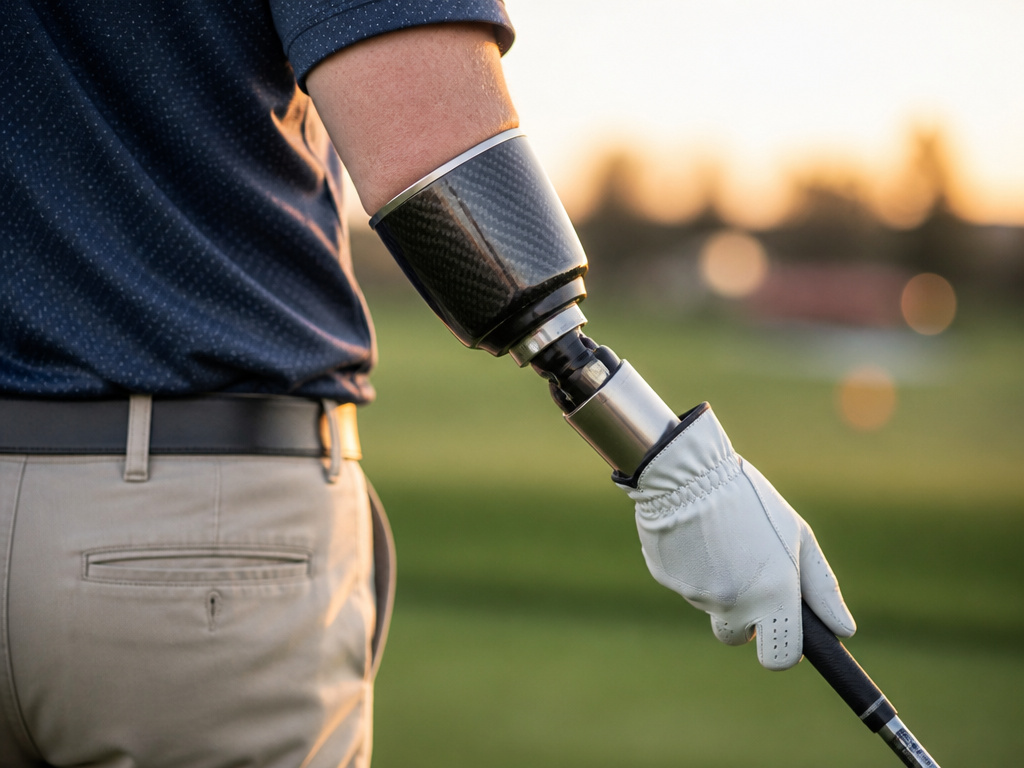 The drills above are for diagnosis. This section is for construction. If you are an adaptive golfer—whether from birth, injury, or illness—the goal shifts from fixing a fault to building the most efficient, repeatable motion your body can produce.
The first decision is often the hardest: with or without a prosthesis? The European Disabled Golf Association (EDGA) notes that some athletes develop more proper swing sequencing without one. It forces the body to create a unified motion. Golfer Matt Lees, born without a left hand, eventually abandoned a custom prosthetic he used for years, finding he could play “just as good or better one-handed.”
If you do use a prosthetic, the fit of the socket is everything. A poor fit causes pain, blisters, and makes the limb feel heavy, which will wreck your rotational swing timing. Work with your prosthetist on “golf-specific” adjustments.
The Rules: What’s Allowed?
You can’t build a legitimate game without knowing the boundaries. The USGA amputee golf rules provide the framework.
- Prosthetic Devices: An artificial limb is considered an artificial device under Rule 14-3. However, Exception 1 applies if it alleviates a medical condition. The committee must be satisfied it does not provide an “undue advantage.”
- Club Attachments: Attachments to the grip or shaft to assist an artificial arm in holding the club are permitted, provided they also don’t create an undue advantage.
- Anchoring: For amputee golfers unable to swing without anchoring due to limb loss, the Committee can waive Rule 14-1b, allowing them to make a stroke while anchoring the club.
These aren’t just guidelines; they’re the difference between a casual round and tournament play. Get clarity before you compete.
Equipment and Technique Modifications
Your equipment should adapt to you, not the other way around. Mark Marshall, the one-armed world champion, hits drives 270 yards with his left arm. He didn’t do it with off-the-rack clubs.
- Club Fitting: Lighter clubheads, graphite shafts, and shorter lengths reduce the moment of inertia, making the club easier to control with one arm. More loft on your driver helps get the ball airborne with less spin manipulation.
- The Kinetic Reality: A peer-reviewed kinetic analysis of amputee golfers found that parameters like the takeaway and horizontal force angle are dependent on the level of amputation, not individual technique. This means some aspects of your swing may be physically immutable. Stop trying to change them and instead build consistency around them.
- The Mental Shift: Your strategy must change. Playing from forward tees isn’t a concession; it’s smart course management. Your advantage comes from precision and course management, not brute force.
Common Faults and How to Correct Them
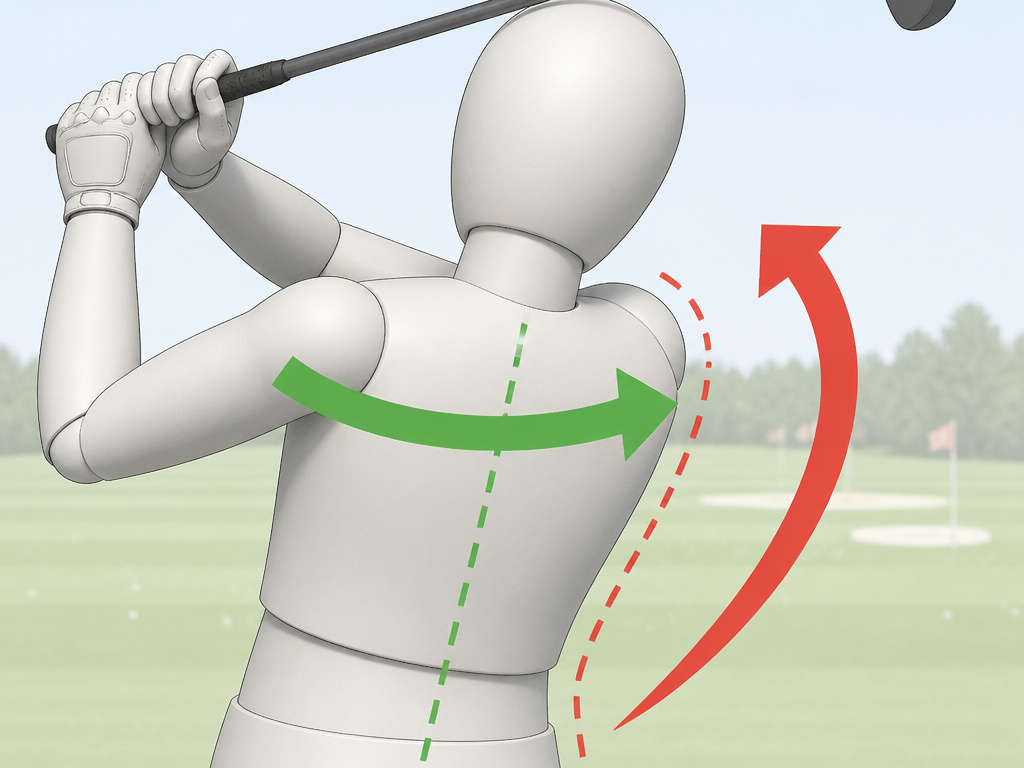 Even with a clear plan, predictable problems emerge. Here’s how to spot and fix them.
Fault 1: Excessive Body Sway. Without the counterbalance of a second arm, it’s easy to sway laterally instead of rotating. This destroys your low point and leads to fat and thin shots. * Fix: Practice swings with your back against a wall. Feel your head stay in place as your shoulders turn. This drill directly trains the feeling of a rotational golf swing mechanics without lateral movement.
Fault 2: Casting or Early Release. This is the number one power leak. With one arm, there’s a strong urge to throw the clubhead at the ball from the top. * Fix: The single-arm release drill outlined above is the specific remedy. It trains you to hold the lag in the swing longer. Another cue: feel like you’re pulling the grip butt through the ball, not throwing the clubhead.
Fault 3: Reverse Pivot. This is a weight-transfer fault where weight stays on your front side during the backswing, then shifts back during the downswing. It saps all power. * Fix: For a right-handed golfer swinging with the right arm only, feel your right hip turn behind you in the backswing, loading your right side. Your downswing then starts by pushing off that right side. If you feel your weight never gets to your back foot, you’re likely reverse pivoting.
Integrating One-Armed Work into Your Practice
Random one-handed swings won’t help. They need structure.
- Warm-Up: Start every range session with 10 slow, lead-arm only swings with a short iron, then 10 trail-arm only swings. This activates the mind-body connection for each arm’s role.
- Diagnostic Block: Once a week, perform the full Single-Arm Diagnostic Drill. Film it. Note any changes or persistent gaps.
- Blending: After a set of one-arm drills, immediately hit 5-10 balls with both hands. Your focus is to replicate the feeling from the “better” one-arm swing. Did your strike improve? Did the club feel more connected?
This isn’t about adding time; it’s about making your existing practice more insightful. Good golf should feel less complicated the more you understand it.
Frequently Asked Questions
Is a one-armed golf swing legal in tournament play?
Yes, absolutely. There is no rule requiring the use of two hands. The rules govern how you use the club (e.g., anchoring, artificial devices), not how many limbs you use to hold it. For adaptive golfers using prosthetics, the USGA disability golf guidelines provide the specific framework for what is permitted.
How far can you realistically hit a golf ball with one arm?
Distance varies massively with technique and strength. Mark Marshall drives it 270 yards with his left arm. Biomechanist Sasho Mackenzie, while injured, generated 104 mph clubhead speed swinging right-handed with his right arm only. Matt Lees claims 300-yard potential with a device. For most, a well-executed one-arm swing with a driver will travel 60-80% of your two-handed distance, with accuracy being the greater challenge.
What is the best club to start learning a one-armed swing?
Start with a 7-iron or 8-iron. The shorter length and higher loft make it easier to control the clubface and make solid contact. The driver is the worst possible club to start with—its length and low loft exaggerate every flaw.
Can practicing one-handed actually improve my two-handed swing?
It’s one of the fastest ways to improve it. By isolating each arm, you identify which side is causing your steep downswing, early release, or poor low-point control. It removes compensation and forces you to build a swing where the body leads the arms, which is the foundation of a powerful kinematic sequence.
Should I switch to left-handed clubs if I lose my right arm?
Not necessarily. It depends on your dominant side and coordination. A right-arm amputee might find more power and control learning to swing left-handed, using their dominant right side as the lead side. However, as the EDGA suggests, experimenting with both orientations is crucial. The goal is to find the motion that gives you the most sequenced, repeatable pattern.
The Bottom Line
Strip it back. A one-armed swing is not a gimmick or just a drill—it’s either a vital diagnostic tool or a complete athletic pursuit. For the player with two arms, the 20% speed gap rule tells you when to stop general practice and start specific training. For the adaptive golfer, the science is clear: build your motion around your body’s reality, not a textbook model.
I favor straightforward drills players can actually stick with. So here’s your first step: before your next range session, hit ten shots with your lead arm only, then ten with your trail arm only, using a 7-iron. Don’t judge the distance. Listen to what the strike tells you. That sound, that feel, is the information every other tip has been hiding.
