
Learn How to Hit a Greenside Bunker Shot Every Single Time
This post contains affiliate links. As an Amazon Associate, we earn from qualifying purchases.
To hit a greenside bunker shot, you use the sand, not the ball. Open a high-lofted wedge (58° lob or 54° sand wedge), set your stance open with the ball forward, and place 60-80% of your weight on your front foot. Accelerate through a spot 1.5 to 3 inches behind the ball, splashing a consistent divot of sand onto the green. The ball rides out on that cushion.
The cushion of sand between your club and the ball is the whole game. It dampens the energy transfer, which is why you need more swing speed than you think and why trying to pick the ball clean almost always fails. Your goal is to throw a specific patch of sand a specific distance.
What follows breaks down the three variables you actually control: your setup specs, the mechanics of the splash, and how to manage distance without changing where you hit. We’ll also cover the two lies that change everything, wet sand and the plugged “fried egg.”
Key Takeaways
- Scratch golfers get up and down from greenside sand only 37% of the time; a 25-handicapper’s success rate drops to about 10%.
- Your wedge’s bounce is critical, it prevents the leading edge from digging and allows the club to glide through the sand.
- For standard 10-20 yard shots, use a three-quarter swing at three-quarter speed. Changing clubs, not swing length, is the safer way to add distance.
- Never try to control distance by hitting closer to or farther behind the ball. Strive for a consistent divot starting 2-3 inches behind the ball every time.
- In wet sand, open the clubface more and increase your swing speed to move the heavier, denser material.
The Non-Negotiable Setup: Loft, Stance, and Weight
You cannot play this shot from your standard address position. The setup creates the steep, outside-in swing path needed to slide under the ball.
A proper greenside bunker setup requires three specific adjustments: an open clubface with maximum effective loft, an open stance aligned left of target (for right-handers), and a significant forward weight bias of 60-80% to ensure a descending blow into the sand.
Start with the right tool. You need a wedge with sufficient bounce, the curved angle on the sole that prevents digging. Your lob wedge (around 58 degrees) or sand wedge (around 54 degrees) are built for this. The higher loft gets the ball up quickly over the lip.
Grip the club normally, then rotate the handle in your hands to the right. This opens the clubface, adding even more loft. Your stance should be open, feet, hips, and shoulders aligned slightly left of your target line. This pre-sets the outside-in path.
Place the ball just forward of center in your stance. Now, shift 60% to 80% of your weight onto your front foot. Feel it in your lead thigh. This weight distribution is not a suggestion. It forces the low point of your swing to be in front of the ball, guaranteeing you hit sand first.
| Setup Element | Specification | What Happens If You Skip It |
|---|---|---|
| Club & Loft | Lob wedge (58°) or sand wedge (54°) with bounce. | A pitching wedge digs; the ball either stays in the trap or rockets over the green. |
| Stance | Open—aligned left of target (right-handed). | The club approaches too squarely, leading to a thin strike or no sand contact. |
| Ball Position | Just forward of center. | Hitting the ball first becomes likely, resulting in a skulled shot. |
| Weight | 60-80% on front foot. | The club bottoms out behind the ball, causing a fat shot that goes nowhere. |
This setup feels exaggerated. It is. In the bunker, subtlety gets you stuck. Dig your feet in for stability. Your goal is to create a predictable, repeatable launch platform for one job: splashing sand.
The Mechanics of the Splash: From Takeaway to Follow-Through
The swing is an aggressive cut across the ball, not a gentle scoop. Acceleration is non-negotiable.
Take the club back with an immediate wrist hinge. The clubface should point back at you quickly, setting the steep angle of attack. Your thought is “up early, down steep.” The length of your backswing dictates potential distance, but even for a short shot, you need a full three-quarter motion to generate enough force to move the sand.
The downswing is where most amateurs fail. They decelerate, fearing the ball will fly too far. This is backwards. The sand absorbs the energy. You must accelerate through impact.
Common mistake: Decelerating through the sand. The clubhead slows, digs too deeply, and the ball stays in its own pitch mark. The shot travels maybe three feet.
Aim to enter the sand 1.5 to 3 inches behind the ball. Don’t stare at that spot. Your focus should be on carving out a divot that starts before the ball and exits after it, like you’re cutting a shallow trench. Imagine using “Superman X-ray vision” to see the tee under the ball and cut it in half.
The follow-through is your report card. You must finish high, with the clubface pointing at you again. If you “quit” on the shot, you’ll chunk it. The feeling is of throwing the sand in your divot onto the green. If you’re finishing in a balanced position, you’ve accelerated correctly.
Controlling Your Distance from the Sand
You have two reliable levers for distance: club selection and swing speed. The most dangerous lever, varying how far behind the ball you strike, should be locked away.
Most greenside bunker shots are 10 to 20 yards. For this standard shot, use your sand wedge with a three-quarter swing at three-quarter speed. That’s your baseline.
Need more distance? The safe method is to take less loft. Grayson Zacker of Jim McLean Golf Schools lays it out: use a gap wedge, pitching wedge, or even a 9-iron. Keep your standard bunker setup and swing, but the lower loft will send the ball farther with a lower trajectory. A 9-iron with an open face and a three-quarter swing can produce a 30-50 yard shot.
For a shorter shot, keep your sand or lob wedge and simply reduce your swing speed to about 60%, while maintaining that three-quarter backswing length. A short, stubby backswing lacks the momentum to glide through the sand.
| Shot Distance | Club Recommendation | Swing Speed & Length | Expected Outcome |
|---|---|---|---|
| 5-10 yards | Lob Wedge | 60% speed, 3/4 length | High, soft landing with lots of spin. |
| 10-20 yards (Standard) | Sand Wedge | 75% speed, 3/4 length | Balanced height and carry. |
| 30-50 yards | 9-Iron (face slightly open) | 75-90% speed, 3/4 to full length | Lower trajectory, more roll. |
Where this goes sideways: Trying to hit closer to the ball to make it go farther. Yes, it will fly farther, but with unpredictable spin. Hit farther behind to make it shorter, and it comes out dead with no spin. Strive for a consistent divot every time. Let club selection and swing speed do the work.
This approach turns a guess into a system. It removes the variable you can’t consistently control, the exact point of sand entry, and focuses on the ones you can.
When the Sand Changes: Wet Conditions and Plugged Lies
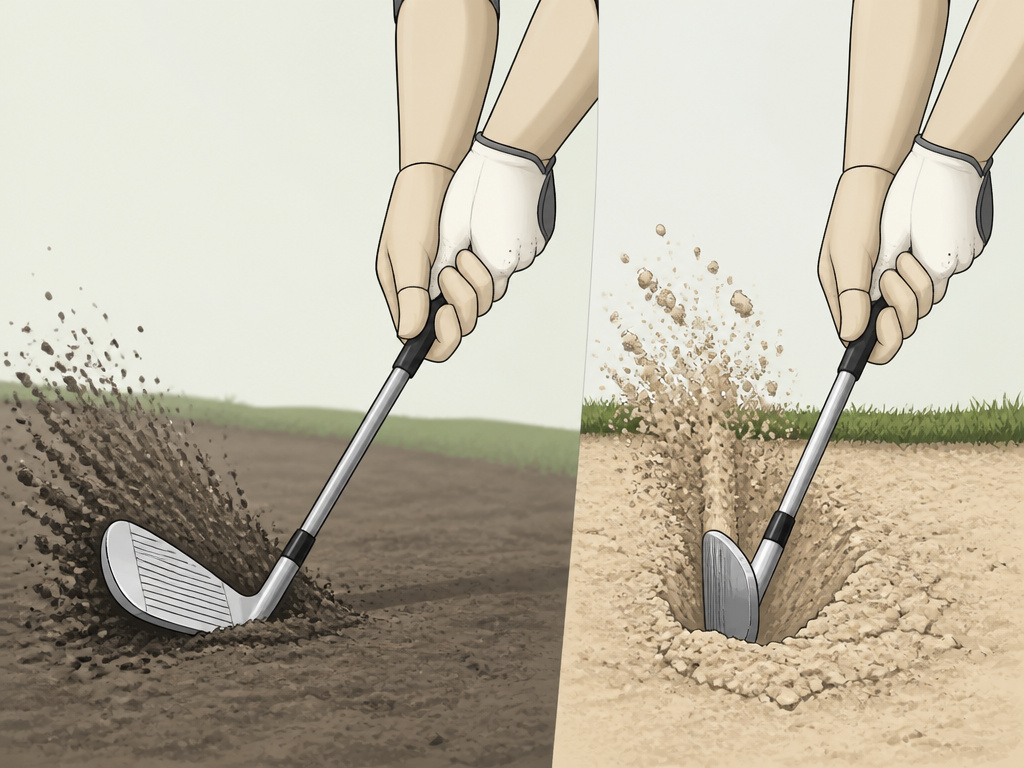 Standard technique assumes fluffy, dry sand. The real world gives you concrete-like wet sand and buried lies. Your process must adapt.
Wet, compacted sand is heavier. Your club will not glide through it as easily. To compensate, you need to open the clubface even more than usual to maximize the bounce and prevent the leading edge from digging. You also need to increase your swing speed to move the heavier material. The thought is “splash aggressively.” The ball will come out with less spin and more roll.
A plugged lie, the “fried egg”, is a different beast. The ball is buried in its own crater. Here, the goal is not to splash. It’s to dig. You need the leading edge of your wedge to excavate the sand from under the ball. – For a standard plugged shot: Square or even slightly shut the clubface. This presents the sharp leading edge. Take a very steep, aggressive swing, aiming to hit directly behind the buried ball. You must commit to a hard swing and follow through, taking a large amount of sand. – If you have a high lip to clear: You can try with an open face, but you must hit even deeper behind the ball. Understand that any plugged shot will come out with almost no spin and run considerably upon landing.
These are low-percentage shots even for pros. Your primary objective is escape. Choosing the right wedge selection for the conditions is your first strategic decision.
Greenside vs. Other Sand Shots
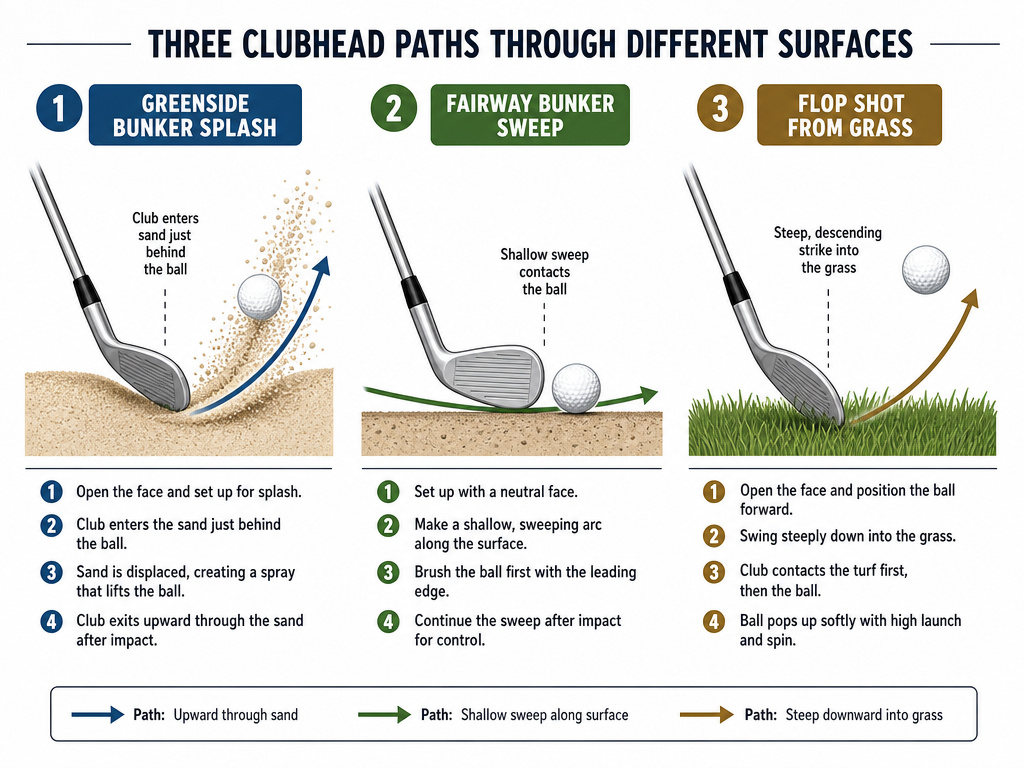 The greenside splash is a specific technique for a specific problem. Confusing it with other bunker shots is a recipe for wasted strokes.
A fairway bunker shot is a completely different animal. Here, the priority is clean ball-first contact to maximize distance. You often use a mid-iron, play the ball back in your stance, and make a controlled, sweeping swing. You can read our full breakdown on hitting from a fairway bunker for the contrasting technique.
Around the green but not in sand, you have other options. The flop shot uses a similar open-face, steep-swing technique but from grass, requiring precise strike. The bump and run is its opposite, a low, running chip. Knowing the strategic choice around the green between these shots is a mark of a skilled player.
Furthermore, not all hazards are the same. Understanding the different types of bunkers you might face, from sprawling waste areas to deep pot bunker hazards, informs your strategy before you even take your stance.
Frequently Asked Questions
What is the most common mistake in a greenside bunker?
Deceleration. Golfers are afraid of hitting the ball too far, so they slow down through impact. The sand then swallows the club, and the ball goes nowhere. You must accelerate through the sand to a full finish.
Can you ground your club in a bunker?
No. The rules for bunkers are very clear: your club cannot touch the sand before the swing. Grounding your club in the hazard before your shot results in a penalty. You can hover it just above the surface.
Why does my bunker shot always come out low and hot?
You are hitting the ball first, likely with a square or closed clubface. This “skulls” the ball. Check your setup: Is the clubface open? Is the ball forward? Is your weight on your front foot? All three must be true to hit sand first.
How much should I practice bunker shots?
If you’re a mid-to-high handicapper, spend at least 20% of your short-game practice time in a bunker. The physical memory of accelerating through sand is counterintuitive and must be trained. Start by just hitting shots without a target, focusing on creating a consistent, shallow divot.
What if there’s almost no sand in the bunker?
This is a tough lie. Treat it like very firm, wet sand. Open the face dramatically to use the bounce, and make a committed, accelerating swing. The margin for error is small, so focus on a crisp strike just behind the ball.
Before You Go
The greenside bunker shot is a test of technique, not strength. Commit to the setup: open face, open stance, weight forward. Commit to the swing: accelerate through the sand. Your job is to move a specific patch of turf onto the green; the ball is just along for the ride.
Forget the fear. With the right wedge selection and this process, the bunker changes from a penalty zone to a place you can get up and down. Now go dig your feet in and splash one out.
