
Shaft Kick Point Explained | The Real Impact on Your Launch
This post contains affiliate links. As an Amazon Associate, we earn from qualifying purchases.
This post contains affiliate links. As an Amazon Associate, we earn from qualifying purchases.
A shaft’s kick point is the specific 3–4 inch section along its length where it bends the most during the swing. The location of this maximum bend influences how the clubhead rotates at impact, changing the effective loft presented to the ball and altering launch angle and spin. Static lab tests and dynamic swing measurements can show different kick point locations.
That gap between static and dynamic measurement is the whole game. A shaft stamped “low kick” on a spec sheet might not perform that way when you’re at the top of your backswing. The research is clear on this: the shaft’s behavior in a controlled test doesn’t always match its behavior in your hands.
What follows: the precise definition from industry engineers, the real-world effect on your ball flight, and the three variables that matter more than the kick point label on your shaft.
Key Takeaways
- The kick point is a 3–4 inch section of maximum bend, not a single point. Manufacturers like Fujikura and True Temper design for launch angle, not an abstract “kick point” measurement.
- Dynamic kick point location can differ from the static measurement by several percentage points, according to motion-analysis studies. The shaft you feel is not the shaft on the lab bench.
- Shaft mass is a major confounder. Isolating kick point in research often requires changing weight, which itself changes swing feel and timing.
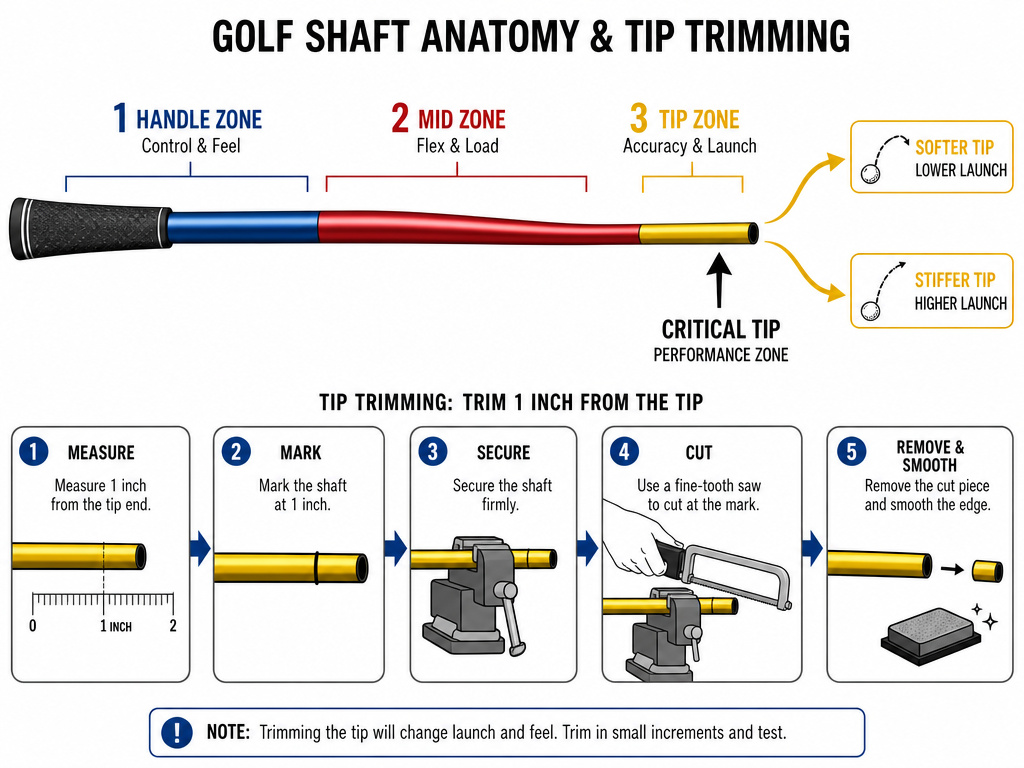
- Tip stiffness is the real lever. A softer tip section correlates with a lower effective kick point and higher launch, while a stiffer tip raises the bend and lowers the flight.
- Fix your loft first. Changing the clubhead loft is a more direct and predictable way to alter launch conditions than chasing a specific kick point.
What Is a Shaft Kick Point?
Forget the single dot on a diagram. Pat McCoy, the director of technical services for Fujikura, defines it as a 3–4 inch section somewhere in the middle of the shaft where the bend concentrates. It’s not a pinpoint at the tip or the grip. When engineers like Don Brown from True Temper design a Project X or Grafalloy shaft, they don’t measure for a kick point. They measure for launch angles.
The term itself is dated. Brown notes it’s used far more by consumers than by tour pros or people inside the industry. But because golfers are familiar with it, a company might still label a shaft “low” or “high” kick point to give a general performance idea. The real engineering target is the ball’s flight window.
Common mistake: Assuming a “low kick point” label guarantees a high ball flight. The shaft’s overall stiffness profile, your swing mechanics, and the clubhead loft have a larger combined effect. A low-kick shaft in a low-lofted head might still produce a piercing trajectory.
The academic definition is more precise. In a static test, it’s the point of maximum deflection along the shaft when a load is suspended from the tip. Research from the University of Birmingham MRes thesis found this static kick point in commercial shafts ranges from 45 to 52.9% of the shaft length from the tip. That’s a surprisingly narrow band.
Static vs. Dynamic: Why Your Swing Changes Everything
Here’s where the commodity advice falls apart. The golf swing is a violent, accelerating motion. What a shaft does under a slow, hanging weight is not what it does when you transition from the top.
A landmark peer-reviewed study on shaft performance used motion capture to compare static and dynamic kick points. They fitted elite golfers with two different “stiff” shafts, a 56g model and a 78g model, in otherwise identical drivers. The dynamic kick point location measured during the swing was different from the static location. It also varied between the two shafts and even between swings with the same club.
The takeaway is mechanical, not mystical. The forces you apply, the rate of acceleration, the timing of your wrist hinge, the lag in the swing, all change how the shaft loads and unloads. A shaft that tests as “high kick” in the lab might bend lower for a player with a late, aggressive release. This is why robot testing often fails to predict real-world performance.
| Measurement Type | How It’s Found | Key Limitation |
|---|---|---|
| Static Kick Point | Hanging a weight from the tip, measuring max bend. | Doesn’t account for swing speed, acceleration, or timing. |
| Dynamic Kick Point | 3D motion capture during an actual golf swing. | Captures real behavior but is complex and player-dependent. |
| “Feel” / Player Feedback | Golfer’s perception of where the shaft bends. | Subjective and influenced by shaft weight and overall flex. |
The engineering analysis of shaft behavior confirms this complexity. Researchers classify swings by their deformation patterns, showing that the same shaft bends differently for different swing styles. Your move is the X-factor.
Kick Point vs. Launch Angle: The Real Connection
So does kick point actually change ball flight? Yes, but through a specific mechanical chain. It’s not magic.
A lower kick point (or, more accurately, a softer tip section) allows the shaft to bend forward more easily just before impact. This forward bend, or “kick,” causes the clubhead to rotate slightly upward, adding effective loft. More loft at impact means a higher launch angle and usually more spin. Conversely, a higher kick point (stiffer tip) resists that forward bend, reducing effective loft for a lower launch.
John Oldenburg from Aldila frames it best: think about the stiffness in the lower-third of the shaft. That’s the zone that governs this head rotation.
Where this goes sideways: Chasing a kick point to fix a major launch issue. If you’re hitting knuckleballs or moon balls, your swing plane, angle of attack, or clubhead loft is the primary culprit. Shaft tweaks are for fine-tuning.
Frank Thomas, the inventor of the graphite shaft, gave blunt advice: change the loft first. If your trajectory is too low, increase the loft on your driver. Once you’re hitting it consistently and just need a minor tweak, then consider how shaft torque or tip stiffness might help. The kick point is a tuning adjustment, not a fundamental fix.
The Three Factors That Matter More Than Kick Point
Before you spend another minute thinking about bend points, get these three things sorted. They have a larger, more direct impact on your shots.
- Clubhead Loft. This is the biggest lever. A 1-degree change in loft will have a more pronounced and consistent effect on launch angle than any shaft designation. Dial this in with a qualified fitter first.
- Shaft Flex and Overall Stiffness. Getting the right shaft flex for your swing speed and tempo is foundational. A shaft that’s too weak or too stiff will wreak havoc on your timing and low point control, masking any subtle benefit from kick point.
- Shaft Weight. Weight influences swing feel, tempo, and swing weight. A heavier shaft can promote a smoother transition for some players; a lighter shaft might help increase speed. This characteristic often changes the perceived “bend” of the shaft more than its designed kick point.
The difference between regular and stiff shafts is a gulf compared to the nuance between a mid and low kick point. Nail the flex and weight first.
How to Use Kick Point in a Fitting
Now that the big levers are set, here’s how kick point or tip stiffness enters the conversation. You’re looking for a specific ball flight adjustment.
- You want a slightly higher launch/spin: Look for a shaft described as having a softer tip or lower kick point. This can help if your strike is solid but the ball drops out of the air too quickly.
- You want a slightly lower launch/spin: Seek a stiffer tip section or higher kick point label. This is for the player who hits high, spinning balloons that lose distance.
- You need a different feel: Some players sense the shaft loading more in the middle or toward the hands. This feel can influence confidence and timing. It’s subjective but real.
This is where “tipping” a shaft comes in. As Danny Le from UST Mamiya explains, trimming an inch from the tip section stiffens it. It’s a way to fine-tune a shaft you otherwise love, moving its performance a half-step toward a higher kick point and lower launch. It’s not for drastic changes.
Frequently Asked Questions
Does kick point affect distance?
Indirectly, by optimizing launch angle and spin for your swing speed. The right combination can maximize carry distance. A severely mismatched kick point can hurt distance, but it’s rarely the sole culprit.
How do I find the kick point on my shaft?
You can’t, by looking at it. The old “flex it on the ground” trick is unreliable. Static kick point requires precise measurement, and dynamic kick point requires high-speed cameras. Rely on the manufacturer’s description or a fitter’s assessment based on your launch data.
Do irons have a kick point?
Yes, but it’s discussed even less. Iron shafts are designed with specific trajectories in mind. The concept is the same, a bend profile influences launch, but the shorter length and stiffer overall design make the effects subtler than in a driver shaft.
Is high or low kick point better for a slow swing speed?
General wisdom suggests a low kick point can help slower swing speeds achieve a higher launch, which is often beneficial. However, the correct overall flex and lightweight design are far more important. Get fit.
What is a “mid kick point”?
It’s the broad middle ground, designed for a neutral launch. Most stock shafts in off-the-rack clubs fall into this category, aiming to suit the widest possible audience without extreme bias.
The Bottom Line
The shaft kick point is a real engineering characteristic with a measurable effect. But its importance has been inflated in consumer marketing. It is a fine-tuning adjustment, not a primary fitting parameter.
Focus on getting the correct clubhead loft, the proper shaft flex, and a comfortable shaft weight first. These will deliver 95% of the performance gain. Once those are locked in, use the idea of tip stiffness, the practical cousin of kick point, to tweak your launch conditions by a degree or two. That’s the order of operations. Anything else is putting the cart before the horse.
