
What Is Swing Plane? Finding Your Natural Golf Swing Angle
This post contains affiliate links. As an Amazon Associate, we earn from qualifying purchases.
This post contains affiliate links. As an Amazon Associate, we earn from qualifying purchases.
Swing plane is the three-dimensional angle your club’s shaft travels on during the swing. For a 7-iron at address, that ideal starting angle is roughly 60-65 degrees. The driver’s plane is shallower, around 55-60 degrees. Trying to keep the club on one single plane throughout the entire motion is biomechanically impossible for a full swing, even tour pros shift planes slightly from backswing to downswing.
That last sentence is where most instruction gets it wrong. The goal is managing a natural, efficient shift between a steeper backswing plane and a shallower downswing plane, not a rigid, glass-pane plane. Force the club to stay on one line and you’ll lose power, consistency, and likely develop a painful reverse pivot.
What follows is a breakdown of what swing plane actually is, where the famous Ben Hogan image was misinterpreted, and the two measurable specs that matter: your club’s address angle and your body’s turned shoulder plane. We’ll also look at the training tools that can help, and the one common mistake that makes them useless.
Key Takeaways
Your swing plane is the three-dimensional circle the clubhead traces, defined by the shaft’s angle at address and your body’s rotation. A 7-iron starts on a plane around 60-65 degrees; a driver starts around 55-60 degrees.Trying to swing a driver on a 7-iron’s plane is a recipe for a slice. – A slight plane shift from backswing to downswing is normal and efficient. The myth of a “single plane” swing comes from a widespread misreading of Ben Hogan’s “Five Lessons.” – Tools like the PlaneSWING work by training your feel for width and rotation, not by forcing a rigid path. Using them to hit balls defeats their purpose. – The real fault isn’t having two planes; it’s having an excessive or uncontrolled shift, often caused by poor posture or an incorrect downswing sequence.
What Is Swing Plane? (The Simple Answer)
Swing plane is the inclined angle, relative to the ground, that the club’s shaft travels along during the golf swing. It is primarily set by the club’s shaft angle at address and is influenced by your posture, height, and the length of the club.
Think of it as the tilted hula-hoop your club would swing inside if you repeated the same motion perfectly. A longer club, like a driver, creates a wider, flatter hoop. A shorter club, like a wedge, creates a smaller, more upright hoop. Your body stands in the center, and your turn powers the club around this imaginary circle.
The most useful reference is the shaft angle at address. For a standard 7-iron, that’s about 60-65 degrees from the ground. Your goal isn’t to keep the shaft glued to that line for the entire swing, that’s physically unrealistic. Instead, that address angle gives you the launch point. A good backswing will naturally steepen the plane slightly as your arms lift. A good downswing will then shallow it, returning the shaft close to that original angle at impact.
Where this goes sideways: golfers hear “swing plane” and picture Ben Hogan’s famous glass pane. They then spend months trying to keep their club under an imaginary sheet of glass, which leads to a cramped, arm-dominated swing with no power. Hogan was talking about his left arm, not the clubshaft. The entire “single plane” ideal for amateurs is built on a 70-year-old misinterpretation.
The Ben Hogan Myth & Why Plane Shift Is Normal
The image is iconic: Ben Hogan with a pane of glass resting on his shoulders, extending down to the ball. Most golfers and even many instructors took this to mean Hogan wanted the clubshaft to swing along that glass plane. That’s wrong.
In his book “Five Lessons,” Hogan explicitly said the glass pane was a reference for his left arm. He wanted his arm to stay below that plane to avoid getting too steep. He never said the clubshaft should trace it. This misunderstanding spawned decades of instruction pushing a rigid, one-plane model that doesn’t match human biomechanics.
A 2023 analysis on PerfectGolfSwingReview.net states the case bluntly: the idea of swinging along a “single” plane matching the address angle has “very little utility in a ‘real world’ golf swing.” It’s “physically/biomechanically impossible” to maintain this plane throughout a full backswing unless the swing is very short.
| Swing Model | What It Is | Reality Check |
|---|---|---|
| Single / “Glass Pane” Plane | Clubshaft stays on the address-angle plane throughout. | Biomechanically impossible for a full swing. Only Moe Norman came close. |
| Two-Plane Shift (Common) | Backswing on a slightly steeper plane, downswing shallows to approach address plane. | This is what 95% of tour pros do, including Tiger Woods in his prime. It’s efficient. |
| Turned Shoulder Plane (TSP) | A steeper reference plane running from the ball to your right shoulder at the top of your backswing. | A useful checkpoint. Many pros have the clubshaft parallel to the TSP at the top. |
The takeaway is liberating. You are not broken if your backswing plane is steeper than your downswing plane. That’s the engine of a powerful swing. The problem is an excessive shift, like a drastic “over-the-top” move where the downswing plane is wildly steeper than the backswing. That’s often caused by poor body rotation sequence or a reverse pivot.
How Swing Plane Changes With Every Club in Your Bag
You don’t have one swing plane. You have a spectrum of them, dictated by the length of the club in your hands. This is non-negotiable geometry.
A driver, held at the end of a 45-inch shaft, sets up with the shaft much more horizontal to the ground. The ideal plane angle for a driver is between 55 and 60 degrees. This shallow plane promotes a sweeping, upward strike for max distance.
A 7-iron, with a shorter shaft and more upright lie angle, sets up around 60 to 65 degrees. This steeper plane helps you hit down on the ball and compress it.
A wedge is steeper still. If you try to swing your driver on your 7-iron’s plane, you’ll likely come over-the-top, cut across the ball, and hit a weak slice. If you swing your wedge on your driver’s plane, you’ll likely hit it fat or thin.
| Club | Approx. Plane Angle (Shaft at Address) | Why It Matters | Common Fault If Ignored |
|---|---|---|---|
| Driver | 55° – 60° | Promotes shallow, upward strike for distance. | Coming “over-the-top,” resulting in a slice or weak fade. |
| 7-Iron | 60° – 65° | Allows for a descending blow and proper compression. | “Scooping” or hitting thin, losing distance and control. |
| Wedge | 65°+ | Enables steep attack for spin and stopping power. | Hitting fat shots or blading the ball over the green. |
This is why the concept of a universal “perfect plane” is flawed. Your setup changes everything. Understanding the iron vs driver swing differences starts with accepting these different planes.
Diagnosing Your Own Swing Plane Faults
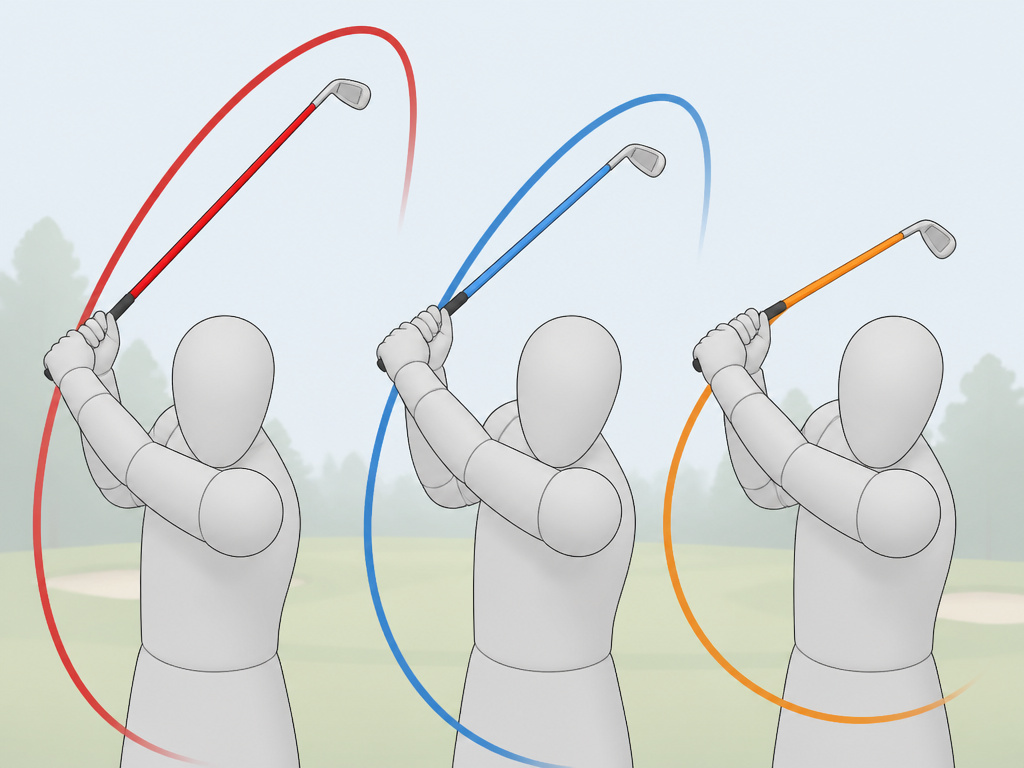
You don’t need a launch monitor to see plane issues. Two common faults have clear visual signatures and specific feels.
The Over-the-Top (Steep Downswing): This is the most common fault. The downswing is drastically steeper than the backswing. From the top, the first move is with the shoulders and arms, throwing the club outside the ideal path. * Look for: The club shaft pointing well left of the target line (for a righty) in the early downswing. Shallow divots that point left, or a slice ball flight. * The Feel: You’re “pulling the rope” down with your left side. It often feels powerful, but the contact is weak. * The Fix: Focus on initiating the downswing with your lower body, letting your arms drop. The “umpire’s belt” drill, keeping your back to the target longer, can help. This fault is tightly linked to a poor swing path.
The Inside-Overrun (Too Flat): Here, the backswing is too shallow, wrapping around the body. The downswing then has to crudely reroute, often leading to a “stuck” position and a hook or block. * Look for: At the top, the club shaft points well right of the target (for a righty). The downswing feels cramped, like you’re hitting from behind your back. * The Feel: You’re “slinging” the club from behind you. You might feel a lot of lag, but you have no space to deliver it. * The Fix: Work on a more vertical arm lift in the backswing, feeling the clubhead work more “up” than “around.” This creates the space you need. This is often a root cause of casting, as you throw the club early to create room.
Where this goes sideways: Trying to fix a steep downswing by making your backswing flatter. That usually makes you flatter and more stuck. Fix the downswing initiation first. The backswing will often clean itself up.
The Tools That Actually Work (And How to Use Them)
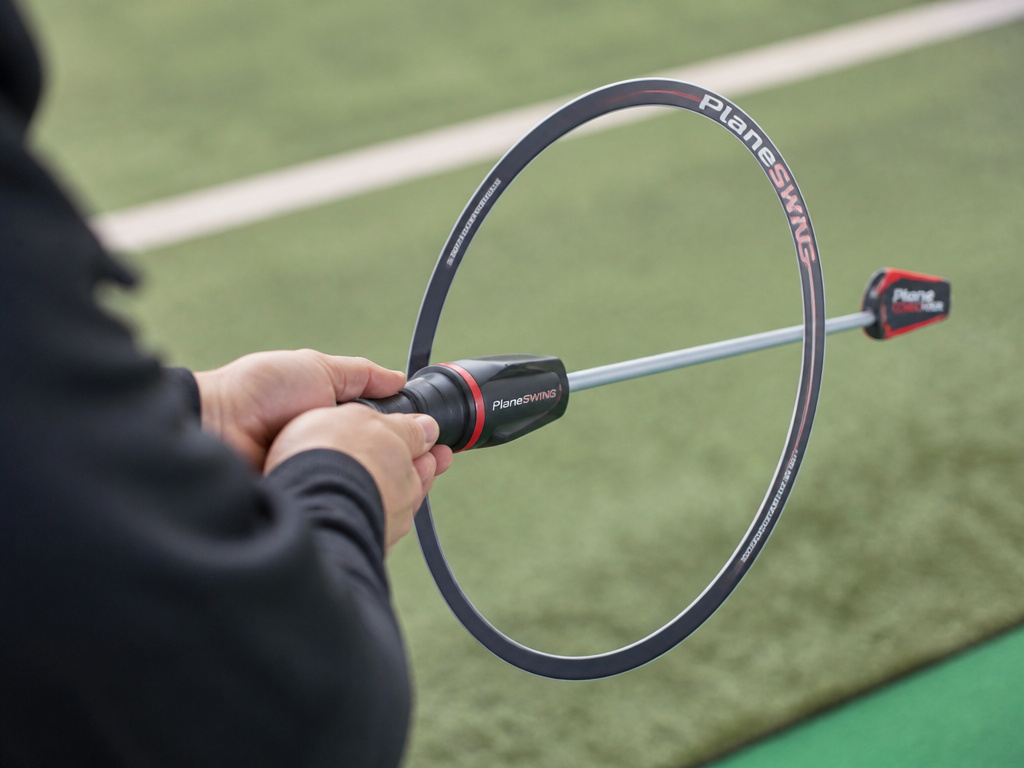
Training aids for swing plane are everywhere. The key is understanding what they’re actually training. These are guides for width, rotation, and sequence, not magic planes of glass.
The PlaneSWING is one of the most structured. It’s a large, adjustable hoop on a stand. You set the hoop to your desired plane angle (more upright for short irons, flatter for driver) and swing a weighted rod (the PowerSLIDER) inside it. Its official manual is clear: you do not hit balls with it. The weight trains the muscles for the motion; hitting balls corrupts the feedback and is dangerous.
According to the PlaneSWING FAQ, regular use, three 20-minute sessions a week, trains “motor skill change.” The key feature is the PlaneCHECKER, a lollipop-like tool that fits on the end of the rod. It gives you visual feedback on whether your hands are on-plane without making you stand up and lose your spine angle. If the checker is above the hoop, you’ve over-rotated your forearms. If it’s below, you’ve taken the rod too far inside.
Other effective tools include: * Alignment Sticks: Place one in the ground along your target line and another along your toe line. Swing over the top of the stick on your toe line to feel a shallow plane. * The “Headcover Under Arm” Drill: Tuck a headcover under your right armpit (for a righty) and swing without dropping it. This promotes connection and prevents the arms from running wild, stabilizing your plane.
The common mistake with all these tools is using them to chase a perfect, static shape. Use them to develop a feel for width and connected rotation. Then step away and hit balls focusing on that feel, not the shape.
Why Certification and Standards Matter (A Paraglider Lesson)
This might seem off-topic, but it’s a perfect analogy for understanding “on-plane” as a certified, repeatable standard, not a vague ideal.
SWING Flugsportgeräte GmbH, a paraglider manufacturer, doesn’t leave safety to chance. Their manuals state compliance with the ANSI Z535.6 standard for safety information and the LTF NFL HG GS 2-565-20 airworthiness requirements. These are the “swing planes” of paragliding, precise, tested, and certified frameworks that ensure predictable performance.
Their gliders, like the MIURA 2 RS, must be inspected every two years or after 150 hours of flight. Ground handling time counts double due to wear. If you fly past the inspection date or use an unauthorized inspector, the warranty and certification are void. You are, effectively, “off-plane.”
Think of your golf swing the same way. Your body has its own certification standards, mobility, strength, timing. Ignoring them (poor flexibility, no strength training, erratic tempo) is like flying an uncertified glider. You might get away with it for a while, but the collapse is predictable. A stable swing plane in the backswing sets the certification for your entire motion.
Frequently Asked Questions
Is a one-plane or two-plane swing better?
For most amateur golfers, focusing on the one-plane and two-plane golf swing methods as rigid systems is counterproductive. The “one-plane” swing, popularized by Jim Hardy, is extremely body-dependent and difficult to master. The “two-plane” swing is more common but can get disconnected. It’s better to understand that a slight plane shift is natural and work on making that shift efficient, not eliminating it.
How do I find my natural swing plane?
Stand in your golf posture without a club. Let your arms hang relaxed. Now, make a backswing turn, letting your arms swing up naturally as your shoulders turn. Where your hands stop is a good indicator of your natural plane. It will be steeper if you’re tall or less flexible, flatter if you’re shorter or more flexible. A mirror or video from face-on is the best tool.
Does swing plane cause a slice?
An excessively steep downswing plane, the over-the-top move, is a primary cause of a slice. It forces the clubhead to cut across the ball from outside-to-in, imparting side spin. However, an open clubface at impact is also required. So, a bad plane enables the slice, but the face delivers it.
Can I have a good swing with a flat plane?
Yes, but within limits. Golfers like Matt Kuchar and Bryson DeChambeau have flatter planes. It works because they are exceptionally strong, flexible, and have built their entire swing around that geometry. For most, an extremely flat plane makes it hard to create consistent power and leads to being “stuck” on the downswing.
What’s the difference between swing plane and swing path?
Swing plane is the 3D angle of the club’s shaft. Swing path is the 2D direction the clubhead is moving (in-to-out, out-to-in, straight) at impact. They are related: a very steep plane often leads to an out-to-in path (slice). A very flat plane can lead to an in-to-out path (hook). You need to manage both.
The Bottom Line
Swing plane is a framework, not a prison. Your 7-iron wants to swing on a 60-degree tilt, your driver on a 55-degree tilt. Between those points, a slight shift is a matter of physics.
Stop chasing the ghost of Ben Hogan’s glass pane. Instead, work on the fundamentals that create a repeatable plane: athletic posture, a connected backswing, and a downswing initiated from the ground up. Use tools like the PlaneSWING for feel, not for forging a perfect shape. The goal is to deliver the clubface to the ball with speed and consistency, swing after swing. That’s the only plane that truly matters.
