
Understanding Free Relief and Penalty Relief in Golf Rules
This post contains affiliate links. As an Amazon Associate, we earn from qualifying purchases.
This post contains affiliate links. As an Amazon Associate, we earn from qualifying purchases.
Free relief lets you move your ball without penalty when it’s affected by specific conditions on the course, like ground under repair or an embedded ball. Penalty relief costs you one stroke (or more) and is your option when your ball is in a penalty area, lost, or out of bounds. The choice is never yours, the situation dictates which relief applies.
That distinction is the entire scoring game. Getting it wrong turns a potential bogey into a triple, and the mistake is almost always a timing one, you assume a penalty when you could have had a free drop, or you search for a free drop that doesn’t exist and rack up a slow-play penalty from your group.
What follows is the field manual. We’ll break down the exact conditions that grant free relief, the three types of penalty relief, and the single most common misjudgment that adds two strokes before you even swing.
Key Takeaways
- Free relief is for abnormal course conditions (like casual water or ground under repair) and an embedded ball in the general area. No stroke penalty.
- Penalty relief always costs at least one stroke and is your path out of a penalty area, a lost ball situation, or an out-of-bounds shot.
- The “known or virtually certain” standard (about 95% sure) is what lets you take penalty relief from a penalty area without finding your ball, saving time and avoiding stroke-and-distance.
- Ignoring available free relief from an embedded ball or casual water means playing from a terrible lie; taking penalty relief when you could have had a free drop is a wasted stroke.
- For casual play, Model Local Rule E-5 is a game-changer for a lost ball or OB, allowing a two-stroke penalty drop in the fairway instead of going back to the tee.
The Core Difference: Free Relief vs Penalty Relief
The rules don’t give you a menu. Your ball’s location and the condition it’s in trigger one specific set of relief options. Confusing them is how a hole blows up.
Free relief is a correction for bad luck with the course itself, not your shot. Penalty relief is the cost of recovery from a bad shot. The governing bodies, the R&A and USGA, frame it this way in the official Rules of Golf: free relief removes an unfair disadvantage you didn’t create; penalty relief manages the disadvantage you did create.
Free Relief (Rule 16): You get this when your ball, stance, or swing is interfered with by an abnormal course condition, casual water, ground under repair, an animal hole, or an immovable obstruction. Also, when your ball is embedded in its own pitch mark in the general area (fairway or rough). You find the nearest point of complete relief, drop within one club-length, and play on. No penalty.
Penalty Relief (Rules 17 & 18): You choose this when your ball is in a penalty area (red or yellow stakes/lines), is lost, or is out of bounds. It costs one penalty stroke (or two under local rules) and requires a specific drop procedure. This is your recovery path.
The mental shift is from “Can I get relief?” to “What does this situation force me to do?” Your ball in a puddle in the fairway forces free relief. Your ball in a red-staked creek forces penalty relief. There is no overlap.
When Free Relief is Your Right (And When It Isn’t)
Free relief isn’t a negotiation. The rules define the conditions precisely. Claim it when you have it; don’t waste time looking for it when you don’t.
You get free relief from:
- Casual Water: Any temporary standing water not in a penalty area. Your feet sink, water surfaces around your shoes, that’s casual water.
- Ground Under Repair (GUR): Marked areas, often with white paint or signs. Includes piles of turf cut for removal.
- Immovable Obstructions: Sprinkler heads, cart paths, benches, artificial walls. If it’s artificial and not meant to be moved, you get relief if it interferes with your stance or swing.
- Animal Holes/Burrows: Damage from digging animals, not just footprints.
- An Embedded Ball: When your ball is in its own pitch mark in the general area (anywhere except sand or penalty areas). This is the most overlooked free drop.
The part nobody mentions: An embedded ball gets relief even in the rough. The old “through the green” rule is gone. If it’s embedded in its own mark outside a bunker or penalty area, you get a free drop. Skip this and you’re hitting off dirt.
You do NOT get free relief from:
- A bare or divoted lie in the fairway.
- Tree roots, bushes, or long grass (these are “natural objects”).
- A ball in a bunker (except from dangerous animals or specific local rules).
- A ball in a penalty area (water hazard). That’s always penalty relief.
The procedure is mechanical. Find the nearest point of complete relief, the spot where the condition no longer interferes. Drop within one club-length of that point, no closer to the hole. The ball must be dropped from knee height and come to rest in the relief area. If it rolls outside, you re-drop.
The Three Flavors of Penalty Relief (And When to Use Them)
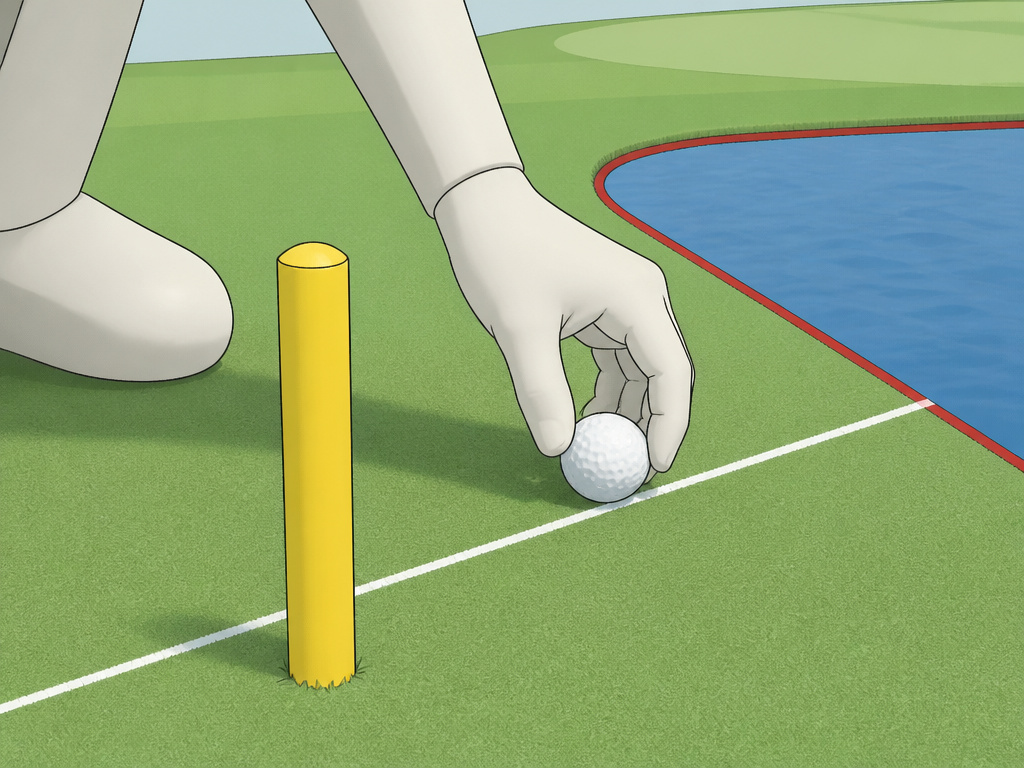 Penalty relief is your escape hatch, but each type has a different cost and drop zone. Picking the wrong one adds unnecessary strokes.
| Situation | Relief Type | Penalty | Key Reference Point | Relief Area Size |
|---|---|---|---|---|
| Ball in Yellow Penalty Area | Back-on-the-Line | 1 stroke | Where the ball last crossed the edge | Drop anywhere on a line back from the hole through that point |
| Ball in Red Penalty Area | Lateral Relief | 1 stroke | Where the ball last crossed the edge | Drop within two club-lengths of that point |
| Ball Lost or Out of Bounds | Stroke-and-Distance | 1 stroke + distance | Where the previous stroke was made | Replay from that spot (tee, fairway, etc.) |
Back-on-the-Line Relief (Yellow Stakes) is the most restrictive. You must keep the point where your ball last crossed the penalty area margin between you and the hole. You can drop anywhere on that line behind you. Use this when the penalty area runs in front of the green, it keeps the challenge intact.
Lateral Relief (Red Stakes) is more forgiving. From the reference point, you get a two-club-length semicircle to drop in, no closer to the hole. This is for lateral water hazards or areas where going back isn’t practical. Understanding red vs yellow stakes is critical here.
Stroke-and-Distance (Lost Ball/OB) is the most costly. You add a penalty stroke and lose all the distance of your previous shot. This is governed by the out of bounds rule. It’s why a lost ball or OB is effectively a two-stroke penalty: the stroke you hit plus the penalty stroke, and you’re hitting again from the same spot.
Common mistake: Taking lateral relief from a yellow-staked area. If the stakes are yellow, you only have the back-on-the-line option (or playing it as it lies). Taking a two-club-length lateral drop is a wrong-place penalty, two more strokes in stroke play.
The “Known or Virtually Certain” Lifesaver
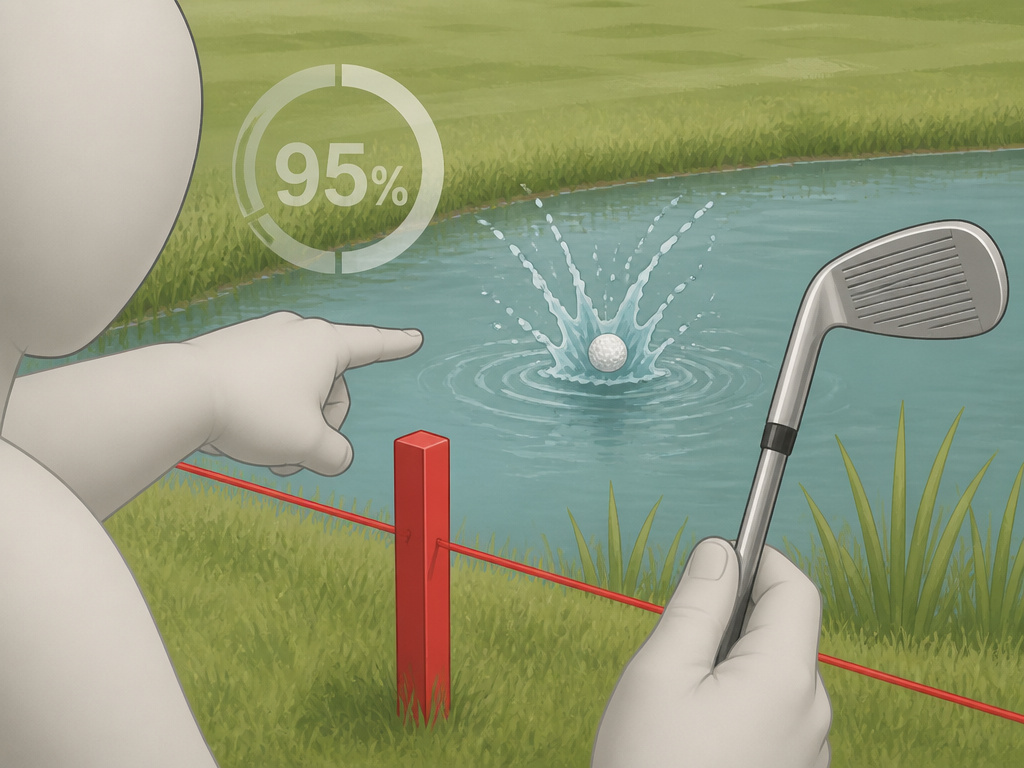 This is the rule that prevents five-minute searches for a ball everyone saw splash. You don’t have to find your ball in a penalty area to take relief.
The R&A Rule 17 on Penalty Areas states that if it is “known or virtually certain” your ball is in a penalty area, you can proceed under the penalty area rules. The USGA and experts define “virtually certain” as at least 95% sure. If you saw it splash, or it vanished into thick red-staked vegetation with no other place it could be, you’re clear.
Why this matters: Without this standard, an unfound ball in a penalty area would be treated as a lost ball under the lost ball rule, forcing you back to the previous spot under stroke-and-distance. That’s a massive time and stroke penalty. The 95% rule lets you take your one-stroke penalty and drop near where it went in, keeping pace and saving a shot.
The burden is on you and your group to use reasonable judgment. If there’s any chance it could be outside the penalty area (in deep rough just outside the red line), you must treat it as lost. But when it’s obvious, call it. Drop, take your stroke, and move on.
Free Relief in Action: The Embedded Ball Rule
This is the most common free relief scenario players miss. The rule changed in 2019, and many golfers are still playing the old version.
Your ball plugs in the fairway after a rain-soaked round. Old rule: free relief only if “embedded in its own pitch mark through the green” which excluded the rough. New rule: free relief if embedded in the general area, which is everywhere except penalty areas and bunkers.
Procedure:
- Identify that the ball is in its own pitch mark (not just sitting down in soft ground).
- Mark the ball.
- Find the nearest point of complete relief no closer to the hole.
- Drop within one club-length of that point.
If you skip this and try to play the plugged ball, you’ll likely hit it fat or blade it. The free drop gives you a clean lie. It’s a gift. Take it. For more on this specific situation, our guide on embedded ball relief walks through the nuances.
The Pace-of-Play Savior: Model Local Rule E-5
Stroke-and-distance for a lost ball or OB is brutal for casual play. It slows everything down. The governing bodies know this, which is why they created Model Local Rule E-5.
This local rule, detailed in a USGA stroke-and-distance article, offers an alternative for general play. If your ball is lost outside a penalty area or out of bounds, you have a two-stroke penalty option: * Find the point where your ball is estimated to have gone lost or crossed the OB line. * Drop a ball in the fairway within two club-lengths of that point, no nearer the hole.
You’re now lying three (original stroke + two penalty strokes) and hitting from the fairway. It’s a huge time-saver and keeps the round moving. Check with your course or event committee to see if this rule is in effect. It’s not for competition, but for your Saturday fourball, it’s a sanity preserver.
How to Choose in Real Time: A Decision Tree
Overthinking is the enemy. Follow this sequence when you walk up to your ball.
- Is it in a Penalty Area (red/yellow stakes)? If YES → Mandatory penalty area relief. Determine red (lateral) or yellow (back-on-line). Take your stroke.
- Is it Lost or Out of Bounds? If YES → Mandatory stroke-and-distance penalty (or use MLR E-5 if allowed).
- Is it Embedded in its Pitch Mark? If YES → Free relief. Take your drop.
- Is there Casual Water, GUR, or an Immovable Obstruction interfering? If YES → Free relief. Take your drop.
- Is it in a Bunker? If YES → Generally no free relief. Play it as it lies, following standard bunker rules.
- None of the above? Play it as it lies.
This flow eliminates the “what can I do?” paralysis. The situation locks in your option.
Frequently Asked Questions
Can I ever get free relief from a bunker?
Almost never. You play the ball as it lies in the sand. The only exceptions are if the bunker is marked as ground under repair, or if a dangerous animal condition exists (like a snake or beehive). You don’t get relief from casual water in a bunker, you can either play it or take back-on-the-line relief outside the bunker for one penalty stroke.
What’s the difference between dropping and placing?
For almost all relief (free or penalty), you drop the ball from knee height. You only place the ball when you are taking relief on the putting green, or when a dropped ball has rolled into a bad spot twice and you then place it where it first struck the ground. The USGA Rule 17 interpretations cover the specific drop procedures.
Does “free relief” mean I can move my ball anywhere?
No. It’s “free” of stroke penalty, not free of procedure. You must find the nearest point of complete relief from the condition and drop within one club-length of that point, no closer to the hole. It’s a specific spot, not a preferred lie.
If I’m unsure whether my ball is in a penalty area, what should I do?
You have three minutes to search. If you don’t find it within three minutes, you must apply the “known or virtually certain” standard with your group. If you’re 95% sure it’s in the penalty area, take penalty relief. If there’s reasonable doubt, it’s a lost ball, and you must proceed under the R&A Rule 18 on stroke-and-distance.
Is taking a mulligan a form of relief?
No. A mulligan is an informal, off-the-books do-over with no basis in the rules. It’s not relief; it’s cheating by agreement in casual play. In any sanctioned round, a mulligan is simply a stroke that counts, followed by playing from where that ball lies (likely under penalty if it’s lost or OB).
Before You Go
Free relief is a correction. Penalty relief is a tax. Knowing which applies turns disaster management into routine course navigation. Remember the triggers: embedded ball and abnormal conditions grant a free drop; penalty areas, lost balls, and OB demand a stroke.
Spend your mental energy on the 95% rule for penalty areas and the embedded ball check in the rough. Those two alone will save you three or four strokes a round. And for your weekend games, ask about Model Local Rule E-5, it’s the difference between a five-minute hunt and a thirty-second drop. Now go find your relief.
