
The Golf Scoring System: How Par, Birdie, Eagle & Bogey Work
This post contains affiliate links. As an Amazon Associate, we earn from qualifying purchases.
This post contains affiliate links. As an Amazon Associate, we earn from qualifying purchases.
Golf scoring works by counting every stroke to complete a hole, then comparing that number to the hole’s “par”, the expected strokes for an expert. A score one under par is a birdie, two under is an eagle, and one over par is a bogey. Your total for 18 holes is your gross score, which can be adjusted by your handicap for a net score used in competition.
That comparison to par is the entire language of the game. It turns a raw number like “4” into a story: was that a solid par, a missed birdie chance, or a scrambled bogey save? The system is built for relativity, which is why a 4 on a par-3 is a disaster, a 4 on a par-4 is standard, and a 4 on a par-5 is a brilliant eagle.
What follows: a breakdown of where par numbers come from, the full list of scoring terms from condor to quintuple bogey, and how formats like Stableford and the World Handicap System use this core vocabulary to level the field. You’ll also see how wind and altitude quietly change what “par” means on the day.
Key Takeaways
- Par is not arbitrary. A par-4 assumes two shots to reach the green and two putts. Changing that formula is how course designers create difficulty.
- “Albatross” and “Double Eagle” are the same thing: a score of 3-under-par on a hole. The term used depends on whether you’re in the U.S. Or most other golfing nations.
- Your handicap doesn’t make birdies easier. It subtracts strokes from your total after the round, letting you compete against better players on net score.
- Environmental factors are real. A golf ball flies about 8-10% farther at 5,000 feet of elevation, effectively shortening every par on the course.
- Stableford scoring rewards risk. This format encourages going for birdies because a double bogey scores zero points, the same as a quintuple bogey.
Where Par Numbers Actually Come From
Forget the idea that par is just a guess. It’s a mechanical formula printed on every scorecard. The calculation starts with distance and ends with a number that defines the challenge.
A par-3 is short enough that a skilled player is expected to hit the green with their tee shot. They then have two putts to get down. That’s one shot plus two putts: par 3.
A par-4 demands two shots to reach the green. A good drive, then an approach, then two putts. Two shots plus two putts: par 4.
A par-5 requires three shots to reach the green. Drive, second shot, approach, then two putts. Three shots plus two putts: par 5.
The “two putts” allowance is the constant. Course architects manipulate the number of shots needed to get there. Adding 30 yards to a par-4 might push it out of reach in two for most players, effectively making par unattainable and shifting the real target to bogey.
This is why total course par is almost always 70, 71, or 72 for professional events. It’s a mix of those three hole types. A standard public course might have four par-3s, ten par-4s, and four par-5s. That’s 4×3 + 10×4 + 4×5 = 72.
What Does Par, Birdie, Eagle, and Bogey Mean?
These terms are just shorthand for your score relative to that par number. The table below shows the translation.
| Your Score vs. Par | Term | Example on a Par-4 |
|---|---|---|
| 3 Under Par | Albatross (Double Eagle) | Hole-in-One (extremely rare) |
| 2 Under Par | Eagle | Score of 2 |
| 1 Under Par | Birdie | Score of 3 |
| Equal to Par | Par | Score of 4 |
| 1 Over Par | Bogey | Score of 5 |
| 2 Over Par | Double Bogey | Score of 6 |
| 3 Over Par | Triple Bogey | Score of 7 |
A hole-in-one is called an “ace,” not an eagle, regardless of the par. Making a 2 on a par-5 is an albatross. Making a 1 on a par-5 would be a “condor”, a score of 4-under-par so rare it’s only been recorded a handful of times in history, usually on holes with extreme elevation drops or doglegs you can cut.
Where this goes sideways: Calling a 3-under score a “double eagle” in Scotland or the Bahamas will get you a confused look. “Albatross” is the preferred term in most of the golfing world outside the United States. It’s the same score, just different local slang.
The BBC Sport’s guide to par notes that the term ‘par’ has been the official scoring benchmark since 1911. Before that, golfers chased the “bogey man,” which was the original term for the ground score we now call par.
How Environmental Factors Secretly Change Par
The par number on the card is static. The par you play against on a given day is not. Weather and geography change the effective length of every hole, which changes how many shots you need to reach the green.
The main levers are altitude, temperature, and wind. The effect isn’t small.
- Altitude: At 5,000 feet above sea level, the air is thinner. A golf ball flies 8-10% farther. A 400-yard par-4 plays like a 360-yard hole. Your 7-iron goes the distance of your 6-iron. The entire course shrinks.
- Temperature: A ball travels about 1-2 yards farther for every 10°F increase in air temperature. A 50°F morning round versus an 80°F afternoon round can add 6 yards to your drives.
- Wind: This is the big one. A steady 15 mph headwind can add 2-3 clubs to your approach shot. A same-strength tailwind can turn a par-5 into a reachable two-shot hole for long hitters. Crosswines affect accuracy more than distance.
Humidity, contrary to old caddie tales, has a negligible effect. Wet conditions affect roll and clubface friction, not carry distance.
The practical takeaway: on a cold, windy day at sea level, par is a brutally honest target. On a warm, calm day at high altitude, birdies should be in play. Adjust your expectations and club selection before you even tee off.
The Two Main Scoring Formats: Stroke Play vs. Everything Else
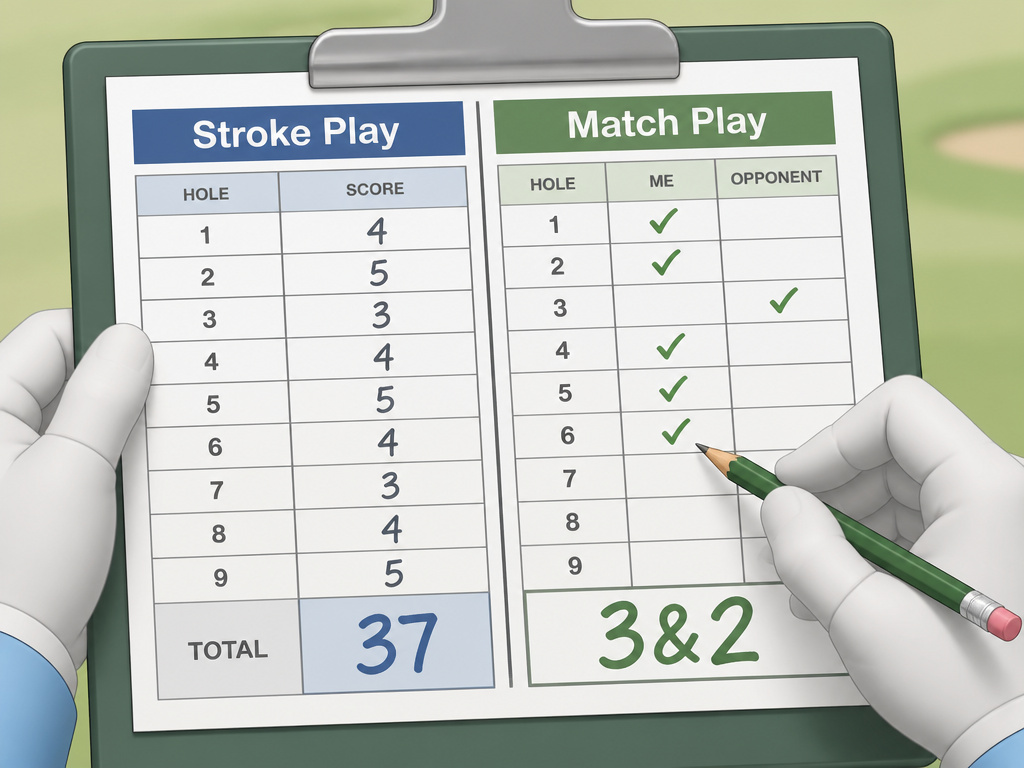
You count strokes the same way no matter what. How those strokes determine a winner is where formats diverge. The official Rules of Golf recognize two pillars: match play and stroke play, with several variations under each.
Stroke Play (Medal Play) is what you see in professional tournaments. Every stroke over 18 holes (or 72) is added up. The lowest total wins. It’s simple, brutal, and unforgiving. One terrible hole can wreck your round. This is the default for most casual and club play, and using a clear golf scorecard is non-negotiable for keeping an honest count.
Match Play is a head-to-head duel. You compete hole-by-hole against one opponent. The player with the lower score on a hole wins that hole. The match is won by being “up” more holes than remain to play (e.g., 3&2 means you were 3 up with 2 holes left). You can lose a hole 8-7 and it only counts as one loss; the magnitude doesn’t matter. This format allows for more aggressive strategy.
Common mistake: Conceding short putts in stroke play. That’s a one-stroke penalty for giving advice. In match play, you can concede your opponent’s next stroke, hole, or even the entire match. The formats have different DNA.
Other formats like Stableford (points based on net score per hole) and Scrambles (team play) are built on these rules. Understanding the difference between stroke play and match play is the first step to choosing the right game for your group.
How Handicaps Turn Your Gross Score Into a Net Score
This is the system’s great equalizer. Your gross score is the raw number of strokes. Your Handicap Index is a portable number representing your potential ability. At each course, that index converts to a Course Handicap, which tells you how many strokes you get to subtract for your net score.
Let’s say you have a Course Handicap of 15. You shoot 90 on a par-72 course. Your net score is 75 (90 – 15). A scratch golfer (handicap 0) who shoots 75 has a net 75. You tied on net score, despite being 15 strokes apart in raw skill.
The handicap system uses two course-specific numbers: * Course Rating: What a scratch golfer (0.0 handicap) is expected to shoot from a given set of tees. * Slope Rating: How much harder the course plays for a “bogey golfer” (a ~20 handicap) compared to the scratch golfer. A higher slope (113 is average) means higher handicaps get more strokes.
The Net Double Bogey rule is a critical handicap safeguard. For posting purposes, the worst you can score on any hole is a net double bogey. It caps the damage of one nightmare hole so it doesn’t unfairly inflate your handicap.
A Step-by-Step Guide to Keeping Your Own Score
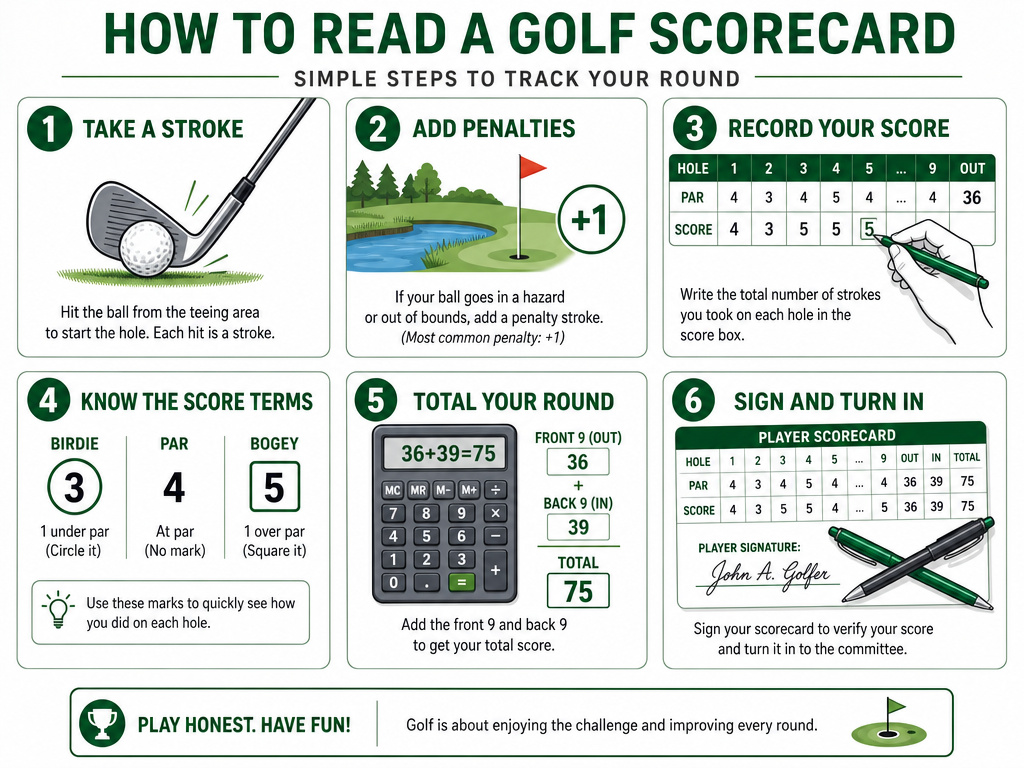
Honest scoring is a habit. Here’s the drill, from the first tee to signing the card.
- Count Every Swing with Intent. Per the basic golf rules, a stroke is any forward club movement made to hit the ball. Whiffs count if you were trying to hit it. Practice swings don’t.
- Tally Penalties Immediately. Lost ball? Out of bounds? Add one penalty stroke and replay from the previous spot. That OB drive means your next shot is your third. Drop in a penalty area? Add one stroke. Know the common penalties before you play.
- Write One Number in the Box. After holing out, write your total strokes for that hole in the box on the scorecard. No math yet.
- Mark Circles and Squares (Optional). A common notation: circle the number for a birdie or better, leave par plain, and square the number for a bogey or worse. It makes your round visual at a glance.
- Add It Up at the Turn and the End. Total your front nine (holes 1-9) and back nine (holes 10-18) separately, then add them for your gross total.
- Check and Sign the Card. In any formal stroke play round, you and your marker must verify each other’s hole scores and sign the card. An unsigned card means disqualification.
Using a digital golf stroke counter or app can help, but have a paper backup. Phones die. Apps crash. Paper is evidence.
Beyond the Basics: Stableford, Slang, and Rare Scores
Once you’re comfortable with stroke counting, other formats and terms open up. They use the same core language but change the objective.
The Stableford scoring system replaces strokes with points. You earn points based on your net score (gross minus your handicap stroke) on each hole: * Double Eagle / Albatross or Better: 4 points * Eagle: 3 points * Birdie: 2 points * Par: 1 point * Bogey: 0 points * Double Bogey or Worse: 0 points
You play until you can’t score a point, then pick up. It’s faster and encourages aggressive play for birdies. The Stableford system is hugely popular in club games.
You’ll also hear golf slang on the course. A “mulligan” is a do-over (not allowed by the rules). A “gimme” is a conceded short putt. A “sandie” is getting up-and-down from a bunker. A “snowman” is a score of 8. Our guide to golf slang decodes these and more.
And for the record books, the best golf scores ever recorded are a mix of these terms coming to life under extreme pressure, 59s on the PGA Tour, a 58 on the Korn Ferry Tour, and amateur rounds that defy belief.
Frequently Asked Questions
What’s the difference between a birdie and an eagle?
Birdie is one stroke under par on a hole. An eagle is two strokes under par. On a par-4, a birdie is a 3 and an eagle is a 2. On a par-5, a birdie is a 4 and an eagle is a 3.
Is an albatross the same as a double eagle?
Yes. They both describe a score of three-under-par on a single hole. “Albatross” is the standard term in British and international golf. “Double eagle” is more common in American golf. It’s the same rare feat, like a hole-in-one on a par-4 or a 2 on a par-5.
What is a good golf score for a beginner?
Breaking 100 is the first major milestone for a new golfer. This means shooting 99 or better on a par-72 course. It represents a baseline of consistency. The next targets are breaking 90 (bogey golf) and breaking 80. The average male amateur handicap is around 14, which typically means scoring in the high 80s.
How does a golf handicap work?
Handicap measures your potential ability. The World Handicap System averages the best 8 of your last 20 score differentials (your score adjusted for course difficulty). The result is your Handicap Index. When you play a course, that index converts to a Course Handicap, the number of strokes you subtract from your gross score to get your net score for competition.
What is the rarest score in golf?
Condor**, a score of four-under-par on a single hole. This means a hole-in-one on a par-5. There are only a handful of verified instances worldwide, usually on extreme doglegs or downhill par-5s where players can cut the corner. It has never occurred in a professional tournament.
The Bottom Line
Golf scoring is a language built on a single, simple comparison: your strokes versus par. Birdie, eagle, bogey, they’re just nicknames for that difference. The real depth is in how that system adapts: through handicaps that level competition, through formats like Stableford that change strategy, and through environmental factors that rewrite the day’s challenge.
Your job is to count honestly, learn the basic golf terminology, and understand what the numbers are telling you about your game. The scorecard isn’t a test. It’s the best coach you’ll ever have, showing you exactly where to improve. Now go out and turn some of those bogeys into pars.
