
The Stories Behind Golf Slang Terms Explained for Beginners
This post contains affiliate links. As an Amazon Associate, we earn from qualifying purchases.
This post contains affiliate links. As an Amazon Associate, we earn from qualifying purchases.
Golf slang terms explained means decoding the game’s rich, centuries-old vocabulary that describes scores, shots, and situations. The core terms, birdie, bogey, par, eagle, have specific historical origins, while modern slang like “stinger” or “worm-burner” describes ball flight. Knowing this language lets you follow conversations, understand betting games, and even diagnose your own swing flaws.
That historical grounding changes how you hear the words. When you know “birdie” comes from 19th-century American slang for “excellent,” the term stops being an abstract score. It becomes a story. The same goes for “bogey,” named after an elusive song character, and “fore,” a shortened military warning from Scotland.
What follows is not just a list. It’s the breakdown of where these phrases came from, what they actually mean on the card, and how they’re used in real rounds. We’ll cover scoring, course geography, shot shapes, betting games, and the etiquette terms that keep the game moving. By the end, you’ll translate any locker-room conversation.
Key Takeaways
- The term “birdie” originated in 1899 in Atlantic City, NJ, from slang for an excellent “bird of a shot,” with “eagle” and “albatross” following by analogy.
- “Bogey” comes from a 1890s British song, “The Bogey Man,” representing an elusive perfect score before “par” was standardized by the USGA in 1911.
- “Fore” is a Scottish shortening of “before” or “afore,” adopted from 18th-century military warnings to alert people downrange.
- Slang for bad shots (shank, chunk, yips) is often more precise and colorful than terms for good ones, helping diagnose specific swing faults.
- Betting terms like “Nassau” and “Skins” create structured side games within a round, with their own vocabulary for presses, carries, and gimmes.
The Core Scoring Lingo: Birdie, Bogey, Par, and Beyond
Scoring terms are the absolute bedrock. You can’t keep a card without them.
Par is the baseline. The USGA defined it in 1911 as “perfect play without flukes and under ordinary weather conditions, always allowing two strokes on each putting green.” It’s the expected score for a scratch golfer. A standard 18-hole course is typically a par 72.
The USGA defined ‘par’ in 1911 as ‘perfect play without flukes and under ordinary weather conditions, always allowing two strokes on each putting green’.
A birdie is one stroke under par. Its origin is pure American slang. In 1899, during a match at Atlantic City Country Club, Ab Smith hit a shot within six inches of the cup and called it a “bird of a shot.” He suggested double compensation for a hole completed in one under par, and the group agreed to call it a “birdie.” The term stuck.
An eagle is two under par. An albatross (or double eagle) is three under par. These followed the “bird” analogy. They are rare. An albatross usually means holing out from the fairway on a par-5.
A bogey is one over par. The term comes from a British song from the early 1890s, “The Bogey Man.” Golfers equated the quest for the elusive Bogey Man with the quest for an ideal score. By the mid-1890s, “bogey score” was that target. When “par” was later standardized as the expert’s expectation, “bogey” settled as one stroke worse.
Beyond that, numbers often take over. But slang exists: * Double Bogey: Two over par. * Triple Bogey: Three over par. * Snowman: An eight on a hole, the number looks like a snowman. * Buzzard: Slang for a double bogey.
Your gross score is your total strokes. Your net score subtracts your handicap allowance. That’s the foundation of all common golf scores.
On-Course Geography: Fairways, Bunkers, and Doglegs
The course itself has a precise map. Knowing it lets you describe where your ball is, and where it shouldn’t be.
The tee box is where you start. The fairway is the mown highway to the green. Hit it. The rough is the longer, penalizing grass lining the fairway.
Hazards have specific names. A bunker is a sand-filled pit. Water hazards are now officially called penalty areas. If your ball goes out-of-bounds (OB), past the white stakes, you’re re-hitting with a penalty stroke.
The green is the putting surface. The fringe is the slightly longer collar around it. The pin or flagstick marks the hole.
| Course Feature | What It Is | Common Slang / Note |
|---|---|---|
| Fairway | Closely mown path from tee to green | “Short grass”; where you want to be |
| Rough | Longer grass bordering fairway | “Deep rough” is punitive; “first cut” is manageable |
| Bunker | A hazard filled with sand | Also called a “sand trap”; a fried egg is a plugged lie |
| Green | The putting surface | The “dance floor” |
| Dogleg | A hole that bends left or right | A dogleg hole forces a strategic choice: cut the corner or play safe |
Where this goes sideways: Calling any sandy area a “sand trap.” The official term is bunker. “Trap” is casual slang, mostly American. On a rules sheet, it says bunker.
The architecture creates the strategy. A dogleg hole demands you decide how much corner to cut. A blind shot means you can’t see your landing area. Understanding these principles of course design is what separates a player from a golfer.
Shot-Shaping and Ball Flight Lingo
This is the technical dialect. It turns “I hit it badly” into a diagnosis.
A draw is a controlled right-to-left curve for a right-handed golfer. A fade is a controlled left-to-right curve. These are intentional shapes.
A hook is an uncontrolled, severe draw. A slice is an uncontrolled, severe fade. The slice is the most common miss in amateur golf.
Other ball flights get descriptive names: * Push: Goes straight but right of the target. * Pull: Goes straight but left of the target. * Stinger: A low, penetrating shot popularized by Tiger Woods. * Worm-burner: A shot hit so thin it skims along the ground.
The quality of contact has its own vocabulary. * Pure/Flushed: Perfect contact. It feels like nothing. * Chunk/Fat: Hitting the ground well before the ball. The shot is heavy and short. * Thin/Skull: Striking the ball with the leading edge. It rockets low and long. * Shank: The ball strikes the hosel, shooting violently right at a 45-degree angle. The most feared word in golf.
The part nobody mentions: A “shank” often comes from getting too close to the ball, not from a wildly outside swing path. It’s a proximity issue before it’s a path issue.
Why the “yips” are different: They aren’t a shot shape. The yips are a neurological glitch, a sudden, involuntary twitch that ruins putting or chipping. It’s psychological in origin but physically devastating. Saying someone has “the chipping yips” explains a lot.
The Slang of Good Shots, Bad Shots, and Side Games
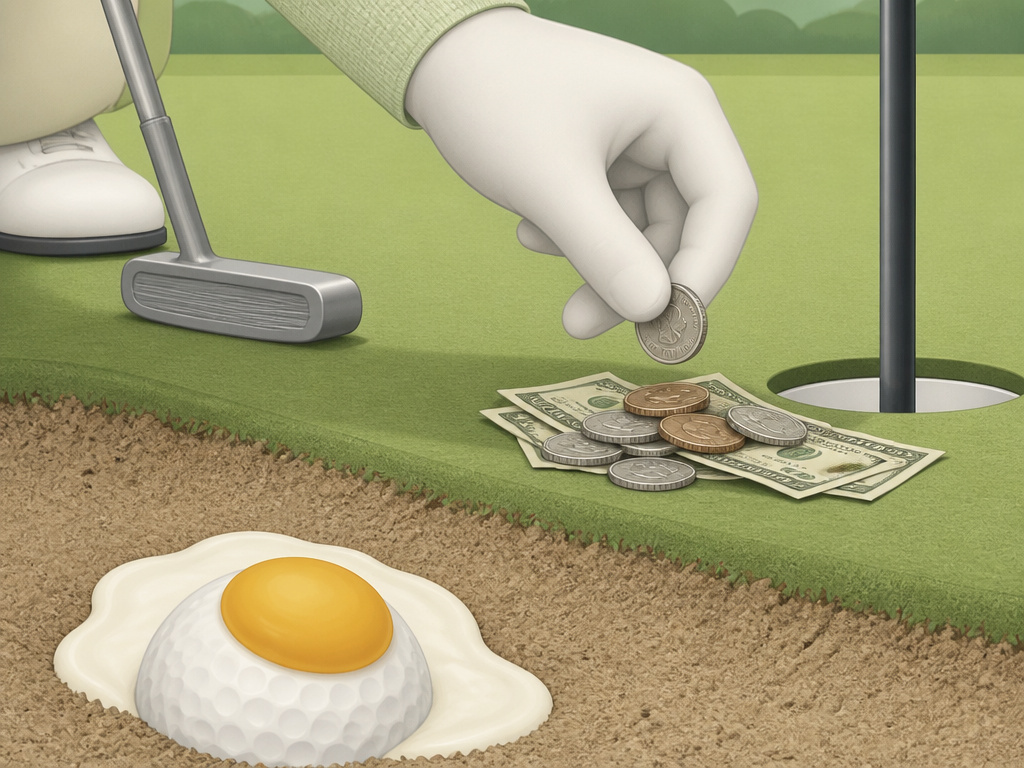 Golf’s culture is built on camaraderie, misery, and friendly wagers. The slang here is the most colorful.
For good shots, you might hear “bomb” for a huge drive, “drained it” for a made putt, or “stiffed it” for an approach shot left next to the hole. A “greenie” is a side bet won for being closest to the pin on a par-3 and making par.
Bad shots get creative metaphors. A “banana ball” is a huge slice. “Army golf” is left, right, left, right. A “fried egg” is a plugged lie in a bunker. A “foot wedge” is the illegal use of your shoe to improve a lie.
Betting games have formalized terms. A Nassau is three bets in one: front nine, back nine, and overall match. A skins game awards a pot for each hole, with ties carrying over. “Press” means starting a new side bet during a match if you’re losing.
| Betting Game | How It Works | Key Slang Within the Game |
|---|---|---|
| Nassau | Three separate bets: front 9, back 9, overall 18. | A “press” is a new bet initiated mid-match. |
| Skins | Each hole is worth a skin (money). Ties carry over. | A “carry over” makes subsequent holes more valuable. |
| Match Play | Win individual holes, not total strokes. | “Dormie” means you’re up by as many holes as are left (you can’t lose). |
| Stableford | Points awarded based on score relative to par. | Popular because you pick up after a bad hole; limits big numbers. |
Knowing this slang is part of on-course etiquette. It’s how you negotiate a $2 Nassau without confusion. It also clarifies what’s a real rules of golf violation versus casual gamesmanship.
Equipment, Etiquette, and the 19th Hole
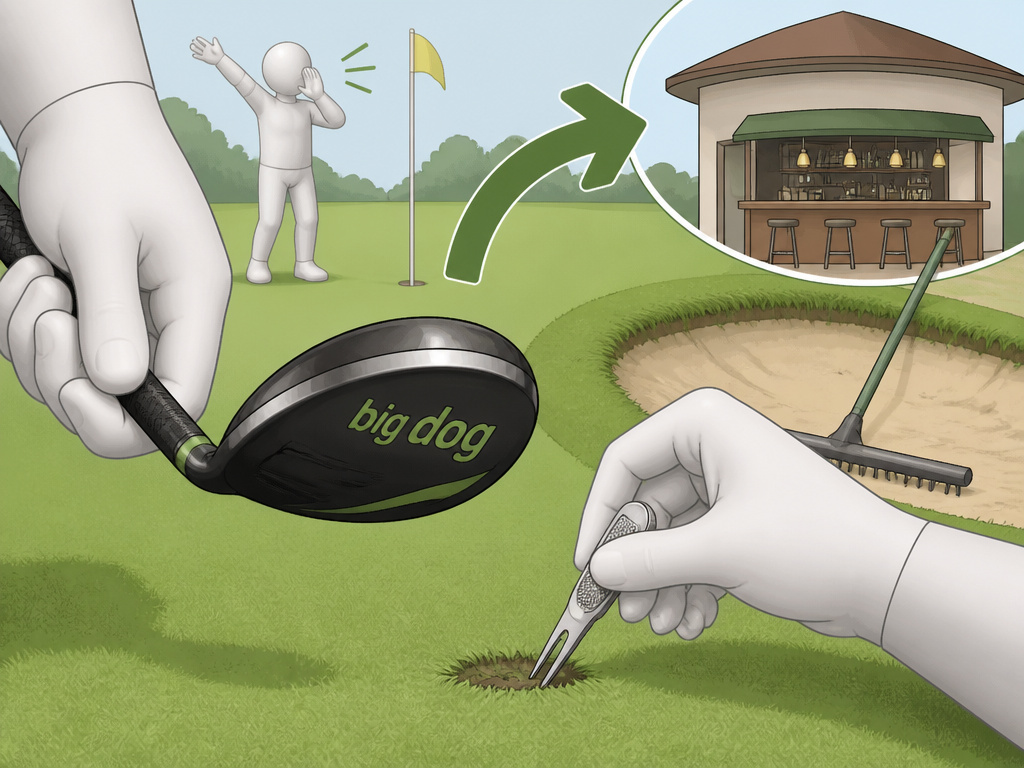 The gear and the rituals have their own terms. Your “sticks” are your clubs. “Blades” are unforgiving player’s irons. “Cavity backs” are forgiving game-improvement irons. The “big dog” is your driver.
Etiquette terms keep the game moving. “Ready golf” means hitting when ready, not strictly following honors. “Fore!” is the universal warning shout. Its origin is Scottish, a shortening of “before” or “afore,” likely borrowed from military artillery warnings.
You must “repair your pitch mark” on the green and “rake the bunker” after you play. These aren’t just suggestions; they’re obligations.
The “19th hole” is the clubhouse bar. It’s where the stories from the round are told, often with embellishment. It’s also where terms like “mulligan” are debated. A mulligan is a do-over, a free second chance off the first tee. It’s named for a Canadian amateur, David Bernard Mulligan, who took one in the 1920s. They are not allowed under any official rules of golf.
Why this vocabulary matters for travel: When you play a new course, you’re navigating its layout and its local culture. Understanding whether a group is playing a serious target golf match or a casual skins game changes how you interact. It’s the difference between being a visitor and a participant.
Frequently Asked Questions
What is the origin of the term “birdie” in golf?
The term “birdie” originated in the United States in 1899. According to the USGA golf history FAQ, during a match at Atlantic City Country Club, Ab Smith hit a shot close to the hole and called it a “bird of a shot.” The group agreed to call one under par a “birdie,” and the name stuck, with “eagle” and “albatross” following later.
What’s the difference between a bogey and a double bogey?
Bogey is a score of one stroke over par on a hole. A double bogey is two strokes over par. The terms are part of the standard scoring terms hierarchy. “Bogey” itself comes from an old British song, while “double bogey” is a modern extension of that scoring system.
Why do golfers yell “fore”?
Golfers yell “fore” as a warning that a ball is headed in someone’s direction. The SCGA golf terminology origins note it’s of Scottish origin, a shortened form of “before” or “afore,” likely adopted from 18th-century military warnings. It’s a critical safety shout.
Is a “mulligan” allowed in official golf rules?
No. A mulligan, a free do-over of a shot, is strictly a casual, unofficial practice. It is never allowed under the official Rules of Golf. The term comes from amateur golfer David Mulligan in the early 20th century.
What does “dormie” mean in match play?
In match play, “dormie” means a player is ahead by the exact number of holes remaining. For example, being “4 up with 4 to play” is dormie. The player cannot lose the match at that point, only win or tie. It comes from the French word “dormir” (to sleep), implying you could coast.
What is a “shank”?
Shank is a mishit where the ball strikes the hosel (the socket where the clubhead connects to the shaft) instead of the clubface. It shoots off at a sharp angle, usually right, and travels a very short distance. It’s widely considered the worst shot in golf.
The Bottom Line
Golf slang is more than a quirky dialect. It’s the game’s living history and its shared shorthand. When you know a “birdie” started as a compliment in 1899 New Jersey, the word carries weight. When you understand that “fore” is a centuries-old safety warning, you’ll yell it louder.
This vocabulary connects you to every other golfer. It lets you decipher a comprehensive golf terminology guide, follow a broadcast, and engage in the post-round talk in the 19th hole. It turns the course from a series of challenges into a place with its own stories, told one term at a time. Learn the language, and you’re not just playing golf, you’re part of it.
