
Understanding the Clubface vs Swing Path Relationship in Golf
This post contains affiliate links. As an Amazon Associate, we earn from qualifying purchases.
This post contains affiliate links. As an Amazon Associate, we earn from qualifying purchases.
The relationship between clubface and swing path determines your ball’s starting direction and its curve. For a right-handed golfer, a clubface pointed right of the target with a swing path further right produces a push-slice. The clubface angle at impact is responsible for about 80% of the ball’s starting direction, while the path dictates the remaining 20% and the curvature.
That 80/20 split is the load-bearing fact. Most amateurs try to fix a slice by swinging more in-to-out, chasing a perfect path. They ignore the face. The clubface pointing left of your path at impact is the non-negotiable requirement for a draw. If your face is open relative to that path, you get a push or a slice no matter what your path does.
What follows is the breakdown of why face angle dominates, how modern club technology tries to help on mishits, and the two drills that actually rewire the relationship in your swing.
Key Takeaways
- Clubface angle at impact dictates roughly 80% of the ball’s starting direction. Your swing path influences the other 20% and the side spin that creates curve.
- To hit a draw, the clubface must be closed relative to the swing path at impact. A perfect in-to-out path with an open face still produces a slice.
- Modern clubface technology like Callaway’s Tri-Force Face aims to maintain ball speed on off-center hits, but it cannot change the fundamental face/path relationship. It helps distance, not direction.
- The “hold the face square” advice is a speed killer. A 2025 instructional source noted this feel can cost about eight miles per hour of clubhead speed by restricting natural rotation.
- Diagnose your issue by looking at your strike pattern on the face. Consistent heel strikes often signal an out-to-in path with an open face, the classic slicer’s combo.
The Physics Package: D-Plane and Why It’s Not 50/50
The old advice said swing path controlled direction and face controlled spin. Launch monitors like Trackman and high-speed video proved that wrong. The modern model is called the D-Plane, a geometric plane formed by the clubhead’s direction of travel (path) and the angle of the clubface at the moment of collision.
The D-Plane concept states the ball’s initial launch direction is a weighted average, approximately 85% influenced by face angle and 15% by path for a driver. With irons, the face’s influence is even greater due to more loft.
Your brain wants it to be 50/50. Your eyes lie to you. When you hit a big slice that starts right and curves further right, it feels like you swung way out to the right. The reality is your path was likely only slightly out-to-in, but your face was wide open, pointed even further right than that path. The ball starts where the face points, then curves away from the path.
Why does the face have so much control? Think of the collision in microseconds. The golf ball compresses against the clubface. The initial impulse, the shove, is delivered perpendicular to the face’s surface. The path adds a glancing blow, a sideswipe, that imparts sidespin. The perpendicular shove is stronger. That’s the 80%.
The 80/20 Rule: Clubface Dominates Direction
Forget swing path for your first correction. Look at your clubface.
If you slice, your face is open at impact. If you hook, your face is closed. You can have a beautiful, neutral path and still hit a wild slice if your face is open. Conversely, you can have a horrific over-the-top move but if you manage to slam the face shut, you’ll hit a pull-hook that starts left and goes further left.
Where this goes sideways: Trying to fix a slice by only swinging more in-to-out. If your face stays open relative to that new path, you’ll hit a bigger push-slice that goes even further right. The face must close.
How do you know your face angle? You need feedback. Use a can of Dr. Scholl’s foot spray on your clubface. Hit a few shots. The strike mark shows where you hit it, but the ball flight tells the face story. A shot that starts straight but curves right means your face was square to the target at impact, but your path was left (out-to-in). A shot that starts right and curves right means your face was open and your path was left.
The fix starts with grip and forearm rotation. A weak grip (hands turned too far left) makes it physiologically harder to square the face. It’s not about strength; it’s about geometry.
Can Technology Change the Relationship? The Clubface Engineering Arms Race
Manufacturers know amateurs miss the center. They engineer faces for “forgiveness,” which in physics terms means maintaining the Coefficient of Restitution (COR) across a larger area. This is where patents and layered materials come in.
Take Callaway’s Tri-Force Face, detailed in patent US12629566B1. It’s a three-layer sandwich: a titanium alloy striking layer, a middle polyurea damping layer, and a carbon composite back layer. The polyurea is key. Prototype testing showed a 0.040-inch thick polyurea layer increased durability by 102% over a non-coated face. When combined with the carbon panel, it improved another performance metric by 47%.
“Adhering a polymer coating to the rear side of the striking face improves the durability of the golf club during impact… This polymer coating can be specifically used on brittle face materials that would not otherwise be suitable due to poor durability.” . Excerpt from Callaway Tri-Force Face Patent US12629566B1
What does this mean for you? If you hit it off the toe, a Tri-Force Face or similar technology (like TaylorMade’s Thru-Slot Speed Pocket) will lose less ball speed. The face flexes more efficiently on mishits. Your toe-shot might go 210 yards instead of 190. But the ball will still curve based on the relationship between that point on the face and your swing path. Technology salvages distance, not direction. It doesn’t break the 80/20 rule.
| Your Common Miss | Likely Face/Path Combo | What Tech Can Do | What Tech Can’t Do |
|---|---|---|---|
| Big Slice (starts right, curves right) | Face OPEN, Path OUT-TO-IN | Maintain ball speed on heel strike | Close the face for you |
| Pull-Hook (starts left, curves left) | Face CLOSED, Path OUT-TO-IN | Maintain ball speed on toe strike | Open the face for you |
| Push (starts right, goes straight) | Face OPEN, Path IN-TO-OUT | Maintain ball speed | Change the starting direction |
| Pull (starts left, goes straight) | Face CLOSED, Path IN-TO-OUT | Maintain ball speed | Change the starting direction |
Your Strike Pattern Is the Diagnostic Map
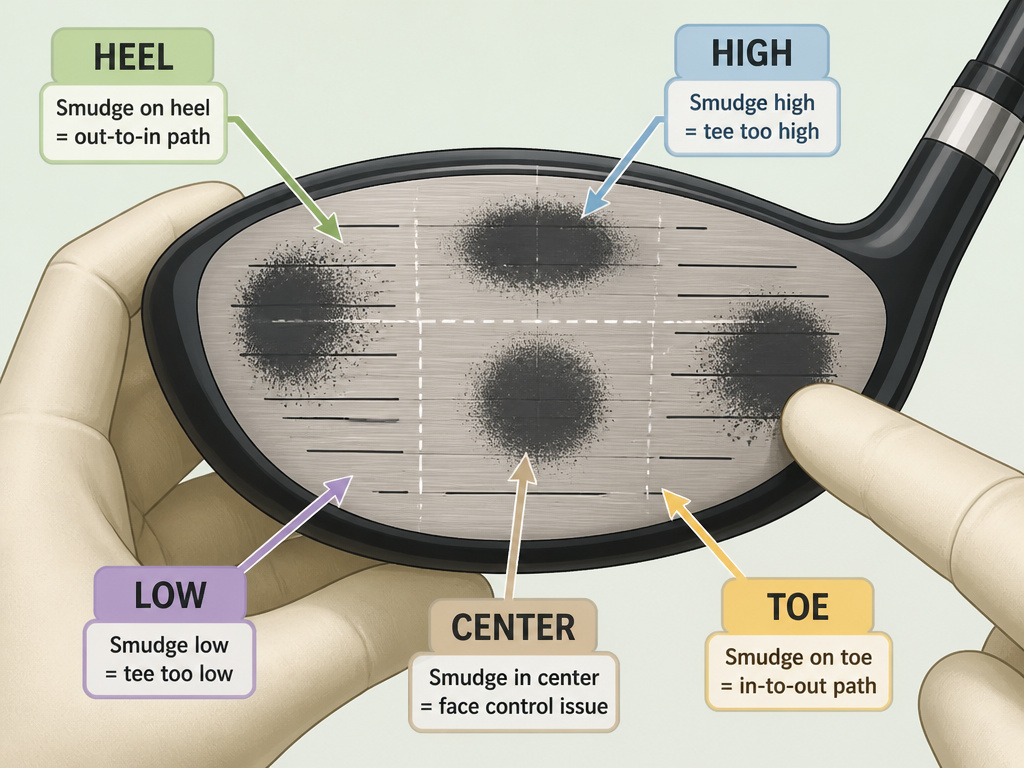
You don’t always need a $20,000 launch monitor. Your clubface tells a story after a range session. Clean it and hit 10 shots with your driver. The smudge pattern is your data.
- Smudge concentrated on the heel: You’re likely coming over-the-top (out-to-in path) and may be standing too close. The face is probably open at impact.
- Smudge concentrated on the toe: You might be stuck inside (in-to-out path) or standing too far away. The face could be either open or closed.
- Vertical spray all over the face: Inconsistent low and high strikes. This points to a major swing plane issue or excessive body movement like swaying, not a pure face/path problem.
- Consistent center-ish strikes but wild curvature: This is the pure face/path disconnect. Path might be decent, but face control is absent.
This pattern helps you choose your drill. Heel strikes with slices need a different fix than toe strikes with hooks.
The Two Drills That Actually Rewire Face and Path
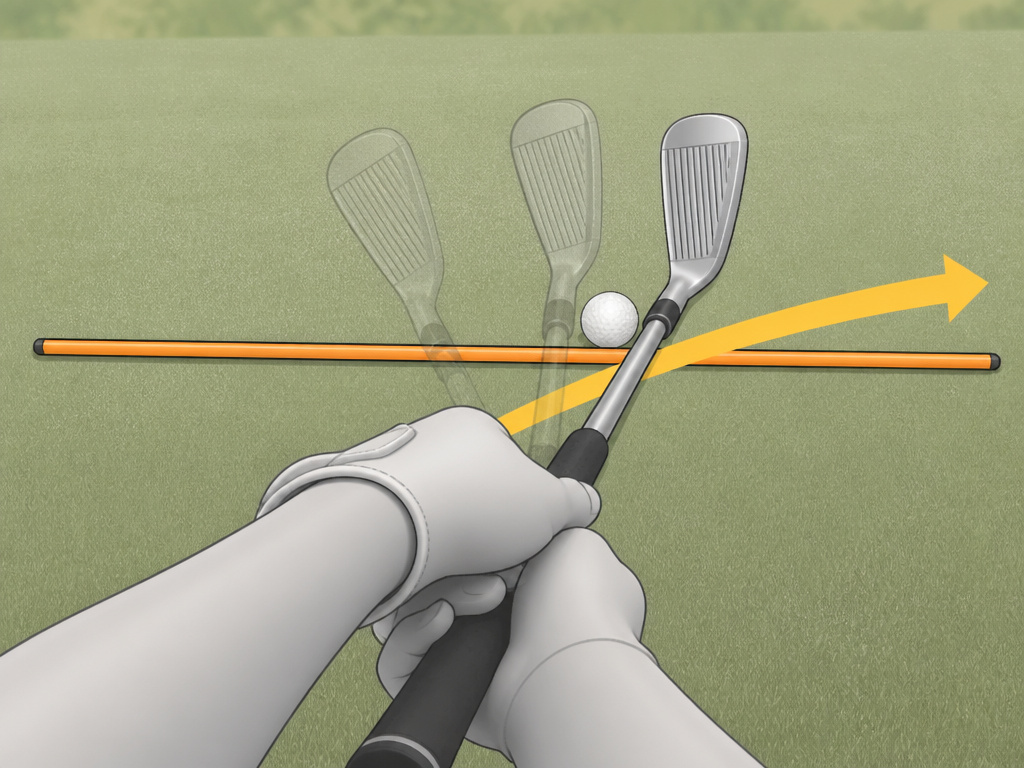
Drill selection is critical. Picking the wrong one reinforces your mistake. Use the strike pattern to choose.
Drill 1: For the Slicer (Heel Strikes, Open Face)
This is the “Face Control” drill. You’ll need an alignment stick.
- Place an alignment stick on the ground, parallel to your target line, about a foot outside the ball.
- Take your normal setup.
- Make half-swings, focusing on brushing the grass inside the alignment stick on the downswing.
- The real key: Feel your right forearm (for righties) rotating over the left through impact. Say “cover the ball” with the back of your left hand.
The consequence if you skip the forearm rotation: You’ll hit the stick or still swing out-to-in. The rotation squares the face. This drill combines a shallower path with an intentional closing action.
Drill 2: For the Chronic Hooker (Toe Strikes, Closed Face)
This is the “Path and Release” drill. It feels weird.
- Set up to a 7-iron. Place a headcover just outside the ball, about two inches away.
- Your goal is to hit the ball without touching the headcover.
- To do this, you must swing from the inside. Feel like you’re hitting the ball to right field.
- Here’s the face part: As you swing through, feel like the clubface is looking at the sky for as long as possible after impact. This delays the shutoff rotation.
Common mistake: Trying to hold the clubface square through impact. As one instructional source bluntly put it, “That’s counterproductive and it costs you a ton of speed. About eight miles an hour.” The face must rotate; you’re just timing it.
Why this works: It forces an in-to-out path while discouraging the violent face-shutting move that causes hooks. The hook often comes from a path that’s too in-to-out combined with a face that’s shut relative to it. This drill manages both.
How Swing Path Types Interact With Face Control
Your chosen swing plane technique sets the stage for the face/path battle. A single-plane swing, like the Moe Norman method, minimizes variables. The arms and torso move as one unit, making it easier to deliver a consistent face angle because there’s less independent hand action. The trade-off is it can feel restrictive and limit shot shaping.
A two-plane swing has more separation between arm swing and body turn. This creates more potential for power and shot variety, but also more places for the face to get lost, casting the club early or getting stuck behind you. Most amateurs with two-plane swings struggle with consistency because the face control requirement is higher.
Neither is inherently better. But understand your technique: a one-plane swinger’s miss is usually a block or push from failing to rotate the body enough to square the face. A two-plane swinger’s miss is more often a wild slice or hook from a timing breakdown between the arms and body.
Frequently Asked Questions
Does a more forgiving driver fix my slice?
No. Forgiveness in modern drivers refers almost entirely to maintaining ball speed on off-center hits. It makes your slice go farther, not straighter. The relationship between your clubface and swing path is a technique issue, not an equipment one. Equipment can help moderate spin, but it cannot change the fundamental ball flight laws.
I hit draws on the range but slice on the course. Why?
Pressure. On the course, the subconscious demand for a good result often triggers your old, “safe” habit. For slicers, that safe habit is often a subconscious effort to “guide” the ball, which stalls body rotation and leaves the face open. You might also be subconsciously altering your setup or ball position. The fix is to make your range drill so simple that it becomes your default under pressure.
What’s more important for a beginner: clubface or swing path?
Clubface control, 100%. A beginner can make decent contact with a terrible path if the face is square. A perfect path with a wide-open face results in an unplayable slice. Work on grip and the feeling of squaring the face with half-swings before ever worrying about path.
Can a strong grip fix my slice?
It can help, but it’s a band-aid. A strong grip (hands turned to the right for a righty) makes it easier to square the face physically. However, if your underlying swing motion is still over-the-top with no rotation, you might just hit pull-hooks instead. Use a grip adjustment in conjunction with drills that fix the root cause.
How does this relate to a reverse pivot or swaying?
Those are power and consistency killers that indirectly destroy face/path control. A reverse pivot or excessive swaying moves your low point and center of gravity all over the place. This makes delivering the clubface to the ball at a consistent angle nearly impossible. You might hit one shot with a square face, the next with it wide open, because your body was in a different place. Stability is the platform for consistency.
Before You Go
Stop trying to solve a face problem with a path solution. Your clubface is the CEO of ball flight; your swing path is the VP. The 80/20 rule isn’t a suggestion, it’s the physics of the collision.
First, diagnose using your strike pattern and ball flight. Second, pick the drill that matches your miss, not the one you wish you needed. Third, understand that technology is your distance backup, not your swing coach. Finally, be patient. Rewiring this relationship takes focused repetition, not just beating balls.
The goal isn’t a perfect robot swing. It’s understanding the lever so well that you can use its flaws. A face that’s three degrees open relative to a path that’s two degrees in-to-out? That’s a playable cut. Knowing that is how you move from fixing to playing.
