
Understand the Inside Out vs Outside In Swing Path Debate
This post contains affiliate links. As an Amazon Associate, we earn from qualifying purchases.
This post contains affiliate links. As an Amazon Associate, we earn from qualifying purchases.
The difference between an inside out and outside in swing path comes down to degrees measured by a launch monitor: a positive number (e.g., +2°) means inside-out, a negative number (e.g., -3°) means outside-in. The optimal path for a driver is +1 to +3 degrees in-to-out; for irons, it’s 0 to +2 degrees. An outside-in path beyond -3 degrees is the primary cause of a slice.
That range from -3 to +3 degrees is where 90% of amateur ball flight problems live. It’s not a vague feeling, it’s a number you can measure. A California State University study put golfers on monitors and found their right elbow was 7 degrees more extended in an outside-in backswing. That single kinematic shift pulls the entire sequence out of position.
What follows: the exact degree ranges that define each path, the physical reason most fixes fail within two weeks, and the one drill that gives you undeniable feedback in ten swings. By the end, you’ll stop guessing about your path and start changing the number.
Key Takeaways
- Your swing path is a measurable angle. Positive degrees (+1 to +3) are inside-out (draw bias), negative degrees (-1 to -5) are outside-in (slice bias).
- Fixing an outside-in path often makes contact worse before it gets better because the low point of your swing shifts backward.
- The right elbow is the kinematic key. A study found it’s 7 degrees more extended in an outside-in backswing, forcing a steep, “over-the-top” downswing.
- Optimal path depends on the club. Driver thrives on +1° to +3°, while a neutral to slightly in-to-out path (0° to +2°) works best for irons.
- Use a gate drill with two headcovers for immediate feedback. If you hit the outside headcover, your path is still outside-in.
What Do the Numbers Actually Mean?
Forget “swinging to right field” or “coming over the top.” Those are feels, not facts. Your swing path is the direction the clubhead is traveling at impact, measured in degrees relative to the target line. Zero degrees is perfectly down the line. Modern launch monitors like the Garmin R10 or higher-end units spit out this number after every swing.
A launch monitor measures swing path as the horizontal direction of the clubhead at impact. A positive value (e.g., +2.5°) indicates an inside-out path where the club is moving outward relative to the target line. A negative value (e.g., -4.1°) indicates an outside-in path where the club is moving across the body and left of the target line for a right-handed golfer.
Here’s how those numbers translate to real ball flights and the common mistakes tied to each range.
| Path Range (Degrees) | Common Name | Typical Ball Flight (RH Golfer) | The Miss It Creates |
|---|---|---|---|
| -7° to -4° | Severe Outside-In | Big slice, weak fade, pull | Uncontrollable slice, loss of 30+ yards |
| -3° to -1° | Mild Outside-In | Controlled fade, straight pull | Inconsistent curve, thin contact |
| 0° to +2° | Neutral to Slight In-to-Out | Straight, gentle draw | Push if face is open, hook if face is closed |
| +3° to +5° | Moderate In-to-Out | Strong draw, push-draw | Snap hook, block right |
Most high-handicap golfers live between -4° and -7°. Low-handicappers and pros typically operate between -1° and +3°. The goal is a controlled, positive number, not a massive in-to-out swing.
The part nobody mentions: A mild outside-in path (-1° to -3°) is playable and even preferred by some elite players for a fade. The problem is the severe, negative path that comes with no face control and a steep angle of attack, not the fade. That combination is where distance goes to die.
The Kinematic Proof: Why Your Elbow Betrays You
Why is an outside-in path so hard to fix? Because it’s not just a hand path. It’s a full-body sequence that starts going wrong before you even start your downswing. The research gives us a specific, measurable culprit.
The CSUS kinematic golf swing study tracked fourteen golfers and found one glaring difference in the backswing. When players intentionally swung outside-in, their right elbow (for right-handed golfers) was significantly more extended, about 57.7 degrees on average versus 50.9 degrees in a normal swing. That’s a 7-degree gap.
Where this goes sideways: Letting the right elbow float away from the body in the backswing. It forces the shoulders to tilt instead of turn, setting the club on a steep, outside plane. The downswing then has no choice but to come “over-the-top” to reach the ball.
This elbow position is a kinematic dead end. From there, your body’s only option to deliver the clubhead is to lunge forward with the right shoulder. This is the “over-the-top” move everyone complains about. It’s not the cause; it’s the required compensation for a poor backswing position.
Your kinematic sequence, the order in which your body segments fire, gets wrecked. The arms and upper body have to start the downswing because the lower body is stuck. There’s no space for the club to drop inside. So you chop across the ball, adding left-to-right spin and robbing yourself of power.
The fix starts before you move the club. Focus on keeping the right elbow tighter and in front of the right hip in the backswing. This is about maintaining the relationship between your elbow and your torso rotation, not about pinning it to your side. When that connection stays intact, the swing plane naturally shallowens, and an inside path becomes possible, not forced.
The Fix That Feels Wrong (And Why You Quit)
You’ve taken a lesson. You’re working on swinging from the inside. Your first few shots are pushes or even hooks. Then, you start hitting it fat. The club digs into the ground behind the ball. This is the moment most golfers abandon the change and revert to their old, reliable slice. They blame the new swing thought. The real issue is geometry.
An outside-in swing is steep. Because the club is moving leftward (for a righty), it tends to contact the ball later in its arc, often with a more forward low point. When you successfully shallow the club and create an inside-out path, the arc of the swing changes. The low point moves backward.
If your body doesn’t adjust by moving its center forward, you will hit behind the ball. Every time.
Common mistake: Changing your swing path without moving your low point. Your old outside-in path masked a weight distribution flaw where your center hung back. The new, better path exposes it, causing fat and thin shots for 2-3 weeks until your body learns to shift forward.
You won’t find in a quick tip video. The feel of a proper rotational swing with forward shaft lean will initially feel like you’re falling toward the target. It should. You are moving your pivot point forward to match the new, shallower arc.
Drill: The Headcover Gate
This drill gives you no place to hide. 1. Place a headcover just outside the ball (about 4-6 inches away and slightly toward the target). 2. Place another headcover just inside the ball (same distance, closer to your feet). 3. Your goal is to hit the ball without touching either headcover.
If you hit the outside headcover, your path is still outside-in. If you hit the inside headcover, you’ve overdone it and are too far inside-out (a “shank” path). The silence of a clean strike is your reward. Start with half-swings to build the feeling of the club traveling through the gate.
Inside-Out vs. Outside-In: The Shot Shape Showdown
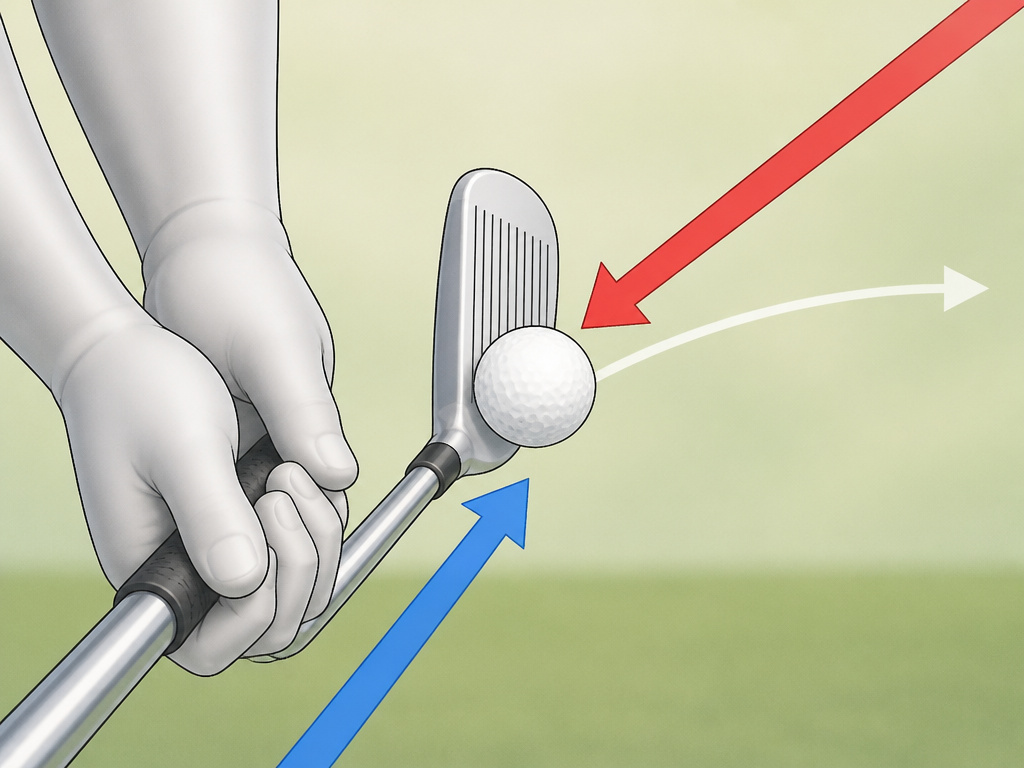
It’s not enough to know your path number. You have to know what it’s paired with. Your ball flight is a product of the relationship between your swing path and your clubface angle at impact. This is the ball flight laws in action.
Let’s break down the four most common combinations for a right-handed golfer.
| Path Direction | Clubface Direction (Relative to Path) | Resulting Shot Shape | What It Feels Like |
|---|---|---|---|
| Outside-In | Open (pointing right of path) | Slice | A glancing blow, weak, ball curves right late |
| Outside-In | Closed (pointing left of path) | Pull / Pull-Hook | A sharp tug left, can be low and hot |
| Inside-Out | Closed (pointing left of path) | Draw / Hook | A powerful, rolling release, ball curves right-to-left |
| Inside-Out | Open (pointing right of path) | Push / Push-Slice | A block to the right, feels like you “held on” |
Most slicers have an outside-in path with an open face. To fix a hook, you’re often dealing with an inside-out path that’s too extreme paired with a severely closed face. The path sets the stage, but the face writes the script.
Do you need an inside-out path? For maximum distance and a forgiving miss, yes. An inside-out path with a square face promotes a draw, which has lower spin and more roll. But a consistent, slight outside-in path (like -2°) with a perfectly matched face can produce a powerful fade. The problem for amateurs is matching that face consistently. It’s a high-wire act.
The safest, most powerful place to live is with a slightly inside-out path (+1° to +3°) and a face that is square to slightly closed relative to that path. This produces a gentle draw. If the face is a few degrees open, you get a push. If it’s a few degrees closed, you get a hook. Both misses are generally more playable than a violent slice.
Your 3-Step Path Diagnosis & Prescription
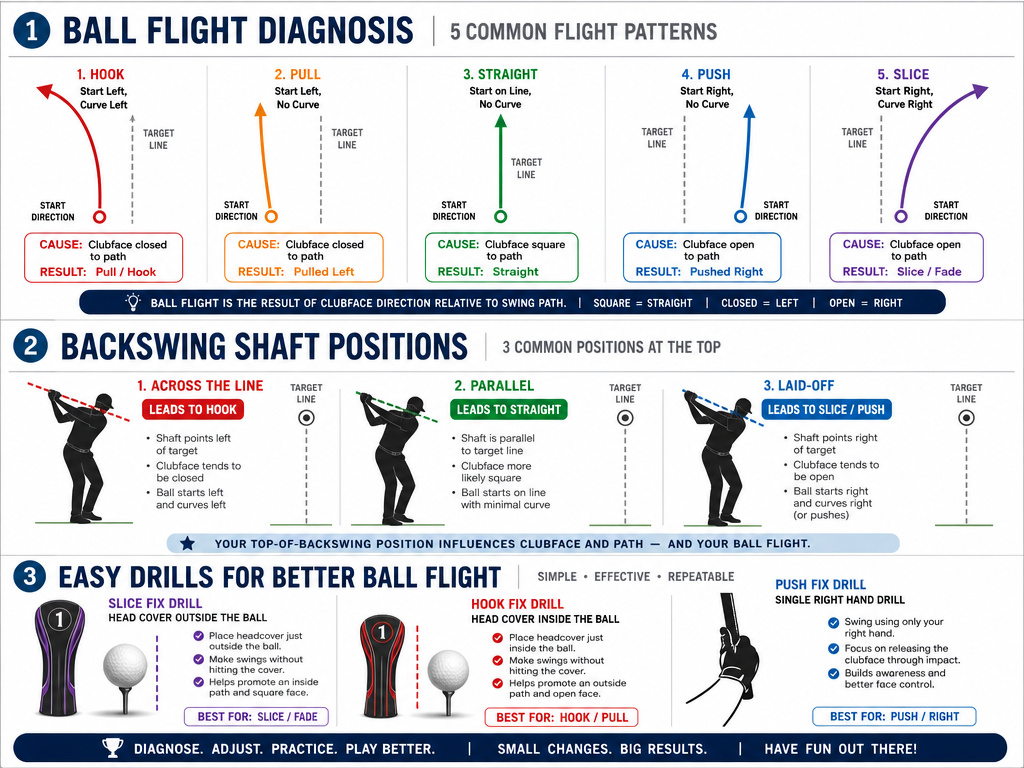
You don’t need a $20,000 launch monitor. Your ball flight and a bit of awareness can tell you almost everything. Follow this sequence to self-diagnose and apply the right fix.
Step 1: Read Your Ball Flight.
- Starts Left, Curves Right (Slice): Outside-in path with an open face. This is the most common pattern.
- Starts Straight, Curves Right (Fade): Likely a mild outside-in path with a slightly open face.
- Starts Right, Curves Left (Draw): Inside-out path with a closed face.
- Starts Right, Goes Straight Right (Push): Inside-out path with a face square to the path but open to the target.
- Starts Left, Goes Straight Left (Pull): Outside-in path with a face square to the path but closed to the target.
Step 2: Check Your Backswing Position.
Set up your phone to record a down-the-line video. Pause at the top of your backswing. Draw a line along your clubshaft. Does the shaft point: – Across the Line (at the target or right): You are likely laid off or in a position that encourages an over-the-top move. This often leads to casting the club from the top. – Parallel to the Target Line: Good neutral position. – Left of the Target (Pointing “at the camera”): This is a “laid-off” position that can make an inside path easier but can also lead to blocks.
Step 3: Apply the Focused Fix.
- If you slice (outside-in): Work on the headcover gate drill. Feel like you are starting the downswing by bumping your left hip toward the target while your arms drop. The thought “swing to right field” can help.
- If you hook (severe inside-out): Your path is too much from the inside. Place a headcover just inside the ball. Focus on swinging more down the target line, feeling like your hands work more outward after impact. Check your grip isn’t too strong.
- If you push (inside-out, open face): The path is okay, but the face is open. Focus on squaring the clubface through impact. A drill is to hit shots with your right hand only (for righties), focusing on the back of the left hand facing the target through impact.
This process turns a vague problem into a solvable equation. Path first, then face.
Frequently Asked Questions
What’s more important, swing path or clubface?
The clubface and swing path relationship is what matters, but for initial direction, the clubface is king. The clubface direction at impact determines about 70-80% of the ball’s starting direction. The swing path (relative to the face) then determines the curve. You need to manage both, but you can’t ignore a wildly open or closed face.
Can I have a good swing with an outside-in path?
Yes, but it’s a narrower path to success. A consistent, mild outside-in path (around -1° to -3°) with precise face control can produce a reliable fade. Many tour players, including legends like Jack Nicklaus, have played this shot. The problem for amateurs is the “mild” part, it often spirals into a severe outside-in path under pressure, leading to a slice.
How long does it take to change my swing path?
You can feel a difference in a single range session with a good drill. To make a new path your reliable, default move, especially on the course, typically takes 4-6 weeks of consistent practice. The body needs time to rewire the sequence of movement and trust the new geometry. Using a launch monitor for feedback drastically speeds up this process.
Does an inside-out swing automatically mean a draw?
No. An inside-out swing path enables a draw, but doesn’t guarantee one. A draw requires an inside-out path AND a clubface that is closed relative to that path (but still slightly open to the target line). If your path is inside-out but your face is open to both the path and the target, you’ll hit a push or a push-slice.
What’s the difference between swing path and swing plane?
Your swing plane is the inclined angle or circle that the clubshaft travels on during the entire swing. Your swing path is the horizontal direction of the clubhead specifically at impact. You can have a good plane but still deliver the club on an outside-in path at the last second (a common flaw called “coming over the top”). They are related, but path is the final delivery metric.
The Bottom Line
Stop describing your swing in vague terms. Your path is a number. Chase the right number: +1 to +3 degrees with the driver, 0 to +2 with your irons. Get that right elbow connected in the backswing, and accept that better contact might feel worse for a few weeks as your body learns to move forward.
The Garmin R10 or a similar personal launch monitor is the fastest teacher you can buy. It turns feel into fact. One range session with real-time path feedback is worth ten sessions of guessing. Your old slice wasn’t a mystery. It was a -5 degree path with an open face. Now you have the map to change it.
