
When to Use a Fairway Wood vs a Hybrid: The Complete Guide
This post contains affiliate links. As an Amazon Associate, we earn from qualifying purchases.
This post contains affiliate links. As an Amazon Associate, we earn from qualifying purchases.
Choose a fairway wood for clean lies in the fairway or off a tee when you need maximum distance and a penetrating ball flight from 200+ yards. Choose a hybrid for tricky lies in the rough, tight lies, or when you need a higher, softer landing from 180-220 yards. Your average swing speed decides the rest: under 85 mph favors a hybrid, over 95 mph leans toward a fairway wood.
That distance and lie framework gets you halfway there. The other half is the specific tech in your hands right now, a modern fairway wood isn’t the same club it was ten years ago, and a hybrid has evolved past being just an “easy long iron.”
What follows: a decision matrix for the three most common scenarios, the two swing-speed thresholds that override lie conditions, and the one modern material change that makes the old advice obsolete.
Key Takeaways
- Lie overrides loft. A perfect fairway lie opens the door for a fairway wood. Any rough, slope, or bare patch slams that door shut, that’s hybrid territory every time.
- Swing speed picks the tool. If your driver carry is under 230 yards, a 5-wood or 7-wood will often launch too low and spin too little. A hybrid in the same loft gets the ball up.
- Modern fairway woods are shallower. Models like the Callaway Paradym Ai Smoke MAX have a shallower face and lower center of gravity than their predecessors, blurring the line with hybrids for clean strikes.
- The hybrid is a recovery cheat code. Its compact head cuts through rough, and its sole design glides over tight lies. It’s the one club you can use from a fairway bunker without a perfect swing.
- Know your 15-yard gap. If your 4-iron goes 190 and your 3-wood goes 225, you have a 35-yard canyon. A 21-degree hybrid typically fills it at 205-210.
The Quick-Answer Matrix: Fairway Wood vs Hybrid
Stop overthinking it. Your next shot fits into one of three boxes. The club choice is already made for you.
The variables are lie, target distance, and the shot shape you need. Your personal swing speed is the final filter, if you’re under 85 mph with a driver, you slide one column to the right.
| Scenario | Fairway Wood (e.g., 15°-18°) | Hybrid (e.g., 19°-22°) | Why It Works |
|---|---|---|---|
| Perfect Fairway Lie, 220+ yds | Yes — default choice. | Only if you struggle with woods. | A fairway wood delivers lower spin and more roll. The shallow face of a model like the Callaway Quantum Max sweeps the ball off the turf. |
| Light Rough, 200-215 yds | Risky. | Yes — default choice. | The hybrid’s compact head cuts through grass without twisting. A bump and run with a hybrid from this lie is more reliable than a wood. |
| Tee Shot on a Short Par 4 | Yes — best for distance. | Good for accuracy. | A fairway wood off a tee maximizes carry. A hybrid offers more control and a steeper landing angle, holding the green. |
Where this goes sideways: Using a fairway wood from any lie where the ball sits below the grass blades. The larger head will catch the grass before the ball, causing a heavy or fat shot that goes nowhere. The hybrid’s leading edge gets to the ball first.
That matrix works for 80% of your decisions. The remaining 20% comes down to your mechanics and the specific technology in your bag.
How Your Swing Speed Dictates the Choice
The textbook says a 3-wood is for distance and a hybrid is for forgiveness. Your driver clubhead speed rewrites that book.
If you don’t know your speed, use this proxy: if your average distance with each club in your driver is under 230 yards total, your swing speed is likely below 90 mph. That changes everything.
For swing speeds under 85 mph:
A fairway wood is a liability from the turf more than 50% of the time. The club is designed to produce low spin for players with high speed to maximize roll. At slower speeds, you can’t generate enough spin to keep the ball in the air. The result is a low line-drive that runs out of steam. Your solution is to loft up. A 21-degree 7-wood or a 22-degree hybrid will launch higher and land softer. The best hybrid golf clubs for beginners in this category, like many easy-to-hit hybrids, have a low, deep center of gravity specifically for this player.
For swing speeds over 95 mph:
You have the speed to launch a fairway wood properly. Your problem is often too much spin with a hybrid, which can balloon shots into the wind and lose distance. Your bag should lean on fairway woods for distance gaps. A strong 3-wood (13.5-14°) and a 5-wood (18°) can cover from 240 down to 215 yards. Use a hybrid only as a specialized tool for rough or when you need a high, stopping shot into a par 5.
The Lie: The Ultimate Decision-Maker
Club selection starts with your eyes, not your yardage book. The condition of the fairway, rough and fringe dictates which club can make clean contact.
When the Fairway Wood Wins:
- Tee Box: Any time you can tee it up, even slightly. This is the easiest condition for a fairway wood.
- Clean, Fluffy Lie: The ball sits on top of the grass in the fairway. You can get the clubhead under it.
- Slight Downhill Lie: The fairway wood’s shallower face helps pick the ball cleanly. A hybrid can dig on a downslope.
When the Hybrid is Non-Negotiable:
- Any Rough: The hybrid’s smaller, rounded head deflects less grass. It’s why the hybrid around the green from light rough is a standard play.
- Tight, Hardpan Lie: The hybrid’s sole is designed to glide. A fairway wood can bounce into the ball, causing a thin shot.
- Fairway Bunker: This is the hybrid’s masterpiece. The technique for a fairway bunker shot with a hybrid is simpler than with a long iron or wood. You play it like an iron, and the club does the rest.
I’ll take a 4-hybrid from a buried lie in the rough over a 5-wood from a perfect fairway lie any day. The wood might go farther when I pure it, but the hybrid goes somewhere playable when I don’t. That’s the difference between a bogey and a double.
How Modern Tech Changes the Choice
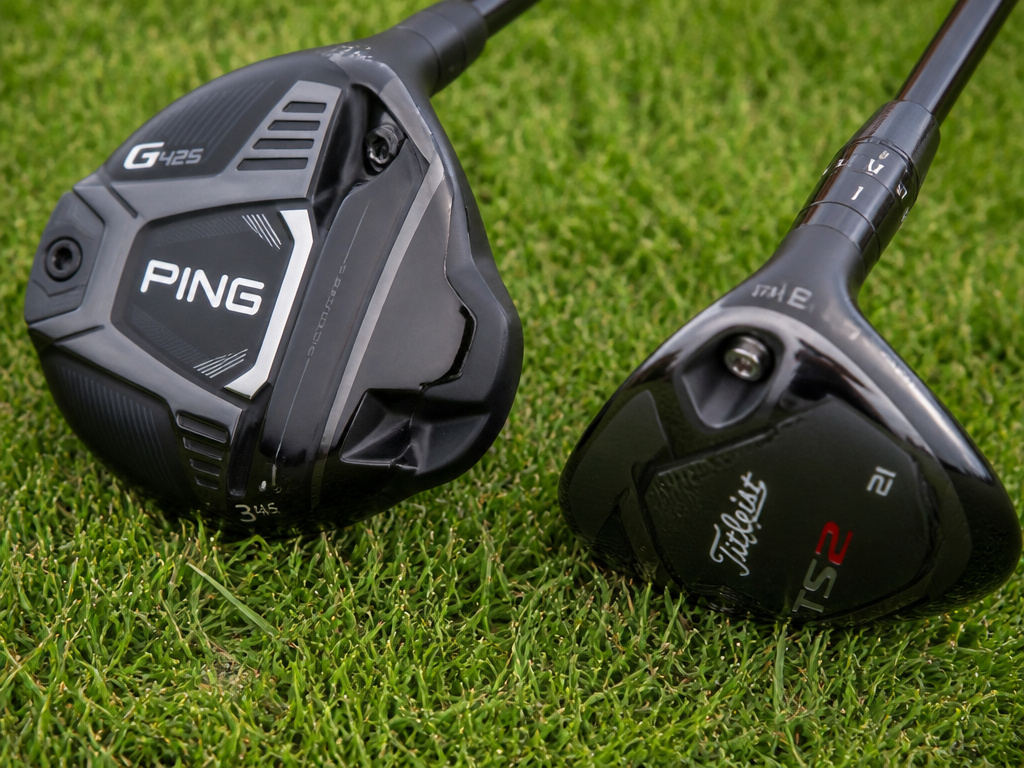 The old rule that “hybrids are easier” is outdated. Today’s fairway woods are engineered for forgiveness, and today’s hybrids are built for players’ distance. You have to look at the specs.
Fairway Woods Got Friendlier:
The Callaway Paradym Ai Smoke MAX fairway wood uses a carbon crown to move weight low and deep, raising the MOI (forgiveness on off-center hits). Its Step Sole design reduces turf drag by 57% compared to a traditional sole (per Callaway’s specs). This means it’s less likely to dig on a slightly heavy strike. The Project X Denali shaft in many stock setups is also lighter and helps with launch. The gap between a fairway wood selection for a mid-handicapper and a hybrid has never been smaller.
Hybrids Got More Versatile:
Better players’ hybrids, like certain TaylorMade M6 models, now have adjustable hosels (like the OptiFit4 hosel) for tuning loft and lie. They also use high-strength steel like C300 face cup for faster ball speeds on mis-hits. This means a hybrid isn’t just a rescue club. It’s a precision distance instrument that can be worked left or right. The best rescue clubs now live in better players’ bags for specific shots.
| Technology | Modern Fairway Wood | Modern Hybrid | Impact on Your Choice |
|---|---|---|---|
| Center of Gravity (CG) | Very low, slightly forward. | Low and deep. | Wood: lower launch, less spin. Hybrid: higher launch, more spin. |
| Face Technology | Thin, flexible maraging steel (C300). | Often the same C300 steel. | Both are hot across the face. Speed is equal. |
| Sole Design | Stepped or curved to reduce drag. | Flat or rounded for glide. | Wood better from clean lies. Hybrid better from uneven lies. |
| Adjustability | Common on 3W/5W (loft/lie). | Common on better-player models. | Lets you fine-tune your gapping. |
Building Your Bag: The 14-Club Puzzle
 You probably can’t carry both a 5-wood and a 3-hybrid. So how do you slot them in?
The Gapping Sequence:
Start with your longest iron you hit well. For most, that’s a 5-iron. From there, build up in 15-yard increments. 1. 5-Iron (180-190 yds) 2. 4-Hybrid (195-205 yds) – The most common slot. Covers rough and fairway. 3. 7-Wood or 3-Hybrid (210-220 yds) – This is the debate. 7-wood for high, soft landing from fairway. 3-hybrid for versatility from rough. 4. 5-Wood (225-235 yds) – For the fairway and tee. 5. 3-Wood (240-250+ yds) – Primarily a tee club for most.
The One-Club Solution:
If you only want one club between your 4-iron and 3-wood, you must diagnose your typical miss. – Miss is often in the rough? Choose a 21-degree hybrid. – Miss is usually short of the green on par 5s? Choose an 18-degree 5-wood. – Can’t decide? Get a 19-degree hybrid and learn to hit it off a tee for those shorter par 4s. It’s the most versatile single club in golf.
Frequently Asked Questions
What goes farther, a 3-wood or a 3-hybrid?
For the same player, a 3-wood will always go farther from a perfect lie or a tee. It has a longer shaft and is designed for lower spin and maximum ball speed. A 3-hybrid might carry a similar distance but with more height and spin, so it will roll out less. The total distance gap can be 15-25 yards.
Can I use a hybrid instead of a 5-wood?
Absolutely. For most amateur golfers, a hybrid in the same loft as a 5-wood (around 18-19 degrees) is often a smarter choice. It’s easier to hit from more lies, launches higher, and is generally more forgiving. The 5-wood might give a better player more penetrating ball flight and more roll.
Should high handicappers use fairway woods?
High handicappers should be cautious with fairway woods longer than a 5-wood. A 7-wood (21-22 degrees) is often a fantastic “fairway wood” for a high handicapper because it launches high and lands soft. The traditional 3-wood is one of the hardest clubs in the bag to hit consistently off the deck.
What is a rescue club vs. A hybrid?
They are the same thing. “Rescue” was TaylorMade’s original marketing name for its hybrids, and it stuck as a generic term. When looking at hybrid rescue club reviews, you’re just reading about hybrids. Any modern utility club designed to replace a long iron is a hybrid.
How do I hit a hybrid consistently?
Treat it like an iron, not a wood. Ball position is just forward of center. Make a descending strike, taking a small divot after the ball. The most common mistake is sweeping it like a fairway wood, which leads to thin and fat misses. For using a hybrid from tricky lies, choke down an inch for more control.
The Bottom Line
Stop carrying a club because you think you should. If you fight your 3-wood from the fairway, take it out and put in a second hybrid. If your hybrid balloons into the wind, try a 7-wood.
The right choice is the one that gives you a confident swing when you’re 210 yards out, in the first cut of rough, with water fronting the green. For most, that’s a hybrid. For some, a modern fairway wood now fits that shot.
Build your set from the green backward, fill your yardages with clubs you can hit from the lies you actually find, and let the old rules about what belongs in a “proper” bag go.
