
Master the Downswing in Golf: How to Initiate It Correctly
This post contains affiliate links. As an Amazon Associate, we earn from qualifying purchases.
This post contains affiliate links. As an Amazon Associate, we earn from qualifying purchases.
To start the downswing in golf, initiate a pressure shift into your lead foot just before your backswing finishes, followed by a lateral hip slide. The exact feel of this move, whether you actively “pull” or “hit”, depends on your clubface position at the top, a distinction GOLF Magazine categorized in 1979 as “hitter” versus “puller.” Get this sequence wrong, and you lose power, spray the ball, and fight a two-way miss.
Most instruction talks about the downswing as a single, universal move. That’s why so many tips feel wrong. The real answer isn’t one move; it’s a diagnosis. Your first move down is dictated by a fact already locked in at the top of your swing: your clubface angle. Trying to force a “hip bump” when you’re a “puller” is how you get stuck behind the ball every single time.
What follows is the breakdown that cuts through fifty years of generic advice. We’ll cover the non-negotiable pressure shift, the hitter/puller rule from a 1979 magazine, how your desired ball flight changes the move, and the drills that install the correct sequence before you even swing a club.
Key Takeaways
- Your downswing starts with a pressure shift into your lead foot, ideally before your lead arm reaches parallel in the backswing.
- Your feel is dictated by your clubface at the top: “Hitters” (square/open face) can drive laterally and release early; “Pullers” (closed face) must clear the hips first to avoid hooks.
- For a draw, your pelvis moves more laterally with less rotation. For a fade, it rotates more with less lateral slide.
- The most common fault is starting the downswing with the shoulders or arms, which forces an over-the-top path and kills power.
- Use the Step-Through Drill and Pump Drill to feel the ground-up sequence without hitting a ball.
The First Move: It’s Not One Thing
Ask ten golfers how to start down, and you’ll get twelve answers. Hips first. Pull the chain. Drop the hands. The confusion exists because the advice is often given without the necessary diagnosis. The proper first move isn’t a universal feel; it’s a physical response to the position you’ve created.
If you start with your arms, you’ll cast the club, lose lag, and come over the top. If you spin your hips with no lateral shift, you’ll early extend and hit weak blocks or fat shots. The correct initiation is a chain reaction, and the first link is almost invisible.
The transition from backswing to downswing is initiated by a shift of pressure into the lead foot before the backswing is fully completed. This ground-force reaction precedes any visible lateral hip movement and allows the pelvis to begin rotating while the upper body remains coiled, creating the separation needed for power.
Where this goes sideways: Trying to “turn” your hips aggressively from the top. Without the preceding pressure shift, this is just spinning in place. Your weight stays on your trail side, your pelvis moves toward the ball, and you have to stand up (early extend) to make room for your arms. The result is inconsistent contact and a complete loss of power.
The Pressure Shift Reality
Forget “weight shift.” Think “pressure shift.” This is the first and most critical movement. It’s not a big, swaying motion. It’s a deliberate push into the ground with your lead foot that begins your movement toward the target.
In the best swings, this happens early. As your lead arm is approaching parallel to the ground in the backswing, pressure should already be moving into your lead side. This is the “surfing the wave” sensation, you load into the front side before you’ve even finished loading the backswing. When this timing is late, everything else rushes. The arms have to start the downswing to catch up, and the sequence is broken.
Why does this matter for power? This early pressure shift creates what’s called “ground reaction force.” Pushing into the ground allows your body to push back, generating the force that starts your pelvis moving laterally and rotationally. It’s the foundation of the entire kinematic sequence. Without it, you’re just using arm muscles.
| If You Start With… | What Happens | The Ball Flight Tell |
|---|---|---|
| Arms / Shoulders | Casting, over-the-top path, loss of lag. | Weak slice or pull-hook. |
| Hips Spinning (No Shift) | Early extension, loss of spine angle. | Fat shots, blocks, two-way miss. |
| Pressure Shift → Hips | Maintained coil, proper hand path, stored energy. | Powerful, consistent draws or fades. |
The 1979 Rule: Hitter vs. Puller
In December 1979, GOLF Magazine instruction editor Ernie Vossler published a framework that cuts through the noise. He categorized golfers into two types based on their clubface position at the top: Hitters and Pullers. This isn’t about style; it’s about geometry, and it dictates your first move down.
A “Hitter” has a square or slightly open clubface at the top. The toe of the club is pointing roughly toward the sky. From here, the downswing feels like a “hit” or an early release. They can shift laterally and start rotating the clubface back to square almost immediately. Their first move can be more aggressive with the lower body.
A “Puller” has a closed clubface at the top. The toe is pointing more toward the ground. This golfer must “pull” from the left side to get the face back to square before they can release it. For them, the first move is about clearing the left hip aggressively to make room for the arms to drop. Trying to “hit” from the top will result in a violent hook.
Common mistake: A “puller” trying to use a “hitter’s” lateral bump. If your face is closed and you drive your hips left without clearing, you’ll trap the club behind you. The only way out is a massive flip of the hands, leading to a low hook or a desperate block to the right.
This is why one tip ruins one golfer’s swing and fixes another’s. Knowing your tendency changes your focus. Are you trying to square a closed face, or are you trying to release an open one? Your downswing sequence depends on the answer.
How Your Shot Shape Changes the Move
 Your desired ball flight, draw or fade, fine-tunes the recipe. It changes the ratio of lateral movement to rotation in your pelvis during the downswing initiation.
Golfers who prefer a draw will show more lateral movement of the pelvis toward the target and less initial rotation. This creates more secondary axis tilt (leaning your trail side back), which helps deliver the club from the inside with a slightly closed face.
Golfers who prefer a fade will generally have less lateral slide and a higher degree of pelvic rotation from the start. This keeps the pelvis more centered, promoting a swing path that is more out-to-in or neutral, with a slightly open face at impact.
Neither is wrong. But forcing a big lateral bump when you’re trying to hit a cut will make it nearly impossible. This is where understanding golf biomechanics helps you match your intention to your movement.
Drills to Rewire Your Start
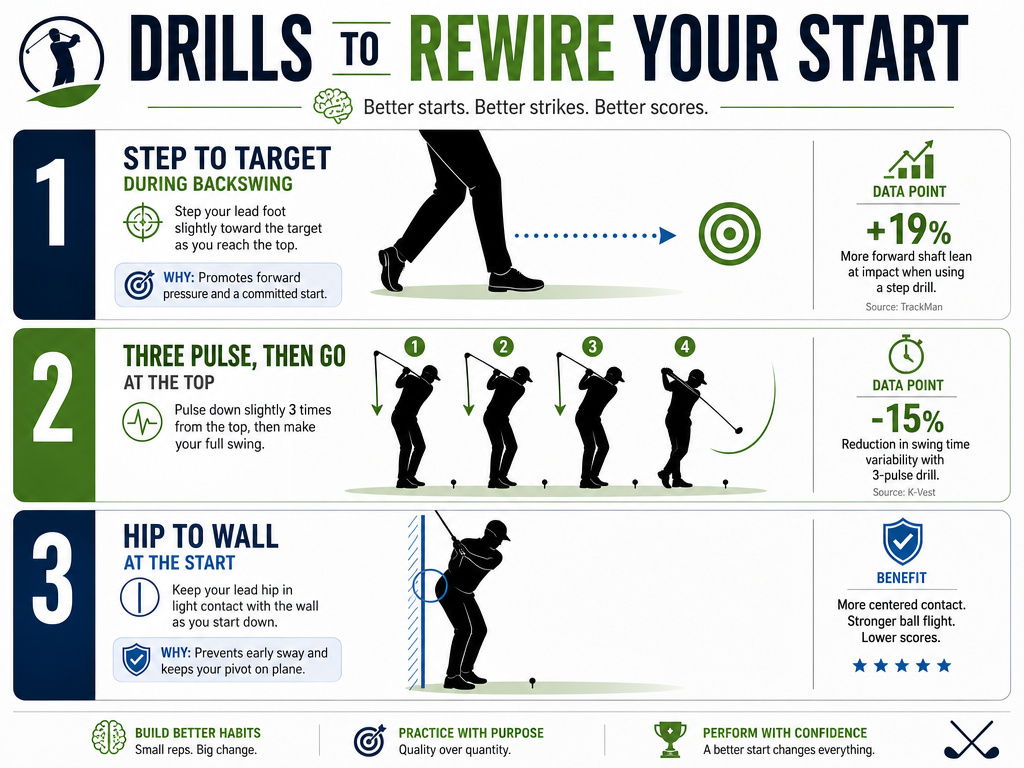 Thinking your way through a 2-second swing is impossible. You need feels, and these drills create them.
1. The Step-Through Drill
This is the best tool for feeling the early pressure shift. Set up without a ball. Start your backswing. As your hands reach hip height, step your lead foot toward the target. Finish your backswing as your foot plants, then swing through. This forces you to load into your lead side before you finish your backswing. It’s the exact “surfing the wave” timing pros like Xander Schauffele use.
2. The Pump Drill
Take your backswing to the top. From there, rehearse the start of the downswing three times in slow motion: shift pressure, slide hips left, let arms drop, but don’t swing through. On the fourth rehearsal, complete the swing. This trains the arms to be passive responders to the lower body, cementing the proper swing rhythm.
3. The Wall Drill (For Early Extension)
Stand with your trail hip and shoulder touching a wall. Make a backswing. Start your downswing, focusing on keeping your trail hip touching the wall as long as possible. This prevents the hips from spinning out and sliding toward the ball, which is the root of early extension.
Putting It All Together: A Practice Plan
Don’t just hit balls. Use this structure to make a change.
- Diagnose. Film your face-on swing. Are you a hitter or a puller? Does your pelvis spin or slide?
- Drill. Spend 10 minutes with the Step-Through and Pump drills. No ball. Just feel the sequence.
- Apply. Hit half-wedge shots focusing only on starting the downswing with a pressure shift. Ignore ball flight.
- Integrate. Hit full 7-irons. Your only thought: “Shift, then turn.” Check that your impact position is solid.
- Trust. Take it to the course. Your body knows the move. Don’t overthink it.
This process connects the feel of a good hip rotation to the mechanics you’ve practiced. It moves you from theory to a repeatable motion.
Frequently Asked Questions
What is the most common mistake when starting the downswing?
The most common mistake is initiating the downswing with the shoulders or arms. This causes an over-the-top swing path, a loss of lag, and weak, inconsistent contact. The downswing must start from the ground up with a pressure shift, not from the top down with a pull.
Should I feel like I’m pulling the club down or pushing it?
Your feel depends on your clubface at the top. If you’re a “hitter” with a square/open face, you can feel a push or a drive from the ground. If you’re a “puller” with a closed face, you must feel a pull from your left side to clear the hips and square the face. There is no one right feel for everyone.
How do I know if I’m a hitter or a puller?
Film your swing face-on and pause it at the top. Look at your clubface. If the toe is pointing toward the sky or slightly behind you (open), you’re a hitter. If the toe is pointing toward the ground or significantly across the line (closed), you’re a puller. Most amateur golfers are pullers.
Can I change from a puller to a hitter?
Yes, but it requires a grip or backswing adjustment to achieve a more neutral or open clubface at the top. This is a significant swing change often best tackled with a professional. It’s often easier to learn the correct downswing move for your current top position.
The Bottom Line
Starting the downswing isn’t about finding one magic move. It’s about executing a specific sequence triggered by your own swing’s geometry. Shift pressure early, let your hips respond based on your shot shape, and allow your arms to follow. Remember the 1979 rule: match your first move to your clubface. Hitters drive. Pullers clear. Force the wrong one, and you’ll fight your swing forever.
