
How the Downswing Sequence Creates Power, Explained Simply
This post contains affiliate links. As an Amazon Associate, we earn from qualifying purchases.
This post contains affiliate links. As an Amazon Associate, we earn from qualifying purchases.
The downswing sequence is the transfer of energy from the ground up, through your core, and out to the club in a specific proximal-to-distal order: legs stabilize, hips initiate rotation, torso unwinds, shoulders follow, arms deliver, and wrists release last. This sequence, proven by motion-capture studies, builds maximum clubhead speed by storing and releasing energy efficiently. Getting the order wrong—specifically letting your wrists dominate early—is the primary difference between low and high handicap swings.
That order is a measurable, physical chain reaction where each link fires after the one below it has done its job. The sequence creates lag, stores elastic energy in your muscles and the club shaft, and delivers it all at the moment of impact.
What follows is the breakdown of that chain: the core biomechanical principle, the exact joint-timing differences science has measured, the common failure point that robs power, and the drills to rewire your muscle memory. By the end, you’ll know what to do and why each piece matters for compressing the ball.
Key Takeaways
- The proven sequence is a bottom-up, proximal-to-distal transfer: ground force -> hips -> torso -> shoulders -> arms -> wrists. This is the kinematic sequence that every efficient swing follows.
- Low handicap golfers lead with the elbow joint early; high handicaps lead with the wrist. A 2026 study found this difference in the first 25% of the downswing dictates the entire strike’s quality.
- Early wrist activation (“casting”) is a power leak. It releases stored angle and lag prematurely, forcing you to use only arm strength. The feel is a “hit” instead of a “throw.”
- Your hips start the downswing, not your hands. A proper downswing start is a lateral shift and rotation of the lead hip, pulling the rest of the chain.
- Swing efficiency matters more than raw strength. A smoother, sequenced swing often transfers more internal body work to the club than a faster, disjointed one.
The Core Principle: Proximal-to-Distal Energy Transfer
Forget “clearing your hips” or “dropping it in the slot” as isolated tips. They are effects, not the cause. The cause is the sequential firing of body segments from the ground upward.
Think of cracking a whip. The energy starts in your hand (the handle), travels through the body of the whip, and finally snaps the tip. If you try to snap just the tip, nothing happens. The golf swing is a full-body whip. The ground is your anchor, your core is the handle, and the clubhead is the tip. A Journal of Sports Science & Medicine study on swing work and power analysis confirmed this, showing over 70% of the body’s work is generated by the hips and spine before the arms ever take over.
The downswing is a bottom-up phenomenon where a segmental summation of work occurs as the swing progresses from the legs, through the hips, lower back, upper back, shoulders, arms, then wrists. Work generation in each joint generally peaks in that order.
This sequence for power is physics. Each segment accelerates, then decelerates, transferring its momentum and stored elastic energy to the next link in the chain.When the sequence is correct, the club is the last thing to accelerate. This delay is what creates lag and the sensation of the club “whipping” through impact.
| Body Segment | Primary Role in Sequence | Key Movement | Consequence if Out of Order |
|---|---|---|---|
| Feet/Legs | Stabilize and initiate ground force. | Pressure shift into lead foot. | Loss of balance; no power foundation. |
| Hips/Pelvis | Initiate rotational acceleration. | Lead hip rotates back and away from target. | Over-the-top swing; all arms. |
| Torso/Core | Amplify rotational speed. | Chest unwinds against stable lower body. | Slice; loss of rotational power. |
| Shoulders | Transmit rotation to arms. | Shoulders follow hips, staying on plane. | Casting; steep swing plane. |
| Arms | Deliver the club on path. | Arms extend naturally from body rotation. | “Stuck” position; blocks and hooks. |
| Hands/Wrists | Final release of stored energy. | Uncock and rotate through impact. | Early release; weak, high shots. |
What Science Says: Elbow Lead vs. Wrist Cast
We now have precise data on what this sequence looks like in skilled vs. Unskilled players. A 2026 study in Frontiers in Sports and Active Living used 3D motion capture (Vicon systems) to analyze the joint coordination of low and high handicap golfers. The findings were specific and telling.
The researchers measured something called Continuous Relative Phase (CRP) between joints. Simply put, it shows which joint in a pair (like elbow and wrist) is leading the movement at any given moment.
The sourced-number finding is clear: In the first 4% to 25% of the downswing, low handicap players showed left elbow dominance in the elbow-wrist coupling. Their elbow joint initiated the movement. High handicap players showed left wrist dominance in that same critical window. Their wrists were in charge from the very start.
Where this goes sideways: Letting your wrist lead your elbow in the early downswing. The study termed this a “distal-leading pattern.” It forces an inverse motion between joints, disrupting the kinetic chain and forcing you to compensate with your hands for the rest of the swing. Your consistency vanishes.
This isn’t about “quiet hands.” It’s about hierarchy. In a proper sequence, the proximal (closer to the body) joint must lead the distal (farther away) joint. The elbow leads the wrist. The shoulder leads the elbow. When that order reverses, the kinematic sequence breaks. You lose the whip effect and trade it for a pushing or slapping motion.
The High Handicap Mistake: Wrist Dominance (Casting)
The scientific “wrist dominance” finding has a common name on the driving range: casting. It’s the #1 power leak in amateur golf. You see it as a premature straightening of the right arm and a loss of the angle between the club shaft and the lead forearm.
Why does it happen? Two reasons. First, a poor backswing sequence that lacks a proper turn or wrist hinge forces you to create power from the top with your hands. Second, a misunderstanding of “starting the downswing” with the lower body. If your hips don’t lead, your hands will.
The physical consequence is a loss of leverage. That wrist angle you set in the backswing is stored energy. Releasing it early is like opening a parachute at the start of a drag race. All the speed you could have built is gone. You’re now trying to accelerate the club with just your arm and shoulder muscles, which are far weaker than your kinetic chain.
How to know if you’re doing it: Film your swing face-on. Pause the video when your left arm is parallel to the ground in the downswing. Draw a line along your club shaft. If that line points well outside the golf ball (toward the sky), you’ve cast. If it points at the ball or just inside it, you’ve maintained your lag.
Building the Correct Sequence: A 3-Step Guide
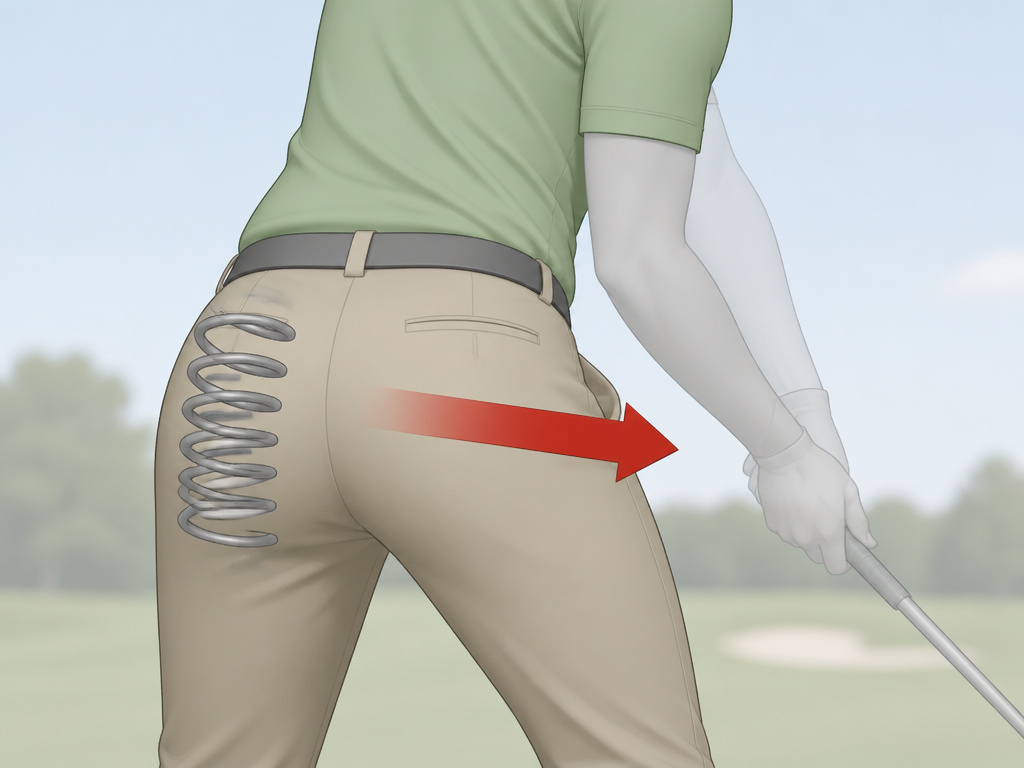
Fixing the sequence requires retraining feel. You must learn to start the movement from the ground and allow the club to follow, not make it happen with your hands.
Step 1: Establish the Proper Backswing Load
You can’t sequence a downswing from a bad backswing. A full, connected turn where your shoulders rotate over a stable hip coil is non-negotiable. This creates the tension (potential energy) that the downswing sequence will release. Focus on completing your hip rotation in the backswing so your lower body is ready to initiate the downswing.
Step 2: Initiate with a Lateral Hip Shift
The first move down is a small, lateral bump of your lead hip toward the target. This pressure shift into your left side (for right-handed golfers) is the trigger that pulls your pelvis into rotation.Your arms and hands should feel like dead weight at this point. If you feel your right shoulder or hands move first, stop and reset.
Drill: Step Drill
- Take your backswing normally.
- As you start down, actually step your left foot toward the target (about 6 inches).
- Hit the ball with that stepped-forward stance.
- This exaggeration forces your lower body to lead. The feeling of your hips “pulling” your arms through is the correct one.
Step 3: Feel the “Elbow Lead” Sensation
This directly addresses the scientific finding. In the first part of your downswing, focus on the feeling of your right elbow (for righties) moving down and in front of your right hip. Think “elbow toward belly button.” This sensation keeps the wrist angle intact. A good swing thought is to try to keep the back of your lead hand facing the target for as long as possible.
Drill: Towel Under the Trail Armpit
- Tuck a small hand towel under your right armpit.
- Make slow-motion swings, focusing on starting the downswing with your lower body.
- Your goal is to not let the towel drop until after impact.
- This drill connects your arm to your torso, preventing the independent, casting hand action.
Why a Smooth, Sequenced Swing Beats a Hard Lunge
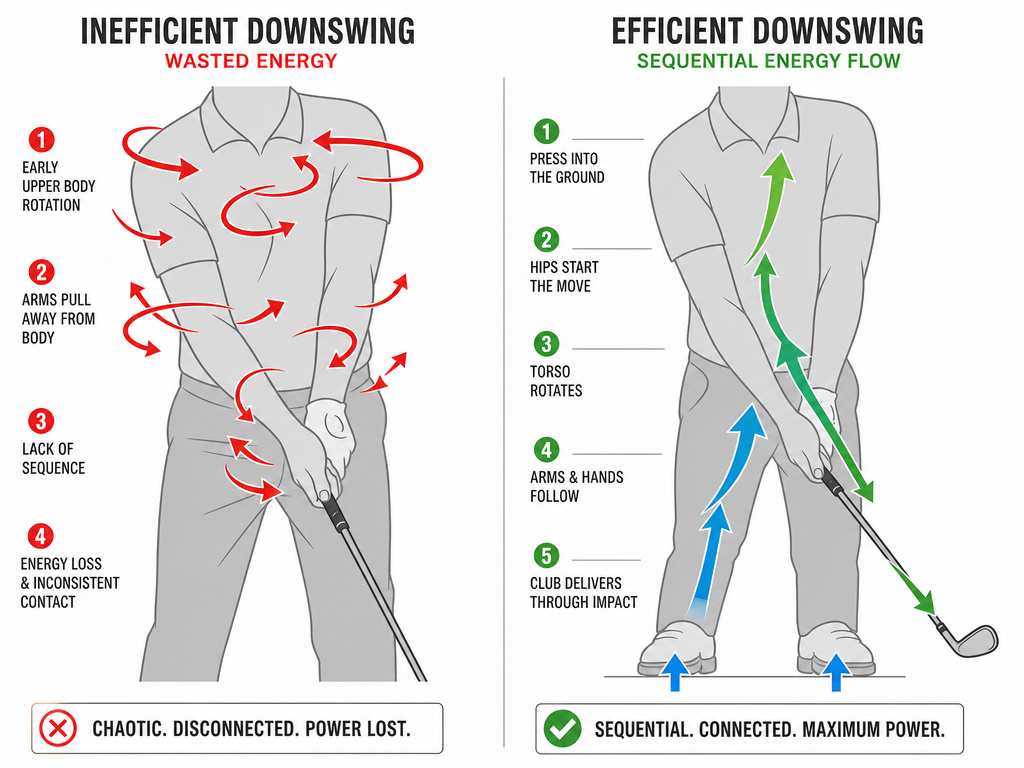
This is the counterintuitive part. Swinging harder with a broken sequence often produces less clubhead speed and certainly less consistency. The JSSM study analyzed the efficiency of work transfer from body to club. They found that less-skilled players who swung more smoothly and with better sequence sometimes transferred a higher percentage of their internal work to the club than stronger, more forceful players with poor sequence.
Your body has to work to move itself. In a disjointed swing, a huge amount of the energy you generate is wasted moving your own segments out of the way or fighting against opposing forces. A sequenced swing is an efficient engine. Every piston fires in order, with minimal friction and waste. This is why a 140-pound tour pro can out-drive a 220-pound amateur who is swinging for the fences. The pro’s engine is tuned.
This efficiency also has a huge benefit for longevity and injury prevention. A Clinical Journal of Sports Exercise study on golf after rotator cuff repair highlights the importance of proper biomechanics for safe participation. A jerky, arm-dominated swing places immense shear forces on the lead shoulder and elbow. A smooth, ground-up sequence distributes the forces healthily across the entire kinetic chain.
Frequently Asked Questions
What is the first move in the downswing sequence?
The first physical move is a lateral shift of your weight into your lead foot, initiated by your lead hip. It’s a bump, not a spin. This move creates space for your arms to drop and begins the proximal-to-distal chain. Thinking “hands down” or “shoulder turn” here is the most common error.
How do I stop casting the club from the top?
You stop casting by giving your hands a job they can’t do first. Focus on starting the downswing with your lead knee moving toward the target. A great drill is to pause at the top of your backswing for two full seconds. This pause eliminates any hand reflex and forces you to initiate the downswing with your lower body to get the club moving again.
What does “proximal-to-distal” actually feel like?
It feels like a wave of motion starting in your feet. Imagine you’re skipping a stone. The power starts in your legs and core as you coil, then flows out through your arm as you side-arm the stone across the water. Your arm and wrist are the last parts to fire. That same whip-like, wave feeling is what you want in the golf swing.
Can I have too much lag in my downswing?
Yes, but it’s a rare problem. “Too much lag” usually means you’ve maintained the wrist angle correctly but failed to release it at all through impact. This leads to a massive block or a snap-hook as the clubface violently shuts. The release must happen, but it must be timed correctly—just before and through impact, not at the start of the downswing. Achieving proper shaft lean at impact is the visual result of a well-timed release.
Does this sequence change for irons vs. Driver?
The kinematic sequence remains identical. The differences are in setup and swing shape. With a driver, the ball is forward, promoting a sweeping strike and a wider arc. With an iron, the ball is centered, promoting a descending blow. The order of operations—ground up, core to arms—does not change. A consistent sequence is the foundation of a consistent ball flight.
The Bottom Line
The downswing sequence explained is a documented, measurable biomechanical event. The power difference between a good player and a great player often comes down to a few degrees of joint timing in the first quarter of the downswing.Stop trying to hit the ball with your hands. Your job is to build an efficient kinetic chain from the ground up. Let that chain throw the clubhead through impact. When you get the sequence right, power feels effortless, and the strike sounds different. It’s a crack, not a slap. That’s the sound of physics working for you.
