
How to Start the Golf Backswing Correctly for a Powerful Swing
This post contains affiliate links. As an Amazon Associate, we earn from qualifying purchases.
This post contains affiliate links. As an Amazon Associate, we earn from qualifying purchases.
To start the golf backswing correctly, initiate a subtle forward press of your body mass toward the target, then shift it back to your trail side as you begin rotating your core. This body-first trigger engages your large muscles, prevents a snatchy arm takeaway, and sets the club on the correct plane. Forget the old “one-piece” advice, modern analysis shows the clubhead should move first, followed by the arms, shoulders, and hips in a sequence.
That initial shift of mass is the physical cue that turns a static, tense setup into a flowing motion. Without it, your hands and arms are forced to jerk the club away, which immediately throws the swing off-plane and makes consistency almost impossible.
What follows is a breakdown of the three physical triggers that start the backswing, why the most common piece of advice is wrong, and how your body’s own limits dictate the correct length for you. By the end, you’ll know the exact first move to practice.
Key Takeaways
- Start with a subtle forward press of your body toward the target before moving the club back. This creates momentum and stops a jerky, arm-dominated takeaway.
- The clubhead should initiate movement, not your hands and arms together. The correct kinematic sequence is clubhead, arms, shoulders, torso, then hips.
- Your natural flexibility is the final governor of your backswing length. Forcing extra rotation leads to injury and a complete breakdown of your setup posture.
- A proper grip and athletic posture are non-negotiable prerequisites. A weak grip or a hunched setup guarantees a flawed takeaway before you even move.
- The goal of the first 12 inches is connection, not distance. Keep the clubhead outside your hands initially to maintain width and avoid rolling the club inside.
The 3-Step Trigger for a Connected Start
The first move isn’t about the club. It’s about getting your body out of a dead, static position and into a rhythm. Most amateurs start from a complete stop, which forces the small muscles in the hands and arms to do all the work. The result is a disconnected lurch that ruins the swing before it begins.
The fix is a three-part trigger sequence. Think of it as winding up a spring, not yanking a rope.
Step 1: The Forward Press. Before the club moves backward, make a conscious, slight movement of your body mass toward the target. This isn’t a big lunge, it’s a subtle shift of pressure into your front foot. It’s the same pre-shot routine trigger you see in players like Jack Nicklaus or Justin Thomas. This motion breaks the tension, engages your core, and creates natural momentum.
Step 2: The Mass Shift. Immediately from that forward position, initiate the backswing by shifting your mass back onto your trail foot. Feel your entire center, your chest, your head, move as a unit to the right (for a right-handed golfer). This is the “body starting the swing” feeling. If you do this correctly, your arms and club will feel like they’re being pulled away passively.
Step 3: Core Rotation Engages. As your mass settles into your trail side, your torso begins to rotate away from the target. This rotation, driven by your core, continues to pull your arms and the club into position. The feeling is one of width, not of your hands picking the club up.
Where this goes sideways: Starting with just your hands. If your first move is a twitch in your wrists or forearms, the club gets sucked inside the target line instantly. You’ll spend the rest of the swing trying to reroute it, usually resulting in a weak slice or a snap-hook.
This sequence, press, shift, rotate, ensures your swing rhythm is built from the ground up. It’s the foundation for a consistent golf swing tempo.
Why the “One-Piece” Advice is Misleading
For decades, the mantra was the “one-piece takeaway.” The idea was that the club, hands, arms, and shoulders should move back together as a single, connected unit. It sounds logical, but 3-D motion analysis of professional swings tells a different story.
The reality is a kinematic sequence. The movement starts with the clubhead, followed in order by the arms, shoulders, torso, and finally the hips. This isn’t a disconnected, jerky process; it’s a smooth cascade of energy from the smallest levers to the largest engines. Trying to move everything as “one piece” often forces the club too far inside the target line too early.
| Takeaway Method | What It Promises | What Often Happens |
|---|---|---|
| “One-Piece” Takeaway | Connected, simple start. | Club gets dragged inside, leading to an over-the-top downswing and a slice. |
| Kinematic Sequence | Efficient energy transfer, proper club path. | Clubhead leads, creating width and setting the stage for an inside attack path. |
So, what should you feel? Give the clubhead a head start. A good thought is “small to big.” The smaller muscles of the hands and wrists move the club first, then the bigger muscles of the arms and core engage. This feels like an earlier, more deliberate wrist set compared to the stiff-armed one-piece move. It’s the difference between dragging a suitcase and throwing a ball, the latter uses a sequential whip.
This understanding reframes the entire initial takeaway. It’s less about locking everything together and more about initiating the correct backswing sequence.
Grip and Posture: The Non-Negotiable Foundation
You cannot execute a good takeaway from a bad address position. The grip and posture are the software and hardware of your swing; if they’re faulty, the program will crash immediately.
Your Grip Dictates the Clubface. The club must rest in the fingers of your lead hand, not the palm. The heel pad should sit on top of the grip. A grip that’s too much in the palm locks the wrists, making a proper hinge in the backswing stages impossible. If you consistently wear a hole in your glove, your grip is the first place to look. A neutral or slightly strong grip allows the forearms to rotate naturally, which directly influences your swing plane.
Posture is Your Athletic Platform. Stand too close to the ball, and your arms get cramped, forcing the club away from your body in the takeaway (often causing a pull). Stand too far away, and you’ll reach, rounding your swing and likely hitting pushes or hooks. Good posture has a slight knee flex, a straight back hinged from the hips, and your arms hanging freely. This creates the space for your arms to swing under your shoulders, which is the literal definition of a good golf swing plane.
A simple test: get into your posture and have someone gently push you from the side. If you easily lose your balance, your weight isn’t centered over the balls of your feet. A stable, athletic base prevents swaying before you even take the club back.
How Your Body Dictates Your Backswing Length
 One of the most damaging pursuit in golf is the long, picture-perfect backswing. Forcing rotation beyond your body’s natural limits is a guaranteed path to inconsistency and injury. Your flexibility is the final, non-negotiable governor.
The goal is a full shoulder turn with a restrained hip turn. This creates the coil, the separation between upper and lower body that stores power. But “full” is relative to you.
The Chair Test. Sit in a chair and hold a club across your chest. Without moving your lower body, rotate your shoulders back as far as you comfortably can. That point is your functional, injury-free shoulder turn limit. Trying to push past it on the course requires your hips to spin out or your spine to bend laterally, both of which destroy your coordinating shoulder and hip turn in the backswing.
Forcing length leads directly to an overswing, where the club passes parallel and your structure collapses. Power comes from the quality of the coil and the speed of the transition from backswing to downswing, not from the length of the lever.
Common Faults and Their Immediate Fixes
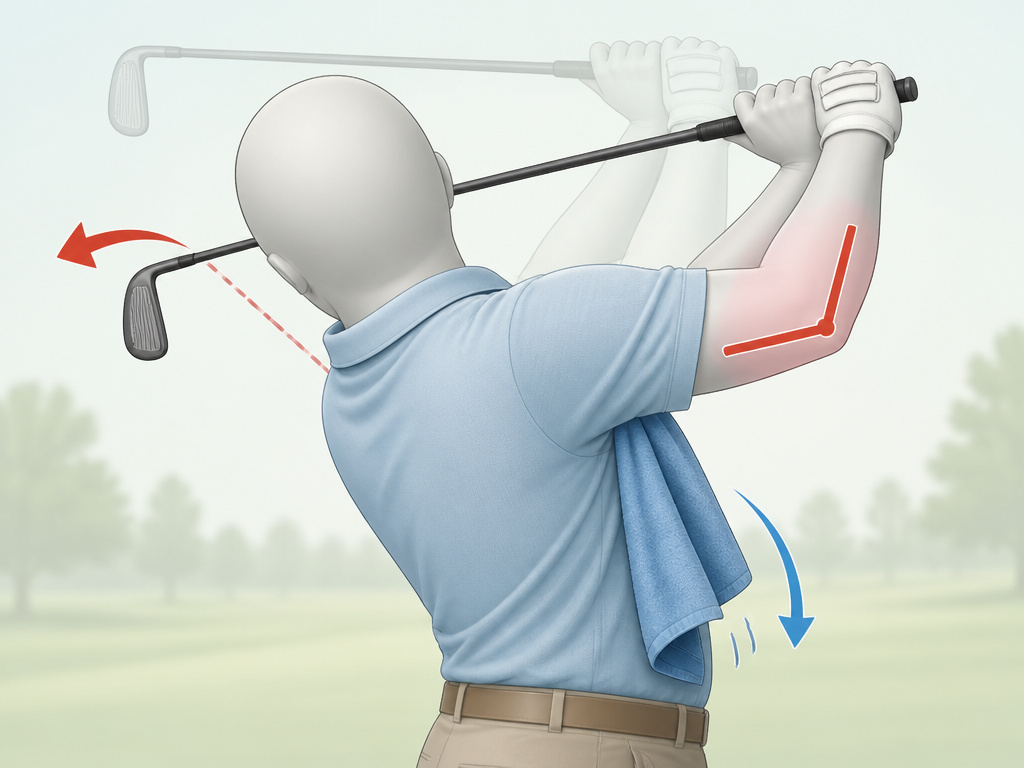 The takeaway is where most swing flaws are born. Here’s how to diagnose and correct the big three.
Fault 1: The Inside Yank. The clubhead moves inside the target line immediately, your wrists roll, and the clubface opens. You’re now stuck behind your body, leading to a flip or a block to the right. * Fix: Place a headcover just outside and behind the ball. Focus on pushing the clubhead straight back along the target line for the first foot, missing the headcover. This promotes the proper importance of the swing plane in the backswing.
Fault 2: The Lifting Arms. Your arms separate from your torso, lifting the club vertically with little body rotation. This creates a narrow, steep swing with no power. * Fix: Hold a towel or your glove under your lead armpit. Start your takeaway. If the item falls out before your hands reach hip height, your arm is disconnecting from your body. Keep it pinned to maintain width.
Fault 3: The Flying Elbow. Your trail elbow flares out away from your body early, causing a flat, across-the-line position at the top and a loss of power. * Fix: Focus on keeping the trail elbow pointing down toward the ground for as long as possible in the takeaway. Think of it staying in front of your shirt seam. This is key to correcting a flying right elbow in the backswing.
Easy to miss: The role of the lead arm. As you rotate, feel your lead arm rotating internally across your chest. This isn’t an active move; it’s a consequence of a good turn that keeps the club in front of you and sets the mechanics of the wrist hinge in the backswing.
Frequently Asked Questions
Should I feel like I’m hinging my wrists early?
Yes, but it’s a passive hinge, not a forced cocking. As you initiate the takeaway with your body and the clubhead leads, your wrists will naturally begin to hinge. If you try to actively “set” them early, you’ll likely break your lead wrist and close the clubface. Let it happen as a result of the club’s momentum.
How is starting the backswing different for a driver vs. An iron?
The sequence and fundamentals are identical. The only differences are setup-related: with a driver, the ball is positioned further forward in your stance and you have more spine tilt away from the target. This promotes a slightly wider arc and a shallower attack angle, but the first move, the body trigger, remains the same.
I’m a senior golfer with limited flexibility. What should I change?
Shorten your backswing intentionally. Use the Chair Test to find your comfortable shoulder turn. A shorter, controlled backswing you can repeat is infinitely more powerful than a long, loose one that breaks down. Focus on a smooth starting the takeaway and a crisp transition. Power comes from sequencing and timing, not range of motion.
What’s the single most common mistake?
Starting the swing with the hands and arms alone, from a dead stop. This eliminates any chance of using your body’s larger muscles and instantly puts the swing on a faulty path. The forward press trigger is the antidote.
Does head movement matter in the takeaway?
Some lateral movement is natural and good. As you shift your mass to the trail side, your head will move slightly right (for a righty). The key is that it moves with your turning core, not independently. Excessive lateral head movement is swaying; a stable head that turns with the shoulders is coil.
The Bottom Line
Stop trying to perfect the top of your backswing. The destination is determined by the departure. Master the departure by forgetting your arms for a moment. Feel the forward press, the shift of your mass, the rotation of your core pulling everything into place. Practice that trigger without a ball until it’s rhythm, not thought.
When you get that first move right, the rest of the proper backswing has a chance to fall into place. The club finds its plane, the coil builds naturally, and you arrive at the top loaded and ready, not already fighting a flaw born in the first inch.
