
What Is a Scratch Golfer? The 1.6% Reality & How It’s Defined
This post contains affiliate links. As an Amazon Associate, we earn from qualifying purchases.
This post contains affiliate links. As an Amazon Associate, we earn from qualifying purchases.
A scratch golfer is a player with a USGA Handicap Index of 0.0, meaning they can play to a Course Handicap of zero on any rated golf course. This official definition is based on scoring potential, not average performance, and includes physical benchmarks: a male scratch golfer averages 250-yard drives and can reach a 470-yard hole in two shots.
That definition is the starting line, not the finish. The “zero” is a calculation, not a promise of par. Your handicap index represents your best eight rounds out of twenty, so a 0.0 player is consistently very good at their best. They are not consistently perfect.
What follows is a breakdown of the three layers: the USGA’s technical and physical definition, the real-world scores and rarity the data shows, and the tangible gap between a scratch player and a touring professional. By the end, you’ll know exactly what the label means, how few golfers ever earn it, and what it actually looks like on a scorecard.
Key Takeaways
- A scratch golfer’s 0.0 Handicap Index is a measure of potential, calculated from their best 8 of their last 20 rounds. It does not mean they average par.
- USGA data shows only about 1.6% of male golfers with a handicap are scratch or better. The real number among all golfers is far lower.
- For course rating purposes, the USGA defines a male scratch golfer as someone who averages 250 yards off the tee and can reach a 470-yard hole in two shots.
- Analysis of nearly 4,000 rounds shows the average scratch golfer scores about 74.6 on a par-72 course and shoots par or better only about 10% of the time.
- The performance gap between a scratch amateur and a PGA Tour professional is vast, spanning driving distance, greens in regulation, and scoring consistency.
The USGA’s Physical Definition of a Scratch Golfer
The United States Golf Association doesn’t just use math. It also uses measurable, physical benchmarks to define player types for the purpose of rating courses. This is where the abstract “0.0” gets grounded in concrete reality.
A male scratch golfer, for rating purposes, can hit tee shots an average of 250 yards and can reach a 470-yard hole in two shots at sea level. The female scratch golfer benchmark is an average of 210 yards off the tee, able to reach a 400-yard hole in two. These aren’t aspirational goals for the player. They are standardized reference points used by course rating teams.
The USGA definition of a scratch golfer is: “a player who can play to a Course Handicap of zero on any and all rated golf courses.” The 250-yard and 470-yard specs are the physical translation of that ability, used to evaluate every tee box on every rated course.
These ratings are not guesses. A USGA or state association team evaluates over 400 variables per tee set. They measure effective playing lengths, account for roll and elevation, and assess the difficulty for both this scratch reference player and a bogey golfer. The difference between these two reference players is what creates the slope rating, which ranges from 55 to 155.
| Reference Player | Handicap Index | Avg. Drive | 2-Shot Reach | Purpose |
|---|---|---|---|---|
| Scratch Golfer | 0.0 | 250 yards (M) | 470 yards (M) | Sets the Course Rating (expected scratch score) |
| Bogey Golfer | ~20.0 (M) | 200 yards (M) | 370 yards (M) | Used with scratch golfer to calculate the Slope Rating (relative difficulty) |
The course rating is the number that predicts what a scratch golfer should score on that course under normal conditions. If the rating from the blue tees is 72.1, a scratch player is expected to shoot around 72. If the rating is 68.5, the expectation drops to a 69. This is why asking “what does a scratch golfer shoot?” is meaningless without knowing the course rating of the track they’re playing.
What Score Does a Scratch Golfer Actually Shoot?
They do not shoot 72 every time. The biggest misconception in amateur golf is that a handicap index is an average. It is a measure of potential.
Your Handicap Index is calculated from the best eight Score Differentials of your last 20 rounds. A Score Differential is: (Adjusted Gross Score – Course Rating) x (113 / Slope Rating). If the best eight of those differentials average out to zero, you have a 0.0 index. This means a scratch golfer’s typical round is several strokes higher than their capability.
Real data paints the picture. An analysis by BreakXGolf of 3,788 rounds showed the average scratch golfer scores about 74.6 on a par-72 course. Furthermore, scratch golfers shoot par or better only about 10% of the time. Other datasets suggest that number might stretch to 25% on their very best days, but the point stands: a scratch player averages a few strokes over par.
Where this goes sideways: Assuming a 0.0 means averaging par. The handicap system is designed to highlight your best golf, not your average golf. A player who averages 75 but has eight brilliant rounds near the course rating can still be a scratch golfer.
This is why the net score in competition is so important. If an 18-handicap is playing a scratch golfer, the 18-handicap generally gets a stroke on every hole. On a par 4 where both make a 5, the 18-handicap wins with a net score of 4. The scratch golfer’s gross score of 5 stands. The system works because it’s based on potential, not averages.
TL;DR: A scratch golfer’s average score is typically 2-3 over par. Their handicap reflects the much lower scores they are capable of posting when everything clicks.
How Rare Is a Scratch Golfer?
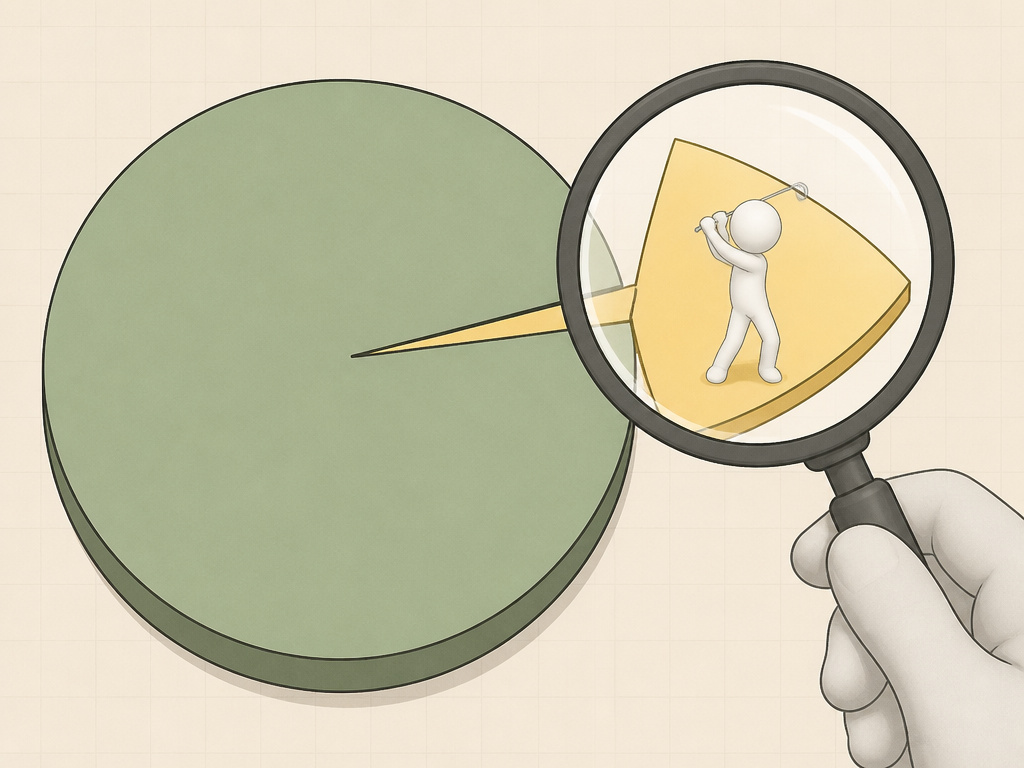
Extremely rare. When you account for all golfers who play, the number shrinks to a tiny fraction.
According to the USGA’s own distribution of golfers with an official Handicap Index, only about 1.6% to 1.99% of men carry a 0.0 or better. For women, the figure is even smaller, between 0.37% and 0.75%. These percentages are already exclusive—they only include golfers disciplined enough to post scores for an official handicap.
The real-world prevalence is almost certainly lower. Most recreational golfers never establish an official handicap. The pool of golfers who can genuinely play to a Course Handicap of zero from any set of tees is a fraction of that already small 1-2%. Golf News Net’s analysis positioned scratch-or-better players as close to the top 1% of registered handicaps. Among all people who golf, you’re looking at the top fraction of a percent.
| Golfer Group | Estimated % at Scratch (0.0) or Better | Key Context |
|---|---|---|
| Men with a USGA Handicap Index | 1.6% – 1.99% | Only includes golfers who track scores officially |
| Women with a USGA Handicap Index | 0.37% – 0.75% | An even more exclusive segment |
| All Recreational Golfers | < 1% (likely < 0.5%) | Includes the vast majority who don’t keep a formal handicap |
This rarity explains the social weight of the term. Calling yourself a scratch golfer is a claim that places you in a minuscule, verified elite among amateurs. It’s not a label for someone who once shot par.
Scratch Golfer vs. Professional: The Size of the Gap
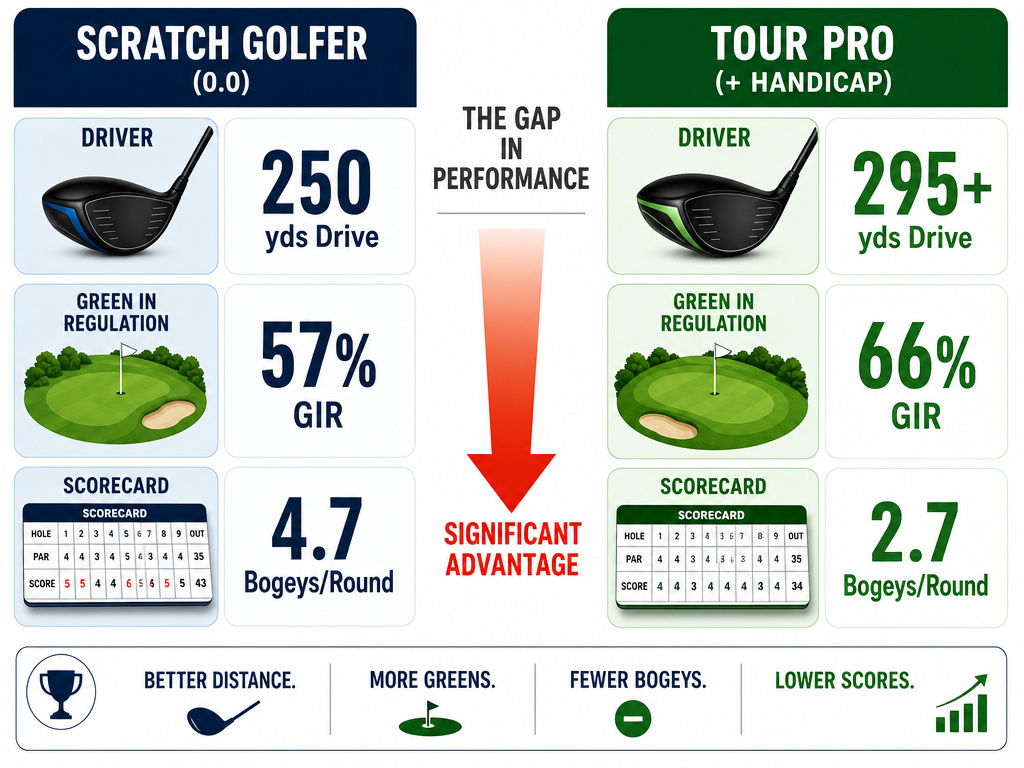
The distance between a scratch amateur and a touring pro is a chasm. It’s the difference between being the best player at your club and being the best player in the world.
Statistical comparisons are stark. While a scratch golfer averages those 74.6 rounds, a PGA Tour professional’s scoring average is typically under 71. The differences are systemic:
- Driving Distance: The scratch benchmark is 250 yards. The 2025 PGA Tour average is over 295 yards. That’s a 45-yard deficit off the tee, which changes the entire approach into every par 4 and par 5.
- Greens in Regulation (GIR): A scratch golfer hits about 57% of greens (roughly 10 of 18). A PGA Tour pro hits about 66% (nearly 12 of 18). That’s two more birdie looks per round.
- Scoring: Analysis by EJS Golf shows scratch golfers average about 4.7 bogeys per round. PGA Tour pros average roughly 2.7. That’s two fewer mistakes, every single round.
The part nobody mentions: A professional golfer typically carries a plus handicap (e.g., +4.2), meaning they are expected to shoot under the course rating. In a net event, they add strokes to their score. A scratch golfer plays off zero; a pro plays off a negative number.
The pro’s game is also built for punishment. They practice with a swing analyzer and monitor clubhead speed with a dedicated swing speed monitor to fine-tune mechanics under fatigue. Their course management is a science, and they have coaches to fix flaws like early extension immediately. A scratch golfer has a complete game. A professional has a optimized, repeatable, and resilient game built for competition. It’s a different sport.
How the Handicap System Works (The Math Behind the Zero)
The World Handicap System is elegant in its simplicity. It answers one question: what is this player capable of on a good day?
You only need 54 holes (three 18-hole rounds) to establish a Handicap Index. The system then takes your most recent 20 rounds and calculates a Score Differential for each:
- Adjust your Gross Score (apply net double bogey max per hole).
- Subtract the Course Rating of the tees you played.
- Multiply by 113 (the standard slope rating).
- Divide by the actual Slope Rating of the tees you played.
Once you have 20 Score Differentials, the system takes the best 8 and averages them. That average is your Handicap Index. It updates as new scores are posted, but only if a new score cracks your best eight or an old best score rolls off the 20-round window.
This is why a player can have a great round and see their index stay the same. It’s also how you can have a negative Score Differential—shooting a 68 on a course rated 71.5 creates a negative number. String together enough of those, and you become a “plus” golfer, moving beyond scratch.
The system’s genius is its focus on potential. It doesn’t care about your blow-up rounds, only your demonstrated ceiling. This levels the field for net score competition, allowing golfers of vastly different abilities to compete fairly. Understanding this is the first step to understanding what a scratch golfer truly is.
Frequently Asked Questions
What’s the difference between a scratch golfer and a plus handicap?
Scratch golfer has a Handicap Index of 0.0. A plus handicapper has an index below zero (e.g., +2.4). In competition, a plus handicapper adds their handicap to their gross score because they are expected to beat the course rating. A scratch golfer plays off zero.
Can a senior golfer be a scratch golfer?
Yes, absolutely. The USGA definition and the handicap system are age-neutral. A senior golfer’s course handicap from the appropriate tees can be zero. The physical benchmarks (250 yards) are for course rating, not eligibility. A senior who consistently scores at or near the course rating from their tees is a scratch golfer.
Do you have to be long off the tee to be scratch?
Not necessarily for your handicap, but it helps. The 250-yard benchmark is for rating courses. In reality, a scratch golfer can achieve a 0.0 index with exceptional short game and putting, compensating for shorter distance. However, most scratch players are at least average length for their age and gender.
How long does it take to become a scratch golfer?
There’s no set timeline. It depends entirely on starting point, athleticism, practice quality, and access to coaching. For a talented junior playing competitively, it could take a few years. For an average adult amateur starting from a mid-handicap, it’s a multi-year journey requiring dedicated, focused practice on both technique and course management.
Is a scratch golfer good enough for mini-tours?
Scratch golfer is a top-tier amateur. The jump to even the lowest-level professional mini-tours is significant. Those fields are filled with plus handicappers, many of whom were collegiate stars. A scratch golfer would need to improve substantially in consistency, distance, and mental game to be competitive.
The Bottom Line
A scratch golfer is defined by a number—0.0—that represents proven potential, not typical performance. They are part of a group that makes up less than 2% of golfers who even track their scores. They average a few over par, shoot under par only occasionally, and are separated from touring professionals by a gap that is both statistical and systemic.
The label carries weight because it’s earned through the grind of posting scores and having the system confirm your best is that good. It’s not about a single round. It’s about a sustained, verified ability to play any course at its rated difficulty. That’s the reality behind the term, and that’s what makes it a legitimate accomplishment in this game.
