
Strokes Gained Benchmarks by Handicap for Every Golfer Level
This post contains affiliate links. As an Amazon Associate, we earn from qualifying purchases.
This post contains affiliate links. As an Amazon Associate, we earn from qualifying purchases.
Strokes gained benchmarks by handicap compare your performance in driving, approach, short game, and putting against the average for golfers at your skill level. The most cited data shows a 10-handicap loses about 4.0 strokes per round on approach shots alone, while a 20-handicap loses 9.5. This isolates your true weaknesses, moving past generic stats like fairways hit.
The numbers come from massive shot databases, not guesses. Platforms like Shot Scope are building their handicap benchmarks from over 90 million existing user shots. This creates a reference pool of amateur performance that is fundamentally different from PGA Tour data. Your benchmark changes based on who you’re being compared to.
What follows is a breakdown of the specific benchmark numbers you can use today, where they come from, and the critical distinction between different platforms. By the end, you’ll know exactly which category is costing you the most shots and how to interpret the data from your own tracking app.
Key Takeaways
- Approach play is the biggest separator. Across all handicaps from 5 to 25, the strokes gained approach (SG:APP) category shows the largest deficit. Improving your iron play offers the highest return.
- Benchmark pools differ. Shot Scope, Arccos, and other apps use their own proprietary amateur databases for comparison. Your “strokes gained” number is relative to their specific user pool.
- Putting is rarely the main issue. For mid-to-high handicaps, the strokes lost putting (SG:PUTT) are consistently the smallest category. Chasing putting gains often ignores the larger leaks.
- “True Strokes-Gained” adjusts for competition. DataGolf’s concept accounts for field strength, meaning beating a weak field by 2 strokes isn’t the same as beating a strong field by 2.
- Handicap and average score are not the same. A 15-handicap averages about +17 over par, not +15. This inconsistency is baked into the benchmark data.
What Do Strokes Gained Benchmarks Actually Look Like?
The most concrete benchmarks come from aggregated analyses like those published by T5 Golf. They translate the complex strokes gained calculation into a simple table of averages. This is where the rubber meets the road.
For a 10-handicap, the average strokes gained total is -10.5 against a scratch baseline. But that total hides the distribution. They lose 4.0 strokes on approach shots, 2.8 strokes off the tee, 2.0 around the green, and 1.7 on the greens. The approach category is double the putting loss.
A 2023 analysis of aggregated shot data by T5 Golf provided the following strokes gained benchmarks per round, measured against a scratch golfer baseline. These numbers represent the average strokes lost in each category for each handicap level.
| Handicap | SG: Off Tee | SG: Approach | SG: Around Green | SG: Putting | SG: Total |
|---|---|---|---|---|---|
| Scratch (0) | 0.0 | 0.0 | 0.0 | 0.0 | 0.0 |
| 5 | -1.2 | -2.0 | -1.0 | -0.8 | -5.0 |
| 10 | -2.8 | -4.0 | -2.0 | -1.7 | -10.5 |
| 15 | -4.5 | -7.0 | -3.5 | -3.0 | -18.0 |
| 20 | -6.5 | -9.5 | -4.5 | -3.5 | -24.0 |
| 25 | -8.5 | -12.0 | -5.5 | -4.0 | -30.0 |
The table reveals a non-linear relationship. Moving from a 20 to a 15 handicap means gaining 3.0 strokes in strokes gained approach but only 0.5 strokes in putting. If your practice time doesn’t reflect that 6:1 ratio, you’re practicing your relative strength.
The part nobody mentions: These benchmarks assume a consistent baseline, usually a scratch golfer. But your app might be comparing you to its entire user base, which skews higher handicap. Always check what baseline your app’s “strokes gained” report uses.
Where Benchmarks Come From: Tour Data vs. Amateur Databases
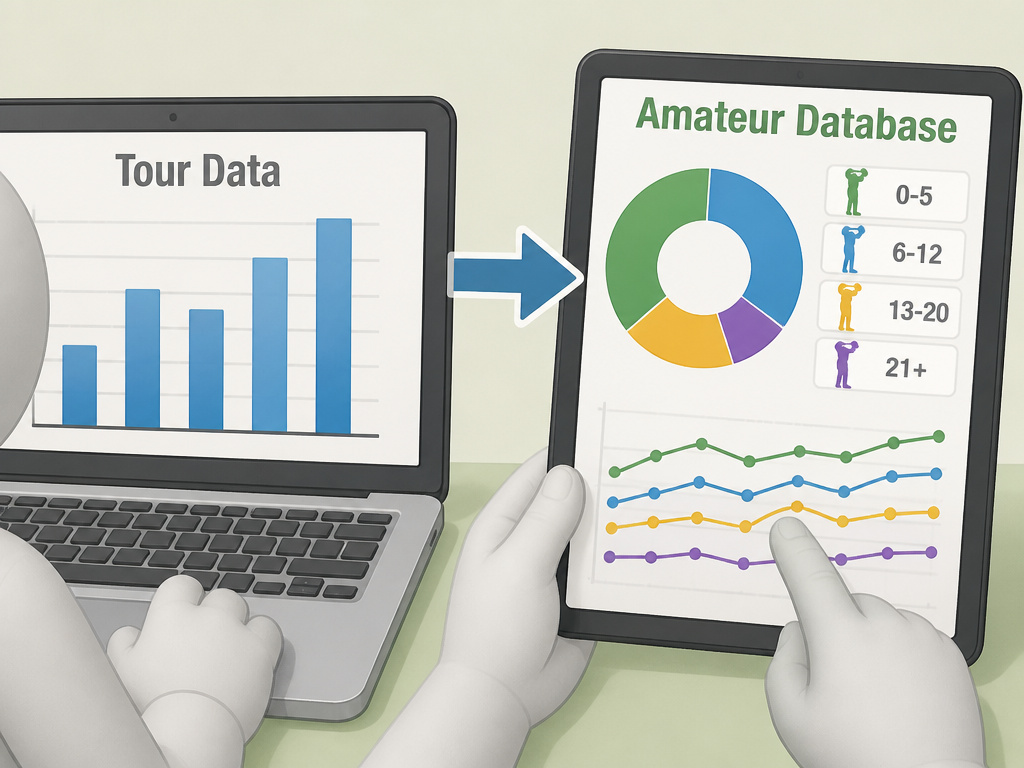
The original strokes gained metric was built from PGA Tour ShotLink data. Professor Mark Broadie’s book Every Shot Counts used millions of tour shots to establish “expected strokes” from every distance and lie. For an amateur, comparing yourself to Scottie Scheffler’s baseline is demoralizing and useless.
That’s why modern platforms create their own benchmarks. Shot Scope has been explicit about its three-phase rollout. Their final phase involves handicap benchmarking generated from their database of 90+ million amateur shots. This will provide a strokes gained value for a 15-handicap from the rough at 150 yards, based on what other 15-handicaps actually do.
Shot Scope’s upcoming handicap benchmarking will not use Tour data. It will be generated from all existing shots within the Shot Scope database (80+ million). This will provide the strokes gained value for every handicap of golfer, for every shot distance and lie type.. Shot Scope, “Understanding Strokes Gained”
This is a fundamental shift. An app using its own database means the strokes gained explained in your report is relative to its users. If Arccos users are, on average, better ball-strikers than Shot Scope users, your SG:APP number will differ between platforms. It’s not that one is wrong; they just have different reference pools.
How to Read Your Own Strokes Gained Report
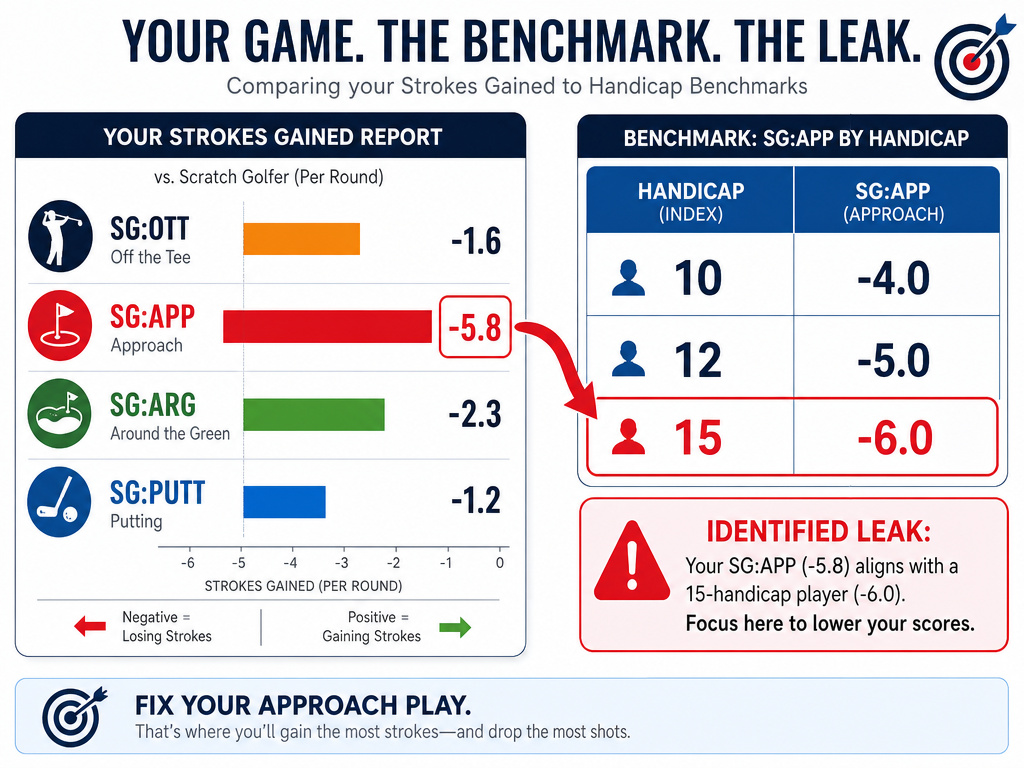
You get a report showing SG:OTT -3.1, SG:APP -5.8, SG:ARG -1.5, SG:PUTT -0.9. Now what? First, find the baseline. Is this compared to a “scratch” golfer or to “all users”? The report should say.
Next, ignore the total and rank the categories. In this example, approach shots are the clear priority, costing nearly twice as many strokes as the next worst category. The strokes gained putting number is the least bad. This tells you your gut feeling about your putting being “off” is likely overblown; your irons are hiding the real problem.
Common mistake: Focusing on the category with the biggest negative number without considering practice tractability. A high handicapper with a massive SG:OTT deficit might improve faster by first shoring up strokes gained around the green, because short-game improvements yield results quicker than a full swing overhaul.
Use the benchmarks table as a rough guide. If you’re a 12-handicap but your SG:APP is -6.5 (closer to a 15-handicap benchmark), you’ve found a specific, quantifiable leak. Your goal isn’t just to lower your handicap; it’s to shift your SG:APP number toward the 10-handicap benchmark of -4.0.
The “True Strokes-Gained” Adjustment and Why It Matters
In August 2026, DataGolf updated its definition of “True Strokes-Gained.” This concept matters if you ever compare performances across different events or leagues.
True strokes-gained is raw strokes-gained adjusted for the strength of the field. Beating a field of PGA Tour pros by one stroke is a better performance than beating a field of club champions by one stroke. The raw strokes gained number would be the same (+1.0), but the “true” value would be higher for the tour event.
For amateurs, DataGolf uses the average NCAA D1 Championship field as its benchmark. A “true” +1.0 means you played one stroke better than that elite amateur baseline. This adjustment prevents a false sense of accomplishment from posting a good number in a weak event.
Most consumer apps don’t apply this field-strength adjustment. Your Saturday foursome strokes gained driving number is just compared to the app’s static benchmark. That’s fine for personal improvement but remember it’s not a “true” measure of performance quality across varying competitions.
How to Get Your Own Strokes Gained Data
You need a shot-tracking system. Manual entry is possible but brutally tedious. The three mainstream paths are sensor-based systems, GPS watches, and subscription apps.
| Platform | How It Works | Key Consideration |
|---|---|---|
| Arccos Caddie | Bluetooth sensors in each grip auto-detect shots. | Requires annual subscription after the first year. The data is incredibly rich but you pay for it. |
| Shot Scope | GPS watch or earbuds with automatic shot tracking. No sensors. | One-time hardware cost. Strong in European markets. Uses its own 90+ million shot database. |
| Garmin Golf | Integrated with compatible Garmin GPS watches. | Good if you already own the watch. Subscription fee for advanced analytics, including strokes gained. |
All three will generate a strokes gained vs traditional stats report. They move beyond fairways hit and putts per round. The initial setup takes a round or two to dial in, but the automatic tracking works reliably after that.
The choice often comes down to your ecosystem. If you wear a Garmin watch daily, adding the Garmin Golf subscription is logical. If you hate wearing a watch while playing, Arccos sensors are less intrusive. Want no subscription? Shot Scope’s hardware model locks in the cost.
Translating Benchmarks into a Practice Plan
Data is useless without action. Your report says SG:APP is -6.0. Your practice plan must address that.
First, break down the category. Is the loss from 150+ yards or inside 100 yards? Your app should show a proximity-to-hole distribution. If your 8-iron shots are finishing 40 feet away while the benchmark is 30 feet, you have a specific target: improve mid-iron proximity.
Where this goes sideways: Practicing your 5-iron because the benchmark says “long irons are hard.” The T5 Golf data shows the 5-iron is the biggest stroke loser for every handicap, including scratch. For most players above a 10-handicap, replacing the 5-iron with a hybrid is a smarter equipment fix than beating balls with it.
Schedule your practice time proportionally. If your SG:APP deficit is four times larger than your SG:PUTT deficit, spend roughly four times as much practice time on the range with your irons as you do on the putting green. This seems obvious, but most golfers do the inverse.
TL;DR: Let the largest negative number dictate your primary focus. Use the benchmarks to set realistic improvement targets, like moving your SG:APP from a 15-handicap level to a 10-handicap level over a season.
Frequently Asked Questions
What is a good strokes gained total for a 10-handicap?
Good strokes gained total for a 10-handicap, when measured against a scratch baseline, is around -10.5. That’s the benchmark average. If you’re a 10-handicap with a SG:Total of -8.0, you’re a better-than-average ball-striker for your handicap, likely let down by another part of your game. The number itself is less important than the distribution across the four categories.
Why do my strokes gained numbers differ between Arccos and Shot Scope?
Your strokes gained analytics can differ because Arccos and Shot Scope use separate, proprietary databases of amateur shots as their benchmark. If the average Arccos user is a better putter than the average Shot Scope user, your SG:PUTT will look worse on Arccos for the same performance. They are different reference pools. This is why it’s critical to stick with one system for consistent tracking.
How does the World Handicap System relate to strokes gained?
The World Handicap System and strokes gained are complementary but separate. Your handicap index is a measure of your potential scoring ability. Strokes gained diagnostics show why that number is what it is. The WHS uses your best scores; strokes gained analyzes every shot from every round. One sets your course handicap, the other provides the improvement roadmap.
Can I calculate strokes gained manually?
You can, but it’s impractical. The strokes gained formula (Expected Strokes Before – Expected Strokes After – 1) requires access to a massive benchmark table of expected strokes for every distance and lie. Apps like Golfshot or simple spreadsheets can mimic this if you input every shot’s location and find the corresponding benchmark value, but the workload is immense compared to automated tracking.
Do strokes gained benchmarks change as I improve?
Yes, dynamically. As you improve your handicap index, you should compare yourself to a better benchmark. If you drop from a 15 to a 10 handicap, your goal shifts from hitting 15-handicap SG:APP benchmarks to hitting 10-handicap benchmarks. The apps typically adjust your comparison group automatically, showing your performance relative to your current peer group.
The Bottom Line
Strokes gained benchmarks cut through the noise. They tell you a 20-handicap doesn’t just need “more practice”, they need, specifically, to find 9.5 strokes per round in their approach play. Your strokes gained off the tee might feel bad, but the data says your irons are almost certainly worse.
Pick a tracking platform. Arccos, Shot Scope, or Garmin, and stick with it for a full season. After 20 rounds, the pattern in your reports will be undeniable. Let the largest negative number own your practice schedule. Ignore the total; chase the category. The benchmarks from 90 million shots are waiting. Your roadmap to a lower handicap is in the data you already produce.
