
The Complete Guide to Deliberate Practice in Golf Explained
This post contains affiliate links. As an Amazon Associate, we earn from qualifying purchases.
This post contains affiliate links. As an Amazon Associate, we earn from qualifying purchases.
Deliberate practice in golf is a structured, goal-oriented training method where you isolate and repetitively work on a specific weakness with high mental effort, using focused feedback to drive improvement. It’s not playing rounds or beating balls. It’s the research-backed engine of skill acquisition, requiring activities designed to push you just beyond your current ability, often for limited daily sessions of 20 minutes to four hours.
That definition comes from a stack of peer-reviewed papers, not golf magazine tips. The difference is the gap between a player who gets stuck at a 12-handicap and one who breaks through.
What follows is the breakdown: the four non-negotiable pillars, the specific motor-learning methods that work (external focus, random practice), the data on how much practice actually changes performance, and the one mistake that installs a “training scar” before you even know it.
Key Takeaways
- Deliberate practice is effortful and often not fun in the moment. If you’re relaxed and chatting, you’re in play mode, not practice mode.
- Research shows aspiring elite junior golfers spend 62% of their time in competitions or competitive practice rounds, not isolated drill work, but those activities are done with high effort and focus.
- A 13-week deliberate practice intervention for elite juniors significantly improved putting performance, with scores jumping from an average of 4.64 to 6.20 on a measured scale.
- The most effective motor-learning methods for golfers are an external focus of attention (thinking about the ball’s flight, not your wrists) and increasing contextual interference (mixing up shots, not hitting the same one 50 times in a row).
- After about 50 hours of quality practice, you hit a crucial juncture. Most players stop challenging themselves here, cementing a merely adequate swing that’s hard to change later.
What Is Deliberate Practice in Golf?
Deliberate practice in golf involves activities specifically designed to improve performance, often requiring sustained physical and mental effort. It is characterized by well-defined goals, immediate feedback, and repetition focused on addressing particular weaknesses, rather than general play or enjoyable repetition of already-mastered skills. This framework was first detailed in the 1993 paper by Ericsson, Krampe, and Tesch-Römer on the acquisition of expert performance.
Forget “beating a bucket of balls.” That’s just activity. Deliberate practice has a blueprint. You walk onto the range or putting green with one goal: to fix a specific fault in your swing path, your distance control from 50 yards, or your start line on 6-foot putts.
The effort is mental, not just physical. Your brain is engaged in problem-solving. You’re analyzing each shot’s outcome against your intent. This is why Ericsson’s original paper noted that even experts can only sustain true deliberate practice for about four hours a day. For beginners, the ceiling might be 20 minutes before mental fatigue degrades the quality.
Where this goes sideways: Calling your weekly Saturday round with buddies “practice.” It’s not. A 2018 study of aspiring elite adolescent golfers found that 62% of their golf activities over nine months were competitions or competitive practice rounds. The key is those rounds were undertaken with high physical and mental effort. They were treating them as deliberate practice, not social outings. If you’re laughing between shots and not grinding over every decision, you’re in play mode.
The Four Pillars of Deliberate Practice
Effective practice is built on four specific pillars that turn time into improvement. Miss one, and you’re just exercising.
| Pillar | What It Means | Golf Example | Risk If Skipped |
|---|---|---|---|
| Specific Goal | A single, measurable technical or outcome goal for the session. | “Today, I will hit 30 pitch shots ensuring my clubface is square at impact, using foot spray on the face to verify.” | Practice becomes aimless repetition. You reinforce your current fault instead of correcting it. |
| Focused Effort | High mental concentration on the task. No distractions, no autopilot. | Putting while counting backwards from 100 by sevens to simulate pressure, forcing total focus on the stroke. | The motor pattern doesn’t engrave into long-term memory. You’ll revert under on-course pressure. |
| Immediate Feedback | A reliable way to know, shot-by-shot, if you succeeded. | Using a launch monitor (like a SkyTrak or Rapsodo MLM2PRO) for club path data, or an alignment stick on the ground for foot position. | You guess. “That felt okay” isn’t data. You can’t adjust what you can’t measure. |
| Repetition & Adjustment | Doing the drill, using the feedback to make a micro-adjustment, and repeating. | Hitting 10 putts from 4 feet, noting the 3 that missed left, and consciously rehearsing a slightly stronger shoulder alignment before the next 10. | You ingrain the mistake. Doing 100 reps with the same error is worse than doing none. |
The first pillar, the specific goal, is where most weekend plans die. “I’m going to work on my irons” is not a goal. “I’m going to hit 20 seven-irons with a 90-degree shoulder turn at the top, filmed from down the line” is a goal. It’s falsifiable. You can look at the video and say yes or no.
This structured approach is the core of effective practice. It turns the driving range from a therapy session into a laboratory.
What Does the Research Say Actually Works?
Golf practice has been a petri dish for motor learning scientists for decades. A 2024 systematic review in Frontiers in Sports and Active Living analyzed 52 randomized controlled trials to see what methods actually move the needle. The results cut through a lot of traditional advice.
The Frontiers systematic review of motor learning identified two clear winners across multiple studies: an external focus of attention and increasing contextual interference.
An external focus means directing your attention to the effect of your movement on the environment. Think “send the ball to that target” or “feel the putter head accelerate through the ball.” An internal focus means thinking about your body parts, “keep my wrist straight” or “rotate my hips.” Study after study shows the external focus group learns faster and performs better under pressure.
Why? An internal focus hijacks your autonomic nervous system. You micromanage muscles that should work on autopilot, creating tension and inconsistency. The external focus lets your body self-organize the most efficient way to achieve the task. It’s the difference between telling someone how to balance on a bike and telling them to look at the spot they want to reach.
Contextual interference is about mixing up your practice. Don’t hit 50 seven-irons in a row (block practice). Hit a seven-iron, then a wedge, then a putt, then a driver (random practice). During the session, your performance will be worse. It’s frustrating. But in retention tests days later, the random practice group significantly outperforms the blocked group.
The reason is deeper learning. Blocked practice lets your brain get into a rhythmic, predictable loop. Random practice forces you to reload the correct motor program from scratch each time, which strengthens the neural pathway. This is a foundational concept in motor learning in golf practice.
Common mistake: Practicing your driver for 30 minutes straight before a round to “find the swing.” You’re just engraving a temporary, context-specific feel. Under the different pressures of the first tee, that feel vanishes.
Another method with strong evidence is errorless learning. This is particularly useful for beginners or when rebuilding a broken part of your game. The idea is to set up the task so success is almost guaranteed, then gradually increase the difficulty. For putting, start from 18 inches. Make twenty in a row. Move back to 3 feet. This builds confidence and a correct neural model before failure and bad habits can set in.
Deliberate Practice vs. Play: The Data on Junior Development
The pathway to elite performance isn’t a straight line of grim, joyless drilling from age five. The research complicates the popular “10,000-hour rule” narrative, especially for golf.
Rick Hayman’s 2018 University of Lancashire master’s thesis followed aspiring elite adolescent golfers. He found that long-term deliberate practice was not a prerequisite throughout childhood. The early pathway looked more like “deliberate play”, sampling the sport in fun, unstructured ways.
The critical shift happened around age 16. For those who progressed to elite junior national squads, engagement in deliberate practice after 16 became the essential driver. Before that, a variety of playful, competitive experiences built athleticism and love for the game without burnout.
His study also provided one of the clearest snapshots of what elite-bound practice actually looks like. Over nine months, 62% of all their golf activities were logged as competitions or competitive practice rounds. But crucially, the participants rated these activities as high in both physical and mental effort. They were competing with intent, not just playing.
This has a direct implication for your practice routine. If you’re an adult beginner, you can’t skip the foundational deliberate practice on technique. But once you have a functional swing, integrating competitive scenarios, even against yourself, is where skill becomes robust.
How to Structure a Deliberate Practice Session
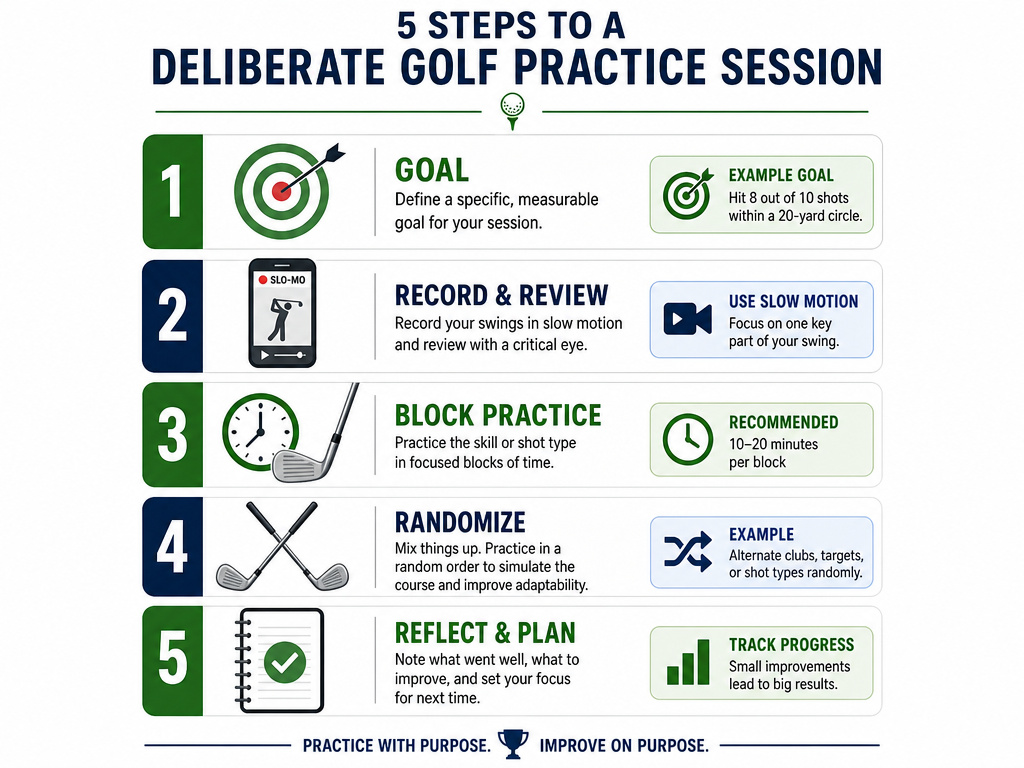
Knowing the theory is one thing. Applying it on a Tuesday afternoon with an hour to spare is another. This is a template that forces you to use all four pillars.
- Define the Single Goal (5 minutes). Be brutally specific. “Improve contact on half-wedge shots.” Narrow it further: “Hit 20 half-wedges with a 56-degree, ensuring the divot starts after the ball, using a tee placed just in front of the ball as a visual guide.”
- Set Up Feedback (5 minutes). How will you know? Use foot spray on the clubface to see strike location. Place two alignment sticks in a “gate” for the clubhead to pass through. Use your phone on slow-motion video. Never hit a ball without a feedback mechanism ready.
- Execute with Focus (20-40 minutes). This is the work block. Hit the 20 shots. After each one, consult your feedback. Did the spray show a centered strike? Did the club pass through the gate? If not, make one small adjustment (e.g., “feel more weight on front foot”). Then repeat. The mental effort here is exhausting.
- Randomize and Test (10 minutes). Now, create contextual interference. Don’t just hit another 20. Mix in a different club, change the target, alter the trajectory. Finally, test the skill without the feedback aid. Hit 5 shots “naked.” This is your retention probe.
- Record the Outcome (2 minutes). In a notes app or journal, write: “Date. Goal: Divot after ball on half-wedge. Feedback: Foot spray. Result: 14/20 clean divots. Key feel: Weight forward. Next session: Add small fade bias.”
This structure works for any skill, from driving to distance control. The limited, intense blocks are why you can make progress with just practice at home in your net for 30 minutes.
The 50-Hour Juncture and Avoiding “Training Scars”
There’s a hidden trap in the practice process, and it strikes right when you’re starting to see results. Motor learning researchers point to a crucial juncture at around 50 hours of quality practice on a new skill.
At this point, the new movement pattern, say, a corrected over-the-top move, starts to feel more comfortable. It’s not yet automatic, but it’s no longer a struggle. This is the danger zone. Most golfers subconsciously stop challenging themselves. They settle into this “good enough” pattern.
The problem is that “good enough” is often a compensation. By stopping the deliberate, effortful refinement, you cement this compensation as your default motor program.This is called installing a “training scar.” It’s a technically flawed action that works under low pressure but will be the first thing to break down on the course.
Skip this if: You’re willing to plateau. The 50-hour mark is where you double down on feedback. Introduce pressure drills (must make 5 in a row), fatigue (practice after a workout), or random practice schedules to keep the skill adaptive and robust.
This is where advanced practice tools like pressure-putt trainers or swing trainers that provide resistance can be invaluable. They force you out of the comfort zone your new skill has created.
Frequently Asked Questions
Can deliberate practice be fun?
Not in the traditional, relaxed sense. The defining characteristic is effortful engagement at the edge of your ability, which is cognitively taxing. The satisfaction comes from measurable improvement and achieving goals, not from the immediate enjoyment of the activity. The “fun” is delayed.
How long should a deliberate practice session last?
Quality trumps quantity every time. Ericsson’s original research suggested experts max out at about four hours daily. For most amateur golfers, a focused, single-goal session of 30 to 45 minutes is far more productive than two hours of mindless ball-beating. Once your focus wanes, stop.
What’s the difference between deliberate practice and a golf lesson?
Lesson is diagnosis and prescription. The PGA professional identifies the flaw and gives you a drill (the deliberate practice activity). Deliberate practice is you, alone, executing that prescription with focus and feedback over the following weeks. The lesson provides the map; deliberate practice is the journey.
I don’t have a launch monitor or high-tech gear. Can I still do it?
Absolutely. Effective feedback doesn’t require a $5,000 machine. Use a smartphone for video. Use chalk or foot spray on your clubface. Use alignment sticks and tees. The Golf Science Journal motor learning review emphasizes that the learner’s attentional focus is more important than the tool’s expense.
Is deliberate practice only for full swing?
No. It applies to every facet: putting, chipping, bunker play, and course management. A deliberate putting session might involve making 100 three-foot putts in a row with a specific start-line drill. A course-management session could be mentally playing your home course, writing down your club selection for every shot based on your average distances, and then reviewing it with a pro.
Before You Go
Deliberate practice is a disciplined system. It means trading the immediate gratification of a good shot on the range for the long-term payoff of a reliable swing under pressure.The research is clear: improvement comes from specific goals, intense focus, instant feedback, and smart repetition.
Start small. Pick one thing, your proper backswing, your putting alignment, your wedge distance gaps. Apply the four pillars for just twenty minutes. Use your phone for feedback. The difference between that session and your usual range time will be obvious. That’s the engine of getting better. Everything else is just noise.
