
Build Your Strength Training Program for Golfers in 8 Weeks
This post contains affiliate links. As an Amazon Associate, we earn from qualifying purchases.
This post contains affiliate links. As an Amazon Associate, we earn from qualifying purchases.
An effective strength training program for golfers prioritizes power transfer over raw muscle, built on an 8-week foundation of 3-4 weekly sessions that blend general strength with high-velocity, rotational movements. The goal isn’t a bigger bench press; it’s increasing upper-torso rotational velocity, which a 2007 study directly linked to gains in club speed, ball speed, and carry distance after just two months.
That link between the gym and the tee box is the whole game. Most programs stop at “get stronger,” but the research shows a clear path: a foundational phase to build resilience and force, followed by a dedicated power phase that teaches your body to apply that force at the speed of a downswing. The gains are measured in milliseconds of force production and extra yards of carry.
What follows is the blueprint. We’ll break down the two non-negotiable training phases, the exercises that actually transfer, and the exact set and rep schemes pulled from peer-reviewed studies. You’ll also see why simply adding weight to a bar can backfire, and how to structure your year so you’re strongest when the season starts.
Key Takeaways
- Power beats pure strength. Golf swing is a high-velocity movement. Your program must include exercises like medicine ball throws and weighted club swings that train rate of force development.
- Commit to 8 weeks minimum. Significant changes in torso rotational strength and swing kinematics require at least two months of consistent, focused training, 3-4 times per week.
- Periodize or plateau. Start with a general strength and hypertrophy phase (2-3 sets of 10-12 reps), then transition to a power phase (3-4 sets of 5-8 reps with intent to move fast). Your body adapts to constant stimulus.
- Train rotation, not just isolation. Standing cable rotations and isokinetic torso work have a higher likelihood of improving swing mechanics than bench press alone, per a 2017 BMC study.
- The first gain is injury prevention. A foundational phase fortifies the shoulders, hips, and core against the repetitive stress of the swing, making your game more durable.
The 8-Week Golf-Specific Exercise Template
This is a condensed version of the protocol used in the University of Pittsburgh study that delivered proven results. The structure is simple: three full-body sessions per week, with at least one day of rest between them.Each session blends strength, power, and mobility.
The program is split into two 4-week blocks. The first block establishes a base of strength and muscular endurance. The second block shifts the focus to power and velocity, teaching your nervous system to recruit muscle fibers faster.
A golf-specific exercise program performed 3-4 times per week for 8 weeks significantly improved torso rotational strength, hip abduction strength, and upper-torso axial rotational velocity at the acceleration point of the swing, leading to increased club velocity, ball velocity, and carry distance.
Week 1-4: Foundation & Resilience
The goal here is to build work capacity and fortify joints. Use moderate weights where the last two reps of each set are challenging but your form remains perfect.
| Day | Exercise Category | Sample Exercises | Sets x Reps | Rest |
|---|---|---|---|---|
| Day 1 | Lower Body & Core Strength | Goblet Squat, Single-Leg Romanian Deadlift, Plank | 3 x 10-12 | 60-90 sec |
| Day 2 | Active Recovery | Light cardio (walking, cycling), dynamic stretching | N/A | N/A |
| Day 3 | Upper Body & Rotation | Single-Arm Dumbbell Row, Push-Up, Standing Cable Rotation | 3 x 10-12/side | 60-90 sec |
| Day 4 | Rest | |||
| Day 5 | Full Body Power & Mobility | Medicine Ball Slam, Lateral Lunge, Banded Pull-Apart | 3 x 8-10 | 90 sec |
| Day 6-7 | Rest |
Week 5-8: Power & Velocity
Now we train intent. On power exercises like the medicine ball toss, the goal is to move the implement as fast as possible, even if the weight is relatively light. This phase wires your strength for speed.
| Day | Exercise Category | Sample Exercises | Sets x Reps | Rest |
|---|---|---|---|---|
| Day 1 | Maximal Strength & Power | Trap Bar Deadlift, Box Jump, Pallof Press | 4 x 5-6 | 2-3 min |
| Day 2 | Active Recovery | N/A | N/A | |
| Day 3 | Rotational Speed & Stability | Seated Medicine Ball Rotational Throw, Weighted Club Swings, Side Plank | 4 x 6-8 | 90 sec |
| Day 4 | Rest | |||
| Day 5 | Complex Training | Heavy Goblet Squat (3×5) followed by Broad Jumps (3×5) | 3 x 5 | 3 min between complexes |
| Day 6-7 | Rest |
Where this goes sideways: Skipping the foundational weeks and jumping straight to power training. Your tendons and ligaments need time to adapt to the new loads. Rushing it is the fastest path to an overuse injury that sidelines you for months.
The seated medicine ball rotational throw is your benchmark. If the distance you can throw a 4-6kg ball increases over these eight weeks, you’re directly improving your rotational power exercises. This is the gym movement that most closely mirrors the kinetic sequence of the downswing.
Phase 1: Building the Base (General Strength)
Think of this as constructing a wider, more stable platform. Before you can swing faster, you need a body that can handle the violent, asymmetric forces of the golf swing without breaking down. This phase is about muscle hypertrophy and connective tissue resilience, not maxing out your one-rep squat.
A foundational golf fitness phase typically lasts 6-10 weeks. For a novice, a protocol from an NIH resistance training study for golf recommends three days per week, performing 2–3 sets of 10–12 repetitions with a 1–2 minute rest. The concentric and eccentric portions of each lift should be controlled, about two seconds each.
The exercises that matter here are the unsexy ones:
- Goblet Squats: Builds leg strength and core stability simultaneously, reinforcing a braced torso.
- Single-Arm Rows: Corrects posture imbalances from a dominant trail side and strengthens the lats, a key downswing muscle.
- Face Pulls: Protects the rotator cuff from the internal rotation stress of thousands of swings.
- Planks & Anti-Rotation Holds: Teach your core to resist movement, creating a stable coil in your backswing.
You’re not trying to move weight fast here. You’re trying to own every inch of the movement. The soreness you feel after the first week isn’t a badge of honor—it’s a signal to dial the weight back until your technique is flawless. This base isn’t just for performance; it’s your best defense against common overuse injuries.
Phase 2: Converting to Power (Golf-Specific Strength)
This is where the transfer happens. Now that you have a stronger engine, you need to teach it to rev higher. Power is the product of force and velocity. This phase uses lighter loads (30–60% of your max) moved with maximal intent to improve that velocity component.
The research is clear on structure. An 18-week strength training for low-handicap golfers split its power phase into two blocks: six weeks of explosive strength (weights plus plyometrics), followed by six weeks of golf-specific strength (weighted clubs, tubing). Gains in driving performance appeared after the first 12 weeks and were maintained.
Your power toolkit should include:
- Medicine Ball Throws (Rotational & Overhead): The gold standard for training rotational power. Aim for 3-4 sets of 5-8 throws with full recovery between sets.
- Weighted Club Swings: Using a club 10-20% heavier than your driver, make smooth, controlled swings focusing on sequence. This is a form of overspeed training in reverse, improving muscle recruitment.
- Box Jumps & Broad Jumps: Develop lower-body explosiveness that translates into ground force.
- Band-Resisted Swings: Attach a resistance band to your clubhead and make practice swings. The band’s pull during the downswing forces your body to work harder, building specific strength.
The rest periods are longer here—two to three minutes. You need full recovery to ensure every rep is done with maximal speed. If you’re grinding out the last few reps, the weight is too heavy. You’re training your nervous system, not your muscles to fatigue.
The Science of Transfer: From Gym to Tee Box
How does a heavier goblet squat turn into more yards? It’s not magic. It’s biomechanics. The golf swing is a kinetic chain where energy generated from the ground transfers sequentially through the hips, torso, and shoulders to the club. A weak link leaks power.
The key measurable is upper-torso rotational velocity. A study of recreational golfers found that an 8-week program significantly increased this velocity at the acceleration point of the swing. That single variable drove the gains in club speed and distance. Your training must improve your ability to rapidly rotate your torso against resistance.
This is where the distance debate gets real. Technique is the steering wheel, but strength and power are the engine. You need both. A powerful engine with poor steering is wild. A polished steering wheel with a weak engine goes nowhere. The BMC isokinetic training study found that isokinetic (constant-speed) rotational training had a likely beneficial effect on carry distance compared to traditional isotonic training. The mechanism? Isokinetic training allows for maximal force production through the entire range of motion, closely matching the demands of the swing.
Common mistake: Neglecting the “stretch-shortening cycle” in training. The golf swing uses a rapid stretch of the torso muscles (the backswing) to generate more force on the downswing. Exercises like medicine ball throws that involve a quick wind-up and explosive release directly train this mechanism.
So the transfer happens when your exercises mimic the swing’s requirements: rotational power, ground force production, and rapid sequential movement. A slow, grinding bench press has less carryover than a explosive standing cable rotation. Choose exercises that look like golf, not just bodybuilding.
Exercise Selection: What to Do (and What to Skip)
Your time is limited. Every exercise in your program must earn its spot by either preventing an injury or directly increasing clubhead speed. Here’s the breakdown.
Do These: The Transfer Champions
- Standing Cable Rotations: The best gym proxy for the downswing. It trains rotational power while forcing your core to stabilize. Keep the reps low (6-8) and the speed high.
- Seated Medicine Ball Rotational Throws: Isolates pure torso power. Measure your progress by how far you throw the ball each month.
- Trap Bar Deadlift: Safer than a barbell deadlift for the spine and fantastic for building total-body strength and hip drive.
- Lateral Lunges: Golf is a side-to-side sport. This builds stability and strength in the frontal plane, crucial for weight transfer.
- Farmer’s Carries: Builds grip strength, core stability, and shoulder health. A simple, brutal, and highly effective exercise.
Skip These: The Time-Wasters
- Machine Leg Extensions: They isolate a single muscle through a non-functional range of motion. They do nothing for the integrated strength your swing needs.
- Behind-the-Neck Lat Pulldowns: A shoulder impingement waiting to happen. The risk far outweighs any minimal benefit.
- Heavy, Slow Bicep Curls: Unless your goal is to look good in a polo, this is wasted energy. Grip strength is important, but it’s trained better with deadlifts and carries.
- Long-Duration, Slow Cardio: While cardiovascular health is important, marathon running can reduce power output and tighten hip flexors. Opt for interval training or brisk walking instead.
For senior exercises, the principles are the same but the loading is different. Focus on bodyweight movements, resistance bands, and lighter medicine balls. The goal is maintaining power and mobility, not setting personal records. Consistency trumps intensity.
Periodization: Your Year-Round Game Plan
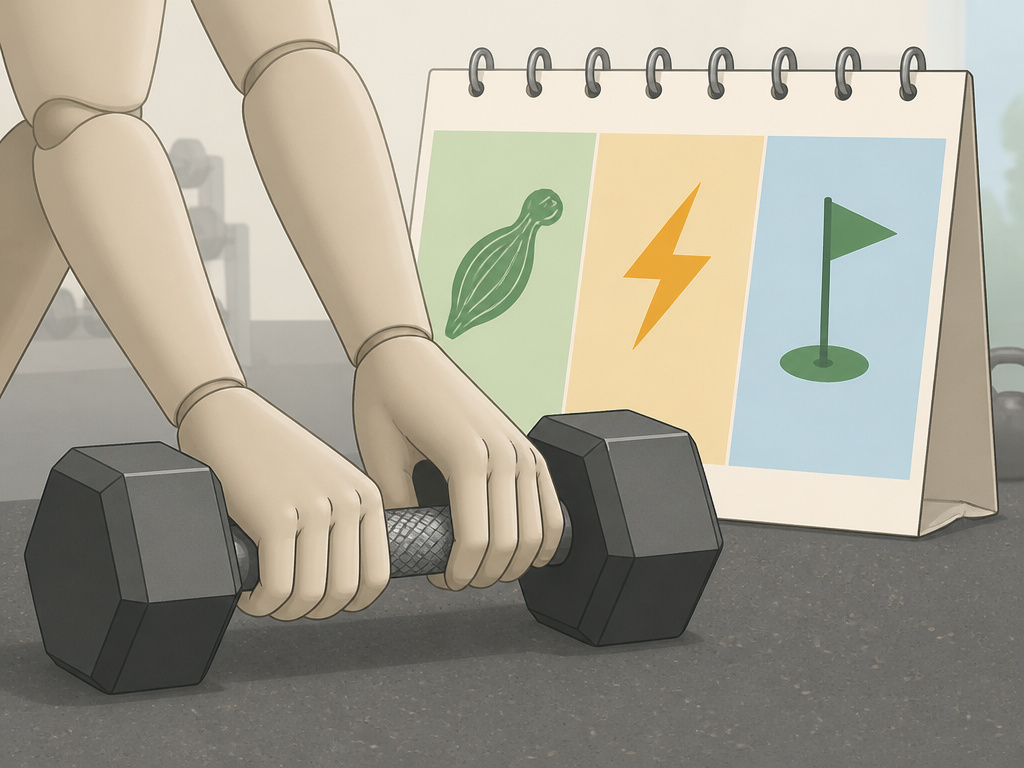 You can’t train at the same intensity year-round. Your body adapts, and you’ll hit a wall. Periodization is the planned variation of your training variables (volume, intensity, exercise selection) to keep making progress and peak for your season. It’s what separates a structured program from a random workout.
A classic model for golfers, outlined in research, uses three phases: 1. Off-Season (Hypertrophy/Base): 6-10 weeks of higher-rep (10-12), lower-intensity work to build muscle and resilience. This is Phase 1, detailed earlier. 2. Pre-Season (Strength/Power): 6-8 weeks of lower-rep (5-8), higher-intensity work to convert that muscle into usable strength and power. This blends into Phase 2. 3. In-Season (Maintenance): A period of undulating periodization. You might have one intense strength session and one lighter power or mobility session per week to maintain gains without causing fatigue that hurts your game.
A JSCR 10-week golf intervention study used a version of this, with 6 weeks of strength training followed by 4 weeks of power training. The female golfers in that study saw massive, significant improvements in upper-body force production. The takeaway is clear: block your training. Don’t just show up and do the same thing.
Your in-season maintenance is critical. This is where tools like swing aids and swing plane trainers can be more valuable than heavy lifting. The goal is to preserve your hard-earned power while keeping your movement patterns sharp. One heavy full-body workout per week is often enough to maintain strength.
Frequently Asked Questions
How long until I see more distance?
Expect a minimum of 8 weeks of consistent training to see measurable gains in driving distance. The peer-reviewed physical capacity trial showed significant improvements in force production and carry distance after a 10-week intervention. Structural changes and neural adaptations take time. You might feel stronger in the gym after 4 weeks, but transferring that to the course requires the specific power training of Phase 2.
Can I do this at home with minimal equipment?
Yes, with a strategic focus. You can build an excellent foundation with bodyweight exercises, resistance bands, and a single medium-weight kettlebell or dumbbell. For the power phase, a medicine ball is essential. While you won’t have the same load progression as a gym, the principles remain: focus on movements like split squats, band-resisted rotations, and medicine ball throws. A dedicated speed trainers can also be a great home tool for the velocity component.
Will I get too bulky and lose flexibility?
No, if you follow the program structure. The goal of a golf strength program is power-to-weight ratio, not maximal size. The rep ranges and exercise selection prioritize neural adaptation and explosive strength over pure muscle growth. Furthermore, the program should be complemented with dynamic stretching and mobility work. In fact, the 8-week study on recreational golfers found that flexibility significantly improved in all measurements after the training block. Smart training makes you more athletic, not just bigger.
How does this differ from a general gym workout?
General workout often aims for aesthetic changes or general health. A golf-specific program is engineered for a single performance outcome: transferring force from the ground to the clubhead at high speed. Every exercise is chosen for its relevance to the swing’s biomechanics. It emphasizes rotational and lateral movements, trains the core as a stabilizer and rotator, and includes dedicated power exercises that are often absent from a standard routine. It’s the difference between building a truck engine and a race car engine.
Should I train on the same day I play golf?
It depends on the intensity. A light mobility session or very low-intensity technique work with training for power tools can be fine before a round. However, a heavy strength or high-power training session will cause neural fatigue that can disrupt your timing and coordination. Ideally, separate intense training days and playing days by at least 24 hours. If you must train and play on the same day, train after you play.
Before You Go
A strength training program for golfers is a direct investment in your performance and longevity on the course. The template is proven: 8 weeks, 3-4 sessions a week, moving from a foundation of general strength to the specific power that drives the ball farther.The data from multiple studies leaves no doubt—it works.
Start with the base. Be patient through the first month where the gains are happening under the hood, building the durability that lets you practice and play without pain. Then, shift your focus to speed and intent.That’s when the extra yards appear.
Remember the pioneer, Gary Player, who was ridiculed for lifting weights. He wasn’t just ahead of his time; he understood the fundamental truth. A stronger, more athletic body is a better golfing body. Your program is the blueprint to build yours.
