
Coore & Crenshaw’s Minimalist Golf Design: Shaping the Land
This post contains affiliate links. As an Amazon Associate, we earn from qualifying purchases.
This post contains affiliate links. As an Amazon Associate, we earn from qualifying purchases.
Coore and Crenshaw minimalist golf design is defined by a foundational rule: the land dictates the golf. Their philosophy rejects imposing a pre-conceived vision, instead seeking out a property’s inherent features, a subtle wrinkle in the ground, a majestic ocean vista, and crafting a routing and strategy that feels discovered, not built. This approach, which moved only 4,000 cubic yards of earth at the seminal Sand Hills, prioritizes strategic interest and environmental harmony over dramatic, manufactured spectacle.
That 4,000-cubic-yard figure isn’t just a statistic. It’s the measurable difference between moving mountains and moving with them. It represents a commitment so deep that it reshapes what’s possible on a property many would have dismissed.
What follows is a breakdown of how that philosophy works in practice. We’ll look at the specific tools they use, the surprising amount of engineering sometimes required to achieve a “natural” look, and the tangible results, like cutting a course’s water use by over 70%. This is how a design partnership changed the modern game by doing less.
Key Takeaways
- The core tenet is working with the land, not against it. Routing and features are derived from existing landforms, leading to courses that feel integral to their landscape.
- “Minimalism” often requires significant, intelligent engineering. Projects on flood plains or flat sites, like Talking Stick or Chechessee Creek, demand extensive sand-capping and drainage work to create playable, interesting ground. Strategic width and options are essential. Coore & Crenshaw designs offer multiple routes to the green, rewarding thoughtful play over purely penal execution.
- Their restoration work, notably at Pinehurst No. 2, proves the philosophy’s sustainability, reducing irrigation water from 40-50 million gallons annually to just 12 million.
- The firm’s “adolescence” period building on “below-average” land was a critical pressure test that proved their style wasn’t dependent on perfect sites.
The Core Philosophy: Letting the Land Lead
Forget the notion of an architect arriving with a portfolio of signature holes to stamp onto a property. The Coore & Crenshaw process begins with silence and observation. They walk. For days. The goal is to listen to what the site has to say.
The routing is the bone structure. If the routing isn’t great, the course can’t be great. It’s a complex puzzle piecing together natural features, drainage, rhythm, and flow before a single shovel hits the ground.
This method is the antithesis of a top-down blueprint. It’s a bottom-up discovery. A knoll becomes a natural green site. A swale dictates a fairway’s movement. This deep reverence stems from their admiration for the Golden Age of golf course architecture, studying the work of Alister MacKenzie, Donald Ross, and Perry Maxwell. They aren’t copying templates; they’re applying a classical mindset of strategic options and natural integration to new land.
The payoff is a profound sense of place. Play Sand Hills Golf Club in Nebraska and you’re playing through the dunes, not on a course plopped atop them. This is why their minimalist philosophy is often misunderstood. It’s not a lack of intervention. It’s intervention so carefully considered it becomes invisible. The hand of the architect is felt in the quality of the shot options, not in the spectacle of the earthworks.
The Minimalist Toolkit: Width, Ground Game, and Strategic Options
 If the land provides the canvas, a specific set of design principles provides the brushstrokes. Coore & Crenshaw designs are immediately recognizable for their generous fairways. This width isn’t about forgiveness in the hack-it-around sense. It’s the foundation of strategic golf design.
A wide fairway presents multiple angles into a green. The preferred angle for an easier approach is usually guarded by a bunker or contour. The safer, wider part of the fairway leaves a longer, more difficult shot. The player is constantly engaged in a risk-reward decision. This is a direct rejection of penal and heroic design that simply punishes a miss.
The second tool is the ground game. Firm, fast conditions are a goal, allowing the ball to run along the natural contours. This demands that players think about where their ball will land and where it will end up. It brings slopes and hollows into play as active defenses, not just scenery. Greens are often open at the front, encouraging a running shot, while being defended at the sides and rear.
Finally, there’s the emphasis on playability and fun. Ben Crenshaw has said, “The easiest thing in the world is to build a tough golf course.” Their designs include short, drivable par fours and reachable par fives. These holes deliver drama and opportunity for every level of player, ensuring that the challenge is mental as much as physical. This focus on enjoyable strategy is a key element of what makes a great golf course.
| Design Element | Purpose | Example in Play |
|---|---|---|
| Generous Fairways | To create multiple angles of approach and risk-reward decisions. | A player chooses between a risky drive over a corner bunker for a wedge, or a safe drive leaving a long iron. |
| Open Green Fronts | To encourage the ground game and running shots. | A player can putt from 30 yards off the green, using a slope to feed the ball close. |
| Short Par 4s / Reachable Par 5s | To inject fun, drama, and scoring opportunity for all skill levels. | A drivable par 4 tempts every player, creating eagle chances and big-number risks. |
| Natural Bunkering | To frame strategy, not just punish. Bunkers often sit where a player wants to hit. | A diagonal fairway bunker forces a decision: carry it for the best angle, or play short and left. |
When Minimalism Requires Maximum Effort: The Engineering Beneath
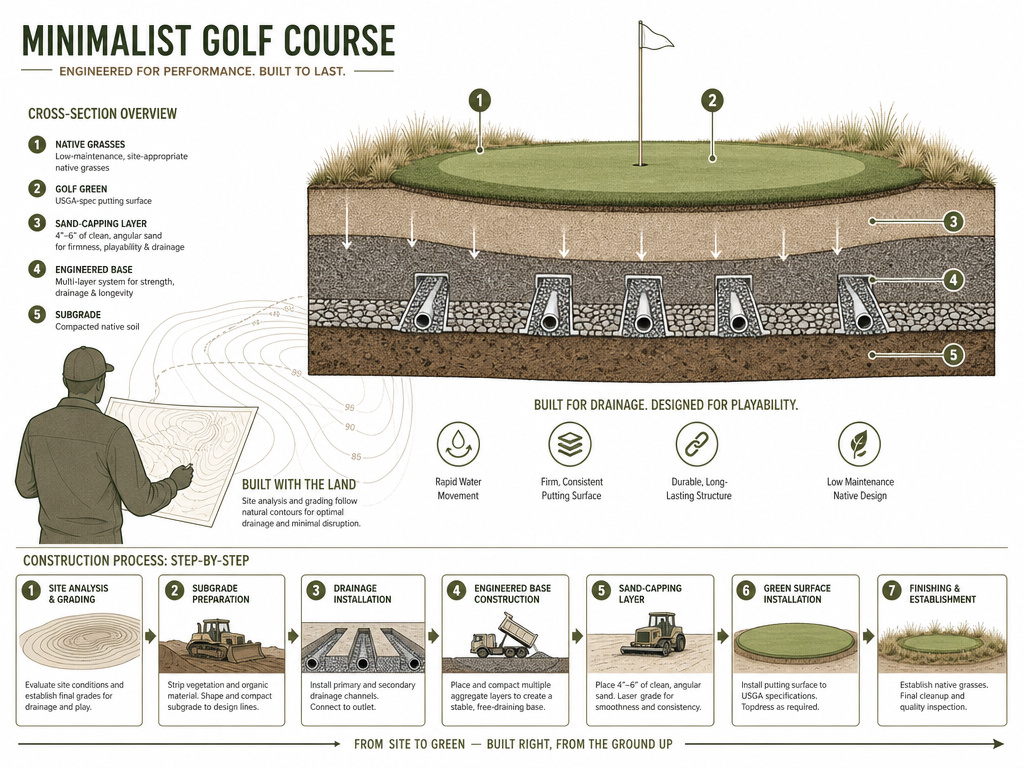 The term “minimalist” can conjure images of simply mowing down native grass and calling it a course. The reality, especially on less-than-ideal sites, is far more complex. Coore & Crenshaw’s reputation was cemented on glorious sites like Sand Hills, but their “adolescence” period around the year 2000 was a critical pressure test.
They took on properties like Talking Stick in Arizona (a barren desert flood plain) and Chechessee Creek in South Carolina (a flat, mushy lowcountry marsh). These were “below-average” lands. To create interesting golf here, they had to engineer the necessary conditions.
At Talking Stick, this meant constructing a network of ridges and channels for drainage, which doubled as diagonal cross-bunkers affecting strategy. At Chechessee Creek, the entire course was sand-capped, a massive undertaking, to elevate it above the water table and create firm conditions. Greens were built up to provide definition.
Where this goes sideways: Assuming minimalist design means no earthmoving. On compromised sites, creating playable, strategic golf often requires extensive, intelligent engineering to manage water and create contour. The artistry is in making that work look untouched.
This period proved their design principles were portable. It wasn’t about finding perfect land; it was about applying a consistent philosophy of strategic, land-sensitive golf to any land. The goal remained the same: after they were done, the course should look and feel like it belonged. Talking Stick still feels like the Sonoran Desert. Chechessee Creek is pure Lowcountry. The work is in service of the place, not the other way around. This nuanced understanding of golf course architecture separates them from imitators.
Case Studies in Dirt and Water: Sand Hills & Pinehurst No. 2
Two projects bookend their career and best illustrate the philosophy’s impact: the new-build of Sand Hills and the restoration of Pinehurst No. 2.
Sand Hills Golf Club (1995): This is the purest expression of their method. On a magical stretch of Nebraska sand dunes, their directive was to “find” the golf course. The result was a routing that seems inevitable. The celebrated statistic is the minuscule 4,000 cubic yards of earth moved. For context, many modern courses move over a million cubic yards. Every hole appears to have been discovered, not built. Sand Hills didn’t just become a top-ranked course; it heralded a new era, proving that remote, naturalistic golf could be a viable, desirable model. It was a direct inspiration for developers like Mike Keiser at Bandon Dunes.
Pinehurst No. 2 Restoration (2012-Present): This project applied the minimalist ethos to a historic masterpiece. Partnering with the USGA, Coore & Crenshaw undertook a “restoration by subtraction.Their thorough examination of the archives aimed to strip away decades of over-softening and return the course to its rugged, sandy-bordered character.
The physical changes were stark: * Removal of 700 sprinkler heads from the main irrigation system. * Planting of more than 20,000 native wiregrass plants. * Conversion of 40 acres of irrigated turf to natural sandy waste areas.
The environmental result was staggering. According to Pinehurst’s director of grounds, water usage dropped from 40-50 million gallons per year to just 12 million, a reduction of roughly 73%. The playing result was a return to Donald Ross’s original intent: a firm, fast, ground-game test where precision and creativity trump power. The success of this project is detailed in the USGA Coore and Crenshaw feature, which documents how a less-is-more approach can preserve history and conserve vital resources.
The Lasting Influence and Your Course Experience
The influence of Coore & Crenshaw is visible in the work of an entire generation of architects. The preference for walking, for strategic width, for environmental sensitivity, these are now mainstream concerns in golf course design principles, largely due to the path they carved.
So, what should you, as a player, notice and appreciate when you step onto a Coore & Crenshaw course?
- Walk it. The rhythm and flow of the course routing are integral to the experience. You’ll feel the intentional sequencing of holes, the variety, and the connection to the land.
- ** Before you tee off, ask yourself: what are the different ways to play this hole? The width is there for a reason. The best angle is usually defended.
- Use the ground. Don’t automatically reach for a high-lofted wedge. Put the ball on the ground and let the contours work for you. This is how the courses are meant to be played.
- Appreciate the silence. The course shouldn’t feel like a loud, dramatic statement. It should feel quiet, settled, and timeless. As Bill Coore has said, their goal is to let the holes “lay upon the land quietly.”
Their partnership, alongside contemporaries like Tom Doak, redefined modern golf architecture. They proved that great golf doesn’t require heroic transformation of the earth. It requires a humble, observant eye and the skill to reveal the great golf that was already there, waiting to be found.
Frequently Asked Questions
What is the most famous Coore and Crenshaw golf course?
Sand Hills Golf Club in Nebraska is widely considered their masterpiece and the most influential. Its 1995 opening, with minimal earth movement on a perfect sandy site, is credited with launching the modern minimalist era in golf architecture.
How do Coore and Crenshaw courses differ from Pete Dye courses?
The contrast is foundational. Pete Dye is known for dramatic, manufactured hazards (railroad ties, island greens), psychological intimidation, and often penal design. Coore & Crenshaw work from the natural land, create strategic width with multiple options, and aim for a quiet, traditional aesthetic. Dye imposes his will; Coore & Crenshaw interpret the site’s.
Are Coore and Crenshaw courses easy?
No, they are strategically demanding. While they offer width and playability, the challenge comes from the constant decision-making required. Choosing the wrong angle or failing to understand the ground game will lead to high scores. They are fair, but they rigorously test course management and creativity.
What does “minimalist” mean in golf course design?
It’s a philosophy prioritizing the existing natural landscape over massive earthmoving. The goal is to find and accentuate the inherent golf interest in a property, creating a course that looks and feels like it was discovered, not built. It emphasizes strategic design over penal, and environmental integration over spectacle.
Can minimalist design work on flat or poor land?
Yes, but it requires different skills. As seen at Talking Stick and Chechessee Creek, Coore & Crenshaw use intelligent engineering, drainage networks, sand-capping, strategic mounding, to create the necessary contours and conditions for interesting golf. The “minimalist” result is a natural-looking course, but the process to get there on poor land can be extensive.
Before You Go
One rule most golf travel guides miss: if you have the chance to play a Coore & Crenshaw design, book the earliest tee time you can. The morning light on their native grasses and the undisturbed dew on their wide fairways reveal the course as it was meant to be seen, quiet, raw, and strategic. That first walk down a fairway where you can’t see a single house or hear anything but your steps is the entire point. It’s the feeling they’re selling, and it’s worth setting an alarm for. Everything else is just a variation on how you get your ball from there to the hole.
