
Shoulder Turn vs Hip Turn in Backswing | The Data-Driven Ratio
This post contains affiliate links. As an Amazon Associate, we earn from qualifying purchases.
This post contains affiliate links. As an Amazon Associate, we earn from qualifying purchases.
The ideal shoulder turn vs hip turn in the backswing follows a 2-to-1 ratio, roughly 90 degrees of shoulder rotation to 45 degrees of hip rotation. This creates the “X-Factor,” the separation between your upper and lower body that stores elastic energy for the downswing. Most amateurs either turn their hips too much, losing tension, or not enough, restricting their shoulder turn and power.
That ratio is a starting point, not a commandment. The real mechanics are about creating stretch, not hitting numbers. Your individual mobility dictates your personal ceiling.
What follows: the precise measurements from tour player studies, the critical difference between hip rotation and hip sway, and why the best cue for you depends entirely on your current swing fault. By the end, you’ll know whether to focus on turning more, turning less, or fixing the lateral move you didn’t know you had.
Key Takeaways
- Tour players average about 45 degrees of hip rotation and 90–100 degrees of shoulder rotation at the top, creating a 45–55 degree X-Factor.
- Hip sway (lateral movement) is different from hip turn (rotation). Pros move their hips laterally toward the target in the backswing by about 0.5 inches on average, amateurs often move away from it.
- For male golfers, greater left hip internal rotation is strongly correlated with higher clubhead speed. For females, the relationship is inverse, highlighting different biomechanical strategies.
- Restricting hip turn is a common but often flawed prescription. For players who slide instead of rotate, increasing hip turn can be the fastest path to a better swing plane and more distance.
- The most learnable mechanical change in the golf swing is proper lateral hip movement in the downswing, with coaching cues showing a 2-to-1 improvement rate.
What the Numbers Actually Say: Tour Player Benchmarks
Forget feels and opinions. Motion-capture studies from GOLFTEC’s SwingTRU and platforms like Sportsbox AI give us the hard metrics.
At the top of the backswing, the average male tour player’s chest is turned about -98 to -102 degrees away from the target. Their pelvis rotation lags behind at roughly -40 degrees. This creates that crucial separation. At impact, the relationship flips, their hips are open about 36 degrees to the target while their shoulders are around 30 degrees open. Amateurs, by contrast, average only 19.5 degrees of hip opening at impact.
This 2-to-1 shoulder-to-hip rotation ratio is the model, but it’s an outcome of proper sequencing, not a rigid target to force. Trying to manufacture 90 and 45 degrees individually often leads to a stiff, disconnected “pose” at the top.
The lateral movement story is more surprising. Using the tailbone as a reference, tour pros actually move their hip center about 0.5 inches closer to the target from the shaft-parallel position to the top of the backswing. Their initial move might be a tiny 0.3 inches away, but they recenter aggressively. High-handicappers, often told they sway away, still move toward the target on average, just less (about 2.55 inches vs. The pros’ 3.9 inches from start to impact).
| Measurement Point | Tour Pro Average | Amateur Average | Why It Matters |
|---|---|---|---|
| Hip Rotation at Top | ~45 degrees | Often less | Sets the coil for the X-Factor; less turn can restrict shoulder turn. |
| Shoulder Rotation at Top | ~90-100 degrees | Varies widely | The engine of the turn; limited by hip mobility and technique. |
| Hip Sway at Top (vs. Address) | ~0.5 in toward target | Often away from target | Recentering is critical; swaying away moves low-point behind the ball. |
| Hip Opening at Impact | 36 degrees | 19.5 degrees | This “clearing” of the hips is a primary power source and path controller. |
The 2-to-1 Ratio (And Why It’s Not a Rule)
The concept is simple: for every degree your hips turn, your shoulders should turn about two degrees. A 45-degree hip turn yields a 90-degree shoulder turn and a 45-degree X-Factor. This isn’t just theory; it’s observed in powerful players like John Daly, who had one of the largest X-Factors on tour and one of the largest hip turns.
The problem arises when this ratio is taught as a restriction. “Turn your shoulders more while keeping your hips quiet” is common advice. For a flexible, athletic player, that can work. For the average golfer with a desk-job posture, it’s a disaster.
Where this goes sideways: Forcing the shoulders to turn without adequate hip rotation often causes the lead hip to jerk outward and the spine to tilt toward the target. This “reverse pivot” kills power and makes consistent contact impossible.
The body seeks efficiency. If your hips don’t rotate enough in the backswing, your shoulders will stop turning early, or you’ll lift your arms to create the illusion of width. The real goal is to maximize your personal shoulder turn, which is often best achieved by allowing your hips to rotate freely to their natural limit. The ratio then takes care of itself.
Hip Turn vs. Hip Sway: The Critical Distinction
This is the most common mix-up in golf instruction, and it ruins swings. – Hip Turn (Rotation): Your belt buckle points farther behind you. The pelvis spins around the spine. – Hip Sway (Lateral Shift): Your entire pelvis slides sideways, either away from the target (bad) or toward it (part of recentering).
You need rotation. You need to manage lateral movement. A good backswing has the lead hip working back and in, not just sliding. When a player is told “don’t sway,” they often freeze their hips entirely, which locks up the turn. The fix isn’t less movement, it’s the right kind of movement.
How Your Body Dictates Your Turn: Mobility Matters
The research from Scientific Reports golf mobility study reveals a crucial, often-overlooked factor: sex-based biomechanics. For male elite golfers, a greater dynamic range of motion in the left hip (the lead hip for a right-handed player) showed a strong positive correlation with clubhead speed. For female elite golfers, the correlation was negative.
The implication is profound. The common prescription of “increase your hip turn for more power” may be universally effective for men but counterproductive for some women. Female golfers, according to the study, may benefit more from developing higher left hip stiffness to maximize speed. This isn’t about ability, it’s about different physiological levers.
Furthermore, studies cited in journals like The American Journal of Sports Medicine show that golfers with limited hip internal motion (less than 20 degrees) exhibit different, and often less efficient, lumbopelvic movement patterns. If you can’t rotate your femur in the hip socket, your body will find motion elsewhere, usually through excessive spinal flexion or lateral slide.
If your lead knee collapses dramatically inward on the backswing, it’s often a compensation for poor left hip internal rotation. You’re not turning your hip; you’re dumping your knee.
The takeaway: Before you work on turning more, assess what you can’t do. A simple test: sit on the edge of a chair, cross your lead ankle over your trail knee, and gently press down on the lead knee. If you feel intense tightness in your glute or hip with little movement, you have a mobility limitation, not a technique problem.
Common Faults and Your Prescription
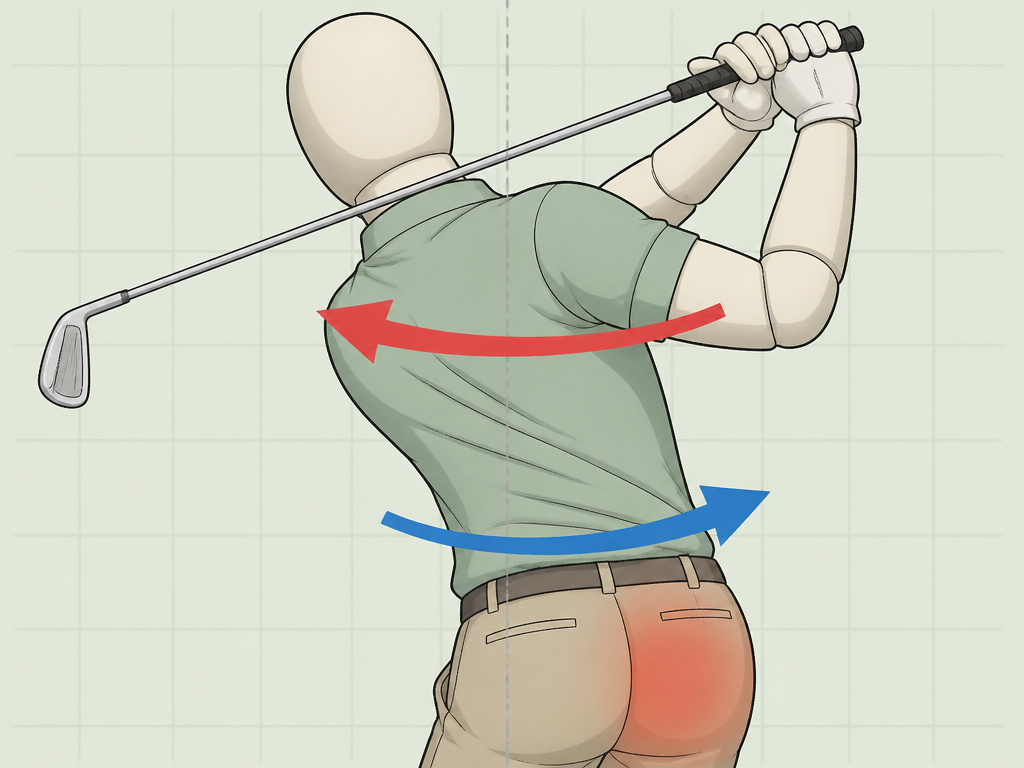
Your ideal focus depends on your current error. Use this table to diagnose.
| What You See/Feel | Likely Fault | Prescription & Drill | If You Skip It… |
|---|---|---|---|
| Short, armsy backswing; can’t feel a coil. | Restricted Hip Turn. Hips aren’t rotating enough to let the shoulders turn. | Increase rotation. Practice the Chair Drill (below). | You’ll never create sufficient X-Factor, forcing you to use only arm strength. Power plateaus. |
| Loss of balance; head moves away from target. | Excessive Hip Sway. Hips are sliding, not rotating. | Manage lateral movement. Practice with a wall or headcover outside your trail foot. | Your swing’s low point moves behind the ball, causing fats and thins. Consistency vanishes. |
| “Reverse Spine” – spine tilts toward target at top. | Fake Shoulder Turn. You’re forcing shoulders without hip participation. | Sync rotation. Focus on the backswing sequence where the hips lead the initial move. | You’ll hit weak slices or pulls as your body fights to get back to the ball. |
| Over-the-top downswing; early extension. | Insufficient Recentering. Hips haven’t moved toward target to start the downswing. | Lead with the lead hip. Work on the step drill or focus on the proper downswing sequence. | You’ll be stuck, forcing the arms to throw the club over the top. Power leaks left. |
Drill 1: The Chair Drill (For More Rotation)
Sit on the edge of a sturdy chair, feet flat, knees at 90 degrees. Hold a club across your chest. Make a backswing turn, focusing on rotating your hips and shoulders. Feel the pressure build in your trail glute. Your goal is to turn until your back is facing the target without lifting your feet. This isolates rotational movement and eliminates any chance to sway.
Drill 2: The Wall Drill (To Stop Sway)
Stand with your right hip and shoulder (for a righty) lightly touching a wall. Make slow-motion backswings. If you lose contact with the wall, you’re swaying away from the target. The correct feel is your right hip rotating into the wall, not sliding off it. This ingrains the sensation of rotation within a stable pelvic frame.
Translating Turn to Power: The Downswing Connection
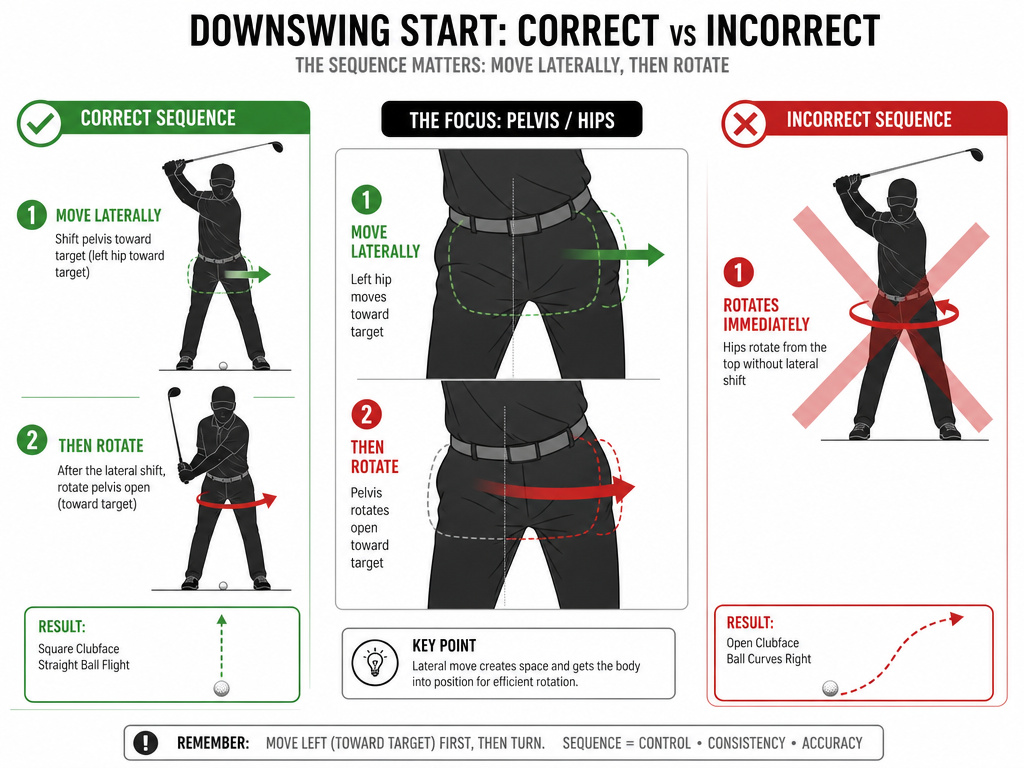
A great backswing turn is useless without the proper starting the downswing. The data from RotarySwing’s analysis of 72,000 coached swings is clear: coaching cues for proper lateral pelvis movement in the downswing have the highest success rate of any mechanical change.
The magic happens in transition. As your backswing finishes, your hips must begin moving laterally toward the target before they aggressively rotate open. This “recentering” moves your swing’s center forward, allowing your arms to drop into the “slot” and your hip rotation to unleash the stored energy.
Common mistake: Trying to spin the hips open from the top. This causes the dreaded “spin out,” where the pelvis rotates but doesn’t translate forward, leaving the upper body stuck behind. The ball starts right and curves further right.
The best-performing cue in the study was “drop into gravity,” framing the move as a passive squat rather than an active thrust. This connects directly to the weight shift, it’s a transfer of pressure into the lead leg, not a shove of the hips.
Frequently Asked Questions
Should I feel more hip turn or less?
If you have a short backswing, struggle with an over-the-top move, or have good flexibility, feel more turn. If you lose your posture, have too long a backswing (overswing), or are very flexible, feel a stable, controlled turn. There’s no universal answer.
Why do I keep losing my posture when I try to turn more?
This is often a core stability or mobility issue, not a technique flaw. You’re asking your spine to flex where your hips should rotate. Work on the Chair Drill and core engagement exercises first. The rotational swing is powered from the ground up, not the spine down.
Is “keeping your back to the target” good advice?
It’s an overcorrection for people who spin out early. For most, it’s harmful. Your shoulders should naturally begin to open before impact as a result of your downswing hip rotation. Forcing them to stay closed leads to a weak, blocked shot.
How does this relate to the swing plane?
Directly. Inadequate hip rotation often forces the arms to lift the club, creating a steep, narrow swing plane. Good hip turn allows the arms to work more around the body, promoting a wider, shallower plane that’s easier to deliver from the inside.
My coach says I have early extension. Is that a hip turn problem?
Often, yes. Early extension, hips thrusting toward the ball in the downswing, is frequently a compensation for a poor backswing turn. If you didn’t create enough space (rotation) going back, your body has to make space coming down, so it stands up. Fix the backswing to cure the downswing.
The Bottom Line
Stop thinking about shoulder turn and hip turn as separate levers to pull. They are parts of a single kinetic chain. Your goal is to create the greatest amount of tension between them that you can comfortably control, your personal X-Factor.
For the majority of amateur golfers, the fault isn’t too much hip turn; it’s the wrong kind of movement (sway) or not enough turn given their physical constraints. Work on pure rotation first, manage lateral motion second, and let the ratio emerge from a dynamic, athletic motion. The research from the PMC lumbar spine rotation study confirms the spine and hips are designed to work together. Let them.
Find your own efficient turn. That’s where power lives.
