
Swing Plane in the Backswing: Driver vs Iron Fundamentals
This post contains affiliate links. As an Amazon Associate, we earn from qualifying purchases.
This post contains affiliate links. As an Amazon Associate, we earn from qualifying purchases.
Your swing plane in the backswing is defined by three measurable variables: its tilt angle (steepness), its azimuth angle (horizontal orientation), and its root mean square error (consistency). A 2026 biomechanics study of low-handicap golfers found the driver’s backswing plane is about 10 degrees flatter than a 7-iron’s, achieved through greater torso and pelvis rotation.
That 10-degree gap is a quantified biomechanical adaptation to different club lengths and performance goals, pulled from motion capture data on skilled players. The driver needs room to build speed; the iron needs precision from a steeper angle.Chasing a picture-perfect, single-plane backswing for every club is how you introduce the very inconsistencies you’re trying to fix.
What follows: the three numbers that define your plane, the proven kinematic differences between your longest and mid-irons, and the two training priorities that stabilize both. This is the data from the lab, applied to your practice.
Key Takeaways
- Your driver backswing plane is approximately 10 degrees flatter than your 7-iron’s, a direct adaptation to the longer shaft.
- The backswing is not a single, rigid plane. Research shows the left arm, torso, and clubhead each trace separate but coordinated paths.
- Greater torso and pelvis rotation drive the flatter driver plane, while a steeper iron plane relies more on lateral tilt and posture control.
- A common flaw is forcing the clubshaft to stay on its address plane too long; skilled golfers naturally steepen the plane in the upper backswing.
- The goal isn’t a perfect plane but a consistent, repeatable one. Train for specific body movements, not an abstract shape.
The 3 Key Variables of a Backswing Plane
Forget the vague “swing on plane” advice. In biomechanical terms, your backswing plane is a three-dimensional reference surface fitted to your clubshaft’s path. It’s measured, not guessed.
Researchers use an algorithm called Singular Value Decomposition (SVD) to calculate the best-fit plane from hundreds of clubhead position points. This gives them three concrete variables.
The swing plane is defined as the best-fit reference plane derived from the shaft trajectory during the swing using singular value decomposition (SVD), representing the primary spatial orientation of the clubhead path rather than a literal planar movement trajectory.
First is tilt angle. This is the plane’s inclination relative to vertical. A 90-degree tilt is a vertical wall; a 0-degree tilt is the ground. Your actual backswing tilt for a mid-iron typically falls between 60 and 70 degrees. A flatter plane has a smaller tilt number.
Second is azimuth angle. This is the plane’s horizontal orientation relative to the target line. It tells you if your path is inside-out (negative azimuth), outside-in (positive azimuth), or square (near zero). This angle shifts dramatically between the backswing and downswing.
Third is Root Mean Square Error (RMSE). This number, in centimeters, quantifies how consistently your club follows the fitted plane. A lower RMSE means a tighter, more repeatable pattern. It’s the purest measure of swing plane consistency you have.
You can’t feel these angles. But you can feel the body movements that create them. Understanding the variables turns an abstract concept into a framework for diagnosis.
How Your Driver and Iron Backswings Actually Differ
They are different movements. Treating them the same guarantees one will be wrong.
The Frontiers biomechanics swing plane study from 2026 provides the clearest evidence. Using 3D motion capture on sixteen low-handicap golfers, it compared driver and 7-iron swings directly. The data is unambiguous.
| Biomechanical Factor | Driver Backswing | 7-Iron Backswing | Why It Matters |
|---|---|---|---|
| Average Tilt Angle | ~60.5 degrees | ~70.6 degrees | The driver plane is 10 degrees flatter, creating a wider arc for speed. |
| Torso Rotation ROM | Significantly Greater | Less | The driver demands more coil around the spine to manage the longer lever. |
| Pelvis Rotation ROM | Significantly Greater | Less | The hips must turn more to create space for the longer club to swing back. |
| Primary Correlation | Not strong in this phase | Strong negative link to torso/pelvis rotation | For the iron, less rotation directly creates a steeper plane. |
The driver’s mission is distance. The flatter plane, powered by greater shoulder turn and hip turn, lengthens the clubhead’s arc. This allows more time to accelerate. The study found the driver’s tilt angle was negatively correlated with lateral ground forces, meaning a flatter plane came from a more centered, rotational move rather than a big lateral slide.
The 7-iron’s mission is control and a steeper angle of attack. Its steeper plane is linked to less rotational range of motion. Instead, it uses more lateral torso tilt and a braced front side to set a consistent, vertical hitting path. Trying to rotate your iron like your driver often results in a flat, sweeping strike that lacks compression.
Bottom line: Your setup and intention should change with the club. For the driver, feel a bigger turn behind the ball. For the iron, feel your sternum stay more centered over the ball as you turn.
Why a “Single Plane” is a Biomechanical Myth
The dream of a perfect, fixed plane where your arms and club trace one exact circle is just that—a dream. The body doesn’t work that way, and the research proves it.
A pivotal 2007 study by Coleman and Rankin analyzed the “left-arm plane.” They found its angle to the horizon changed from 133 degrees at the start of the downswing to 102 degrees at impact. That’s a steepening of 31 degrees. More critically, the clubhead’s average distance from this left-arm plane was 0.291 meters at impact—about 11 inches. The club does not stay in the arm plane.
Where this goes sideways: Believing your club must stay on one rigid plane from start to finish. This leads to robotic, restricted arm movement and a loss of natural wrist hinge. The swing becomes all geometry and no athleticism.
Other research confirms this. The 2012 study by Mackenzie found that in a simulated normal swing, the club’s plane was, on average, 4.5 degrees flatter than the plane traced by the hands during the downswing. At impact, that gap widened to 11 degrees. Your hands and the club are on related, but different, planes.
This is why the single-plane swing popularized by Moe Norman is a specific technique, not a universal law. It minimizes these natural separations for extreme consistency, but it requires a specific setup and arm structure that most golfers don’t use.
For a conventional golfer, the goal is a “semi-planar” motion. Your body segments work in a coordinated sequence, not a locked track. The backswing sequence should feel connected, not identical.
The Most Common Backswing Plane Mistake (And the Fix)
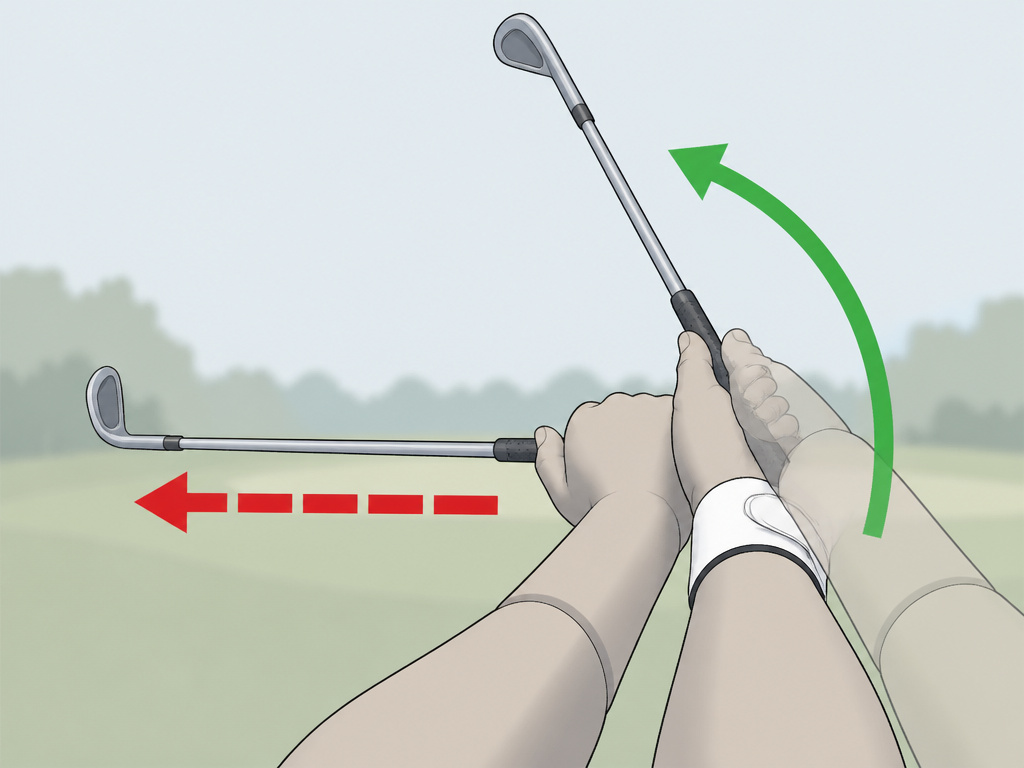
You’ve likely been told to keep the clubshaft on the same angle it had at address. For the first part of the takeaway, that’s fine. But trying to maintain that exact plane to the top is, in the words of one expert analysis, “physically/biomechanically impossible” for a full swing.
The mistake is a rigid, one-piece takeaway that prevents the necessary wrist hinge and natural re-routing of the club in the upper backswing. You end up with a flat, across-the-line position or a reverse pivot.
The fix is understanding the two-phase nature of a good backswing.
- The Initial Takeaway (First 12-18 inches): Here, the club, hands, and arms should move together as a unit, roughly maintaining the address plane. This is about initiating the backswing with your core, not your hands.
- The Setting Phase (To the Top): As your left arm reaches parallel to the ground, your wrists must begin to hinge upwards. This action naturally steepens the swing plane. Your right elbow folds, and the club moves more vertically. This is not a lift; it’s the natural result of a full shoulder turn against a stable lower body.
Common mistake: Keeping the clubshaft on its address plane too long. This forces the arms to separate from the body, creating a wide, flat, and powerless position at the top. The downswing becomes all arms.
To practice this, place a headcover just outside and behind the ball. Make slow-motion backswings, focusing on the clubhead moving straight back for the first foot, then gradually swinging up and over the headcover. You should feel your right elbow tuck and your left shoulder turn under your chin. This promotes the proper, dynamic plane shift that every good player uses.
How to Train Your Backswing Plane Effectively
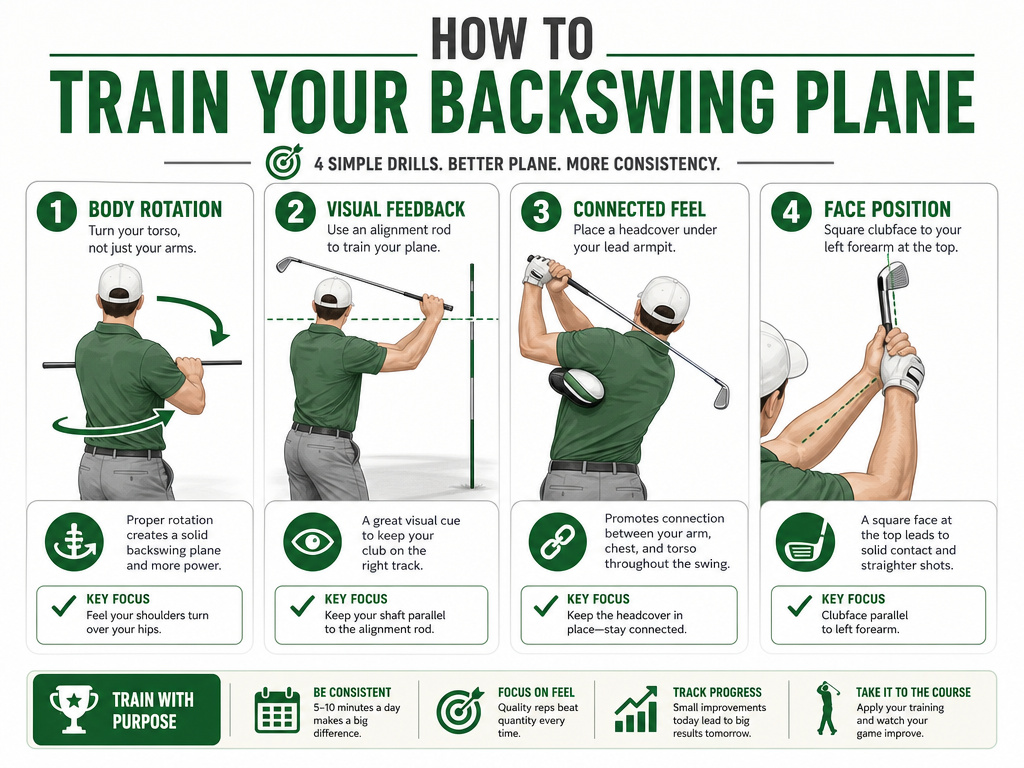
Training the plane means training the movements that create it. Don’t stare at a mirror trying to match a line. Work on the causes.
First, improve your body rotation. The Frontiers study directly linked greater torso and pelvis rotation to a flatter, more powerful driver plane. A simple drill: take your stance and hold a club across your chest. Make a backswing turn, focusing on turning your shoulders a full 90 degrees while your hips turn about half that. Feel your back face the target. This builds the coil that widens your arc.
Second, train consistency with feedback. This is where swing plane trainers like the PlaneMate or simple alignment rods shine. Place a rod in the ground at the approximate angle of your desired plane (steeper for iron, flatter for driver). Make slow swings, ensuring the clubshaft parallels the rod at the key checkpoints: halfway back and at the top. The goal isn’t perfection, but a reliable relationship.
| Training Tool | Best For | What It Fixes |
|---|---|---|
| Alignment Rod | Visualizing plane angle | Casting, over-the-top moves, overly flat or steep takeaway |
| Headcover Drill | Encouraging proper wrist hinge & plane shift | Dragging the club inside, lack of width at the top |
| Wall Drill | Feeling a steeper, more vertical plane | Flat, around-the-body swings with irons |
| Swing Trainer (e.g., PlaneMate) | Building muscle memory for a connected path | Disconnection between arms and torso |
Finally, know your clubface position at the top. A wildly open or closed face will force catastrophic plane adjustments on the way down. At the top, the leading edge of your clubface should roughly parallel your left forearm angle and your swing path. If you can see the clubface pointing skyward (wide open) or groundward (shut), you have face control work to do before plane work matters.
These tools give you physical sensations. The rod gives you a visual. Combine them in slow motion. Speed wrecks new patterns, so rehearse at 50% effort until the move feels automatic.
Frequently Asked Questions
What is the ideal swing plane for a driver?
There’s no universal ideal, but for a driver, research shows skilled players use a plane with a tilt angle around 60-62 degrees. This is about 10 degrees flatter than a mid-iron. The key is that it’s achieved through a full shoulder turn (over 90 degrees) and moderate hip turn, not by dropping the arms or sliding laterally.
How do I know if my swing plane is too flat or too steep?
Too-flat plane often results in deep divots with irons, pushes or hooks, and a lack of height on shots. You may feel like you’re swinging around your body. A too-steep plane typically causes thin or fat shots, slices, and a loss of distance. You’ll feel like you’re picking the club straight up and chopping down on it. Video from down-the-line is the best check.
Should I use a one-plane or two-plane swing?
This is a stylistic choice, not a correctness issue. A one-plane swing keeps the arms closer to the torso’s turning plane, popularized by Moe Norman. A two-plane swing involves a more pronounced arm lift relative to the shoulder turn, common in classic swings. Most modern athletic swings are hybrids. Choose based on what feels more powerful and repeatable for your body type.
Does swing plane change with different clubs?
Absolutely. As detailed in the research, your driver swing plane is measurably flatter than your 7-iron’s. Your wedges will be steeper still. Your setup—ball position, spine tilt, and stance width—should change to facilitate these different planes automatically. Don’t force the same move on every club.
What’s the relationship between swing plane and swing path?
They are closely related but distinct. Your swing plane is the 3D orientation of your club’s arc. Your swing path is the direction the clubhead is moving through impact (inside-out, outside-in, straight). Your plane influences your path, but face control is equally critical. You can have a perfect plane and still hit a slice if the face is open.
The Bottom Line
Your swing plane in the backswing is a dynamic, club-specific motion born from how you pivot and set your wrists. The data is clear: demand more rotation for a flatter driver plane, and accept a steeper, more controlled turn for your irons.Stop chasing a single, frozen picture. Instead, train for the two things that matter—a full, strong turn and a consistent hinge. That’s what builds a repeatable plane, not staring at a line on a screen. Groove the movement, and the shape takes care of itself.
