
Understanding the Types of Golf Bunkers & Essential Rules
This post contains affiliate links. As an Amazon Associate, we earn from qualifying purchases.
A golf bunker is a specially prepared area of sand, defined as one of the five areas of the course under the Rules of Golf. The main types are fairway, greenside, pot, cross, and waste bunkers, each placed to create specific strategic challenges. Knowing which type you’re in changes everything, grounding your club in a standard bunker costs a stroke, but in a waste area, it’s legal.
That definition from the USGA and R&A is the official line. Where it gets real is in the details they print on the scorecard and the local rules sheet. A “specially prepared area” means someone decided where the sand starts and the grass ends, and that decision cost Dustin Johnson a major championship.
What follows breaks down the five bunker types you’ll actually face, the one common sandy area that isn’t a bunker at all, and the construction specs that decide whether your lie is firm or plugged. By the end, you’ll read a hole differently, as a series of questions the architect is asking you about grass and sand.
Key Takeaways
- Waste bunkers are not bunkers under the Rules. You can ground your club and remove loose impediments. Confusing one for a standard bunker led to a famous two-stroke penalty at the PGA Championship.
- Sand depth dictates your lie. The USGA recommends 4-6 inches in the base. Shallow sand lets your club dig to the liner; deep, fluffy sand can bury your ball.
- Bunker placement is a question. A fairway bunker asks, “Did you hit your target?” A greenside bunker asks, “Do you have the touch to get up and down?”
- Rule 12 restrictions are specific. You cannot touch the sand with your club before your stroke in a standard bunker, but you can smooth footprints after playing.
- Environmental factors change everything. A north-facing or shaded bunker stays wet and firm long after a south-facing one has dried out and softened.
The 5 Main Bunker Types (And One That Isn’t a Bunker)
Forget just “fairway” and “greenside.” Architects use bunker types as vocabulary. Each one poses a different question and demands a different answer in your strategy. Good golf course architecture uses this vocabulary deliberately.
| Bunker Type | Primary Location | The Strategic Question | Key Rule Status |
|---|---|---|---|
| Fairway Bunker | Alongside or within the fairway landing zone | “Did you hit your target with your tee shot?” | Standard Bunker (Rule 12 applies) |
| Greenside Bunker | Immediately adjacent to the putting green | “Do you have the short-game skill to recover?” | Standard Bunker (Rule 12 applies) |
| Pot Bunker | Anywhere, classic on links courses | “Can you escape laterally, or are you taking your medicine?” | Standard Bunker (Rule 12 applies) |
| Cross Bunker | Perpendicular across the fairway | “Can you carry this hazard, or will you lay up?” | Standard Bunker (Rule 12 applies) |
| Waste Bunker | Often along fairway edges, large natural areas | “Can you execute from an unpredictable, sandy lie?” | General Area (No special restrictions) |
The “waste bunker” entry is the critical one. Under the official rules, it’s not a hazard. It’s just a sandy part of the general area. This isn’t semantics, it cost Dustin Johnson the 2010 PGA Championship. At Whistling Straits, a local rule declared all sandy areas as bunkers. He grounded his club in what he thought was a waste area on the 72nd hole, took a two-stroke penalty, and lost by one. Always check the local rules.
Where this goes sideways: Assuming all sand is created equal. Ground your club in a standard bunker before your stroke, and it’s a one-stroke penalty. Do it in a waste area, and it’s fine. The difference is printed on the scorecard.
Greenside bunkers are the most frequent test for amateurs. They demand a precise, high-lofted shot that carries the lip and lands softly. The average tour pro gets up and down about 50% of the time. For a 15-handicap, that number drops to maybe 20%. That’s why placement is everything, a bunker short of the green punishes the timid player; one behind the green punishes the overly aggressive.
Pot bunkers are the architects’ exclamation point. Small, deep, and often with steep sod walls (called revetted faces), they offer no chance at a greenward shot. Your only play is out sideways, adding a sure stroke to your score. They are the definition of a penalty hazard.
Bunker Design & Strategic Purpose
Bunkers are the punctuation marks in a hole’s sentence, placed to guide, challenge, or punish rather than being random decorations. Understanding their purpose turns a frustrating hazard into a readable piece of the course design puzzle.
A fairway bunker’s job is to narrow your focus. It creates a visible boundary for the ideal landing zone. If it’s on the right, it’s telling you to favor the left side of the fairway. The strategic response isn’t always to avoid it at all costs, sometimes playing close to it opens up the best angle into a dogleg green. This is the essence of target golf: risk versus reward, mapped out in sand and grass.
Cross bunkers are a different test entirely. They force a carry. You’ll see these on par-5s or long par-4s, asking if you have the distance to reach the green in regulation or if you must lay up. They make a player think two shots ahead, which is the hallmark of good design.
The part nobody mentions: A bunker’s psychological impact often outweighs its physical difficulty. A visually intimidating bunker, even with a shallow face, will steer more players away than a deep but hidden one. Architects use flashy, white sand and high lips to make hazards look scarier than they play.
My hard-won rule is that if you can’t consistently visualize a shot shape to avoid a hazard, that bunker is doing its job perfectly. It’s creating doubt. And doubt leads to defensive swings, missed targets, and, ironically, more balls in the sand. The best way to neutralize a bunker is to have a clear, committed plan before you stand over the ball.
Official Rules: Playing from the Sand
The moment your ball crosses the margin of a standard bunker, Rule 12 takes over. This rule exists, as the R&A states, “to make sure the player confronts this challenge.” The restrictions feel picky, but they’re there to prevent you from improving your lie in the hazard.
Here’s the short list of what you cannot do in a bunker before making a stroke: * Test the condition of the sand with your hand or club. * Touch the sand with your club during a practice swing. * Ground your club behind the ball (letting the clubhead rest on the sand). * Touch the sand when addressing the ball (except as needed to keep your balance).
What you can do often surprises players: * Remove loose impediments like leaves, stones, or twigs. * Smooth the sand with your feet or a rake after you’ve played your shot (this is basic bunker etiquette). * Lean on your club for balance, provided you don’t press it into the sand.
Violations aren’t subtle. Touch the sand with your club on a practice swing? That’s a two-stroke penalty in stroke play. Ground your club behind the ball? One stroke. These penalty strokes add up fast and are entirely avoidable.
Worth knowing before you start: If your ball is unplayable in a bunker, you have a new option. You can take relief outside the bunker by going back on the line, but it will cost you two penalty strokes. This rule changed to prevent the nightmare scenario of a player endlessly playing from the same buried lie.
The USGA bunker rules overview and the R&A’s documentation are the final word. When in doubt during a casual round, apply the strictest interpretation. It keeps things simple and prepares you for when the strokes actually matter.
Bunker Construction & Maintenance
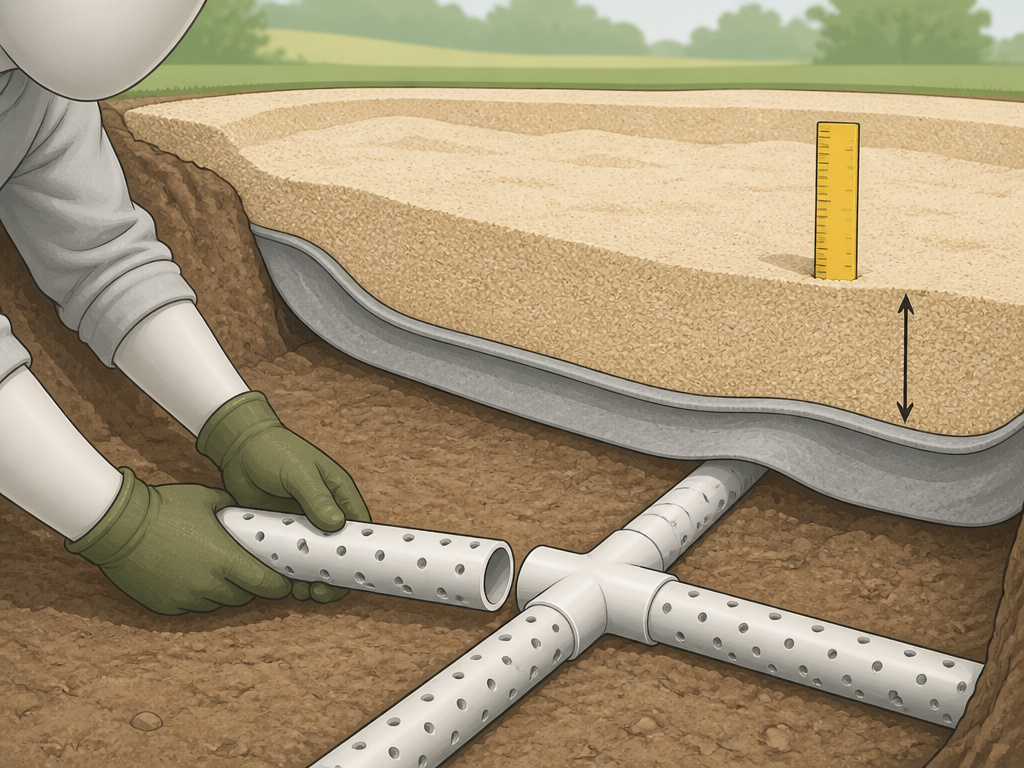
What you experience in a bunker, the firmness, the lie, whether the ball plugs, results from specific construction choices and maintenance routines. The USGA recommends an average sand depth of 4 to 6 inches at the base and 2 to 3 inches on the faces.This depth allows for an explosion shot without the club digging into the liner or subsoil.
A bunker is more than a hole with sand. It’s a engineered system: 1. Excavation: The shape is dug, with slopes designed to shed water. 2. Drainage: A network of 4-inch perforated pipes is laid in a herringbone pattern at the base to channel water away. 3. Liner: A layer (often a fabric like SandTrapper II or a rigid system like Capillary Concrete) is installed to separate sand from soil, prevent washouts, and aid drainage. 4. Sand: The chosen sand is installed to the specified depth. Angular sand creates firmer conditions; rounded sand is softer and more prone to plugging.
This system needs constant care. Bunker faces erode from rain and foot traffic. Sand gets contaminated with silt and organic matter over time, losing its drainage properties. That’s why most courses undertake a full bunker renovation every five to seven years, a process that involves stripping out the old sand, repairing drainage and liners, and refilling with fresh material.
The type of golf course grass surrounding the bunker also affects maintenance. Grass with aggressive rhizomes can quickly grow into the sand edge, blurring the margin between the hazard and the general area. A clean, defined edge is a sign of a well-kept course.
Less Common & Regional Bunker Variations

The standard bunker types cover 95% of what you’ll see. But golf is a global game, and local conditions breed unique variations. Knowing these edge cases helps you adapt your strategy and appreciate course design.
Grass Bunkers: These are exactly what they sound like, deep depressions around a green, but filled with grass instead of sand. They play like a particularly nasty patch of rough. No special rules apply; you can ground your club, take practice swings, and play it as part of the general area. They offer the visual intimidation of a bunker without the technical sand shot.
Environmental Factors: The sun and the water table are silent bunker superintendents. * A north-facing bunker (in the Northern Hemisphere) gets less direct sun. It stays wet, firm, and compacted longer than a south-facing one. * A shaded bunker under trees dries out slowly and remains firm. * A bunker in a low-lying area near the water table may always feel saturated, even with perfect drainage.
These conditions change how your ball reacts and how you should play the shot. A firm, wet sand lie often calls for less aggressive swing, the ball will come out lower and with more roll.
Regional Styles: In New Zealand, you might find Ponga-faced bunkers, which use the trunks of native tree ferns to create a stunning, natural-looking revetted face. It’s a brilliant use of local materials that shapes both the challenge and the character of the course. Recognizing these touches is part of the joy of the game.
Frequently Asked Questions
What’s the difference between a bunker and a sand trap?
“Bunker” is the official term used in the Rules of Golf. “Sand trap” is casual slang that means the same thing to most golfers, but you won’t find it in any rulebook. Using “bunker” is always correct.
Can you ground your club in a waste bunker?
Yes. A waste bunker is not a hazard under the rules; it’s part of the general area. You can ground your club, take practice swings that touch the sand, and remove loose impediments. Always confirm with local rules, as some courses may define them differently.
Why do some bunkers have steep faces and others are shallow?
Steep faces (often sod-walled or “revetted”) are a design choice to increase penalty. They are harder to maintain and require more skill to escape. Shallow, flashed faces are more modern, easier to maintain with mechanical rakes, and often allow for more recovery shots. The style is a clue to the course’s architectural philosophy.
What is the proper etiquette for raking a bunker?
After playing your shot, use the provided rake to smooth over your footprints and divot. Rake from the inside out, walking backward toward the exit so you don’t leave new footprints. Leave the rake outside the bunker, parallel to the line of play. This is a fundamental part of good pace of play and course care.
What club should I use from a fairway bunker?
The general rule is to take enough loft to clear the bunker’s lip. For most players, that means a club or two more than you’d normally hit from that distance. Your priority is clean contact, hitting the ball first, not the sand. This is where understanding your wedge bounce becomes critical for greenside shots.
The Bottom Line
Bunkers are the soul of a golf course’s strategy. They are the physical manifestation of the questions an architect asks on every hole. Learning to read them, knowing a pot bunker demands a sideways escape, a waste area allows a practice swing, and a shaded face will be firm, turns a random penalty into a calculated part of your game.
One rule most guides skip: if you find yourself in a bunker more than three times a round, the problem is your target selection. Bunkers are there to define the correct line.Start aiming for the side of the fairway or green they’re not guarding. Your scores will drop faster than your time spent raking.
Good golf should feel less complicated the more you understand it. And understanding begins with knowing what you’re standing in.
