
Iron vs Driver Swing Differences for Better Ball Striking
This post contains affiliate links. As an Amazon Associate, we earn from qualifying purchases.
This post contains affiliate links. As an Amazon Associate, we earn from qualifying purchases.
The iron swing vs driver swing differences come down to three measurable biomechanical shifts: a flatter swing plane driven by torso rotation for the driver, a steeper plane controlled by posture for the iron, and a complete reversal in how you use the ground for power. A 2026 Frontiers in Bioengineering study found the driver’s swing plane tilt angle is significantly smaller, and its reliance on rear-foot ground force is 37-62% greater during the downswing.
That gap is practical, explaining why a good iron player can struggle off the tee, and vice versa. You’re not making a minor adjustment; you’re executing two distinct athletic motions with the same body.
What follows breaks down the peer-reviewed kinematics, the setup non-negotiables each club demands, and the training focus that actually transfers. By the end, you’ll know why forcing an iron swing onto a driver costs 20 yards before you even make contact.
Key Takeaways
- The driver demands a flatter swing plane built on torso and pelvic rotation; the iron requires a steeper, more vertical plane held by posture and front-side braking.
- Your angle of attack must be positive with a driver (hitting up) and negative with an iron (hitting down) to optimize launch conditions for each club’s design.
- Ground force use flips: the driver loads into the rear foot to push horizontally for speed; the iron shifts weight forward early to compress the ball.
- Swing weight is individual, but data shows an optimal point: too light loses awareness, too heavy kills speed. It’s a feel metric, not a universal rule.
- Training transfer is limited. Drills that ingrain the driver’s rotational sweep often wreck the iron’s descending blow, so you must practice them separately.
The Core Biomechanical Split: Driver vs Iron
Forget “one swing” theory. The physics of each club mandate a different movement pattern. The data from motion-capture studies paints a clear, non-negotiable picture.
A Frontiers in Bioengineering biomechanics study using 3D motion capture on low-handicap golfers quantified the split. The driver’s swing plane tilt angle, its inclination relative to vertical, was significantly smaller than the 7-iron’s across all swing phases. The driver’s plane is flatter; the iron’s is steeper. This requirement stems from the driver’s longer shaft (46 inches vs. 37 inches for a 7-iron) and lower loft (9-10.5 degrees vs. 34 degrees).A flatter plane lets the longer club travel a wider arc, maximizing clubhead speed.
The driver showed a significantly smaller tilt angle than the 7-iron across all phases (p < 0.001), and a significantly smaller azimuth angle during the release-acceleration phase. The driver relies on rotation of the torso and pelvis to create a flat swing plane, while the 7-iron maintains a steep and highly consistent plane through body posture control.
This fundamental difference in plane dictates everything else: where you play the ball, how you shift your weight, and even what your practice should look like.
| Biomechanical Factor | Driver Swing | 7-Iron Swing | Why It Matters |
|---|---|---|---|
| Swing Plane | Flatter (smaller tilt angle) | Steeper (larger tilt angle) | Driver arc is wider for speed; iron arc is steeper for compression. |
| Primary Power Source | Torso & pelvic rotation, rear-side ground push | Posture control, front-side ground braking | Driver builds rotational momentum; iron delivers a controlled strike. |
| Angle of Attack | Positive (+3 to +5 degrees) | Negative (-4 to -6 degrees) | Driver launches ball upward; iron drives ball downward for spin and stop. |
| Weight Shift Peak | Later in downswing, retains rear-side load | Early in downswing, aggressive forward shift | Delayed shift extends acceleration; early shift ensures ball-first contact. |
The short version: Trying to swing a driver like an iron creates a steep, narrow arc that robs speed and promotes a slice. Swinging an iron like a driver leads to thin, scooped shots with no spin. The clubs are different tools. You must use different techniques.
How Your Body Actually Adapts: Kinematics and Ground Force
The swing plane difference involves how your entire kinetic chain, from your feet to your hands, reorganizes to produce the club’s path. This is where the “feel” of each swing diverges dramatically.
The Driver’s Rotational Engine
The driver swing is a slow-burn power build. The NCBI PubMed Central biomechanics article notes its characteristics are “slow-paced energy accumulation, delayed acceleration, and horizontal sweeping shots.” Your body achieves this by maximizing rotation.
- Torso and Pelvis: The same Frontiers study found the driver exhibited greater torso and pelvic rotation range of motion than the 7-iron during the backswing. You’re creating a bigger coil.
- Ground Reaction Force (GRF): This is the critical data point. The driver generates significantly greater anterior-posterior force (front-back force) from the rear foot during key downswing phases (0-5%, 37-62%, and 83-89% of the swing cycle). You’re pushing off the ground horizontally with your back foot to drive rotation and extend the arc.
Where this goes sideways: Restricting your hip turn because it “feels too long” with the driver. That restriction kills the coil and forces you to use only your arms, losing the kinematic sequence that delivers power. You’ll lose 15-20 mph of clubhead speed before you start.
The Iron’s Postural Brake
The iron swing is a compact, controlled strike. The research states the 7-iron’s characteristics are a “compact transition and precise shots driven by the torso.” Control, not max rotation, is king.
- Posture and Tilt: The 7-iron swing maintains a more consistent spine angle and a steeper torso side tilt. You’re not rotating around a single axis as much as you are pivoting down into a firm front side.
- Ground Reaction Force (GRF): The force pattern flips. The iron relies more on medial-lateral force (side-to-side force) and uses the front side as a brake. The weight shifts forward aggressively early in the downswing. Your lead leg becomes a solid post to swing down and through against, creating the descending blow.
The feel difference is stark. A good driver swing feels like an athletic, rotational throw. A good iron swing feels like a firm, descending punch. Confusing these feels is the root of most long-game inconsistency.
The Setup Non-Negotiables: Ball Position, Stance, and Posture
You cannot execute the different biomechanics from the same address position. The setup differences are the foundation, not minor tweaks. Get these wrong, and the rest of the swing is a compensation.
Here’s the breakdown for a right-handed golfer:
-
Ball Position: This is the prime directive.
- Driver: Play the ball off your front heel (or even inside your left heel). This allows you to catch the ball on the upswing, creating a positive angle of attack and optimal launch.
- 7-Iron: Play the ball in the center of your stance. This ensures your club is descending at impact, compressing the ball against the turf for spin and control.
- Skip this, and you’ll fight impact all day. A forward ball position with an iron guarantees fat or thin shots.
-
Stance Width & Posture:
- Driver: Wider stance (outside shoulder width). More tilt away from the target (spine tilted to the right). This creates a stable base for rotation and encourages the sweeping, upward path.
- 7-Iron: Narrower stance (roughly shoulder width). More athletic, neutral spine tilt. This facilitates the downward strike and controlled turn.
-
Tee Height (Driver Only): This is a club-specific skill. The correct tee height for a driver is when the top half of the ball is above the crown of the driver head at address. Too low promotes a negative angle of attack; too high increases the chance of a skyball.
The Equipment Conversation: Loft, Shaft, and Swing Weight
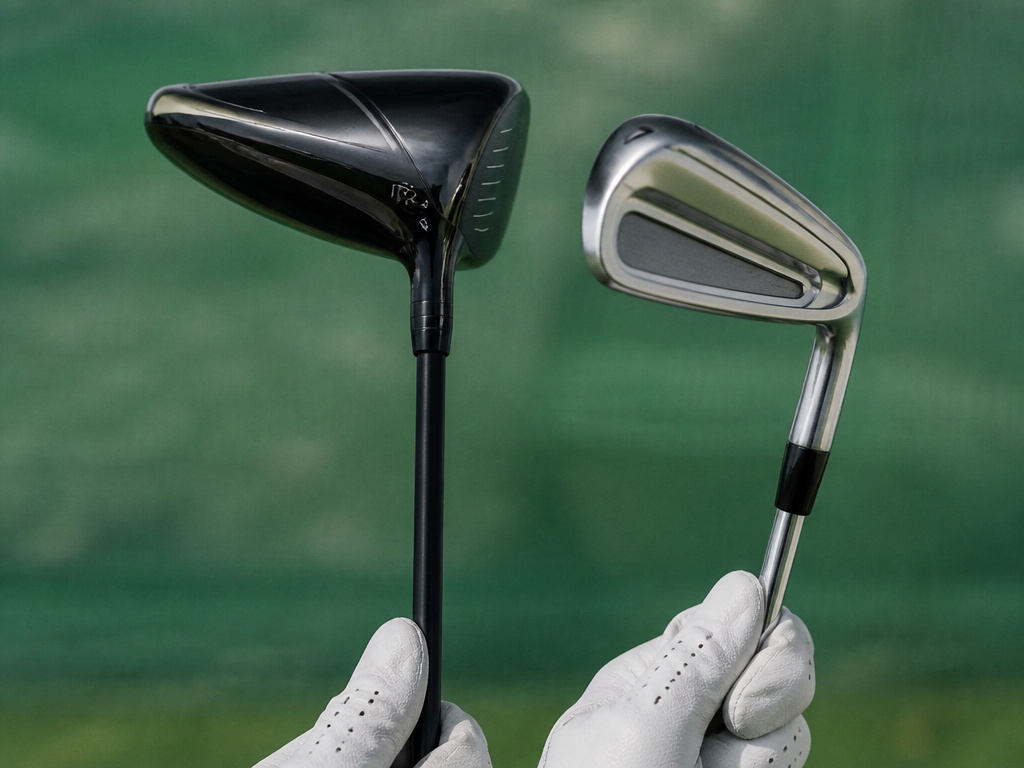 The biomechanical differences are partly a response to the equipment in your hands. Understanding the gear reinforces why the swings must differ.
- Driver Loft vs. Iron Loft: Modern driver loft (9-12 degrees) is designed for launch and carry. You must hit up to maximize it. A 7-iron’s loft (approx. 34 degrees) is designed for trajectory and spin, delivered with a downward blow. The purpose of driver loft is fundamentally different from iron loft.
- Shaft Length and Flex: The driver’s 45+ inch shaft demands a wider arc and earlier release. Its shaft flex must match your transition tempo to load and unload properly. An iron’s shorter, stiffer shaft allows for later release and more precision. Using a driver flex that’s too soft can exaggerate the flat plane into an over-the-top loop.
- Swing Weight: This is the club’s balance point (e.g., D2, D4). The swing weight concept is about feel, not raw weight. The research from independent testing is clear: there’s an individual optimum. One golfer gained 4 mph ball speed at D4.5 versus C8, but lost control at D8. It’s not “heavier is better.” It’s about finding the weight that gives you awareness without slowing you down.
Common mistake: Chasing a driver swing weight because a pro uses it. Your optimum is personal. A weight that gives a tour pro feel might make your transition jerky and late. Test on a launch monitor; don’t guess.
Training Each Swing: Why “One Size Fits All” Drills Fail
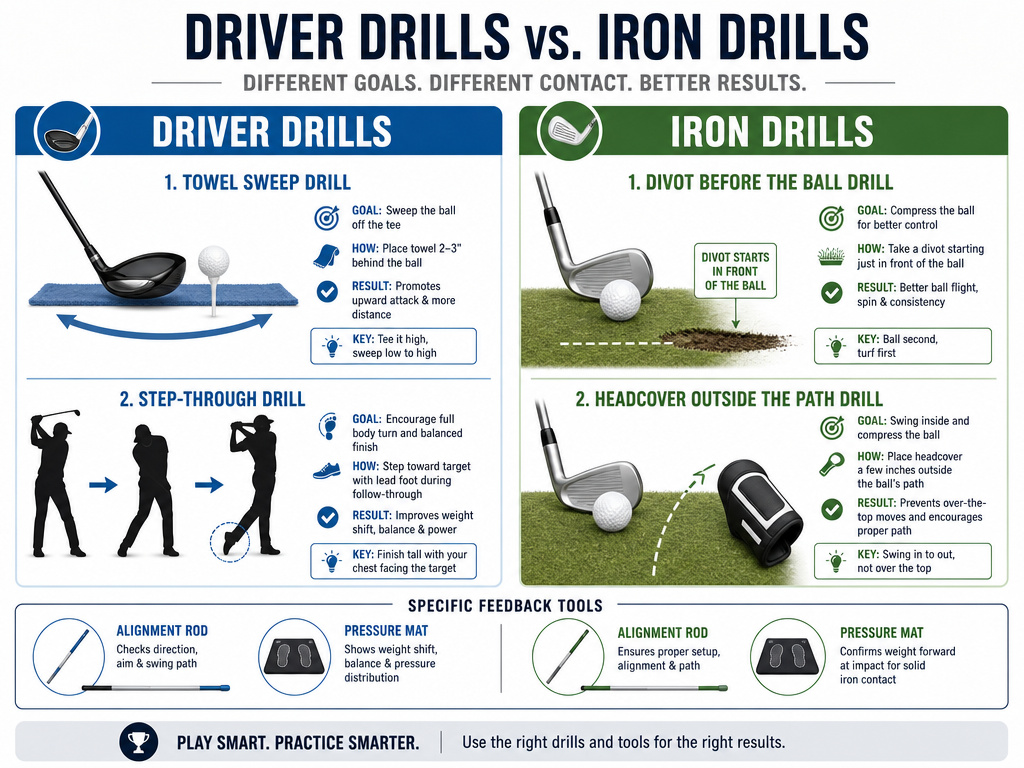 Because the motor patterns are distinct, your practice must be intentional. Drills that improve your driver swing mechanics can actively harm your iron play, and vice versa.
For the Driver (Train Rotation and Low Point Control):
- The Towel Drill: Place a towel just behind the ball (toward your feet). Focus on sweeping the ball away without touching the towel. This ingrains the upward strike.
- The Step-Through Drill: Hit drives finishing with your rear foot stepping forward toward the target. This encourages full rotation and prevents hanging back.
For the Irons (Train Compression and Forward Shift):
- The Divot-in-Front Drill: Place a tee in the ground just in front of the ball. Your goal is to hit the ball and then the tee, taking a divot that starts after the ball’s position.
- The Headcover Drill: Place a headcover just outside and behind the ball. An inside-out, descending strike will miss it; an over-the-top, sweeping strike will hit it.
The tools you use matter. Invest in swing aids that give specific feedback. A simple alignment rod can check swing plane. A pressure mat can show your weight shift. The best trainers for swing improvement are those that provide unambiguous feedback on the specific parameter you’re working on, plane for driver, strike location for irons.
Frequently Asked Questions
Should my driver and iron swing feel the same?
No. They should feel fundamentally different. A driver swing should feel like a powerful, rotational sweep. An iron swing should feel like a controlled, descending punch. If they feel the same, you are likely sacrificing efficiency in one or both.
What is the biggest mistake amateurs make mixing up the swings?
The most common error is using an iron swing, with its steep angle of attack and early weight shift, with the driver. This leads to low, spinning drives that lack carry and often slice. The second is trying to “sweep” or “pick” irons cleanly, resulting in thin, weak shots with no stopping power.
How does swing plane change with other clubs, like fairway woods or hybrids?
Fairway woods and hybrids blend the techniques. A 3-wood swing is closer to a driver’s but slightly steeper. A hybrid swing is closer to an iron’s but slightly flatter. Understanding the distinct roles of driver and iron gives you the endpoints of the spectrum; other clubs fall somewhere in between based on their loft and intended use.
Can I use the same swing thought for driver and irons?
You can have a universal thought for tempo or sequencing (e.g., “smooth transition”). But for swing shape and impact, you need different thoughts. For driver: “Sweep it off the tee.” For irons: “Pinch the ball into the turf.”
Do professional golfers have two completely different swings?
They have one athletic motion adapted to two different tasks. Their biomechanical differences in the golf swing are as pronounced as the study data shows, but they are so well-practiced that the adjustments are automatic. Their practice is highly segmented: driver work focuses on rotation and launch, iron work on strike and trajectory.
Before You Go
The iron swing vs driver swing differences aren’t just tips; they are documented biomechanical facts. The driver is a rotational engine that uses the ground to push for width. The iron is a postural hammer that uses the ground to brace for a descending blow.
Trying to force one pattern onto the other is the fastest way to create a two-way miss. Practice them as separate skills. Use the setup differences to force the correct mechanics, ball forward for the driver, ball center for the iron. Let the equipment design guide you: hit up with low loft, hit down with high loft.
Your game improves when you stop looking for one magic move and start executing the two specific moves the clubs demand.
