
The Definitive Guide to Perfect Putting Alignment and Aim
This post contains affiliate links. As an Amazon Associate, we earn from qualifying purchases.
Putting alignment and aim is matching three things: your putter face angle, your eye position, and a consistent pre-shot routine. A face angle error of just two degrees at impact misses a 10-foot putt. The best putters in the world deliver the face within half a degree of their intended line, a standard supported by data from systems like SAM PuttLab.
That half-degree window is the entire game. It’s why tour pros spend more practice time on alignment than any other putting fundamental. The good news is the mechanics are straightforward, face, eyes, routine. The hard part is trusting what you see, because your own visual perspective is the most common source of error.
What follows: the peer-reviewed data on what alignment aids actually work, the physical setup that guarantees a square face, the training tools that give you instant feedback, and the one common fitting adjustment that can make your aim worse.
Key Takeaways
- Putter face alignment matters more than ball alignment. A 2021 study found putter alignment was higher for a 3-line putter than a 1-line putter, while the number of lines on the ball made no statistical difference.
- Your eye position dictates everything. If your eyes are outside the ball at address, the putter face will look square when it’s actually aimed left (for a right-handed golfer). This visual distortion is the root cause of most chronic mis-alignments.
- Launch monitor data sets a hard benchmark: for reliable analysis, systems like the Foresight Sports GCQuad require alignment within a 1° tolerance. Amateurs often play with 3–4 degrees of error.
- A consistent pre-shot routine that includes an intermediate target is non-negotiable. It transfers your read from the hole to a spot 6–12 inches in front of your ball, making the final aim a simple, short-distance task.
- Lie angle adjustments during a putter fitting can inadvertently hurt alignment for some players. If you get fit, verify your aim after any bend.
What the Research Actually Says About Lines and Aids
You see a thousand options: putters with one line, three lines, dots, or nothing. Balls with single or triple lines. Does any of it help?
A 2021 study in the Medical Hypothesis, Discovery & Innovation in Optometry journal put it to a test with 43 golfers. The researchers measured alignment errors at 1.5 and 3 meters using different combinations of putters and balls with 1 or 3 aiming lines.
The accuracy of ball alignment was not affected by the golfer’s career (beginner vs. Expert) or the number of aiming lines on the ball. Putter alignment was higher for the 3-line putter than for the 1-line putter. Aiming accuracy was highest when the number and shape of aiming lines were the same for both the ball and putter.
The ball’s lines didn’t move the needle. The putter’s lines did. And consistency between the ball and putter lines yielded the best results. This tells you where to focus your attention and budget.
| Alignment Element | What the Data Says | Practical Takeaway |
|---|---|---|
| Putter Aiming Lines | 3-line putters produced higher alignment accuracy than 1-line putters. | More visual cues on the putter head help square the face. A mallet with a long line and a forward dot (like Ping’s Eye Q tech) is optimal. |
| Ball Aiming Lines | Number of lines showed no statistically significant effect on alignment accuracy. | Don’t spend a premium on triple-line balls for alignment purposes. Use any line to point at your intermediate target, then forget it. |
| Visual Consistency | Accuracy peaked when ball and putter line count matched. | If your putter has a single line, use a ball with a single line. Mixing cues can create visual conflict. |
The study also noted that predicted putting success and subjective satisfaction increased with the three-line combination. Feeling confident over the ball is a performance factor all by itself.
This is where a putter like the Ping Scottsdale TEC series shines. Its Eye Q alignment technology uses a long black line with a distinct focal dot at the front. Eye-tracking tests showed this design quiets the gaze and extends the “Quiet Eye” period, the final, steady visual fixation before the stroke that’s linked to elite performance.
For practice, the most effective alignment aids are those that give you objective feedback. A simple alignment stick laid on your target line is a tour-pro staple.
The 1-Degree Tolerance That Decides Makes and Misses
How precise do you need to be? The industry standard for high-level fitting and instruction gives you a number.
Foresight Sports, maker of the GCQuad launch monitor, specifies in its Essential Putting Analysis guide that for the best results, the system’s alignment stick must be set with a 1° tolerance in either direction. This isn’t a suggestion; it’s the error margin their technology is built around.
Where this goes sideways: Ignoring this benchmark in your own practice. If a $20,000 launch monitor demands 1° precision for valid data, your practice should aim for the same. Amateur face angle error is typically three to four times larger.
That 1° window is tiny. Over a 10-foot putt, a face angle that’s 1 degree open pushes the start line about 2.5 inches right of the target. At 2 degrees open, you’re 5 inches off-line, missing the hole entirely if your read was perfect.
This is why the best putting aids are feedback tools. They don’t just show you the line; they show you your error. A putting mirror tells you if your eyes are inside or over the ball. A laser-attached putting tool shows exactly where your face is pointing at address. Without this feedback, you’re guessing.
The geometric reality is unforgiving. As outlined in The Geometry of Putting on a Planar Surface, for putts within 10-15 feet, the target is a small “diamond” above the hole. Miss your start line by an inch or two and you’re relying on luck, not skill.
How to Check Your Eye Position (and Why It’s Non-Negotiable)
Before you worry about your putter’s lines, fix your eyes. This is the most common and correctable flaw in amateur alignment at address.
If you’re right-handed and your eyes are positioned outside the ball (toward your right foot), the putter face will appear square when it’s actually aimed left of your target. Your brain compensates by unconsciously aiming the face right during your setup. The result is a push or a manipulated stroke.
The fix is mechanical and simple.
- Use a putting mirror. Place it on the ground, set a ball on the marker, and take your stance. Look down. The mirror shows a line where your eyes should be, directly over or just inside the ball.
- Feel the correct position. Your shoulders should feel level, and your head should be able to turn toward the hole without tilting. If you have to tilt your chin down to see the ball, your eyes are too far inside.
- Make it repeatable. Build a trigger: let your arms hang naturally, then bend from your hips until your eyes find the spot. Do this every time.
This single adjustment does more for your ability to aim than any new putter purchase. It removes the visual distortion that corrupts your entire perception of the target line.
Common mistake: Setting the putter down after you’ve taken your stance. Your feet and body dictate where the club goes, which is usually offline. Reverse the order.
Your routine should be: read the putt, pick an intermediate target, walk in and set the putter face square to that target, then build your stance around the club. This putting setup sequence forces the face to be the leader.
Putter Fitting: The Alignment Trade-Off Nobody Mentions
Getting fit for a putter is smart. Length, loft, and lie angle matter. But there’s a caveat buried in Odyssey’s own Putter Fitting System guide that most fitters won’t highlight.
The guide states: “Lie angle changes can affect alignment for some players.”
Most Odyssey putters can be bent 2 degrees upright or flat. If you tend to miss left, a fitter might add toe hang or flatten the lie. If you miss right, they might go more face-balanced or upright. The problem is that changing the lie angle alters how the head sits on the ground and, critically, how the alignment markings appear to your eye from your address position.
I’ve seen players leave a fitting with a putter that feels perfect on the robot but aims 3 inches left on the practice green. The bend changed the visual relationship between the top line and the ball.
If you undergo a fitting, insist on a final verification step. After the fitter makes any lie adjustment, use a laser training aid or have them check your aim with their own laser. Your naked eye cannot be trusted to adapt to the new geometry immediately. A proper putting grip and stance built on a faulty visual will fail every time.
| Fitting Adjustment | Intended Correction | Alignment Risk |
|---|---|---|
| Flattening Lie Angle | Reduce a left-miss tendency (for RH golfers). | Can make the toe sit up, causing the alignment line to point left of where the face is actually aimed. |
| Upright Lie Angle | Reduce a right-miss tendency (for RH golfers). | Can make the heel sit up, causing the alignment line to point right of the true face aim. |
| Adding Toe Hang | Help a player who pulls putts. | Changes the head’s balance, which can feel different and disrupt the stroke path that supported your original alignment. |
The goal is a putter that you can aim consistently. If an adjustment makes the head harder to square visually, it’s a net loss. This is why simple, high-MOI mallets with clear lines are so popular on tour, they minimize variables.
Your 15-Second Pre-Shot Routine for Perfect Aim
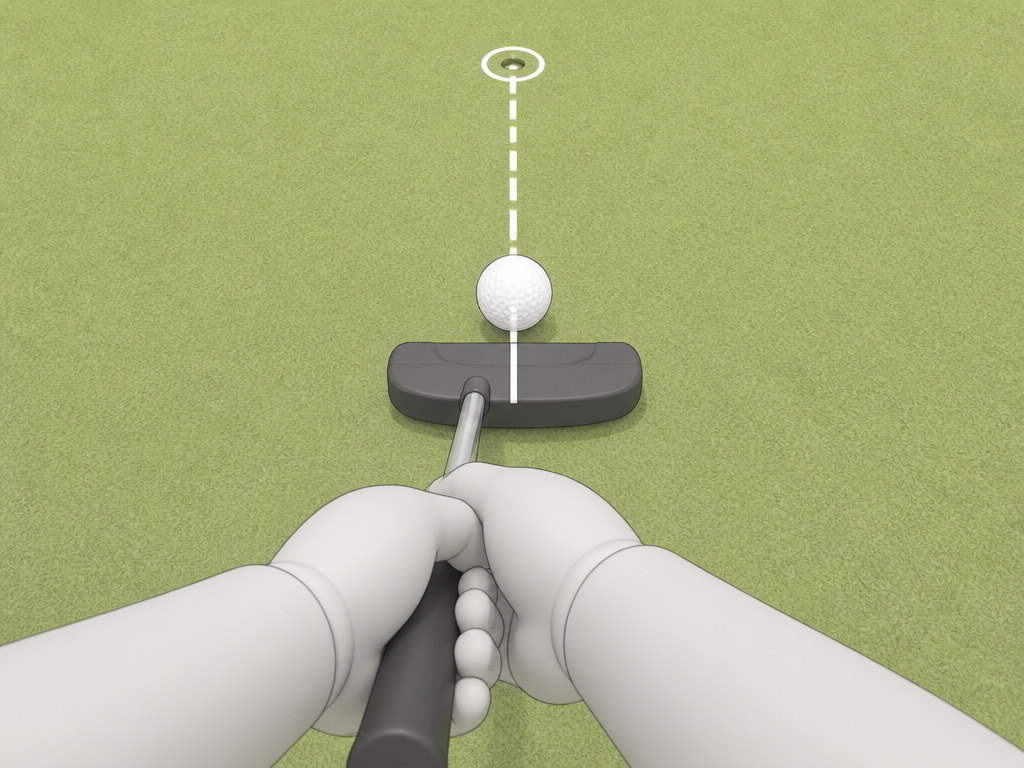
Alignment isn’t a static position. It’s a process you run before every putt. The routine eliminates doubt and transfers the complex read of a breaking 20-footer into a simple mechanical task.
Here is the sequence, timed. It should take about 15 seconds from behind the ball to trigger.
- Read from behind the ball. Crouch directly behind your ball, looking at the hole. Visualize the ball’s entry point. This is your only moment for reading break.
- Pick an intermediate target. Find a spot on your intended start line, a old ball mark, a discolored blade of grass, anything, 6 to 12 inches in front of your ball. Your job is now to roll the ball over that spot.
- Walk in and set the face. Approach the ball from the side. Place your putter head directly behind the ball, squaring the alignment line to your intermediate target. The face is set first.
- Build your stance around the club. Place your feet, knees, and hips parallel to the target line. Let your arms hang. Check your eye position (you’ve practiced this).
- Look, look, stroke. Look at the hole once to confirm distance. Look back at the ball. Your eyes are now “quiet.” Execute the stroke.
This routine makes alignment external. You’re not trying to feel square; you’re matching a line on your putter to a spot on the ground. It’s a binary check. This method is supported by the principles in the golf putting alignment study, which emphasizes the importance of consistent visual cues.
The final piece is practice with consequence. Don’t just hit putts. Use a putting mat with a gate made of tees or training sticks to force a precise start line. If you can’t start the ball on line at 3 feet, you have no chance at 30.
The Tools That Actually Work (And One That’s Overrated)
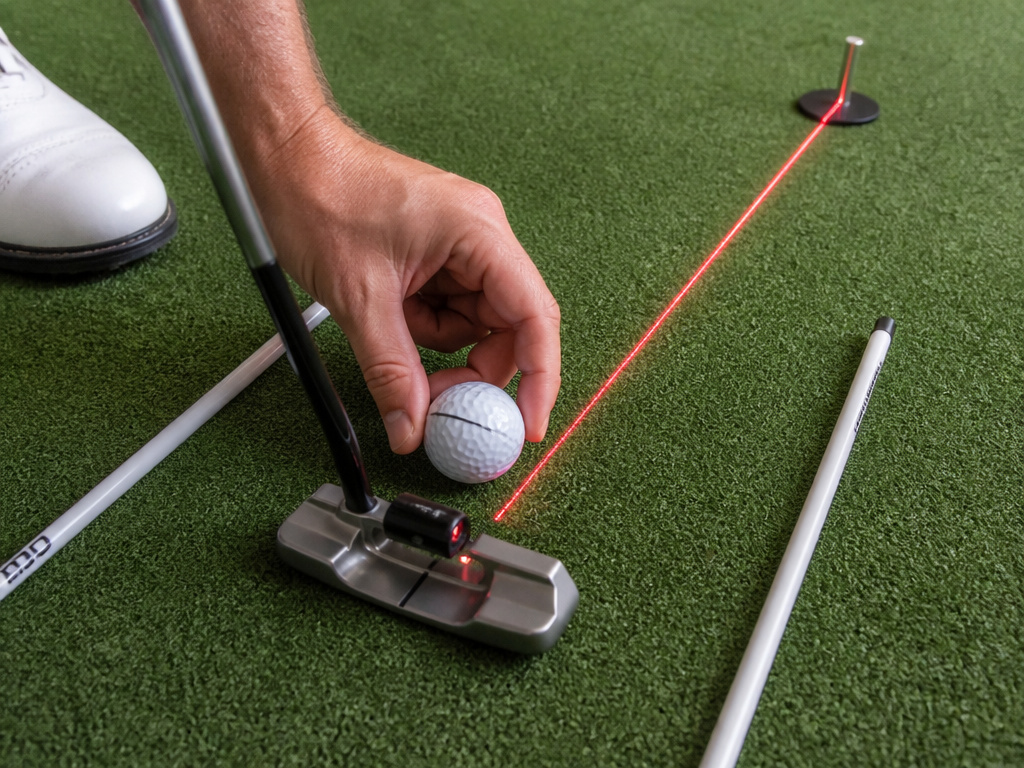
The market is flooded with gadgets. These are the ones that deliver measurable results because they provide objective feedback.
- A Putting Mirror: The fastest way to correct eye position and face angle. The reflection doesn’t lie. Use it for five minutes before every practice session. It’s the best $25 you’ll spend.
- Alignment Sticks: Two sticks laid on the ground, parallel and just wider than your putter head. They create a “railroad track” for your putter path. Inconsistent path leads to face manipulation, so this stabilizes everything.
- String Line: A string stretched between two tees, one behind the hole and one behind your ball. It gives you a perfect, raised visual of the straight line. This is what Jordan Spieth uses.
- Laser Training Aid: A device that clips onto your putter face and projects a beam. It shows exactly where your face is aimed at address. This is the ultimate truth-teller for face angle.
The overrated tool? The complicated, multi-part putting arc trainer that promises a perfect stroke. Alignment is about setup and face control, not forcing a specific path geometry. A simple gate drill with two tees gives you all the path feedback you need.
Incorporate these into structured putting drills that focus purely on start line. Practice doesn’t make perfect. Perfect practice makes perfect.
Frequently Asked Questions
Does the brand of alignment stick matter?
Not really. Any durable, straight fiberglass or plastic stick will work. Golf-specific ones are often brighter colors, but driveway markers from a hardware store do the same job for a third of the price. The key is that they’re straight and you use them consistently.
How often should I check my alignment?
Every practice session. Alignment is a perishable skill. Your eye position can drift over a single round due to fatigue or slope. Start each practice with 10 putts using a mirror or string line to recalibrate. It takes 90 seconds.
I use a line on my ball, but I still miss. Why?
You’re likely using the line incorrectly. The line should point at your intermediate target, not the hole itself (unless it’s a dead-straight putt). If you line it at the hole on a breaking putt, you’ve already mis-aimed. Also, you might be so focused on the ball’s line that you neglect to square the putter face to it. They must be parallel.
Can a putter be “too aligned” with too many lines?
Yes, for some players. Visual clutter can cause paralysis. If you find yourself staring at multiple lines and feeling unsure, you’ve lost the benefit. The 2021 study showed efficacy with three lines, but individual preference rules. If a single, clear line or a simple dot gives you more confidence, use that. Phil Mickelson won majors with a putter that had almost no alignment markings.
Do I need a $20,000 launch monitor to improve my alignment?
Absolutely not. The GCQuad’s 1° tolerance is just a useful benchmark. You can achieve that level of precision with a $5 string, two tees, and honest practice. The monitor provides data; the discipline to use simple tools provides results.
Before You Go
Putting alignment boils down to trusting a process, not your feel. Set the face to an intermediate target. Build your stance around the club. Verify your eyes are in the right place. Use a training aid that gives you black-and-white feedback.
The research is clear: more lines on the putter help, lines on the ball matter less, and visual consistency is key. Your putter’s lie angle can be a hidden enemy after a fitting. And the difference between a make and a miss lives inside a one-degree window.
Spend your next practice session with a mirror and an alignment stick. Don’t worry about holing putts. Worry about starting every single one on your intended line. When you can do that consistently, the holes will start getting in the way.
