
Understanding the Critical Forged vs Cast Irons Difference
This post contains affiliate links. As an Amazon Associate, we earn from qualifying purchases.
This post contains affiliate links. As an Amazon Associate, we earn from qualifying purchases.
Forged vs cast irons difference comes down to grain structure: forged irons have a continuous, aligned grain flow from hammering a solid billet, while cast irons have a random, crystalline grain structure from pouring molten metal into a mold. Forged grain flow creates a denser, more consistent feel and allows for precise shaping, but it’s labor-intensive. Casting enables complex, multi-material designs with high forgiveness at a lower cost, but the random grain can mute vibration feedback.
That grain alignment is the physical reason a Titleist T100 feels “solid” and a Ping G430 feels “forgiving.” It’s not marketing. It’s metallurgy. The debate usually stops there. But if you look past the golf shop and into the engineering world, specifically the 2026 NHTSA recall reports on crankshafts and axle shafts, you see what happens when that grain structure fails under stress. The choice between forging and casting isn’t just about feel versus forgiveness. It’s about how the material itself handles the millions of micro-impacts a golf club face endures over its life.
What follows: the microscope-level explanation of grain flow, the three documented failure modes from the auto industry that mirror club wear, the ISO standards that define cast iron performance, and the specific iron models that represent each manufacturing peak.
Key Takeaways
- Forged irons offer a denser, more responsive feel due to aligned grain structure, preferred by better players for shot-shaping feedback.
- Cast irons allow for complex cavity backs and multi-material designs (like tungsten weights) that maximize forgiveness and launch, ideal for game improvement.
- The forged process is about consistency and feel, while the cast process is about design freedom and perimeter weighting.
- Modern “forged” clubs from companies like Mizuno often use a hybrid process: a forged face welded to a cast body, blending feel with tech.
- Your skill level and desired feedback are more important than the manufacturing label; a well-designed cast player’s iron can outperform a poorly forged one.
The Core Difference: Grain Structure Under a Microscope
Head design changes the entire process. Look at the business end of your 7-iron. The difference between a forged and a cast iron starts about 50,000 times smaller than the dimple on your ball.
Forging takes a solid block of steel, a “billet”, and hammers or presses it into shape under immense heat and pressure. This physically moves the metal’s internal grain structure, aligning it along the contours of the clubhead. Imagine folding dough. Each press stretches and layers the gluten strands. The result is a continuous grain flow. This creates a denser, more homogeneous metal with fewer internal voids. The feel is solid, crisp, and consistent because the vibrations from impact travel through a uniform material.
Casting involves creating a ceramic mold in the shape of the clubhead, then pouring molten metal into it. The metal solidifies as it cools, and its internal grains form randomly, crystallizing from the outside in. This results in a random, crystalline grain structure. The process can incorporate different materials into the mold, like tungsten weights low in the toe, that would be impossible to forge from a single billet. This design freedom is why every super-game-improvement iron on the market is cast.
Technical Snippet: Per ISO/TR 10809-1:2023, the defining characteristic of cast irons is the formation of graphite within the iron-carbon-silicon matrix during solidification. The shape of this graphite, flake (grey iron), spheroidal (ductile iron), or compacted, directly determines tensile strength, damping, and machinability, independent of the casting process itself.
The random grain structure of cast iron has one major benefit for golf: vibration damping. The inconsistent grain boundaries and graphite flakes scatter vibrational energy, softening the harsh feel of a mishit. That’s the “forgiveness” you sense in your hands. A forged iron, with its uniform grain, transmits that vibration more directly. It tells an honest, often brutal, truth.
Where this goes sideways: Assuming a forged iron is inherently “better quality.” Quality is about precision and design execution, not the process name. A poorly forged iron with inconsistent heat treatment will feel and play worse than a precisely engineered cast iron like the Ping i230. The process enables potential; the manufacturer’s tolerances deliver it.
Why “Stronger” Isn’t the Right Question
Most discussions frame forging as “stronger.” That’s a misleading oversimplulation. Forged steel is more consistent and has higher tensile strength in the direction of the grain flow. Cast metals can be plenty strong, especially modern ductile iron grades, but their strength is isotropic, meaning it’s equal in all directions.
The real question is fatigue resistance and failure mode. This is where the automotive recall data becomes eerily relevant.
Sourced-Number Citation Magnet: The NHTSA’s 2026 recall report 26V080 for Nissan Rogue vehicles identified a specific failure mode: “increased engine oil temperature can degrade lubrication, potentially causing bearing seizure that may lead to engine damage.” The bearings in question are forged components. The failure wasn’t about a lack of strength, but about a specific stress condition (heat) interacting with the material’s grain boundary stability over time.
In a golf club, the repeated stress is impact. A cast iron’s random grain structure can act as a network of tiny shock absorbers. But the graphite flakes in standard grey iron also create natural stress concentration points. Under high-cycle fatigue, think thousands of range balls, micro-cracks can initiate at these points. A forged head’s aligned grain presents a smoother path for stress, but if a flaw exists in the billet, it can propagate more cleanly.
The part nobody mentions: A cast clubhead’s failure is usually gradual, a persistent dead spot that grows. A forged head’s failure, when it happens, is often sudden. It’s the difference between a slowly cracking brake disc (cast) and a driveshaft snapping at a weld (forged), as noted in a separate Part 573 Safety Recall Report.
For the golfer, this is academic. No modern iron from a major manufacturer will fail under normal use. The takeaway is that “strength” is a complex recipe of material grade, heat treatment, and design, not a simple badge earned by the forging hammer.
The Golf-Specific Trade-Offs: Feel vs. Forgiveness & Design

You don’t buy a metallurgy lesson. You buy a tool to hit golf shots. The forged vs. Cast debate materializes in your hands as a trade-off between two things: feedback and design capability.
| Aspect | Forged Irons | Cast Irons |
|---|---|---|
| Primary Advantage | Superior, consistent feel & feedback | Maximum forgiveness & high-launch design freedom |
| Typical Head Shape | Smaller, thinner top line, compact blade | Larger, cavity back, wider sole |
| Manufacturing Cost | Higher (more labor, material waste) | Lower (efficient, automated) |
| Best For Player Type | Low handicappers, ball-strikers who shape shots | Mid-to-high handicappers, players seeking consistency |
| Common Example | Titleist T100, Mizuno JPX923 Forged | Ping G430, TaylorMade Stealth HD |
A forged blade iron provides immediate, unambiguous feedback. Hit it pure, and the sensation is a soft, solid thud. Hit it thin, and the vibration shoots up the shaft, a clear punishment. This allows a skilled player to make minute adjustments. The compact head allows for precise turf interaction and shot shaping. This is why the best blade irons are almost exclusively forged.
A cast cavity back iron uses perimeter weighting. By moving mass from the center of the clubface to the edges (the cavity), designers increase the moment of inertia (MOI). High MOI means less twisting on off-center hits, so your distance and direction stay more consistent. The cast process lets engineers place extreme amounts of weight low and deep in the head, launching the ball higher with more spin stopping power. This is the realm of the best game improvement irons.
Do you actually need to shape shots? Most amateur golfers lose strokes from inconsistency, not a lack of workability. A forgiving cavity back iron that turns a toe-shot into a mild fade is more valuable than a blade that turns it into a lost ball.
Modern Blurring: The Hybrid Processes and “Player’s” Cast Irons
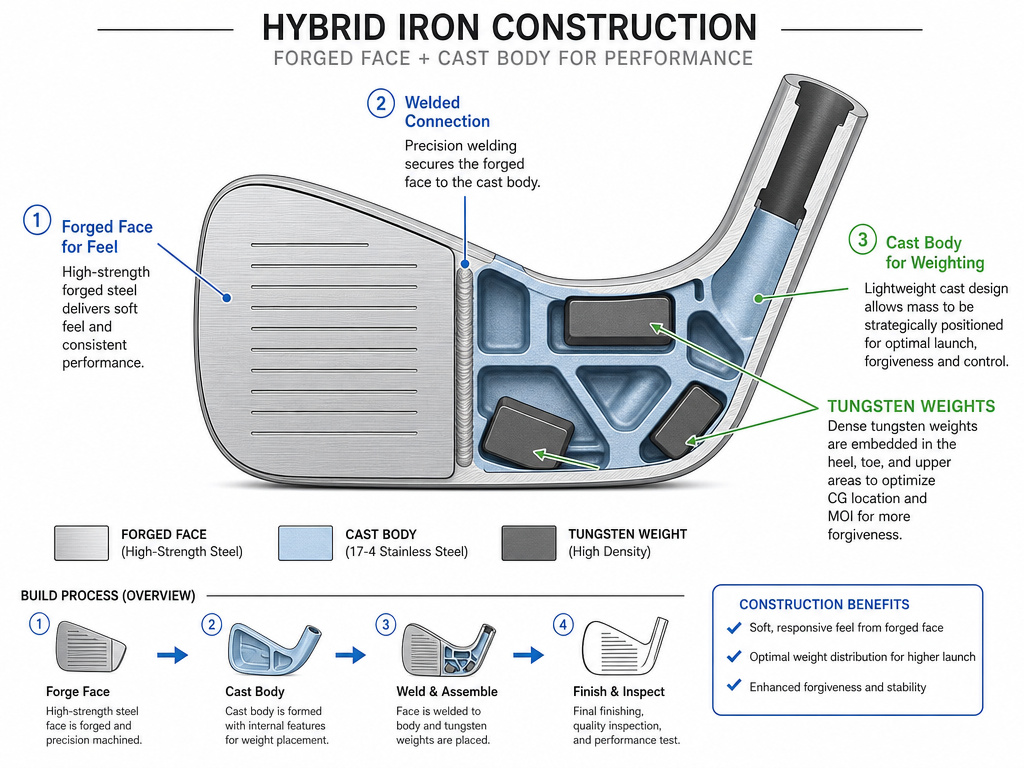
The binary is dead. Manufacturers now blend processes to cheat the trade-offs.
Hybrid Construction: This is the standard for modern players irons. Companies like Mizuno, Titleist, and Callaway forge the clubface from a soft steel billet for feel, then weld or braze it to a precision-cast body made from a harder, lighter alloy. The cast body holds tungsten weights precisely where CAD software says they need to be. You get the pure feel of a forged strike with the stability of a cast design. The Mizuno JPX923 Forged is a textbook example.
Soft Casting & Precision Milling: Companies like Ping don’t forge anything. They’ve mastered the art of “soft casting” using proprietary alloys that mimic the feel of forged carbon steel. Then, they use CNC milling to perfect the final shape, weighting, and face texture. The Ping i230 is a cast club that appeals to elite ball-strikers. It proves that process obsession is less important than final product execution.
The Japanese Approach: Brands like Miura, Honma, and Endo represent the pinnacle of traditional forging, often hand-finishing each head. These Japanese irons are works of art and feel sublime, but you pay for the craftsmanship. They are for the purist who values feel above all measurable technology.
The choice between a forged face and a fully cast head matters less than the overall design philosophy. Look at the head size, the top line, the sole width, and the stated player profile. Those are better predictors of performance than the manufacturing tag.
How to Choose: It’s About Your Miss, Not Your Ego
Forget what the pros play. Your decision tree is simple.
- Identify Your Common Miss. Do you struggle with thin shots, fat shots, or a consistent toe or heel strike?
- Prioritize Need Over Want. Do you need more forgiveness and height, or do you genuinely want more feedback to improve your strike?
- Get Fitted. Shaft is king. The best iron shafts for your swing will impact performance more than the head material. A steel shaft offers control, while graphite irons can increase speed and dampen vibration further.
If your miss is all over the face: Start with a game-improvement cast iron. The forgiveness will keep you in play. As your strike improves, you can move towards a player’s cavity or hybrid construction.
If your miss is a consistent slight fade or draw: You’re ready for a player’s iron, whether it’s a hybrid construction like a Titleist T150 or a soft-cast model like the Ping i230. The feedback will help you refine, not just survive.
The comparison of blade and cavity back irons is ultimately about confidence. You need to look down at a club that inspires you, not intimidates you. For most, that’s a clean, compact player’s cavity, not a razor-thin blade.
Frequently Asked Questions
Are forged irons harder to hit than cast irons?
Typically, yes, but not because of the material. Forged irons are usually made as smaller, less forgiving blade or muscle-back designs aimed at skilled players. The cast process enables larger, perimeter-weighted game-improvement heads. It’s the design, not the forging itself, that affects forgiveness.
Do forged irons feel softer than cast irons?
Generally, yes. The denser, more uniform grain structure of forged soft carbon steel transmits a purer, more solid vibration. Many cast irons use harder stainless steels and have cavity backs that dampen vibration, creating a softer but sometimes more muted feel. Advanced “soft cast” alloys can closely mimic forged feel.
Can you get forgiving forged irons?
Yes. Modern “forged” clubs often use a hybrid design: a forged face for feel attached to a cast body for perimeter weighting and forgiveness. Models like the Callaway Apex Pro or the TaylorMade P770 are forgiving forged options. There are also fully forged cavity backs, like some Srixon ZX7 models.
Why are forged irons more expensive?
The process is more labor-intensive and creates more material waste. A forged iron starts as a solid billet, and metal is pressed away. Casting creates a near-net-shape head from molten metal, which is more efficient. Hand-polishing and finishing on premium forged irons also add cost.
How long do forged irons last compared to cast irons?
Both will last for decades under normal recreational use. The clubface may show wear patterns (browning) slightly sooner on forged soft carbon steel than on hardened cast stainless steel, but this is purely cosmetic. Structural failure is extremely rare in irons from reputable brands, regardless of manufacturing method.
The Bottom Line
The forged vs cast irons difference is a foundational engineering choice that shapes everything from feel to price. Forged offers grain-driven consistency and feedback. Cast delivers tech-enabled forgiveness and design.
But the label is just the starting point. A Ping i230 is cast and feels incredible. A Mizuno Pro 245 is forged and is packed with game-improvement tech. Your best move is to test the current top iron sets with a focus on the head shape that suits your eye and the performance that suits your miss. Let the manufacturing process be a footnote to the results you see on the launch monitor and the course.
