
Golf’s Out of Bounds Rule: A Guide to Stroke-and-Distance
This post contains affiliate links. As an Amazon Associate, we earn from qualifying purchases.
A ball is out of bounds only when all of it is outside the boundary edge of the course. If it’s lost outside a penalty area or out of bounds, you must take stroke-and-distance relief: add one penalty stroke and play from where your last shot was made. You have three minutes to search for a lost ball before it’s officially gone.
That three-minute timer is the line between a frustrating search and a penalty that changes your hole. The rule isn’t about where your ball went; it’s about where it comes to rest. A ball that soars over a white-staked fence but lands back in play is still in bounds. A ball that stops with any part overhanging the course-side edge of that fence is also in bounds. The entire ball must be past the line.
What follows is a breakdown of the official rule, the penalty you can’t avoid, the smart use of a provisional ball, and the specific edge cases, like internal boundaries and roads, that committees use to shape how you play a course.
Key Takeaways
- The three-minute search clock starts the moment you or your caddie begin looking for your ball; after that, it’s lost.
- Stroke-and-distance is mandatory for a lost ball or OOB shot, you must replay from your previous spot under a one-stroke penalty.
- Announce your provisional ball clearly before hitting it; if you don’t, that second ball becomes your ball in play.
- A ball is only out of bounds if all of it is outside the boundary where it rests; its flight path doesn’t matter.
- Committees can create internal out of bounds (like a white-staked line between holes) to prevent cutting doglegs.
The Official Out of Bounds Rule & Penalty
Forget any notion of dropping near where your ball crossed the line. The out of bounds rule in golf is absolute. Under R&A Rule 18, if your ball is lost outside a penalty area or is out of bounds, your only option is stroke-and-distance relief.
A ball at rest is out of bounds only when all of it is outside the boundary edge of the course. A player may stand out of bounds to play a ball on the course.
This 50-word technical snippet is the core of the rule. It means the boundary is a vertical plane. If your ball is nestled in deep rough but a single dimple is touching the course-side edge of that imaginary plane, it’s in. You can even stand outside the boundary to hit a ball that’s in bounds.
The penalty is one stroke, and you must go back to where you played your last shot. If your tee shot sails OOB, your next shot is your third stroke from the tee.
| Situation | Rule Applied | Result & Penalty |
|---|---|---|
| Tee shot is lost outside a penalty area | Stroke-and-distance (Rule 18.2) | Play again from tee, hitting 3rd shot |
| Ball comes to rest completely beyond white stakes | Ball is Out of Bounds | Play again from previous spot, add 1 stroke |
| Ball found within 3 minutes, but identity is uncertain | Reasonable time to identify (Rule 18) | If not identified, ball is lost; stroke-and-distance applies |
Where this goes sideways: Trying to take a “fair” drop near where the ball went out. There’s no such option in the rules for OOB. Doing so incurs the general penalty (two strokes in stroke play) for playing from a wrong place. The only legal drop near a boundary is for a penalty area marked with red or yellow stakes, a different rule entirely.
The clock is your other enemy. You get three minutes to search, starting when you or your caddie reach the area and begin looking. Not four. Not five. After 180 seconds, the ball is officially lost and the stroke-and-distance penalty applies. This is a non-negotiable part of the lost ball rule.
How Boundaries Are Defined and Marked
Boundaries aren’t always a neat row of white stakes. According to the R&A Committee Procedures for course marking, a boundary can be a fence, a wall, the edge of a road, a trench, or even a painted line on the ground. The committee’s job is to make it clear.
White stakes are the standard, but the committee can use another color if it’s declared on the scorecard or a notice. They avoid red or yellow for boundaries to prevent confusion with penalty areas. The official guidance suggests stakes be placed no more than 30 paces apart so you can see the line from a distance.
Common mistake: Assuming a boundary wall or fence is itself out of bounds. The committee must define which edge of the structure is the boundary, usually the course-side edge. A ball leaning against the course-side of a boundary wall is still in bounds.
The more confusing scenarios involve roads and internal boundaries. A public road running through a course is typically out of bounds. This can create a strange situation: you can hit a ball from one side of the road to the other, and if it stays in bounds on the far side, it’s playable. If it lands on the road, it’s OOB. Some committees adopt a Local Rule (Model Local Rule A-5) stating that any ball crossing the road is OOB, for safety or fairness, but they must specify if it doesn’t apply to holes where you must play across it.
The Critical Role of the Provisional Ball
Since walking back to the tee is a pace-of-play killer, the rules give you an escape valve: the provisional ball. This is your single best tool for managing the out of bounds rule.
You are allowed to play a provisional only if your original ball might be lost outside a penalty area or might be out of bounds. You cannot play one if you think your ball is in a red or yellow penalty area.
The announcement is everything. You must say “provisional ball” or clearly state your intention before you hit it. A mumbled “I’ll hit another one” isn’t enough. If you don’t announce it, that second ball becomes your ball in play under penalty of stroke and distance, meaning your first ball is abandoned, and you’re now lying three with the new ball.
How to play a provisional ball (the right way):
- Announce it verbally to your opponent or fellow competitor: “I’m playing a provisional ball.”
- Play it from the same spot as your original shot.
- You can continue to play the provisional until you reach the area where your original ball is likely to be.
- If you find your original ball in bounds within three minutes, you must abandon the provisional and play the original.
- If your original is confirmed lost or OOB, your provisional becomes your ball in play. You are now lying three (one original stroke + one penalty stroke + your provisional stroke).
This provisional ball procedure saves everyone’s time. Use it any time there’s doubt.
Internal Out of Bounds and Other Edge Cases
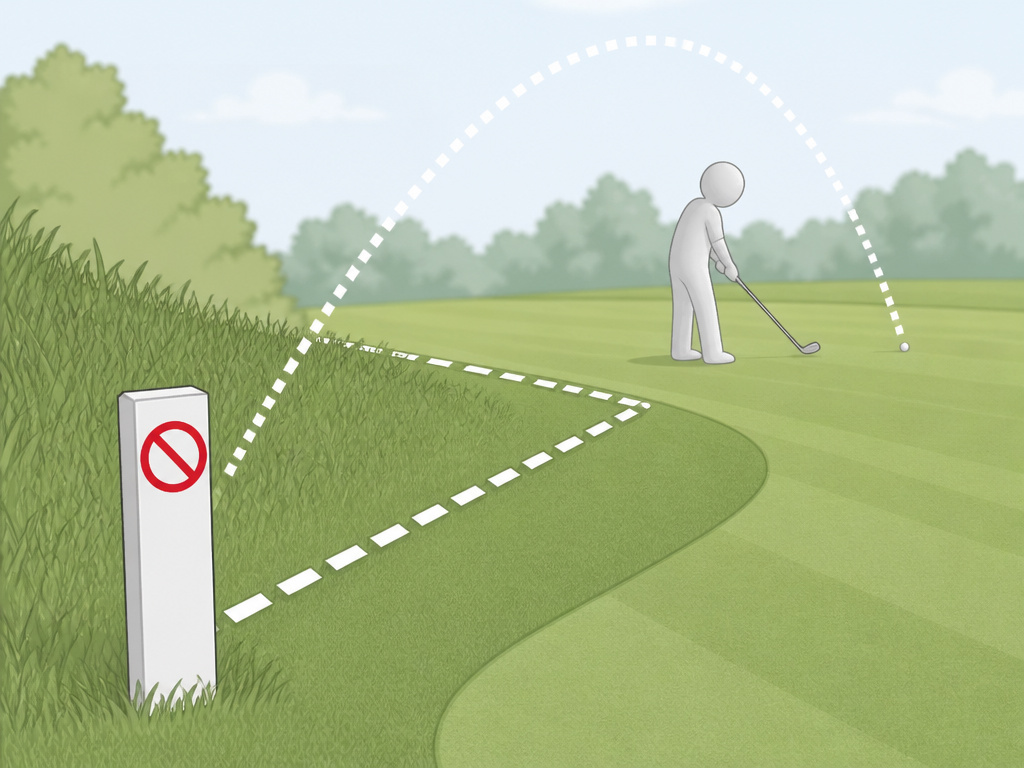
Golf courses aren’t simple rectangles. Design and safety sometimes require “internal” out of bounds, areas on the course property that are marked OOB for the play of a specific hole. You’ll see this on dogleg holes, where white stakes line the inside of the corner to stop players from cutting across another fairway.
A Local Rule stating that a ball is out of bounds if it crosses a boundary, even if it re-crosses and comes to rest on the course, is not authorized because a ball is only out of bounds when it comes to rest out of bounds.
This clarification from the USGA kills a common misconception. You can’t have a rule that says a ball is OOB just because its flight path crossed the line. It’s all about its final resting place. So a high shot that soars over an internal OOB stake but lands in your own fairway is perfectly fine.
Other edge cases matter: * Ball Found But Unidentified: If you find a ball within three minutes but aren’t sure it’s yours, you get a “reasonable time” to identify it (e.g., by checking the brand and number). This can extend beyond the three-minute search window. * Ball Moved by an Outside Influence: If a bird, dog, or spectator moves your in-bounds ball out of bounds, you replace it on the original spot with no penalty. This is a key difference from the standard OOB penalty. * No Dual Status: An area can’t be out of bounds for one stroke and in bounds for another on the same hole. The status is fixed.
Understanding these nuances separates a player who just follows the basic rules of golf from one who navigates complex course layouts correctly.
Out of Bounds vs. Penalty Areas (Red & Yellow Stakes)

This is where many golfers get tripped up. Out of bounds and penalty areas are fundamentally different, with different relief options.
| Feature | Out of Bounds (White Stakes/Lines) | Penalty Area (Red/Yellow Stakes) |
|---|---|---|
| Relief Option | Stroke-and-distance only. Replay from previous spot. | Multiple options: stroke-and-distance, back-on-the-line relief, or lateral relief (red only). |
| Penalty | One stroke. | One stroke. |
| Defining Feature | Ball must be entirely outside boundary. | Ball is in the defined area (often, but not always, water). |
| Provisional Ball? | Allowed. | Not allowed if known or virtually certain ball is in the penalty area. |
The stakes tell the story. White means “go back.” Red or yellow means “you have choices.” Confusing the two leads to wrong procedures and extra penalties. If you’re unsure whether an area is OOB or a penalty area, check the difference between red and yellow stakes and look for committee guidance on the scorecard.
Frequently Asked Questions
What if my ball is on the out of bounds line?
If any part of your ball is touching the course side of the boundary line (or is directly above it, if suspended), it is in bounds. The entire ball must be outside the line to be considered out of bounds.
Can I move a boundary stake to play my shot?
No. Boundary objects (white stakes, fence posts, walls defining OOB) are immovable obstructions from which you get no free relief. You cannot move them if they interfere with your stance or swing. You must play it as it lies or, if unplayable, declare it so and take an unplayable lie penalty.
Is there any alternative to stroke-and-distance for OOB?
For general play, committees can adopt Model Local Rule E-5, which gives an alternative to stroke-and-distance for a ball that is lost or out of bounds in the general area. It allows you to drop in the fairway within two club-lengths of the edge, no nearer the hole, under a two-stroke penalty. This is not the standard rule and must be in effect via a Local Rule.
What’s the difference between lost and out of bounds?
Lost ball is one not found within three minutes. An out of bounds ball is found but is entirely outside the boundary. The penalty (stroke-and-distance) is the same for both. If you find your ball OOB, your search time stops, and you proceed under the OOB rule.
Can I declare my ball unplayable if it’s in bounds?
Yes. If your ball is in bounds but in a bush, tree, or other impossible situation, you can use the unplayable lie rule. This gives you three relief options for a one-stroke penalty, which is often better than the mandatory walk-back of stroke-and-distance.
The Bottom Line
The out of bounds rule is strict for a reason: it protects the course’s defined playing area and keeps the game moving. Memorize the sequence: three minutes to search, then mandatory stroke-and-distance. Your best defense is the provisional ball, announced clearly. Always identify the stakes, white means what it says. There’s no negotiation, no “winter rules” for OOB. It’s one of the game’s bluntest penalties, and knowing it cold saves you strokes and frustration on courses worldwide, where boundaries are as much a part of the challenge as the bunkers and the greens.
