
Putter Face Insert Technology for Superior Sound & Control
This post contains affiliate links. As an Amazon Associate, we earn from qualifying purchases.
This post contains affiliate links. As an Amazon Associate, we earn from qualifying purchases.
Putter face insert technology uses materials, patterns, and construction to manipulate the sound and tactile feedback at impact, not the ball’s initial roll. The goal is a consistent, confidence-inspiring feel, achieved through specific combinations of polymers, metals, and engineered geometries like the 0.180-inch wide oval holes defined in key patents.
That specific dimension results from decades of patent filings aimed at solving one problem: how to make a cast stainless steel head feel as soft and responsive as a precision-milled block of 303 stainless, but for a fraction of the cost. The insert is the answer, a layer of engineering that decouples feel from the base material of the putter head.
What follows is a breakdown of the materials that create that feel, the exact specs patented by major manufacturers, and a clear-eyed look at what an insert can and cannot do for your putting stroke. By the end, you’ll read an insert description and know whether it’s marketing fluff or a meaningful design choice.
Key Takeaways
- Face inserts control sound and feel, not the physics of the roll. Grooves or patterns on a putter face do not impart spin on a ball struck at putting speeds.
- The “soft” sensation comes from dampening vibrations. Materials like thermoplastic polyurethane (TPU) or urethane backings absorb energy that would otherwise travel up the shaft as a harsh ring or click.
- Patent documents reveal the precise geometry that works. For example, Callaway’s patent (US 9498685) specifies oval holes 0.180 inches wide and 0.040 inches tall, spaced 0.026 inches apart horizontally.
- Inserts allow for cheaper manufacturing. A cast head with a polymer insert can mimic the feel of a fully milled putter, bringing a premium sensation into a more accessible price tier.
- Your preference for feel is personal. Some players need the muted feedback of a deep-milled face or soft insert, while others prefer the crisp information of a solid metal strike.
The Two Jobs of a Putter Face Insert
Forget performance claims about topspin or truer roll. At the speed a putter head travels, maybe 10 mph on a long putt, there is negligible ball compression. Without compression, the face can’t grab the ball to impart meaningful spin. The idea that face grooves influence roll is a persistent myth.
Where this goes sideways: Believing an insert’s pattern changes your ball’s roll. It doesn’t. The ball starts rolling based on loft and lie at impact and the quality of your stroke. An insert can’t fix a push or a pull.
So what is it doing? An insert has two real jobs. First, it changes the sound at impact. A pure metal-on-ball strike has a high-frequency “click” or “ping.” Adding a polymer layer or a pattern of holes breaks up that sound wave, resulting in a lower-frequency, duller “thud” or “tock.” Your brain interprets that quieter, deeper sound as “soft.”
Second, it alters the tactile feedback through your hands. Vibrations from impact travel up the shaft. A solid metal face transmits these vibrations cleanly and quickly, you feel a sharp, distinct pulse. An insert, especially one with a soft backing layer, acts as a damper. It absorbs and disperses that vibrational energy before it reaches your grip. The sensation that arrives in your hands is muted and spread out over a fraction of a second longer. That dampened, longer vibration is what we call a soft feel.
Do Putter Face Inserts Actually Affect Roll?
No. The physics is clear and non-negotiable. For a face feature to influence spin, the clubhead must be moving fast enough to significantly compress the ball’s surface, allowing the face to “grip” it. This happens with irons and woods. With a putter, the collision is essentially elastic, the ball squashes maybe a millimeter.
A 2012 analysis from The Power Fade blog put it bluntly: “Grooves on a putter DO NOT IMPACT THE ROLL.” The article notes that with putting, “there is almost no compression of the golf ball, even on really, really long putts.” The only way to create spin is with a severely flawed, upward-glancing blow that no proper putting stroke produces.
The roll of the ball is determined at the moment of separation from the face. The primary factors are the loft angle of the putter at impact (which gets the ball airborne just enough to start rolling) and the direction of the clubhead path. Face grooves, milling, or insert patterns are irrelevant to this equation. Their entire effect is on the sensory information, sound and vibration, returned to the player. This sensory feedback can influence confidence and consistency, which indirectly affects stroke quality, but the insert itself does not directly manipulate the ball’s physics.
A Deep Dive into the Specs That Matter
If inserts are about feel, then the materials and geometry are everything. This marketing is mechanical engineering documented in patent filings. These documents give us the exact recipes manufacturers use.
| Patent / Source | Key Material | Critical Spec | Purpose |
|---|---|---|---|
| US 9498685 (Callaway) | Thermoplastic polyether ester elastomer | Oval holes: 0.180″ width, 0.040″ height. Spacing: 0.026″ horizontal, 0.009″ vertical. | Optimizes sound dampening and provides a consistent surface texture for ball contact. |
| US 11813507 (Cobra) | Steel plate with TPU (Thermoplastic Polyurethane) insert | Protrusions extend 0.05–0.50 mm past the metal face. 10–1,000 individual protrusions. | Creates a hybrid feel: the firmness of metal with the dampening of polymer at the exact point of contact. |
| US 8696492B1 (Callaway) | 6061 aluminum sheet with urethane backing | Urethane hardness: Shore 42D. Backing thickness: 0.100–0.300 inches. | The specific hardness of the urethane layer is tuned to absorb a targeted amount of vibrational energy. |
| US 12515112 | Cast urethane with glass microspheres (K, S, iM, XLD types) | Microspheres prevent the Coefficient of Restitution (COR) from dropping more than 0.05. | Maintains consistent ball speed across the face (performance) while using feel-optimizing materials. |
The 0.180-inch hole from US 9498685 is a perfect case study. That width and the 0.040-inch height create a specific surface area ratio of metal to empty space. This ratio is calculated to disrupt sound waves at the frequencies humans perceive as harsh, while the remaining metal “lands” provide enough structure for consistent contact. The 0.026-inch spacing between holes is just as critical, too close and the metal becomes fragile; too far and the sound-dampening effect diminishes.
The use of materials like TPU or specific urethane grades (Shore 42D) is about predictable damping. Think of it like a car’s shock absorber. The polymer’s durometer (hardness) and thickness determine how much of the impact’s sharp impulse it absorbs and how quickly it returns to its original shape. A putter fitting that includes feel preference should consider these material specs, not just head shape.
Insert Materials: From Urethane to Exotic Composites
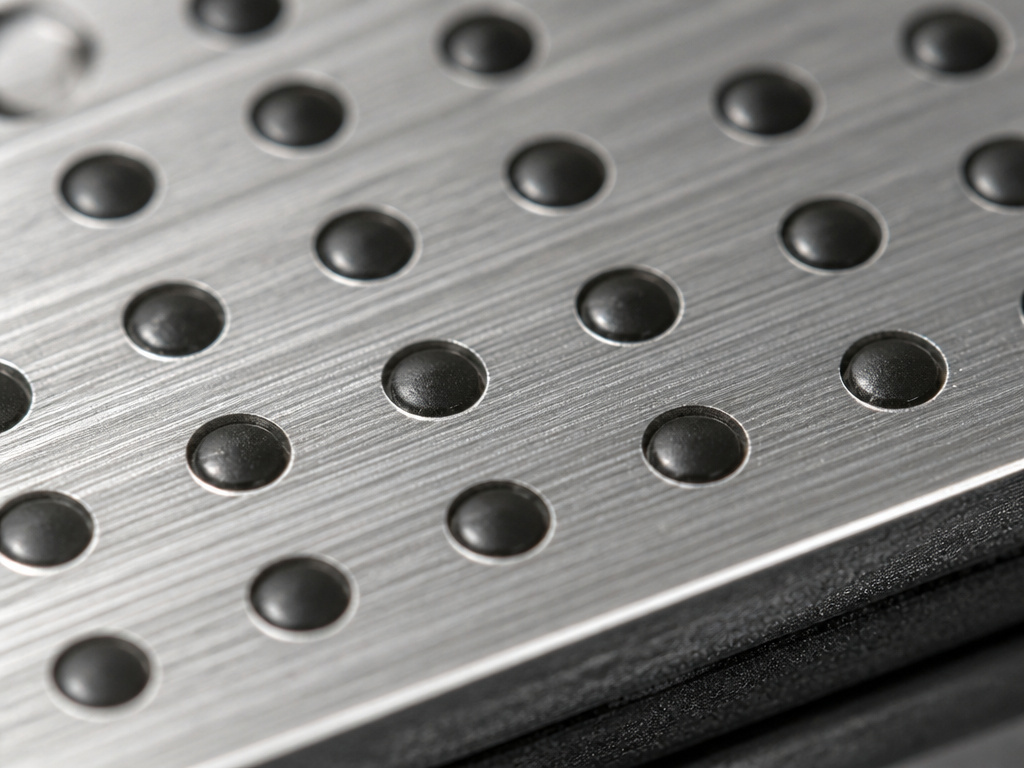
The core material of the insert dictates its fundamental personality. You can group them into three broad categories, each with a distinct feel profile.
Polymer-Based Inserts (Urethane, TPU, Elastomers)
This is the most common category, designed for maximum dampening. A pure polymer face, like many Odyssey White Hot or 2-Ball inserts, feels extremely soft and dead. There’s almost no metallic sound or high-frequency vibration. The ball seems to stick to the face for an instant. The downside for some players is a lack of feedback, it can be hard to distinguish a center strike from a slight mishit because everything feels soft.
Hybrid Metal-Polymer Inserts
This is the current frontier of insert technology, exemplified by patents like Cobra’s 11813507. A thin steel or aluminum faceplate is riddled with holes, and a polymer is molded through them, creating a surface where the polymer contact points sit slightly proud of the metal. – Feel: You get a crisp, firm initial sensation from the metal substructure, immediately followed by the dampened, soft finish of the polymer. It’s a “click-thud” combination. – Example: This design aims to please players who want some feedback but dislike the harshness of a full metal face. It’s a compelling middle ground.
Metal-Only “Inserts” (Milled Faces, Plates)
Technically, a solid piece of milled metal is the putter head itself, not an insert. However, companies like Scotty Cameron use face plates or inlays made from different metals than the body.A Scotty Cameron Select Newport mallet might use a 6061 aluminum face inlay in a stainless steel body. – Feel: This is all about feedback. You hear a precise click and feel a clear, sharp vibration. Deep milling on these faces (aggressive grooves cut into the metal) is a subtractive process to reduce that feedback, mimicking the dampening effect of a polymer insert by disrupting the vibration path within the metal itself.
Common mistake: Choosing an insert material because a pro uses it. Your preference for sound and vibration is personal. A soft polymer insert that feels like butter to one player will feel vague and uninformative to another. Always test based on the feedback you want.
How Face Inserts Interact with Other Putter Tech
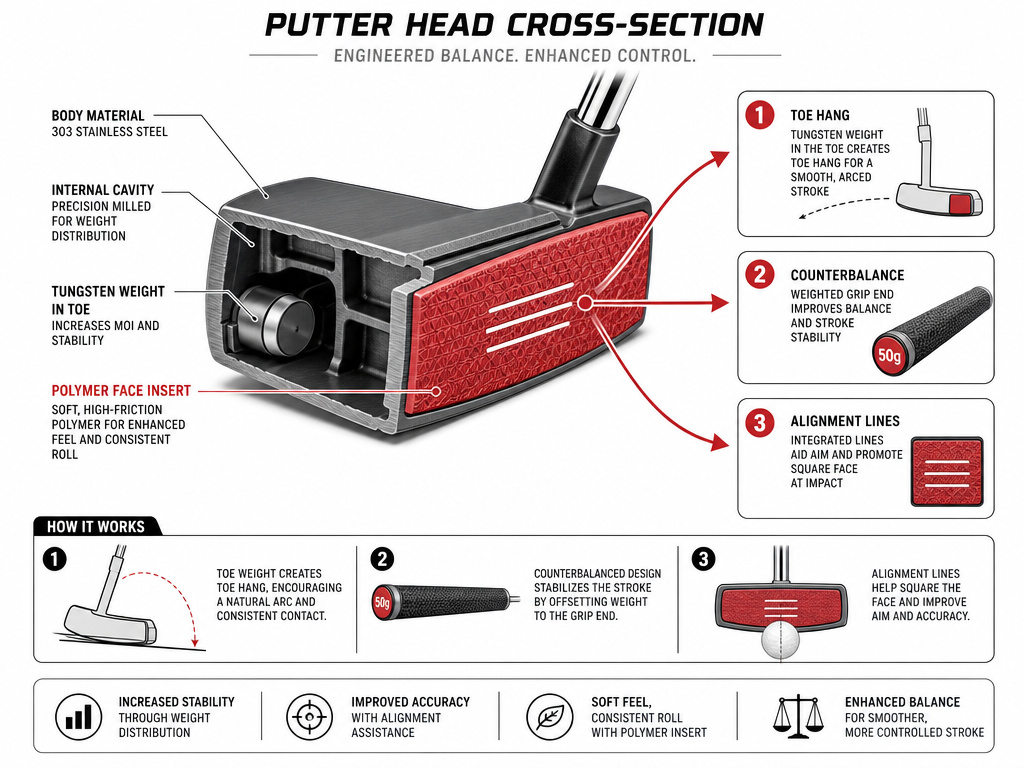
An insert doesn’t work in a vacuum. Its effect is intertwined with the rest of the putter’s design. Understanding these interactions helps you make sense of the whole package.
Toe Hang and Balance
The insert adds weight to the face. Engineers account for this when designing the putter toe hang and overall balance. A heavy polymer insert can help bring the center of gravity (CG) forward and low, promoting a smoother roll. In a counterbalanced putter design, the face weight is part of a larger equation that includes weight in the grip end to stabilize the stroke.
Alignment and Visuals
Many inserts incorporate alignment aids. A white polymer insert with a single black line provides stark contrast, making it easier to square the face. The insert material itself can be part of the visual alignment system, not just a feel component.
The Limits of Customization
While you can adjust putter length and fitting relatively easily, the insert is generally permanent. This is why the industry has seen patents for replaceable face inserts (like US 10786714). The idea is to let a player change the feel without buying a whole new putter. For now, this is rare in retail, underscoring the importance of choosing the right feel upfront.
Frequently Asked Questions
What is the softest putter face insert?
The softest feel comes from pure polymer inserts, like urethane or thermoplastic elastomer (TPE). Models like the Odyssey White Hot Pro 2.0 or the older Odyssey 2-Ball are benchmarks for this muted, almost dead sensation. The softness comes from the material’s ability to absorb nearly all high-frequency vibrations.
Do milled putters have inserts?
Typically, no. A milled putter face is cut from a single block of metal (like 303 stainless steel). However, “deep milling” refers to cutting aggressive grooves into that metal face to disrupt sound waves and vibrations, artificially creating a softer feel that mimics an insert. Some milled putters, like certain Scotty Cameron models, may also have a separate metal face inlay, which functions as a type of insert.
Are face inserts only for mallet putters?
No. While common in mallet putters, inserts are used in blade putters as well. The choice depends on the desired feel and manufacturing approach. Many game-improvement blades designed for forgiveness will feature a polymer insert to promote a softer, more confidence-inspiring feel for a wider range of players.
How long does a putter face insert last?
With normal use, a quality insert should last for decades. The polymers used are highly durable and resistant to weathering. Damage usually comes from extreme abuse (hitting cart paths, rocks) or exposure to harsh chemicals that can degrade the material. The durability is one reason they are so prevalent in beginner putters and rental sets.
Can you replace a worn-out putter face insert?
It is generally not a user-serviceable part. The insert is permanently bonded or mechanically locked into the head. While patents for replaceable inserts exist, most major manufacturers do not offer this as a retail service. If an insert is damaged, the solution is often a new putter or a costly, specialist refinishing job.
The Bottom Line
Putter face insert technology is a triumph of material science and psychology, not a magic performance elixir. Its value is real, but specific: it gives engineers a dial to turn the sound and feel of a putt up or down. The 0.180-inch hole, the Shore 42D urethane, the thousand TPU protrusions, these are the precise tools used to tune that dial.
When you’re testing putter models, let your ears and hands be the guide. Close your eyes and hit a few putts. Do you want the clear, crisp report of a milled metal face, or the subdued, dampened thud of a polymer insert? That answer is more personal and more important than any claim about roll. The best insert is the one that gives you the feedback that makes you confident over a three-footer. Everything else is just engineering supporting that moment.
