
Golf Smash Factor: The Complete Guide to This Key Metric
This post contains affiliate links. As an Amazon Associate, we earn from qualifying purchases.
This post contains affiliate links. As an Amazon Associate, we earn from qualifying purchases.
Smash factor in golf is ball speed divided by clubhead speed. It’s a measure of energy transfer efficiency from the club to the ball. A driver’s ideal smash factor is 1.50, but the number drops for irons, a 7-iron averages 1.34 on the PGA Tour. It’s not a universal “higher is better” metric; a bladed iron can have a high smash factor but produce a terrible shot.
That 1.50 driver benchmark is a physics ceiling, not an opinion. The number is a direct output from launch monitors like TrackMan and FlightScope Mevo+, calculated after they measure both speeds with radar or camera fusion. The calculation is simple, but the interpretation is where most golfers get tangled.
What follows: the real meaning behind the ratio, the club-by-club numbers you should expect, and the three swing flaws a low smash factor actually points to. You’ll also learn why chasing a high smash factor with your irons is a mistake that costs you accuracy and control.
Key Takeaways
- Driver target is 1.50, but 1.45 is strong for amateurs. PGA Tour average is 1.49. If yours is below 1.43, check impact location first.
- Iron smash factor naturally drops with loft. A PGA Tour 6-iron averages 1.39. A 7-iron at 1.40 is often a thin or bladed shot, not a good one.
- It measures efficiency, not effectiveness. A high smash factor tells you energy transfer was good. It says nothing about whether the ball finished near the hole.
- Low smash has three main causes: off-center strikes, high spin loft (face pointing upward relative to path), and a glancing blow from an outside-in or inside-out path.
- Use impact spray, not just the number. Smash factor indicates off-centeredness. To see where you miss, use foot spray on the clubface.
How Smash Factor Is Calculated (And What It Actually Means)
Your launch monitor does the math. Smash factor is ball speed divided by clubhead speed. If your driver swing produces 100 mph of clubhead speed and the ball flies off at 150 mph, your smash factor is 1.50.
Technical Definition: Smash Factor – The ratio between the Ball Speed and the Club Speed. It is used to determine the efficiency of impact. Face-to-path relationships, spin loft, and impact point location are the main factors to examine if the Smash Factor is too low.
The number is a pure efficiency rating. It answers one question: how much of the speed you created with your swing got transferred into the ball? A 1.50 means you transferred everything physics allows with that club. A 1.40 means you left roughly 7% of your potential ball speed on the table.
The calculation depends on accurate speed measurements. Entry-level radar units like the original FlightScope Mevo use 3D Doppler radar. Higher-end models like the Mevo+, Mevo Gen2, and X3 use Fusion Tracking Technology, which combines radar and camera data for more precise readings. Optical systems like the Foresight Sports GCQuad use high-speed cameras. All arrive at the same number by the same formula.
Where this goes sideways: assuming smash factor is only about hitting the sweet spot. Centered contact is the biggest lever, but it’s not the only one. Your angle of attack and the club’s face-to-path relationship at impact, the “spin loft”, change how glancing the blow is. A more glancing impact, even if centered, leaks energy and lowers your smash.
The Driver Benchmark: Why 1.50 Is the Ceiling
For drivers, 1.50 is the theoretical maximum for energy transfer. It’s the number that represents a perfectly centered strike with optimal spin loft. The PGA Tour average is 1.49. The LPGA Tour average is also 1.49.
For amateurs, the targets are lower but reveal skill level. According to TrackMan Combine averages, a scratch or better male amateur averages 1.49 with a driver. A 10-handicap averages 1.45. A bogey golfer averages 1.43.
| Handicap Level | Average Driver Smash Factor |
|---|---|
| PGA / LPGA Tour Pro | 1.49 |
| Scratch or Better Amateur | 1.49 |
| 10-Handicap Amateur | 1.45 |
| Bogey Golfer | 1.43 |
If your driver smash is stuck in the low 1.40s, the problem is almost always strike location. The toe and heel of the club move slower than the center during the swing, so off-center hits bleed speed immediately. Use impact spray. If you see strikes all over the face, your setup or swing path is changing from shot to shot.
A smash factor above 1.50 is possible but usually indicates a misread. Some monitors can slightly mis-measure clubhead speed, especially on very low strikes or with certain head shapes. Treat a 1.51 or 1.52 as a 1.50.
The Iron Smash Factor Trap: Why “Higher” Isn’t Better

This is the most misunderstood part of the metric. With irons, a higher smash factor is not automatically better. In fact, an unusually high number often signals a mis-hit.
As loft increases, the optimal smash factor decreases. A pitching wedge should be near 1.25. A 7-iron on the PGA Tour averages 1.34. A 6-iron averages 1.39. This happens because a lofted club delivers a more glancing blow by design; some energy is converted into spin and lift, not just ball speed.
A 1.4 smash factor with a 7 iron is possible, but not desirable. Smash factor represents the relationship between club head speed and ball speed, but it doesn’t represent the relationship between speed and proximity to the hole. If you blade a 7 iron, it’ll probably have a higher smash factor than a flushed one, but will likely be nowhere near the hole.
A thin or bladed iron shot compresses the ball less, reducing spin and creating a low, hot flight. That can produce higher ball speed relative to clubhead speed, a higher smash factor. But the shot will have no stopping power and fly over the green. You traded effectiveness for efficiency.
| Club | PGA Tour Average Smash Factor | Amateur Target Range |
|---|---|---|
| Driver | 1.49 | 1.43 – 1.50 |
| 6-Iron | 1.39 | 1.35 – 1.39 |
| 7-Iron | 1.34 | 1.30 – 1.35 |
| Pitching Wedge | ~1.25 | 1.20 – 1.28 |
Chasing a high iron smash factor is a trap. Focus on centered contact and a predictable flight. Your impact position and shaft lean matter more for solid iron shots than this one number.
What a Low Smash Factor Actually Diagnoses
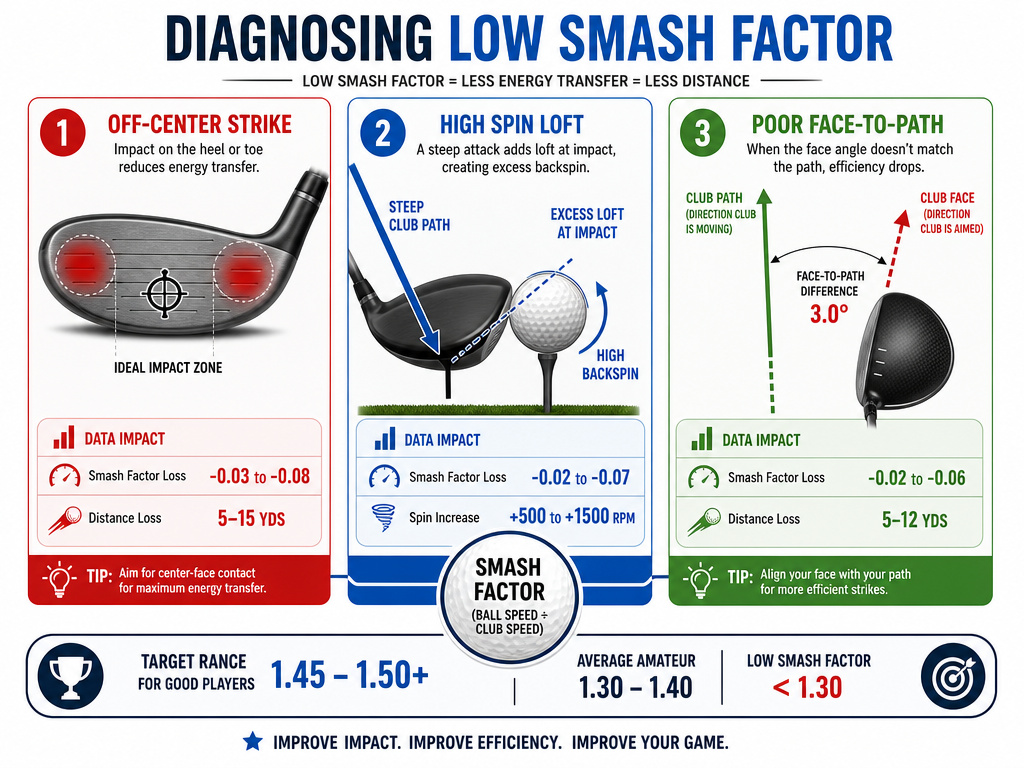
A number below the expected range for your club is a symptom. The cause is usually one of three things.
1. Off-Center Strike. This is the most common culprit. The sweet spot transfers energy best. Heel and toe strikes lose ball speed. Use foot spray or impact tape for two range sessions. Patterns matter. Consistent heel strikes might mean you’re standing too far from the ball.
2. High Spin Loft. Spin loft is the difference between the clubface angle and the angle of attack. A large difference, like a very open face with a steep downswing, creates a glancing blow. This leaks energy into spin, not speed. It’s common in slices and high-floating shots.
3. Poor Face-to-Path Relationship. If your club path is severely out-to-in or in-to-out relative to the face angle, the strike becomes glancing. This saps ball speed and also creates excessive side spin. It kills both smash factor and accuracy.
Common mistake: Blaming the club for a low smash factor. Before you buy a new driver or set of irons, rule out strike and swing path. A fitting can only optimize delivery you can repeat.
A systematic miss (always heel, always high toe) points to a setup or swing pattern issue. A random miss pattern points to a consistency problem in your swing rhythm or lag.
How to Use Smash Factor (And When to Ignore It)
Treat smash factor as a diagnostic tool, not a scorecard. Here’s a practical workflow.
During a Practice Session:
- Start with impact spray on your clubface.
- Hit 5-10 shots with your driver, focusing only on centered contact.
- Check your average smash factor. Ignore the outliers.
- If the average is below 1.45, check the spray pattern. Heel? Toe? High? Low?
- Make one adjustment (ball position, stance width, focus on swing tempo) to move the pattern toward the center.
- Hit another 5-10 shots. Did the smash factor average rise? Did the spray pattern tighten?
During a Fitting:
Smash factor is critical for driver fitting. The fitter’s goal is to find the head and shaft combination that gives you the highest consistent smash factor. If you’re testing two drivers with the same clubhead speed, the one with a 1.48 average smash is objectively better for you than the one at 1.43. It means better energy transfer.
When to Ignore It:
- On short iron and wedge shots. The number is too low and variable to be useful. Focus on distance control and spin.
- When you’re working on a major swing change. Your smash will likely drop while you’re ingraining a new move. That’s fine. Don’t let it discourage you.
- When you’re intentionally playing a fade or draw. A fade (face open to path) is less efficient than a straight shot. Jon Rahm’s preferred fade costs him a few points of smash factor, but the shot dispersion is worth it for him. Effectiveness over efficiency.
The bottom line: smash factor tells you how well you used the speed you created. It doesn’t tell you if you created enough speed, or if the shot was any good.
Frequently Asked Questions
What is a good smash factor for an average golfer?
For a driver, a good smash factor for an average golfer (around a 15 handicap) is between 1.43 and 1.45. For a 7-iron, aim for the high 1.30s, like 1.36-1.38. If you’re consistently below these ranges, start by checking your strike location with impact spray.
Can smash factor be too high?
With a driver, anything consistently above 1.50 is likely a measurement error from the launch monitor. With irons, a number that’s significantly above the tour average (e.g., a 7-iron at 1.42) is almost certainly a sign of a thin or bladed shot, which is undesirable despite the high efficiency.
Does smash factor affect distance?
Directly. Ball speed is the primary driver of distance. Smash factor determines your ball speed from a given clubhead speed. A 100 mph swing with a 1.50 smash produces 150 mph ball speed. The same swing with a 1.40 smash produces only 140 mph ball speed, a loss of about 20 yards with a driver.
Why is my smash factor low with my driver but okay with my irons?
This often points to a driver swing issue. Common causes are hitting down too much with the driver (negative angle of attack), which increases spin loft, or consistently striking the driver on the heel or high toe. The swing differences between driver and iron are real; you might be delivering the driver poorly.
Do better golfers have higher smash factors?
Generally, yes, because they strike the center of the face more often. However, as Rapsodo’s research notes, a lower smash factor does not necessarily mean a golfer is inconsistent. A golfer could have a systematic, repeatable heel strike (low smash) but still be very consistent in their shot pattern. The relationship is strong, but not absolute.
Before You Go
Smash factor is a powerful diagnostic number, but it’s just one piece of data. For your driver, chase 1.50 but be happy with anything over 1.45. For your irons, forget the raw number and focus on centered contact and predictable flight. Use impact spray to see the truth behind the metric.
Remember, it measures the efficiency of your strike, not the effectiveness of your swing. A bladed 7-iron can have a great smash factor and a terrible outcome. Your goal is to pair solid efficiency with a swing that delivers the ball to the target. Start by checking where you’re hitting the ball on the face. Everything else follows from there.
