
How to Check & Fix Your Clubface Position at Top of Backswing
This post contains affiliate links. As an Amazon Associate, we earn from qualifying purchases.
Your clubface position at the top of the backswing is about 103 degrees relative to the ground, on average, and 60% of major winners in the last two decades arrived there with a face the instruction world calls “closed.” Chasing a picture-perfect “square” face that matches your lead forearm is not only misunderstood, it might be steering you away from the most powerful, repeatable position your body can actually support.
That gap between textbook instruction and what elite players actually do is where most amateur frustration lives. You’re told to get the clubface square, but the definition of “square” is vague, and the compensation required to get there can wreck your sequencing. The rest of this guide walks through the real data, the physical checkpoints that matter more than any aesthetic ideal, and how to diagnose whether your top position is an asset or a liability.
What follows: the one measurable angle from a biomechanics study, the survey of major winners that reframes the closed-face debate, and the two body-shape checkpoints that predict your downswing path before you even start it.
Key Takeaways
- A 2016 survey of 44 major winners found 27 (60%) had a closed clubface at the top by conventional standards, versus only 7 (16%) with an open face.
- Biomechanical research puts the mean club angle at the top at 103.83°, but the standard deviation is huge (±28.58°), proving there’s a wide range of functional positions.
- Your lead wrist condition (flat, bowed, or cupped) directly dictates face angle; a bowed wrist pre-sets a closed face, a cupped wrist opens it.
- A convex body shape (spine curved away from the target) at the top indicates a proper turn and sets up an on-plane downswing. A concave shape guarantees a compensation.
- The clubface position you should play is the one that matches your grip and release pattern; changing the top without adjusting the downswing creates two problems instead of solving one.
What Does the Data Say About a Square Clubface?
The 2022 study “An evaluation of temporal and club angle parameters during…” recorded twelve golfers using 2D and 3D motion capture. At the top of the backswing, the mean club angle (the shaft’s inclination) was 103.83° with Kinovea software and 103.08° with the gold-standard Vicon Nexus system. The statistical analysis showed no significant difference between measurement tools for this phase (P = 0.699), confirming the reliability of the angle data.
The number 103 degrees is a reference point, not a target. Look at the standard deviation: ±28.58 degrees. That spread is enormous. It means in their sample, a “normal” top position could see the shaft pointing well short of parallel or well past it. The study’s real finding is that a precise number is less important than a consistent one. Your personal 95 degrees or 115 degrees is fine, as long as you can return to it.
The instruction world’s definition of “square” is where things get muddy. The common cue is that the clubface should be parallel to your lead forearm. A 2016 article surveying major winners highlighted the problem with this. It stated, “The reality is that no one really knows what this means because there’s no way the clubface is square to the path or plane if you go by the current definition.” They used the forearm comparison anyway because it gives a relative gauge, closed versus open, not an absolute truth.
The takeaway is simple. Obsessing over a geometrically perfect square face is a fool’s errand. Your body isn’t a machine set to 90-degree angles. Use the data to understand the spectrum, then use your ball flight to find your spot within it.
The 60% Closed-Face Reality of Elite Golf
Conventional wisdom warns a closed face at the top leads to hooks. The best players in the world didn’t get the memo.
That same 2016 analysis looked at 44 major winners over a 20-year span. The breakdown was stark: 27 players (60%) had a clubface the industry would label closed at the top. Only 7 (16%) had an open face. The remaining 10 were in the “square” bucket. When six out of ten champions are doing something, it’s not a flaw, it’s a feature.
Why would a closed face be an advantage? It presets the face in a condition that reduces the amount of hand rotation needed through impact. Players with a strong grip or a preference for a draw often arrive here naturally. Dustin Johnson’s 2016 U.S. Open win is the classic example. He played a fade all week from a noticeably closed top position by adjusting his body rotation, not by manipulating the clubface in his hands mid-swing.
Where this goes sideways: Forcing an open clubface at the top because you’re afraid of hooks. If your natural motion brings the face to a closed position, opening it artificially means you must now actively rotate it closed during the downswing. That adds a timing variable you will miss under pressure, turning a predictable draw into a block or a snap-hook.
The lesson is that a closed face is a viable, proven option, not a mandatory one. The problem arises from a mismatch between that position and your grip or your downswing release.A closed face paired with a flip-roll release is, as the article noted, “a big hook waiting to happen.”
The One Metric That Actually Matters
Forget “square.” Focus on one relationship: the clubface angle relative to your lead forearm. This is your diagnostic baseline, not your goal.
Stand in front of a down-the-line video of your swing. Pause at the top. Draw an imaginary line along the back of your left forearm (for right-handed golfers). Now look at the leading edge of your clubface. * If they are parallel, your face is square to your forearm. * If the toe of the club points more toward the sky (face looks skyward), your face is open relative to your forearm. * If the toe points more toward the ground (face looks at the ground), your face is closed.
This tells you the work your hands have to do on the way down. An open face must be closed. A closed face must be held off or rotated open. A square face has less rotation required. This is why understanding your natural wrist hinge is non-negotiable, it’s the primary controller of this relationship.
| Lead Wrist Condition | Typical Clubface | Downswing Implication |
|---|---|---|
| Cupped (Extended) | Open | Must actively rotate forearms to close face; promotes slice if timing is off. |
| Flat (Neutral) | Square | Minimal hand rotation needed; most consistent for amateurs. |
| Bowed (Flexed) | Closed | Must delay rotation or hold off release; promotes draw/hook. |
This metric matters because it’s yours. It accounts for your unique anatomy and grip. Don’t copy DJ’s bowed wrist because it works for him. If you have a neutral grip and a cupped wrist, trying to bow it will feel alien and disrupt your entire backswing sequence.
Convex vs. Concave: The Body Shape Truth
Your clubface is important, but it’s a passenger. The driver is your body’s shape at the top. This is the most overlooked checkpoint in the amateur game.
At the top of a good backswing, your spine should form a convex curve relative to the target. Imagine a gentle “C” shape with your back slightly arched away from the target. This shape is the product of a full shoulder turn against a resisting lower body. It creates space for your arms to drop down on the correct swing plane.
The faulty shape is concave. Here, your spine curves toward the target. The left shoulder dips down, the right hip hikes up, and the body collapses. This is often the result of a poor first move of the backswing and an over-reliance on arm lift.
Common mistake: Lifting the arms to get the club to the top without a full torso rotation. This creates the concave shape every time. The club then gets stuck behind you, and the only way to the ball is with an over the top swing move.
Why does body shape trump clubface? A convex shape puts your arms and club in a position where they can fall by gravity. A concave shape puts them in a position where they must be manipulated. You can have a perfect square clubface in a concave body shape, and you’ll still hit a slice because your path will be out-to-in. The body dictates the path; the face then dictates the curve.
How to Diagnose and Fix Your Clubface Position
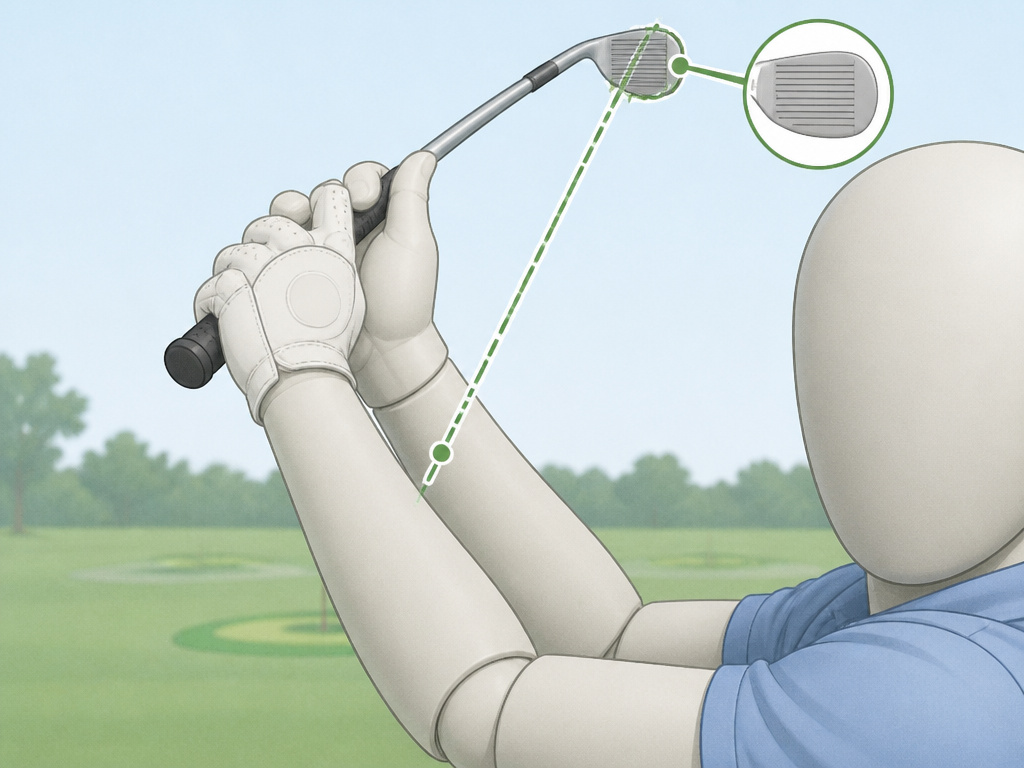
Don’t guess. Use this three-step audit to find your real issue.
1. Film Your Swing. You need a down-the-line view. Use your phone on a tripod, aligned with your hands at address. Record a few full swings with a mid-iron.
2. Pause at the Top and Ask:
- What is my clubface doing? Use the lead forearm comparison. Open, square, or closed?
- What is my wrist doing? Cupped, flat, or bowed?
- What is my body shape? Convex or concave?
3. Trace the Cause Backward.
The clubface at the top is a result, not a cause. The chain usually starts earlier.
| Observed Issue at Top | Likely Origin Point | Immediate Fix |
|---|---|---|
| Consistently Open Face | Weak grip or early wrist cup in takeaway. | Strengthen grip slightly. Feel like the back of the lead hand faces the ground longer in the backswing start. |
| Consistently Closed Face | Very strong grip or excessive forearm roll. | Weaken grip slightly. Place a headcover outside the ball and focus on taking the club back without rolling the face over it. |
| Inconsistent Face (Open/Closed) | Unstable body turn (concave shape) causing arm overrun. | Ignore the arms. Make swings focusing only on achieving a convex shape at the top. Use a mirror. |
The rule of one. Change one thing at a time. If you have a closed face and a hook, don’t change your grip and try to bow your wrist and work on your path. Start with the grip. See how the face and ball flight respond. Most swing faults are a cascade from one root error, often in the initial stages of the golf backswing.
Clubface Position Myths Debunked
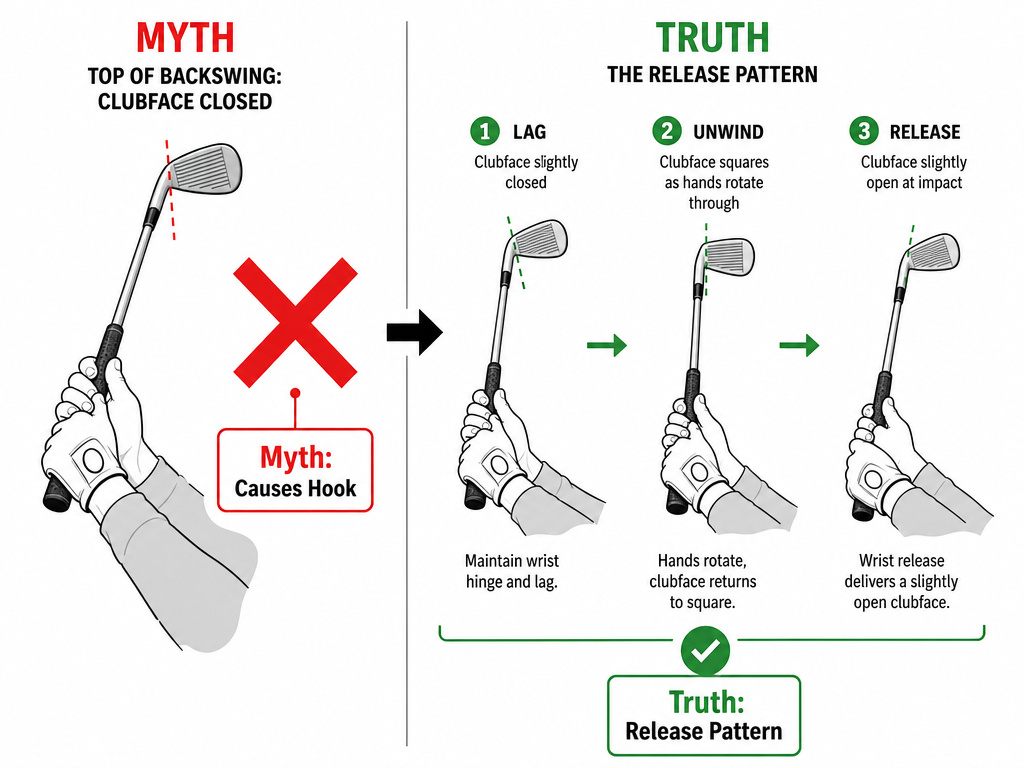
Let’s clear the air on three persistent pieces of bad advice.
Myth 1: “A closed face at the top causes a hook.”
False. A closed face at the top, paired with a body-driven downswing and a held-off release, can produce a powerful fade, ask Dustin Johnson. The hook comes from the release pattern, not the static position. A closed face simply gives you less margin for error if you flip your hands.
Myth 2: “You must see 2-3 knuckles at the top.”
This is a grip prescription disguised as a top-of-swing checkpoint. Your knuckle visibility is set at address. If you have a strong grip (3-4 knuckles), your face will likely be closed at the top. That’s fine. Trying to hide your knuckles by manipulating the club in the backswing ruins your wrist hinge mechanics and creates inconsistency.
Myth 3: “Work on your top position to fix your impact.”
This is backwards. Impact is a dynamic, speeding collision. The top is a static, slow-motion pause. It’s far more effective to work backward. Improve your correct impact position, hands ahead, shaft leaning, and your backswing will often organize itself to support that delivery. Chasing a top position without an impact goal is like arranging your kitchen before you know what you’re cooking.
The research from the NCBI biomechanics journal article supports this. The study measured outcomes, not just positions. Your goal isn’t a museum piece at the top; it’s a delivery mechanism for speed and consistency at the bottom.
Frequently Asked Questions
Does clubface position at the top matter more than swing path?
No. The path is the primary dictator of the ball’s starting direction, while the face controls curvature. A great path with a mediocre face angle will still produce a playable shot. A terrible path with a perfect face is a disaster. They work together, but if you have to prioritize, path is king. Focus on achieving a convex body shape to improve your plane in the backswing, and the path will follow.
I have a closed face and I hook it. Should I open it?
Not necessarily. First, confirm the hook is from the face. If your path is severely in-to-out, even a square face will hook. Try hitting shots focusing on hitting the inside quadrant of the ball with a swing plane that feels more left (for a righty). If the hook persists, then your closed face is the culprit. A slight grip adjustment is safer than trying to manipulate the club during the swing.
How can I feel if my clubface is square?
The best feel drill is the “toe up” checkpoint. On the range, take the club back until the shaft is parallel to the ground and your lead arm is parallel. At that halfway-back point, look at the clubface. The toe of the club should be pointing directly up at the sky. If it’s pointing behind you, the face is closed. If it’s pointing toward the ground, it’s open. Nailing this midpoint often sets the correct tone for the rest of the backswing.
Why do my clubface positions change from swing to swing?
Inconsistent grip pressure is the usual suspect. If you squeeze too tightly at any point, especially during the initiating the backswing, you engage forearm muscles that randomly rotate the club. Another cause is an unstable lower body. If your hips slide or your weight doesn’t load into your trail side, your arms will overrun and lose their relationship to your torso, changing the face angle unpredictably.
Can a closed clubface at the top increase distance?
It can, for some players. A closed face often correlates with a stronger grip and a later release, which can promote more shaft lean and a lower, penetrating ball flight with less spin. This can mean more roll and effective distance. However, it’s not a power source in itself. The distance comes from solid contact and efficient energy transfer, which is a product of your entire sequence, not just one position.
The Bottom Line
Your clubface position at the top of the backswing functions as a report card. It provides information about your grip, your wrist action, and the quality of your body rotation.The data shows elite players succeed across a wide spectrum, with a majority favoring a closed face. Your job is to understand the mechanics behind your own snapshot rather than copying theirs.
Stop chasing square. Start diagnosing matchups. Does your face position complement your natural release, or fight it? Does your body shape at the top allow for a simple downswing, or demand a heroic correction? Answer those questions with video, not feel. The right position is the one that lets you deliver the clubhead to the ball with speed and consistency, not the one that looks best in a freeze-frame.
